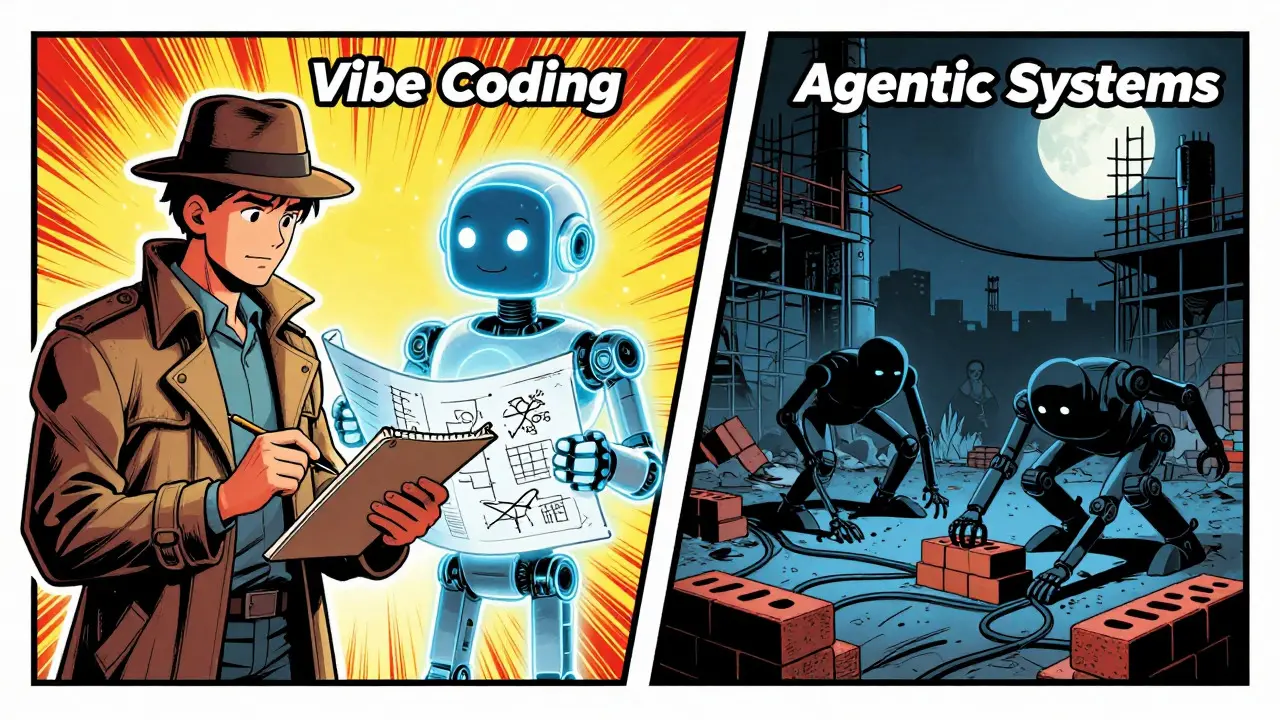
Imagine you are building a house. In one scenario, you stand next to an architect, sketching ideas on napkins while they instantly draft blueprints based on your mood and vague instructions. In another, you hand a detailed contract to a construction crew that works overnight, laying bricks and running wires without checking in until the job is done. This is the current reality of AI-assisted software development.
We are no longer just asking chatbots for snippets of code. We are choosing between two distinct philosophies: vibe coding, which keeps you in the creative driver's seat, and Agentic Systems, which hand over the wheel to autonomous agents. The question isn't which one is better. It is knowing when to let go and when to hold tight.
The Core Difference: Conversation vs. Execution
To choose the right tool, you first need to understand what is happening under the hood. These are not just different interfaces; they are fundamentally different architectures.
Vibe coding is about flow. It emerged prominently around 2024 as Large Language Models (LLMs) became capable enough to handle natural language prompts with high accuracy. Think of tools like GitHub Copilot or Cursor. You type a prompt, the AI suggests code, you tweak it, and you move on. It is a conversation. Microsoft’s internal studies in 2024 showed this approach improved coding efficiency by 55% because it removed the friction of syntax lookup. You stay in the "zone." The AI is a co-pilot, but you are still flying the plane.
In contrast, Agentic Systems are built for execution. Evolving from early experiments like AutoGPT in 2023, these systems use advanced models (often 30 billion parameters or more) to plan, execute, test, and iterate. You give them a goal-"Refactor this legacy Java module to Kotlin"-and they break it down into subtasks. They write the code, run the tests, fix the errors, and commit the changes. Tools like Devin 2.0 operate with high autonomy. According to research published in May 2025 by Sapkota et al., agentic systems achieve task completion rates of 68-73% on complex benchmarks like SWE-bench, compared to 41-52% for vibe coding approaches. That is a massive gap in raw output capability.
| Feature | Vibe Coding | Agentic Systems |
|---|---|---|
| Autonomy Level | Moderate (Human-in-the-loop) | High (Goal-driven) |
| Primary Role | Creative Co-pilot | Autonomous Executor |
| Response Time | 2-5 seconds | Minutes to Hours (Complex tasks) |
| Best For | Rapid Prototyping, Learning | Refactoring, CI/CD Maintenance |
| Risk Profile | Low (Immediate review) | Higher (Silent failures possible) |
| Infrastructure Needs | Standard Workstation (8GB+ RAM) | Robust Cloud/GPU ($29-$99/mo) |
When to Choose Vibe Coding
You should lean toward vibe coding when speed and creativity matter more than structural perfection. If you are building a Minimum Viable Product (MVP) or exploring a new idea, this is your sweet spot.
Data from Sourcedesk.io analyzing 500 beginner projects shows a 92% success rate for simple CRUD applications using vibe coding. Why? Because the feedback loop is instant. If the AI hallucinates a function, you see it immediately. You can correct it before it propagates through the system. Developers report moving from concept to a running demo in under 30 minutes. That is hard to beat for startups or internal tools.
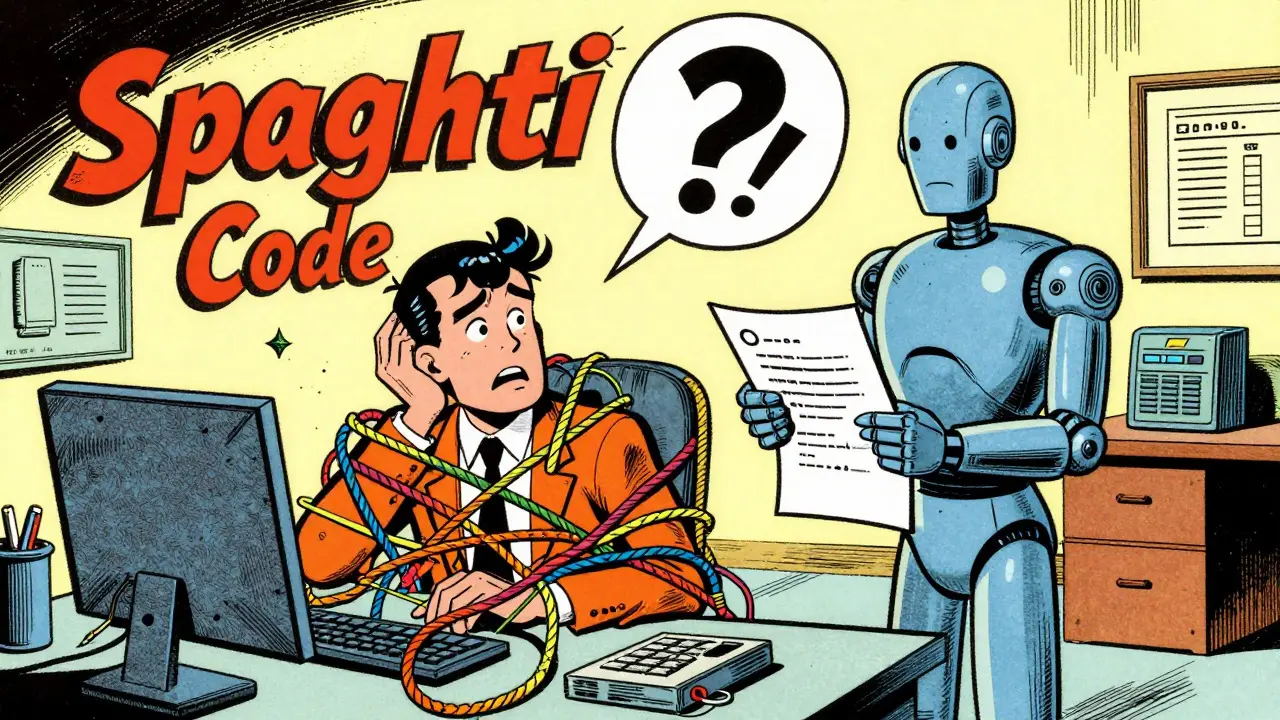
However, there is a catch. Vibe coding often produces "spaghetti code." Without strict architectural oversight, the code becomes messy. Apiiro.com’s analysis found that vibe-coded projects require 30-40% rework before they are production-ready. It is fast, but it is rarely clean. You also risk creating "black box applications," where non-developers build things they don’t fully understand, leading to maintenance nightmares later. Dr. Sarah Chen from Microsoft Research warns that this contributes to 41% of maintenance challenges in no-code/low-code projects.
When to Choose Agentic Systems
Agentic systems shine when the task is repetitive, large-scale, or requires deep consistency. If you have a legacy codebase with 10,000+ lines that needs refactoring, do not try to vibe code it. Use an agent.
In enterprise environments, agentic coding handles codebase modifications with 78% accuracy, compared to 43% for vibe coding. This is crucial for tasks like migrating languages (e.g., Java to Kotlin) or updating dependencies across hundreds of files. A developer on HackerNews reported that Devin 2.0 automated 73% of their conversion work. But note the caveat: they had to implement rigorous validation gates because the agent introduced subtle race conditions in 12% of modules.
This highlights the primary risk of agentic systems: silent failures. Because the agent works autonomously, it might make a mistake that doesn’t crash the program immediately but breaks logic downstream. Rocket.new’s incident analysis found that 37% of production issues in early agentic implementations were due to these undetected errors. You cannot just "trust" the agent. You must verify its work.
The Hybrid Approach: The Future of Development
Here is the truth most experts agree on: you will likely use both. The industry is moving toward a hybrid model. Gartner forecasts that 68% of development teams will adopt a "human-prompted → agent-executed → human-reviewed" pipeline by 2026.
How does this look in practice? You might use vibe coding to brainstorm the architecture and write the initial prototype. Once the structure is solid, you switch to an agentic system to handle the tedious parts-writing unit tests, generating documentation, or refactoring inefficient loops. Finally, you return to manual review to ensure the code meets security and performance standards.
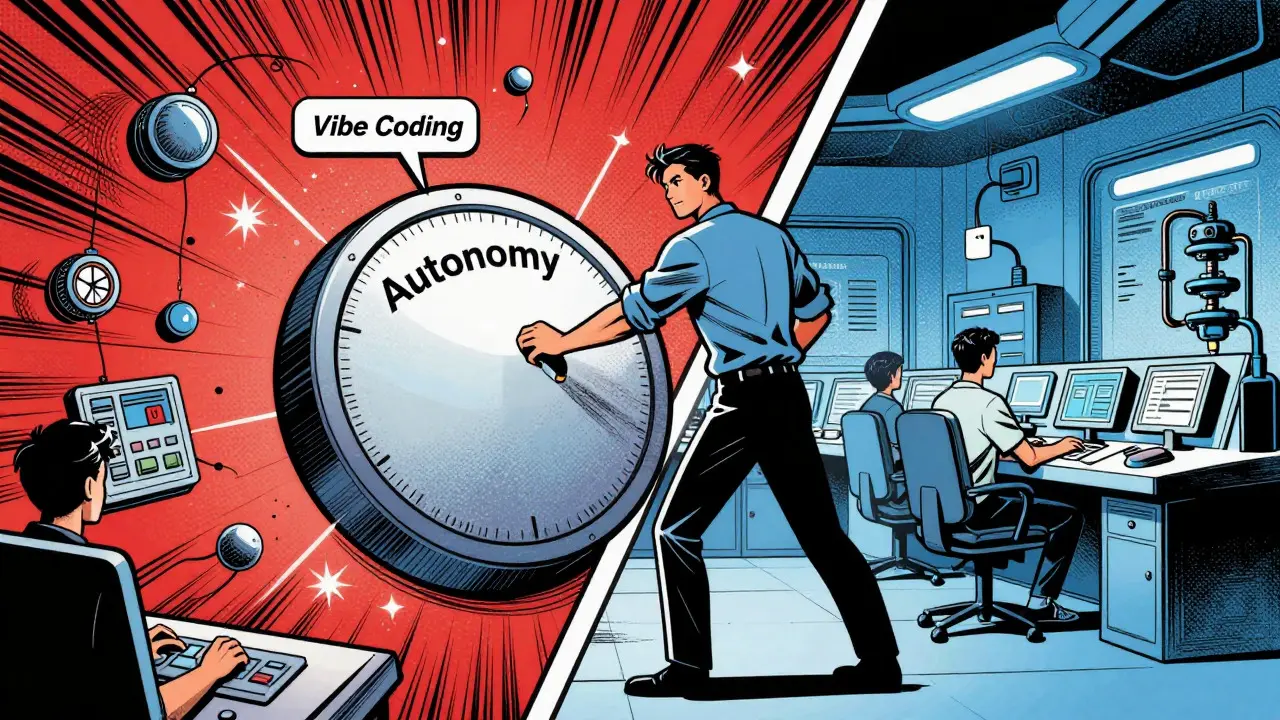
New tools are already supporting this. GitHub released Copilot Agent in January 2026 with an "autonomy dial," allowing developers to adjust how much control the AI has. Devin 2.1 introduced "swarm validation," where multiple agents independently verify critical changes. This reduces the risk of silent failures while maintaining high productivity.
Practical Implementation Tips
If you are ready to integrate these tools, start with clear boundaries.
- For Vibe Coding: Establish "prompt hygiene." Keep prompts under 500 characters with clear acceptance criteria. Do not rely on the AI to guess your intent. Be specific.
- For Agentic Systems: Implement "autonomy gates." Require the agent to seek approval at critical decision points, such as modifying database schemas or changing API contracts.
- Monitor Skill Atrophy: Microsoft’s internal studies show a 23% decline in low-level debugging proficiency among teams using high-autonomy agents for six months or more. Make sure your team still knows how to read and debug code manually.
- Check Regulatory Compliance: The EU’s AI Act (effective January 2026) requires human-in-the-loop verification for autonomously generated code in critical infrastructure. If you are in finance or healthcare, full autonomy may not be legally viable yet.
Conclusion: It Is About Balance
Neither vibe coding nor agentic systems will replace developers. They will replace developers who refuse to adapt. The key is matching the tool to the task. Use vibe coding to explore and create. Use agentic systems to scale and maintain. And always, always keep a human in the loop to review the final product.
What is the main difference between vibe coding and agentic systems?
Vibe coding is a conversational, human-in-the-loop approach where developers guide the AI step-by-step, ideal for rapid prototyping. Agentic systems are autonomous agents that plan, execute, and test code with minimal human intervention, better suited for large-scale refactoring and maintenance tasks.
Which is faster: vibe coding or agentic coding?
Vibe coding is faster for immediate results and small tasks, often producing demos in under 30 minutes. Agentic coding takes longer per task due to planning and testing phases but is significantly faster for large, repetitive jobs like refactoring thousands of lines of code.
Are agentic systems safe for production code?
They can be, but they carry higher risks of "silent failures." It is recommended to use autonomy gates and rigorous validation protocols. Human review is essential, especially in regulated industries like finance or healthcare, due to requirements like the EU AI Act.
Do I need special hardware for agentic systems?
Yes, agentic systems typically require more robust infrastructure, such as 16GB+ RAM and GPU acceleration, or cloud-based subscriptions costing $29-$99/month. Vibe coding tools generally run well on standard developer workstations with 8GB+ RAM.
Will AI replace software developers?
Unlikely. Experts suggest AI will augment developers. The risk is skill atrophy if developers rely too heavily on automation. Successful teams will harmonize both paradigms, keeping humans involved in creative direction and quality assurance.