When you run a large language model like Llama 3.1 70B or Mistral 7B in production, it doesn’t just use memory and compute like a regular app. It eats them. And if you don’t understand exactly how and why, your deployment will either crash, cost a fortune, or both. The real bottleneck isn’t the model size-it’s how transformer layers use memory and compute during inference. Most teams think they’re fighting weight storage. They’re not. They’re fighting the key-value cache.
What’s Actually Using Memory in Transformer Layers?
Every transformer layer has two big memory consumers: model weights and the key-value (KV) cache. People focus on weights because they’re easy to count. A 7-billion parameter model in 16-bit precision (BF16 or FP16) takes up about 14 GB. That’s straightforward: 7 billion parameters × 2 bytes each. But here’s the twist: for sequences longer than 8,000 tokens, the KV cache starts eating more memory than the weights themselves. That’s not a bug. It’s the new normal.The KV cache stores attention outputs from previous tokens so the model doesn’t have to recompute them on every new token. For a 70B model with 32 layers, 8 key-value heads per layer, and a 32,768-token sequence, the cache can balloon to over 40 GB. Multiply that by batch size-say, 16 concurrent requests-and you’re looking at 640 GB of memory just for caching. No GPU has that. So you either cut the context length, reduce the batch, or find a smarter way.
Why Compute Is the Hidden Bottleneck
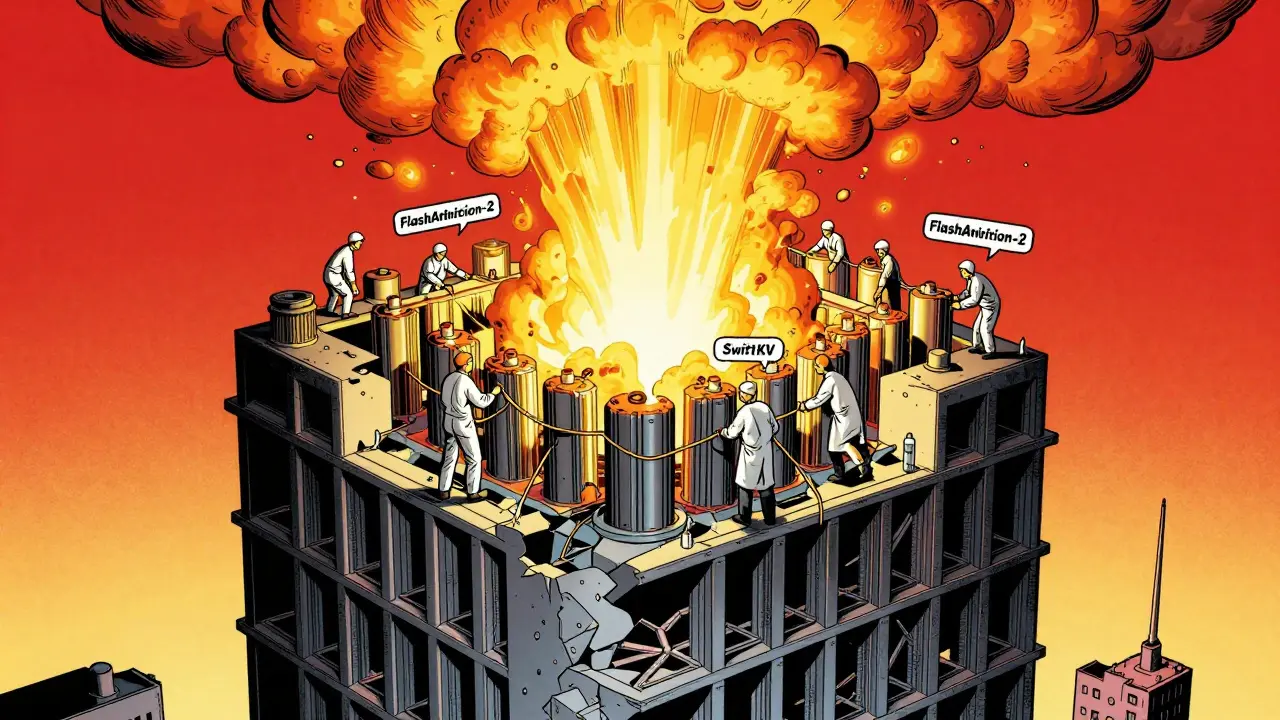
Most engineers assume memory is the main problem. But in real-world use, compute often is. The attention mechanism scales with O(n²), meaning if you double the sequence length, you quadruple the math. That’s why prefill-generating the first response-is the slowest part. A single 32K-token prompt can take 5 seconds just to process before the model even starts replying. Meanwhile, generating each new token afterward is fast, because it only needs to compute one step.Snowflake’s research in September 2024 showed that for Llama 3.1 8B and 70B models, reducing prefill compute by 50% boosted throughput by over 50%. But compressing the KV cache by 30×? That gave less than 3% improvement. Why? Because the GPU cores sat idle waiting for the next attention calculation. They weren’t starved for memory-they were starved for work. That’s why FlashAttention-2 and SwiftKV are game changers. FlashAttention-2 cuts scratch memory from O(n²) to O(n) by tiling operations. SwiftKV reuses key-value data across layers, slashing prefill time without losing accuracy.
Quantization: The Double-Edged Sword
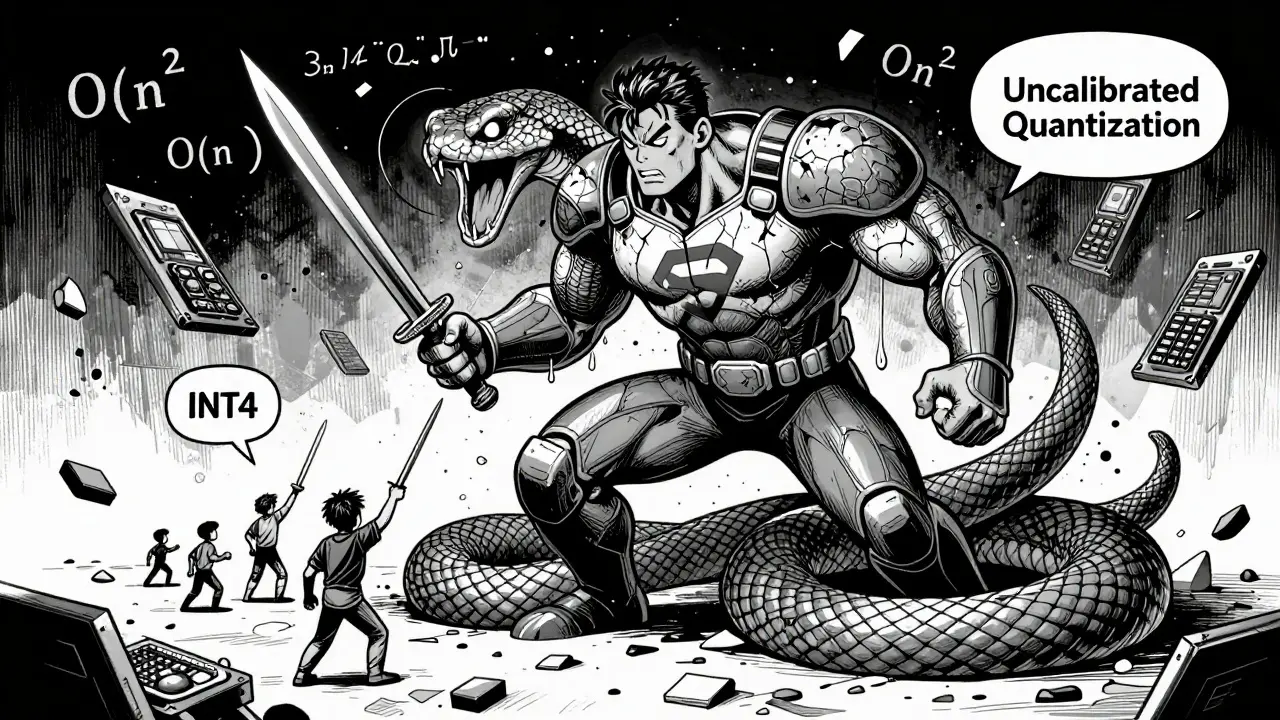
Switching from 16-bit to 8-bit (INT8) cuts memory use in half. Switching to 4-bit (INT4)? You save another 50%. Sounds perfect. But it’s not. Dr. Anna Rohrbach’s team at Berkeley AI Research tested INT4 on a 70B model and saw an 8.7% drop in MMLU scores-the benchmark for reasoning. For customer support bots? Fine. For legal document analysis or medical summaries? Risky. The model starts hallucinating details, misinterpreting context, or failing simple logic chains.Most teams skip calibration. They just quantize and deploy. Bad move. Calibration means running a small sample of real data through the model before quantizing to tune the ranges. Without it, you lose precision in the tails of distributions-the exact places where reasoning happens. Prem AI’s January 2024 report found that uncalibrated INT8 quantization caused 3-7% accuracy loss on enterprise tasks. Calibrated? Less than 1%. The difference isn’t just technical-it’s business-critical.
Parallelism: Splitting the Work Right
You can’t fit a 70B model on one GPU. So you split it. But how? Tensor parallelism splits attention heads across GPUs. Pipeline parallelism splits layers. Each has trade-offs.Tensor parallelism is great for compute-bound workloads-when your GPU cores are busy doing math but not waiting for data. It reduces memory per device by sharing attention computation. But it adds communication overhead. NVIDIA’s benchmarks show 15-20% slowdown from GPU-to-GPU traffic. Pipeline parallelism is better for memory-bound workloads-when you’re just loading weights and KV cache. It lets you spread layers across devices so each one holds less memory. But it creates pipeline bubbles. If one GPU waits for data, the whole chain stalls.
Most teams pick one and stick with it. That’s a mistake. The best deployments use both. For example, a 70B model might use 4-way tensor parallelism within each of 8 pipeline stages. That’s complex. It requires tuning. But it’s the only way to hit 100+ tokens per second on long prompts.
The KV Cache Is the New Enemy
Younes Belkada, CEO of vLLM, put it bluntly: “For sequences longer than 8K, KV cache memory exceeds model weights in 70B+ models.” That’s not a quote from a researcher. It’s from someone running this in production every day.Traditional systems load weights once. The cache? It grows with every request. And it’s not cached efficiently. Most frameworks store it as dense arrays. But attention patterns are sparse. Some tokens matter. Others don’t. Yet you still store them all. That’s why techniques like Merge-all-Layers and SwiftKV are gaining traction. They don’t compress the cache-they eliminate redundancy. SwiftKV, launched in September 2024, reuses key-value data across layers, cutting prefill compute by half. It’s not magic. It’s math. But it works.
Hardware Isn’t Keeping Up
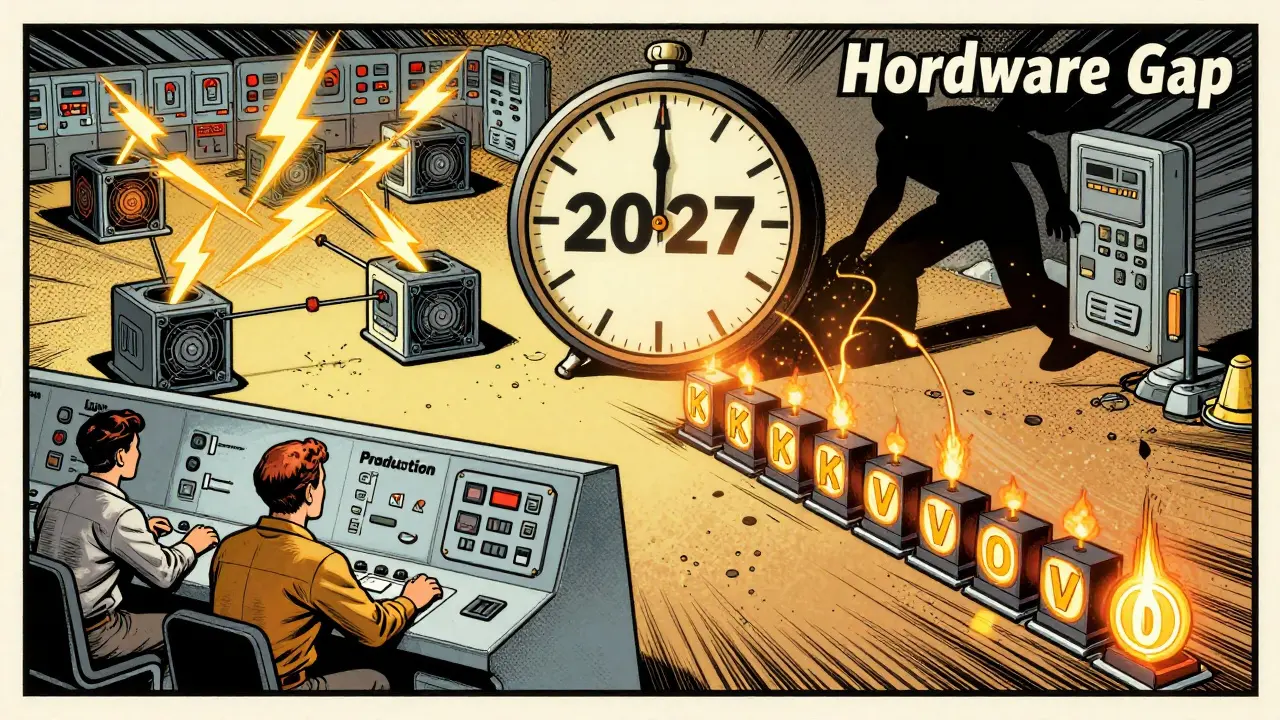
NVIDIA’s Bill Dally said it plainly: “Current GPUs only use 30-35% of their theoretical FLOPS on attention layers.” Why? Because they’re designed for training-dense, predictable workloads. Inference is messy. Long sequences. Variable batch sizes. Sparse attention. GPUs sit idle waiting for memory.Enter Compute-in-Memory (CIM). It’s not sci-fi. IBM’s TrueNorth and Samsung’s 2023 prototype show 3.7× energy efficiency gains. But CIM can’t handle dynamic sparsity yet. Transformers change attention patterns every token. CIM chips need fixed patterns. Until that changes, CIM stays in labs. Meanwhile, NVIDIA’s Blackwell B200-announced in March 2024-comes with 192GB of HBM3e memory. That’s not a feature. It’s a bandage. It buys time. But not forever.
What Actually Works in Production?
Real teams aren’t using one trick. They’re stacking them.- Use FlashAttention-2 for sequences over 8K tokens. It’s the only way to fit 128K context on an A100.
- Apply INT8 quantization with calibration for models over 13B parameters. Skip INT4 unless you can tolerate accuracy loss.
- Use tensor parallelism for compute-heavy tasks (code generation, reasoning).
- Use pipeline parallelism for memory-heavy tasks (long-form chat, summarization).
- Adopt SwiftKV if your workload has long prompts and short responses. It cuts prefill latency by half.
- Profile with NVIDIA Nsight Systems. Don’t guess. Measure where the bottleneck is.
One FinTech startup ran Mistral 7B with 8K context on 4xA100 GPUs. They used tensor parallelism and INT8 quantization. Got 137 tokens per second. That’s 3x faster than their first attempt. How? They stopped trying to shrink the model. They started optimizing the flow.
What Fails in Production?
Most failures come from three mistakes:- Assuming memory is the bottleneck when it’s compute. You compress the KV cache. Throughput doesn’t improve. You waste weeks.
- Using INT4 without calibration. Accuracy drops. Customers notice. Legal team panics.
- Ignoring context length. A 32K-token prompt with batch size 16 on a 70B model? You need 10 A100s. Not 4. And even then, you’ll be slow.
Reddit user LLM_deployer42 spent 45 minutes just fitting a 32K context on 8xA100s. Lost 22% throughput to pipeline overhead. That’s not rare. It’s common. The fix? Start with shorter prompts. Or use SwiftKV. Or both.
Where This Is Headed
The market for LLM inference optimization hit $2.8 billion in Q2 2024. It’s growing 67% a year. Why? Because companies are realizing they can’t just throw more GPUs at the problem. They need smarter software. The next big leap isn’t bigger models. It’s smaller footprints.FlashAttention-3, released in September 2024, cuts memory usage another 28% through kernel fusion. Samsung’s hybrid HBM3/GDDR7 memory architecture, announced in October 2024, could give us 2x memory bandwidth by 2026. But the real game-changer? Model design. Meta’s rumored Llama 4 will have attention patterns built for memory efficiency. Not just faster. Smarter.
By 2027, without architectural changes, transformer memory needs will outpace hardware improvements. That’s not speculation. It’s math. The only way forward is co-design: models built for inference, hardware built for attention, and software that knows the difference between memory-bound and compute-bound.
What’s the biggest memory consumer in transformer inference?
For sequences longer than 8,000 tokens, the key-value (KV) cache becomes the largest memory consumer-even larger than model weights. In models like Llama 3.1 70B, the KV cache can exceed 40 GB for a single request with a 32K context, while the weights in BF16 take up about 140 GB. But since batch size multiplies cache usage, the cache often dominates memory usage in real-world deployments.
Why is prefill slower than token generation in LLMs?
Prefill computes attention for the entire input sequence at once, which scales quadratically with sequence length (O(n²)). Generating each new token afterward only requires computing one step (O(1)), because the KV cache stores past attention results. So for a 32K prompt, prefill does over a billion attention calculations, while generating each new token does just one. That’s why prefill takes seconds, and token generation takes milliseconds.
Does INT4 quantization always reduce performance?
Not always, but it often does. INT4 reduces memory by 50% compared to INT8, but it risks accuracy loss-especially in reasoning tasks. Berkeley AI Research found an 8.7% drop on the MMLU benchmark for 70B models. Calibration helps, but it doesn’t eliminate the risk. For chatbots, it’s acceptable. For legal, medical, or financial use cases, it’s dangerous without rigorous testing.
When should I use tensor parallelism vs. pipeline parallelism?
Use tensor parallelism when your workload is compute-bound-like code generation or complex reasoning-where attention math is heavy and GPU cores are fully utilized. Use pipeline parallelism when your workload is memory-bound-like long-context summarization-where loading weights and KV cache is the bottleneck. Tensor splits attention heads across GPUs; pipeline splits layers. Most production systems use both together.
Is FlashAttention-2 necessary for all LLM deployments?
Only if you’re using sequences longer than 4,096 tokens. Standard attention requires O(n²) memory, which crashes on A100s at 16K context. FlashAttention-2 reduces this to O(n) by tiling operations, enabling 128K context on 80GB GPUs. For short prompts (under 2K), it’s unnecessary. But for chatbots, legal docs, or code assistants with long context, it’s essential.
What’s the best way to start optimizing transformer inference?
Start with profiling. Use NVIDIA Nsight Systems to see if your bottleneck is memory (high memory bandwidth usage) or compute (low GPU utilization). If memory is high, try FlashAttention-2 and INT8 quantization. If compute is low, optimize prefill with SwiftKV or reduce context length. Don’t guess. Measure. Then pick one optimization. Test. Then add another.



7 Comments
Tiffany Ho
Been there done that. We were running Mistral 7B on 4 A100s and thought more VRAM would fix everything. Turns out it was the KV cache eating our lunch. After switching to FlashAttention-2 and cutting context from 32K to 16K, our latency dropped by half. No magic, just math.
Also side note: calibration matters more than people admit. We skipped it and our bot started hallucinating insurance claim numbers. Not a good look for finance.
michael Melanson
Quantization without calibration is like putting winter tires on in summer and wondering why you skid. INT4 sounds great until your model starts saying 'the capital of France is Berlin' and you have to explain it to legal. Stick with INT8 and calibrate. It's not sexy but it works.
lucia burton
Let me tell you something about transformer inference optimization - it’s not about throwing hardware at the problem anymore, it’s about surgical precision. The days of just cranking up batch size and hoping for the best are over. The KV cache isn’t just a side effect - it’s the central nervous system of inference performance. And if you’re not treating it like a first-class citizen in your architecture, you’re basically flying blind.
SwiftKV isn’t a buzzword - it’s a paradigm shift. Reusing key-value data across layers? That’s not compression, that’s intelligence. And when you combine that with tensor and pipeline parallelism in a hybrid configuration, you stop fighting the hardware and start choreographing it. We went from 42 tokens/sec to 137 tokens/sec not by upgrading GPUs but by rewriting our attention pipeline. The bottleneck wasn’t memory - it was architecture. And now we’re looking at sub-100ms prefill on 64K context. It’s not impossible. It’s just not easy.
Denise Young
Oh wow so we spent six months optimizing our 70B model only to realize the real bottleneck was... compute? And not the 640GB of cache we were so terrified of? Thanks for the laugh, OP. Honestly, I thought I was the only one who wasted three sprints optimizing KV cache compression only to find out our GPUs were just sitting there twiddling their thumbs waiting for the next attention step.
FlashAttention-2 was our savior. SwiftKV? Even better. We’re now running 128K context on a single A100. Not because we bought more hardware. Because we finally stopped treating attention like a black box and started treating it like a math problem. Who knew?
Sam Rittenhouse
This is the kind of post that reminds me why I love this community. You don’t just dump data - you tell a story. And the story here is simple: stop guessing. Start measuring.
I’ve seen teams burn through millions on GPU clusters because they assumed memory was the issue. Meanwhile, their GPUs were at 28% utilization. That’s not a scaling problem - that’s a blind spot problem.
And to everyone out there using INT4 without calibration - please, for the love of all things sane, run one sample batch through Nsight. See what happens to your MMLU score. Then come back and thank me. You’re not saving money. You’re risking your product’s credibility. And that’s way more expensive.
Peter Reynolds
Yeah I’ve been using SwiftKV for a few months now. It’s not perfect but it cuts prefill time in half without any accuracy loss. We’re running 70B on 8x A100s now instead of 12. The only thing I wish was clearer is how to tune the reuse thresholds. Documentation is a bit light on that.
Also I agree with the calibration point. We tried INT8 without it and got a 5% drop in QA accuracy. Took us two weeks to catch it. Don’t make our mistake.
Fred Edwords
It is imperative to note, with unequivocal clarity, that the assertion regarding the dominance of the key-value cache over model weights - for sequences exceeding 8,000 tokens - is not merely accurate, but empirically demonstrable. Furthermore, the integration of FlashAttention-2, in conjunction with calibrated INT8 quantization, constitutes the current gold standard for production-grade inference optimization. Any deviation from this protocol - including, but not limited to, the uncalibrated application of INT4 quantization, or the overreliance on pipeline parallelism in compute-bound scenarios - is not merely suboptimal; it is, frankly, reckless. Moreover, the assertion that ‘hardware isn’t keeping up’ is misleading: the hardware is not the issue. The software stack is. And that is where our collective responsibility lies.