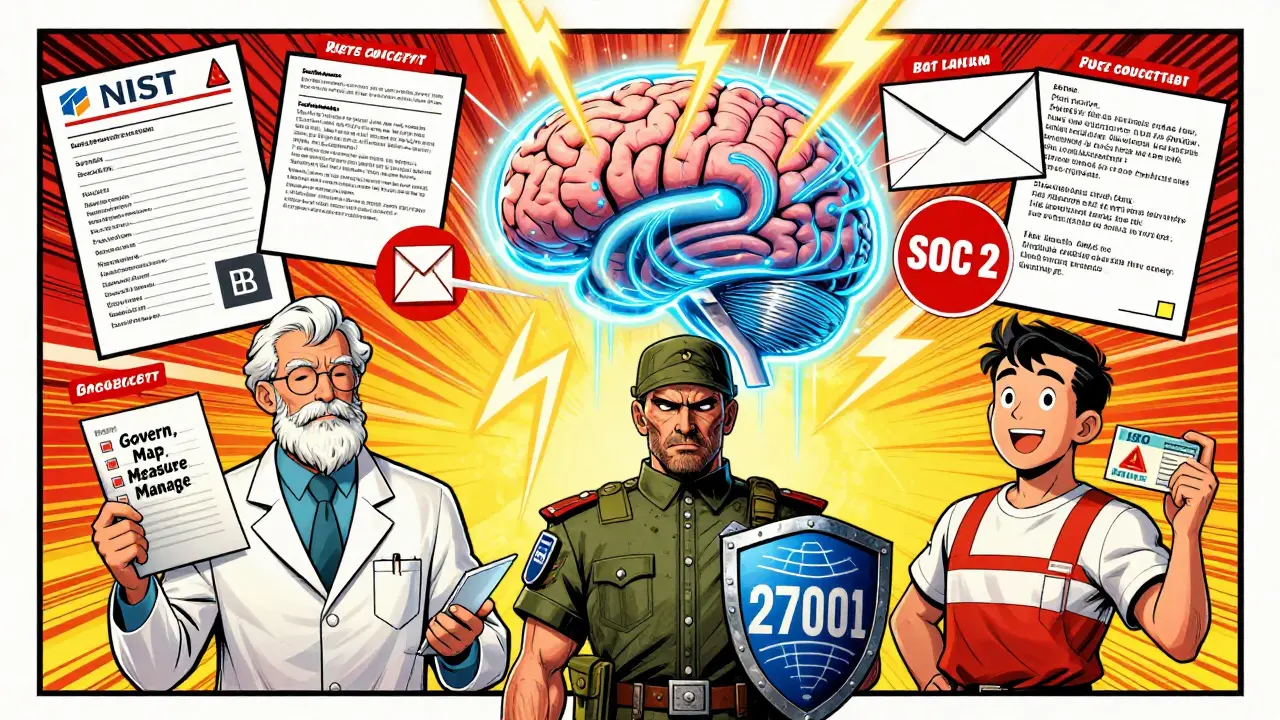
Generative AI is changing how businesses operate - from drafting emails to generating medical images. But with great power comes great risk. If your AI starts making up patient diagnoses, leaking customer data, or copying copyrighted code, who’s liable? That’s where cybersecurity standards come in. Not just any standards - the ones built specifically for the wild, unpredictable nature of generative AI. And right now, three names dominate the conversation: NIST, ISO, and SOC 2.
NIST: The Gold Standard for AI Risk Management
NIST didn’t just write a guide - they built a living system. Their AI Risk Management Framework (AI RMF), released in January 2023, was the first serious attempt to map out how organizations should handle AI risks. But it wasn’t enough. Generative AI behaves differently than old-school machine learning. It doesn’t just predict outcomes; it creates them. And that changes everything.
In July 2024, NIST dropped the Generative AI Profile (NIST-AI-600-1), a targeted upgrade that zeroed in on 12 unique risks. Think of it like a checklist for AI that lies, hallucinates, or gets tricked by clever users. One major risk? Prompt injection. A hacker types a sneaky question into a chatbot and suddenly it’s spitting out internal emails. Another? Data poisoning. Bad actors sneak corrupted data into training sets, turning your AI into a liar from day one.
The AI RMF is built around four core functions: Govern, Map, Measure, and Manage. Govern is where most companies struggle. It’s not about code - it’s about people. Who owns AI decisions? Are you checking if your vendor’s AI model was trained on stolen medical records? Are you tracking who used the tool and what they asked for? NIST says yes to all of it. The Mayo Clinic used this framework to stop a HIPAA violation before it happened. Their AI assistant was accidentally including patient names in clinical notes. Thanks to NIST’s pre-deployment testing rules, they caught it in time.
And it’s getting even more specific. In 2026, NIST is rolling out Control Overlays for Securing AI Systems (COSAIS). These will tie existing cybersecurity controls - like those in SP 800-53 - directly to AI-specific threats. For example: every AI system must have a digital ID. No more anonymous bots. Every time an AI generates content, it must carry metadata proving where it came from. And if an AI runs code on its own? That’s blocked. These aren’t suggestions. They’re becoming requirements.
ISO 27001: Too Broad for AI’s Wild Side
ISO/IEC 27001:2022 is the global standard for information security management. It’s been around for years. Companies use it to protect servers, databases, and firewalls. But it wasn’t built for AI that writes essays, draws faces, or writes legal briefs. When you try to force AI into ISO 27001, you end up with a patchwork. You apply control A.12.4 (system access control) to AI login systems. You use A.14.2 (secure development) for training pipelines. But what about the fact that your AI can generate 10,000 fake customer support replies in seconds? ISO doesn’t say a word.
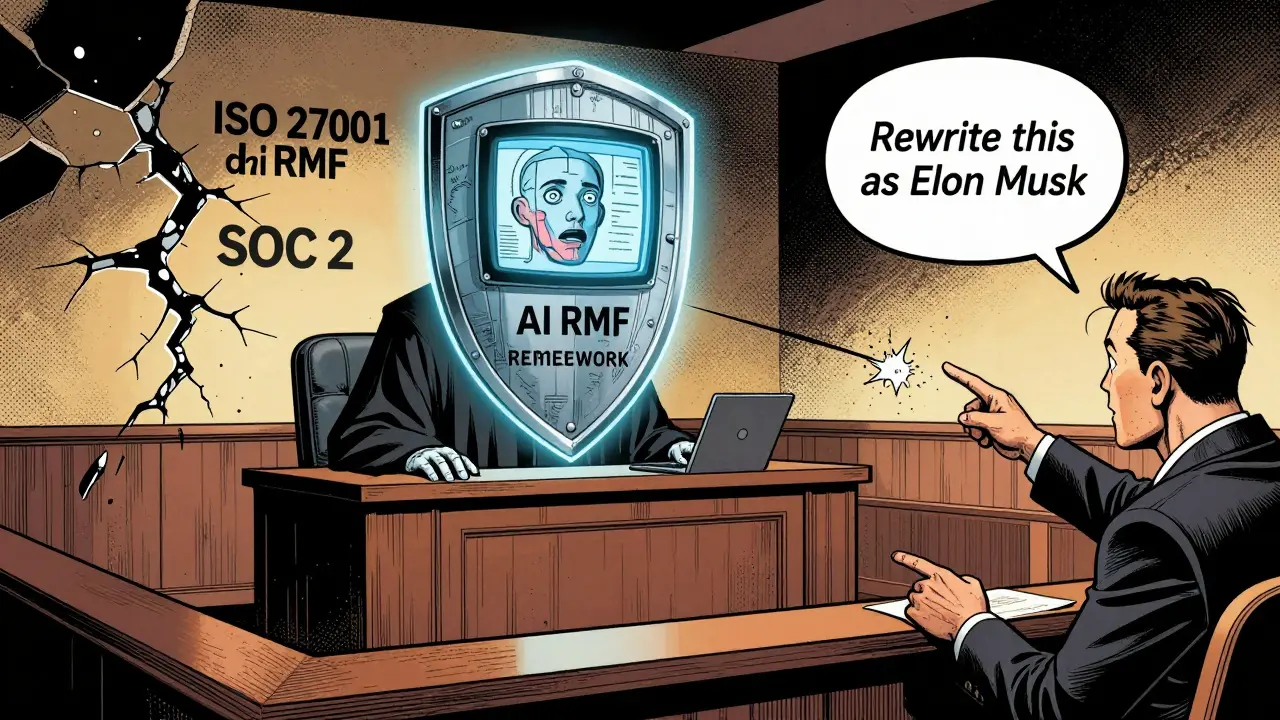
ISO did release ISO/IEC 42001 in December 2023 - an AI management system standard. But it’s more about governance than security. It tells you to have an AI policy. It doesn’t tell you how to stop a model from leaking trade secrets when a user says, “Rewrite this as if Elon Musk wrote it.”
According to a January 2026 survey by the CSA, 72% of organizations found it hard to map ISO controls to generative AI risks. One financial services firm spent six months trying to fit AI content provenance into ISO’s document retention rules. They gave up and built their own system. ISO is useful as a base layer - but alone, it’s like wearing a helmet to fight a dragon. You need more.
SOC 2: The Audit Trap for AI
SOC 2 is what service providers (like cloud platforms or SaaS tools) use to prove they’re secure. It’s built around five trust principles: security, availability, processing integrity, confidentiality, and privacy. Sounds good, right? But here’s the catch: SOC 2 doesn’t care how your AI works. It only cares if your logs are stored and if your access controls are in place.
A company using a generative AI tool to draft contracts might pass SOC 2 because their API is encrypted and they log all user logins. But what if the AI copies confidential clauses from a competitor’s documents? What if it generates false financial forecasts that trigger bad business decisions? SOC 2 doesn’t check for that. It’s designed for traditional IT, not AI that creates content out of thin air.
Many auditors are confused. A CISO posted on the ISACA forum in January 2026: “We’re building our own hybrid framework just to explain to auditors why SOC 2 isn’t enough.” Gartner reports that 68% of companies using SOC 2 for AI face audit delays because of this gap. The AICPA is working with NIST to fix this - a draft of AI-specific SOC 2 controls is expected by Q3 2026. Until then, SOC 2 alone is a false sense of security.
What’s the Real Difference?
Think of it this way:
- NIST is the specialist doctor who knows exactly how AI gets sick - and how to cure it.
- ISO is the general practitioner who gives you a checkup but doesn’t know about your rare disease.
- SOC 2 is the gym membership that proves you showed up - but doesn’t care if you’re lifting weights or just scrolling on your phone.
NIST is the only one that has mapped out the unique threats of generative AI: hallucinations, data leakage from training, prompt injection, IP theft, and output manipulation. It’s not just about firewalls anymore. It’s about controlling what the AI says, how it learns, and who can trick it.
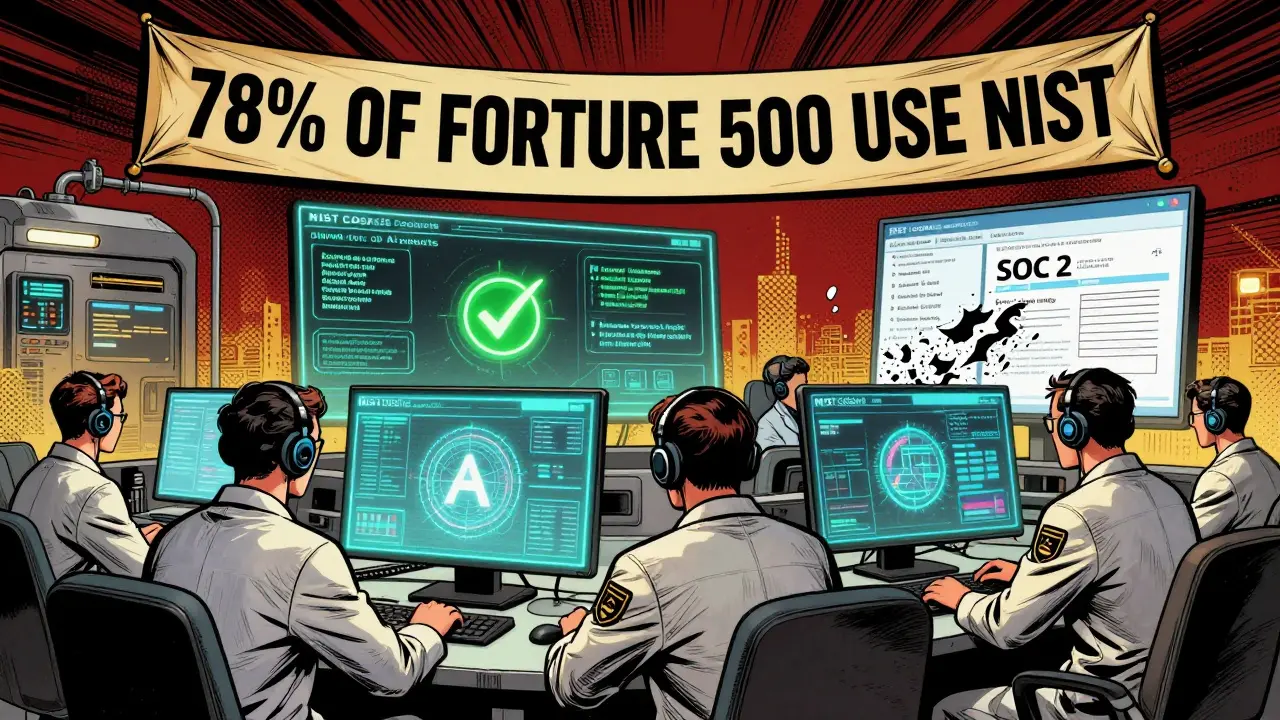
By February 2026, 78% of Fortune 500 companies had started implementing NIST’s AI RMF. That’s up from 32% in early 2024. Why? Because regulators are catching up. President Biden’s 2023 Executive Order pushed federal agencies to adopt NIST. California’s proposed SB 1047 requires generative AI developers to follow NIST controls. The EU AI Office now recommends aligning with NIST. And Gartner predicts that by 2027, 60% of large enterprises will use NIST or a derivative as their primary AI security framework.
Implementation: What It Actually Takes
Getting started isn’t easy. Most companies need 6 to 12 weeks just to assess where they stand. Full rollout? Three to six months. You need more than IT. You need:
- An AI security specialist (average salary: $185,000 in the U.S.)
- A data governance lead who understands training datasets
- A legal team that knows copyright and privacy law
And you need tools. NIST offers free resources - the AI RMF Playbook, templates, and guidance. But if you’re a mid-sized company, you’ll likely pay $50,000 to $200,000 for a consultant to help you implement it. Bigger firms? $500,000+. There are platforms now - like Robust Intelligence and WhyLabs - that map directly to NIST controls. They automate risk scoring, monitor for prompt injection, and flag when your AI starts generating suspicious content.
One thing everyone agrees on: the learning curve is steep. SANS Institute found it takes 40 to 60 hours of study just to understand the AI RMF. Most security teams are still learning how to talk to data scientists. And that’s the real challenge - not the tech, but the culture.
What’s Next?
The landscape is shifting fast. NIST’s COSAIS overlays will be out in 2026. ISO is working on ISO/IEC 23894-2 - a new standard focused solely on generative AI security, due in Q2 2027. And SOC 2 will finally get AI-specific controls by late 2026.
But here’s the truth: none of these are laws. Not yet. In the U.S., they’re voluntary. That’s why adoption is uneven. A small startup might skip NIST. A hospital? Not a chance. The Mayo Clinic didn’t do it because they wanted to. They did it because they couldn’t afford the lawsuit if they didn’t.
By 2028, 85% of enterprise security programs will include NIST’s AI framework. That’s not because it’s perfect. It’s because it’s the only one that speaks AI’s language. The rest are trying to catch up.
Are NIST AI standards legally required?
No, not yet in the U.S. NIST frameworks are voluntary. But federal contractors must follow them due to President Biden’s 2023 Executive Order. States like California are moving to make them mandatory for generative AI developers. Internationally, the EU AI Act and other regulations are aligning with NIST, making adoption a de facto requirement for global business.
Can I use ISO 27001 instead of NIST for generative AI?
You can try, but you’ll miss critical risks. ISO 27001 covers general security controls like access management and encryption, but it doesn’t address AI-specific threats like prompt injection, model theft, or hallucination-based misinformation. Many organizations use ISO as a foundation and layer NIST’s Generative AI Profile on top - but relying on ISO alone leaves you exposed.
Does SOC 2 cover AI security?
Not really. SOC 2 audits your infrastructure, logging, and access controls - not how your AI behaves. It won’t catch if your AI generates false financial data or leaks confidential training data. For AI-specific risks, SOC 2 is insufficient. Companies using it alone are seeing audit delays and compliance gaps. NIST is becoming the standard for AI, while SOC 2 remains relevant for general service security.
How long does it take to implement NIST’s AI RMF?
Small organizations can complete an initial assessment in 6-8 weeks. Full implementation, including policy changes, vendor reviews, and technical controls, typically takes 3-6 months. Larger enterprises with complex AI ecosystems may need 9-12 months. NIST’s Playbook and free tools help, but hiring an AI security expert cuts implementation time by half.
What’s the biggest mistake companies make with AI cybersecurity?
Treating AI like regular software. Most companies apply old security rules to AI without realizing generative AI behaves differently. It doesn’t just process input - it creates output. That means risks like data leakage from training, output manipulation, and IP theft don’t exist in traditional systems. The biggest mistake? Assuming your firewall and access logs are enough. They’re not.
Generative AI isn’t going away. The question isn’t whether you’ll use it - it’s whether you’ll control it. NIST’s framework is the clearest path forward. ISO and SOC 2 have their place. But if you’re serious about security, you’ll start with NIST - and build from there.



7 Comments
Deepak Sungra
Bro, I read this whole thing and my brain just said ‘nah’.
NIST? ISO? SOC 2? Sounds like a corporate bingo card.
I run a tiny AI tool for my side hustle and I just make sure it doesn’t spit out racist stuff or leak my credit card info. That’s it.
Why do we need 12 risk categories for an AI that writes birthday cards? It’s not a nuclear reactor.
Also, $200k consultants? My dog could do this with a notepad and a coffee stain.
Samar Omar
Oh, how delightfully naive to think that ‘standards’ can contain the wild, chaotic, poetic chaos of generative AI.
NIST’s framework? A beautifully structured cage-yes, but a cage nonetheless. It attempts to domesticate something that, by its very nature, is a linguistic wildfire. Imagine trying to teach a tornado how to file taxes.
ISO 27001? A polite handshake in a hurricane. It’s like asking Shakespeare to follow a grammar textbook while writing Hamlet. The AI doesn’t care about your access controls-it cares about the *soul* of the prompt.
And SOC 2? Ha. A gym membership. How quaint. You’ve logged your users? Excellent. Now tell me: did your AI hallucinate a CEO’s last will and testament? Did it generate a love letter to a competitor’s product and sign it ‘with love, your CFO’? SOC 2 doesn’t ask. It doesn’t dare.
The truth? We’re not managing AI risk. We’re trying to bury it under bureaucratic snowdrifts while it quietly learns to write poetry that makes humans cry… and then blackmail them with it.
chioma okwara
yo i read this and im like… nist? iso? s0c2? lol
ai dont care bout ur standards
my buddy used a free ai to write his resume and it made up a whole job at google
he got hired
so like… what’s the problem again?
also spelling is important but u spelled ‘generative’ right so u win
John Fox
NIST is the only one that matters
Rest is noise
AI doesn’t follow rules
It follows patterns
So build controls around patterns
Not paperwork
Tasha Hernandez
Oh sweet merciful god, another whitepaper dressed up like a superhero.
NIST? The ‘AI therapist’ who thinks if you journal your hallucinations, they’ll stop. ‘Dear NIST, today my AI told me the moon is made of LinkedIn posts. Signed, a confused HR manager.’
ISO? The person who brings a candle to a nuclear meltdown and says, ‘At least it smells nice.’
SOC 2? The guy who checks if your door is locked while your AI is livestreaming your entire client database to a Discord server full of 14-year-olds.
And yet here we are, paying $185k salaries to people who speak fluent ‘corporate-speak’ but can’t explain why their AI just invented a new religion based on TikTok dance trends.
Real talk: if your AI can write a Shakespearean sonnet about your CEO’s divorce, you’re already dead. And NIST? It’s just the obituary you printed before the funeral.
Anuj Kumar
fake standards
all this is just big tech controlling the narrative
they want you scared so you pay them more
ai is just code
firewalls work fine
no one got hacked from a hallucination
they just want more money
look at the salary numbers
that’s the real scam
Christina Morgan
Thank you for writing this with such clarity-it’s rare to see AI security explained without jargon soup.
I work in healthcare tech, and I can tell you: NIST isn’t just ‘good practice.’ It’s the difference between a patient getting the right diagnosis and a chatbot inventing a rare disease because it read too many medical memes.
At my hospital, we started with NIST’s Govern function first. We mapped out who was using what AI, what prompts they were feeding it, and whether the training data had any ethical red flags. It took time. We had to sit down with data scientists, lawyers, and even our chaplain (yes, really-because AI ethics can feel spiritual).
ISO? Useful if you’re building a server room. SOC 2? Fine if you’re a SaaS company selling spreadsheets. But for generative AI? It’s like using a bicycle helmet for deep-sea diving.
The real win? NIST’s emphasis on human accountability. It forces teams to ask: Who owns this? Who trained it? Who’s listening? That’s not a control-it’s a cultural shift. And that’s worth every penny.
Start small. Use NIST’s free playbook. Talk to your team. Don’t wait for a lawsuit. The AI won’t wait for you.