
Most companies think generative AI is about buying a tool. It’s not. It’s about building a new muscle-one that needs training, feeding, and constant care. If you’re budgeting for generative AI like you would for a new software license, you’re already behind. The average project fails to deliver ROI because budgets ignore what happens after the first demo. Real cost isn’t just the price tag on the model. It’s the data cleanup, the compliance checks, the team training, the monthly compute bills, and the ongoing tuning that keeps the AI from drifting into nonsense. This isn’t science fiction. It’s finance with a twist.
What You’re Really Paying For
The headline number you hear-$100,000 to build an AI-only tells part of the story. That $100,000 might cover fine-tuning a model like Llama 3 or Gemini. But what about the data? You need clean, labeled, legally compliant data to train it. For a mid-sized company, that’s $10,000 to $30,000 just to gather and prepare it. And that’s before you account for the fact that 30-40% of teams underestimate this step. One retail client I know spent six months and $45,000 just cleaning up product descriptions from 12 different legacy systems before the AI could even start working. Then there’s infrastructure. Running a generative AI model isn’t like running a website. You need GPUs-NVIDIA H100s or A100s. For a basic setup, that’s $5,000 to $20,000 a month in cloud costs. If your AI handles customer service chats during holiday spikes? That number can double. Companies that don’t budget for peak usage get service crashes, angry customers, and lost sales. The term "AI tax" isn’t marketing fluff-it’s the extra compute you need when everyone suddenly asks the chatbot at once.People Costs Are the Hidden Giant
You can’t just hire a developer and call it done. You need AI engineers who understand transformer architectures, data scientists who know how to manage model drift, and domain experts who can tell the AI when it’s making up fake product specs. In North America, these specialists charge $150 to $250 an hour. For a six-month project? That’s $120,000 to $200,000 in labor alone. And don’t forget training. Each team member needs 40 to 80 hours of hands-on learning to use these tools effectively. That’s not optional-it’s part of the budget. One manufacturing firm skipped this step. Their AI started generating safety manuals with dangerous inaccuracies. They lost three weeks fixing it and paid $22,000 in legal fees. Training isn’t a perk. It’s insurance.Compliance Isn’t Optional-It’s a Line Item
If you’re in healthcare, finance, or even retail handling customer data, you’re bound by GDPR, HIPAA, or other regulations. Ignoring compliance isn’t risky-it’s reckless. Budget $10,000 to $20,000 for legal reviews, audit trails, and consent management systems. The EU AI Act, enforced in late 2025, added new requirements for transparency and risk classification. Companies that didn’t plan for this are now scrambling to patch systems. One financial services firm added 17% to their budget just to meet the new rules. They’re glad they did. Fines for non-compliance can hit millions.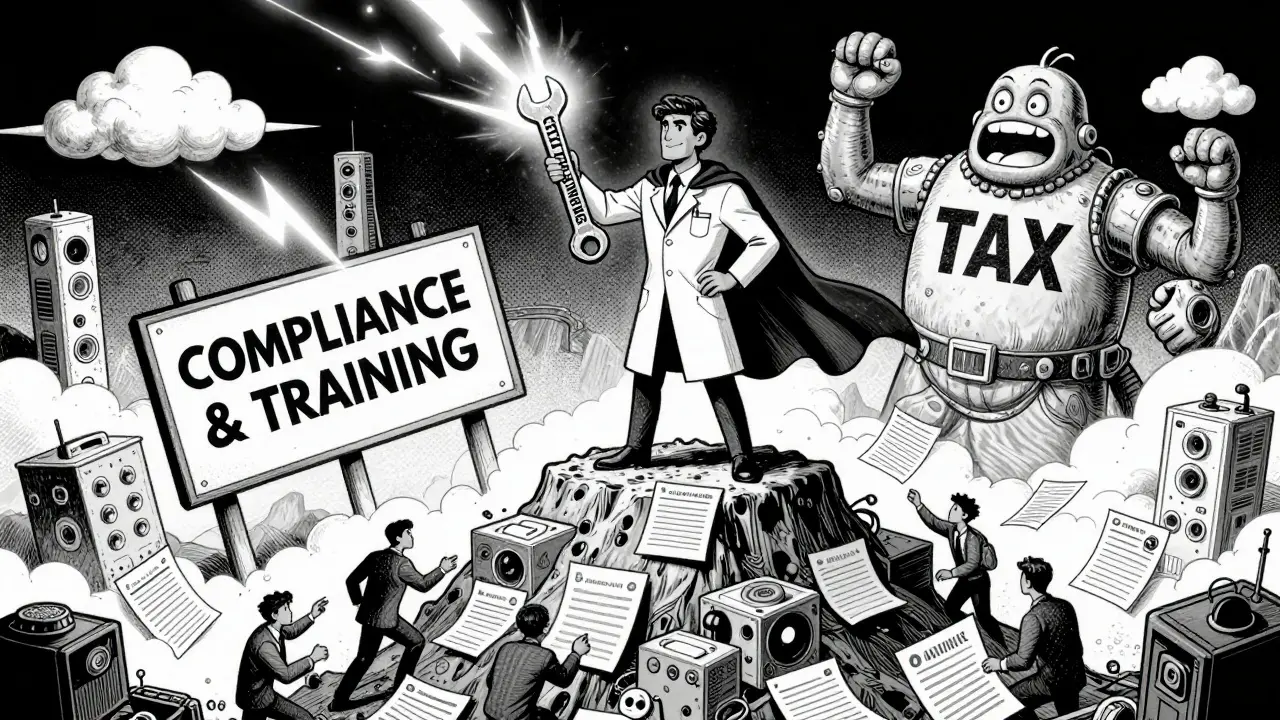
How Much Does It Actually Cost?
Here’s what real projects look like in 2026:- Small team (under 50 people): $30,000-$120,000 total. Best for simple tasks like automating email responses or generating product descriptions.
- Mid-sized enterprise: $120,000-$600,000. Includes custom fine-tuning, data pipelines, compliance, and team training. Common in marketing, customer service, and HR.
- Enterprise transformation: $600,000-$2 million+. Used for end-to-end process redesign-like AI-powered supply chain forecasting or dynamic pricing engines. These projects often cut operational costs by 20-60% in the first year.
Value Realization: The Real Measure of Success
Most companies track AI by how many documents it generates. That’s wrong. Value is measured in outcomes:- How much time did customer service reps save?
- Did marketing campaigns convert better?
- Did you reduce manual errors in compliance reports?
The Pitfalls That Kill Budgets
Here’s what goes wrong-and how to avoid it:- "Out-of-the-box" models fail in real environments. A manufacturing firm spent $350,000 on a generic AI for technical documentation. It couldn’t understand their equipment manuals. They had to restart with a domain-specific model-adding $180,000 and six months.
- No one owns the AI after launch. If no team is responsible for monitoring accuracy, the model drifts. One company’s AI started inventing product features. Sales teams used them in pitches. Legal had to issue corrections. Annual maintenance should be 15-20% of your initial cost.
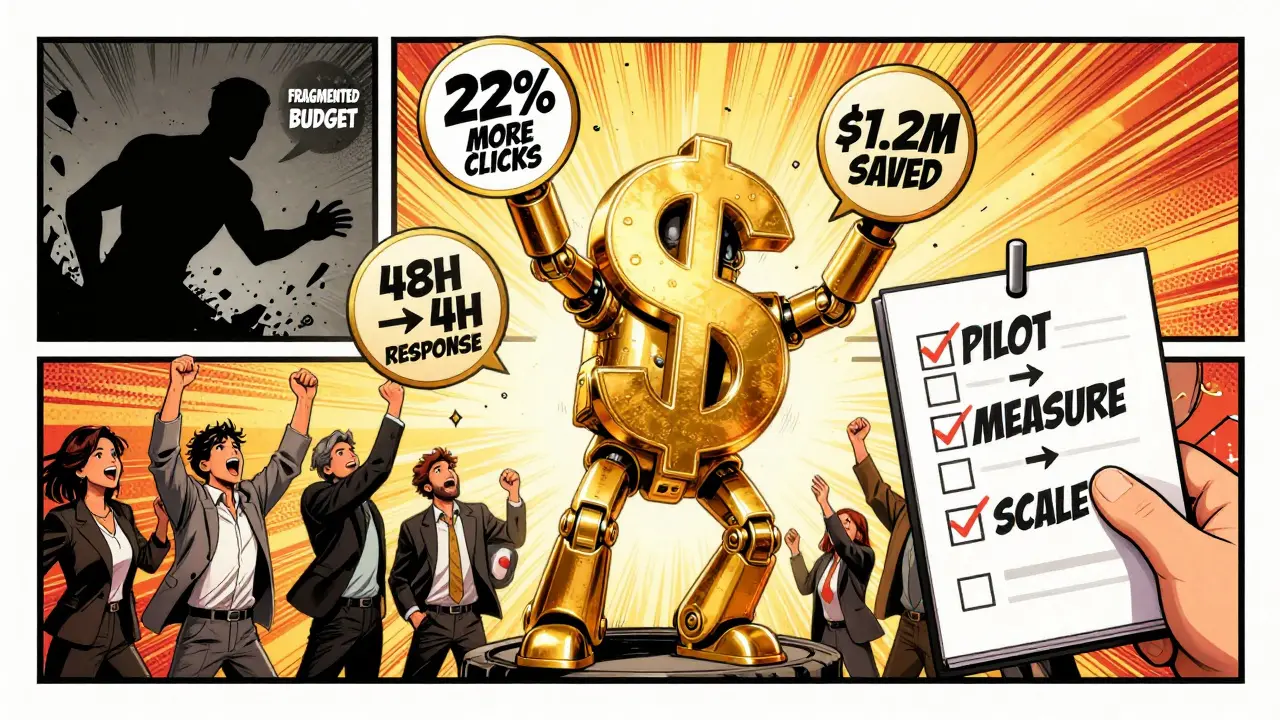
- Budgets are scattered. Marketing buys one tool. HR buys another. IT pays for the servers. Without central oversight, companies overspend by 22-35% on duplicate tools. Assign a single budget owner from day one.
Smart Budgeting Strategies for 2026
There are three ways to approach AI spending:- Platform-based: Use Azure OpenAI, Google Vertex AI, or Anthropic’s Claude. Lower upfront cost, higher long-term usage fees. Good for testing.
- Hybrid: Combine platform tools with custom fine-tuning. This is what 63% of mid-sized companies use. Best balance of control and cost.
- Full custom: Build your own model from scratch. Only for large enterprises with unique data and deep AI teams. Costs $1M+.
What’s Coming Next
New hardware like NVIDIA’s Blackwell chips cut inference costs by 28% in early 2026. Smaller, domain-specific models (1-7 billion parameters) are now available-cutting costs by 40% for niche uses like legal contract review or medical note summarization. But here’s the catch: Gartner predicts 80% of enterprise AI budgets in 2026 will include a line item for AI ethics oversight. That’s $5,000 to $15,000 extra per project for bias testing and transparency logs. Model-as-a-service is growing fast. It lowers upfront costs by 15-25% but raises annual fees by 8-12% because you pay per query. If your usage spikes, your bill spikes. Budget for variable costs, not fixed ones. The biggest threat isn’t cost-it’s fragmentation. When AI spending spreads across departments without oversight, companies waste money. Centralize your budget. Assign ownership. Track every dollar against a real business KPI.Final Rule: Tie Every Dollar to a Result
Don’t budget for "AI." Budget for faster response times, fewer errors, higher conversion rates, or reduced labor hours. If you can’t tie a cost to a measurable outcome, don’t spend it. Companies that do this have a 78% higher chance of surviving economic downturns, according to Deloitte. Generative AI isn’t a tech experiment. It’s a financial decision. Treat it like one.How much should I budget for a generative AI pilot project?
For a small pilot targeting one use case-like automating customer support replies or generating marketing copy-budget between $30,000 and $120,000. This covers data preparation, model fine-tuning, basic infrastructure, and training for 2-3 team members. Keep it narrow. Focus on one measurable outcome, like reducing response time by 50%. Most successful pilots last 3-6 months.
Why do 73% of generative AI projects fail to deliver ROI?
Most fail because they treat AI like software, not a living system. They budget for development but ignore ongoing costs: data drift, model retraining, compliance updates, and team training. One company spent $180,000 building an AI but didn’t budget for the three full-time staff needed to validate outputs. The AI started generating false product claims. Fixing it cost $90,000 and six months. ROI isn’t automatic-it’s planned.
Is it cheaper to use off-the-shelf AI tools or build custom models?
Off-the-shelf tools like ChatGPT Enterprise or Claude for Business cost less upfront-often $20-$50 per user per month. But they’re generic. If you need accuracy in legal, medical, or technical domains, you’ll need custom fine-tuning. That adds $30,000-$100,000. For most mid-sized companies, a hybrid approach works best: use a platform for basic tasks, and fine-tune a model for your core use case. It balances cost and control.
What percentage of my IT budget should go to AI?
Fortune 500 companies are spending an average of 8.7% of their total IT budget on generative AI in 2026. For smaller companies, start with 2-5%. If you’re in a high-impact area like customer service or marketing, you might go higher. The key isn’t the percentage-it’s alignment. Every dollar should link to a business goal: reduce support tickets by 30%, cut content production time in half, or improve conversion rates. Track it. Adjust it.
How do I avoid hidden costs in AI projects?
Ask these questions before you sign anything: Do we have clean, labeled data? Who owns model accuracy after launch? Are we budgeting for peak usage, not just average? Have we factored in compliance, training, and documentation? Have we assigned a single person to manage the budget? If you answer "no" to any of these, you’re underbudgeting. Add 20-30% to your estimate as a buffer. Most teams who do this avoid major overruns.




10 Comments
Nalini Venugopal
Okay but let’s be real - most companies think AI is a magic button that writes their emails and fixes their spreadsheets. I’ve seen teams spend $200k on a chatbot that kept calling customers ‘hon’ and recommending ice cream during tax season. 😅 The real cost? The HR manager who had to manually correct 800 wrong replies before they shut it down. Training isn’t optional - it’s damage control.
Pramod Usdadiya
in india we dont even have enough data to train a basic model without buying it from usa or europe. and then the cloud bills? bro we pay 30k rupees for 100gb data transfer. ai tax? more like ai robbery. still trying to get my boss to understand why we need 3 people just to clean up product names from 1990s excel sheets. 🤦♂️
Aditya Singh Bisht
Guys this is the future and you’re still treating it like a new printer. I worked on a project where we spent $80k on a model that generated fake safety guidelines - luckily we caught it before anyone got hurt. But here’s the win: after we added proper training and a single owner for monitoring, our error rate dropped 90% in 3 months. You don’t need a billion-dollar team. You just need to stop treating AI like a one-time purchase. It’s a living thing. Feed it. Train it. Watch it. Love it. 💪
Agni Saucedo Medel
OMG YES. I just had a client whose AI started writing Instagram captions like a drunk poet. ‘New sneakers: they scream joy and existential dread.’ 😱 We spent $15k on compliance checks and 2 weeks retraining. But now? Their engagement is up 40%. The secret? Not the tech. The *team*. Someone has to hold its hand. 🤝✨
ANAND BHUSHAN
ai is just a tool. if you spend too much on it you are wasting money. just use free stuff. people make it complicated. simple is better.
Jeroen Post
They don’t want you to know this but the real cost isn’t compute or data - it’s the NSA buying your training data through third-party vendors. That $100k you spent? Half of it went to a shell company in Estonia that scraped your customer emails. The AI isn’t learning from your data - it’s being trained on your customers’ private lives. And the ‘compliance’ budget? That’s just a cover so the Feds don’t audit you. Wake up.
Honey Jonson
so true!! i work in hr and our ai started suggesting ‘ideal candidates’ based on old hiring patterns - like only hiring people from ivy league schools or only men for engineering roles. we had to pause everything and bring in a consultant to fix the bias. spent $25k but now our diversity stats are way better. the trick? dont just hire tech people - hire people who care about fairness. and yes, training is not optional lol
Sally McElroy
Let me be perfectly clear: if you’re not budgeting for AI ethics oversight, you’re not just irresponsible - you’re morally bankrupt. Eighty percent of enterprise AI budgets in 2026 will include this line item because the alternative is algorithmic racism, gender discrimination, and legal ruin. You think you’re saving money by skipping it? You’re just delaying the inevitable lawsuit. And no, ‘we’ll fix it later’ is not a strategy - it’s a confession of negligence.
Destiny Brumbaugh
USA built this tech. Europe is trying to regulate it into oblivion. India? They’re still trying to get internet in villages. If you’re not spending on American-made AI platforms, you’re falling behind. Stop listening to these ‘hybrid’ nonsense. Buy Azure. Use OpenAI. Support American innovation. Otherwise you’re just helping China win the AI race. This isn’t business - it’s national security.
Sara Escanciano
Anyone who thinks off-the-shelf AI is ‘good enough’ is either lying to themselves or actively harming their company. I’ve seen AI-generated medical summaries that told patients to stop taking insulin. That’s not a glitch - that’s criminal negligence. If you’re not spending $50k+ on validation, auditing, and human oversight, you’re not managing risk - you’re gambling with lives. And if you’re okay with that, you shouldn’t be in charge of anything.