
Trying to train a Large Language Model (LLM) on a petabyte of data is less about the AI and more about the plumbing. If you've ever hit an Out-Of-Memory (OOM) error or watched your expensive GPUs sit idle while waiting for data to arrive from a slow disk, you know the pain. The core problem is that training requires far more memory than inference-you aren't just storing the model; you're juggling gradients and optimizer states simultaneously. To survive this, you need a sharding strategy that turns a massive, monolithic dataset into a stream of manageable chunks.
| Challenge | Solution | Primary Benefit |
|---|---|---|
| GPU Memory Exhaustion | Sharded Data Parallelism | Fits models with 70B+ parameters in memory |
| Storage Bottlenecks | Tiered Object Storage + Caching | Eliminates GPU idling during epochs |
| Data Randomization | Global Shard Shuffling | Prevents training bias in massive sets |
What Exactly is Sharding in the LLM Context?
In simple terms, Sharding is the process of splitting a massive dataset or model components across multiple devices, such as GPUs or compute nodes, to distribute the workload. When we talk about petabyte-scale data, we aren't just talking about splitting a CSV file. We are talking about serializing raw data-like billions of tokens or images-into compressed formatted objects such as .tar, .tgz, or .tar.lz4 files.
Why bother? Because of a brutal memory reality: training requires model parameters, gradients, and optimizer states to live in the GPU memory at once. This typically triples the memory needs compared to just running the model for a user. If you're working with a model in the 7B to 70B parameter range, it simply won't fit on a single card. Sharding allows each device to handle only a fraction of the total, making the impossible possible.
Building a Tiered Storage Architecture
You cannot run a petabyte-scale training job off a single hard drive. You need a tiered approach that balances cost with speed. Most professional pipelines use Object Storage, such as AWS S3, Google Cloud Storage, or Azure Blob Storage, as the primary landing zone. It's cheap and holds everything, but it's too slow for direct training reads.
To bridge the gap, engineers introduce a high-performance caching layer or a distributed file system. Think of Lustre, CephFS, or WekaIO. These systems present data as a single hierarchical namespace across many nodes, allowing the compute cluster to pull shards at lightning speed. For those needing more structure, "Lakehouse" patterns using Apache Iceberg or Delta Lake add transactional capabilities and schema evolution to the raw object store.
Optimizing the Data Loading Pipeline
The biggest waste of money in AI is a GPU waiting for data. This is why efficient data loading is a non-negotiable part of the pipeline. The goal is to ensure the next batch of data is already in memory before the GPU finishes its current calculation.
Several frameworks handle this coordination. WebDataset and NVIDIA DALI are popular for their ability to stream shards directly from storage without needing to unpack them locally. Meanwhile, DistributedSampler combined with DataLoader in PyTorch ensures that different compute nodes aren't reading the same shards, which would waste bandwidth and ruin the training logic.
A pro tip for randomization: avoid simple local shuffling. With petabytes of data, you need global shuffling of shard names combined with client-side shuffle buffers. This ensures the model doesn't see the data in a predictable order, which is critical for convergence.

Sharded Data Parallelism vs. Tensor Parallelism
When the model is too big for one GPU, you have to choose how to split it. Standard data parallelism replicates the entire model on every GPU, which is a memory nightmare for LLMs. Instead, Sharded Data Parallelism shards the trainable parameters and optimizer states across the GPUs.
For truly massive models, you might combine this with Tensor Parallelism, where a single tensor operation is split across multiple GPUs. Let's look at a real-world scenario: imagine training a GPT-NeoX-65B model. On 64 ml.p4d.24xlarge instances, you might use a degree-2 sharded data parallelism combined with degree-64 tensor parallelism. This setup allows you to handle longer sequence lengths (like 512 tokens) without crashing your hardware.
The math for memory requirements usually follows a simple rule of thumb: Memory Requirement ≈ α × Model Size, where α is usually between 3 and 5. Even with bfloat16 reducing the footprint by 50%, a model like DeepSeek-R1-671B remains a massive infrastructure challenge.
Practical Strategies for Batch Size and Convergence
Finding the right batch size is a bit of an art. The best practice is to start with a batch size of 1 and incrementally increase it until you hit an OOM error. Once you hit that wall, you have two choices: increase the degree of your sharded data parallelism or introduce tensor parallelism.
It's also worth questioning if you actually need a petabyte of data. While pretraining typically requires massive scale, domain adaptation-like creating a specialized cybersecurity LLM-often works with significantly less. Some specialized models have seen competitive performance with only 118.8 million tokens, compared to general-purpose models using billions. This suggests that high-quality, sharded, domain-specific data is often more valuable than sheer volume.
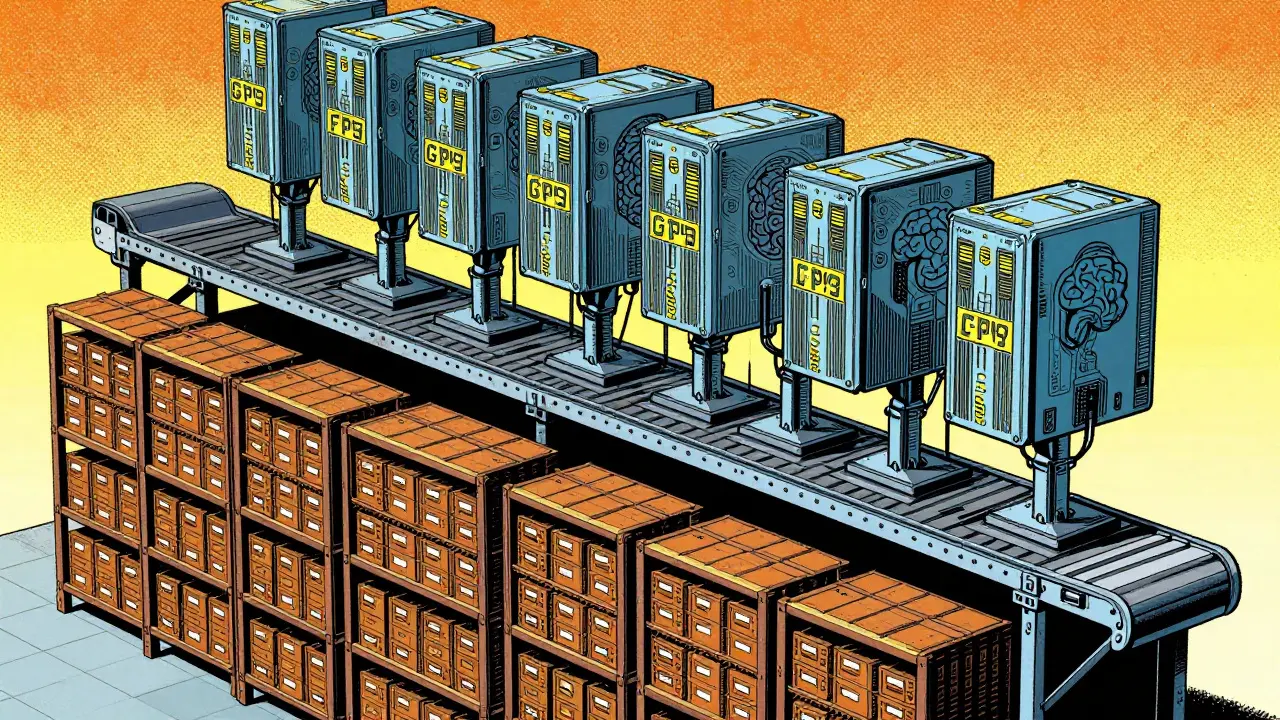
Customizing Shards for Complex Data
Not all data is a simple string of text. Sometimes you need category-based sharding. For instance, if you're working with an ImageNet-style dataset, you can use external key maps to group samples. You might treat 'tench' and 'goldfish' as a single 'fish' category within your shards to simplify the learning task. Tools like ishard allow you to associate specific files into computable samples and group them into consumable shards, giving you a level of control that standard automated splitting doesn't provide.
Why can't I just use standard data parallelism for LLMs?
Standard data parallelism replicates the model on every GPU. For an LLM, this means every GPU must hold the model parameters, the gradients, and the optimizer states. For a 70B parameter model, this would exceed the memory of almost any current GPU. Sharded data parallelism instead splits these components across the cluster, so each GPU only holds a fraction of the state.
What is the difference between a Data Lake and Object Storage?
Object storage (like S3) is the raw physical layer where files are stored as objects. A Data Lake is an architectural pattern that adds a layer of management over that storage, often using tools like Apache Iceberg to provide a table-like structure, versioning, and better metadata handling.
How does sharding prevent GPU idling?
By breaking data into small, compressed shards and using prefetching frameworks like NVIDIA DALI or WebDataset, the system can load the next set of data into RAM while the GPU is still processing the current batch. This ensures a constant stream of data and maximizes GPU utilization.
Is bfloat16 enough to avoid sharding?
No. While bfloat16 reduces the memory footprint by 50% compared to float32, it doesn't solve the fundamental problem that training requires multiple copies of the model state (gradients and optimizer states). For large-scale models, sharding is still necessary to fit the workload across the available VRAM.
What is the ideal batch size for a sharded setup?
There is no single "ideal" number, as it depends on your GPU VRAM and model size. The recommended approach is to start at 1 and scale up until you encounter OOM errors. If you need a larger global batch size for better convergence but are hitting memory limits, increase your sharding degree.
Next Steps for Scaling Your Pipeline
If you're just starting with petabyte-scale data, begin by auditing your storage throughput. If your GPUs are underutilized, focus on moving from direct object storage reads to a tiered caching layer like Lustre or WekaIO. For those already using distributed storage, experiment with combining sharded data parallelism and tensor parallelism to push your model size boundaries. Finally, consider if a smaller, higher-quality domain-adapted dataset could achieve your goals faster than a massive, generic pretraining set.