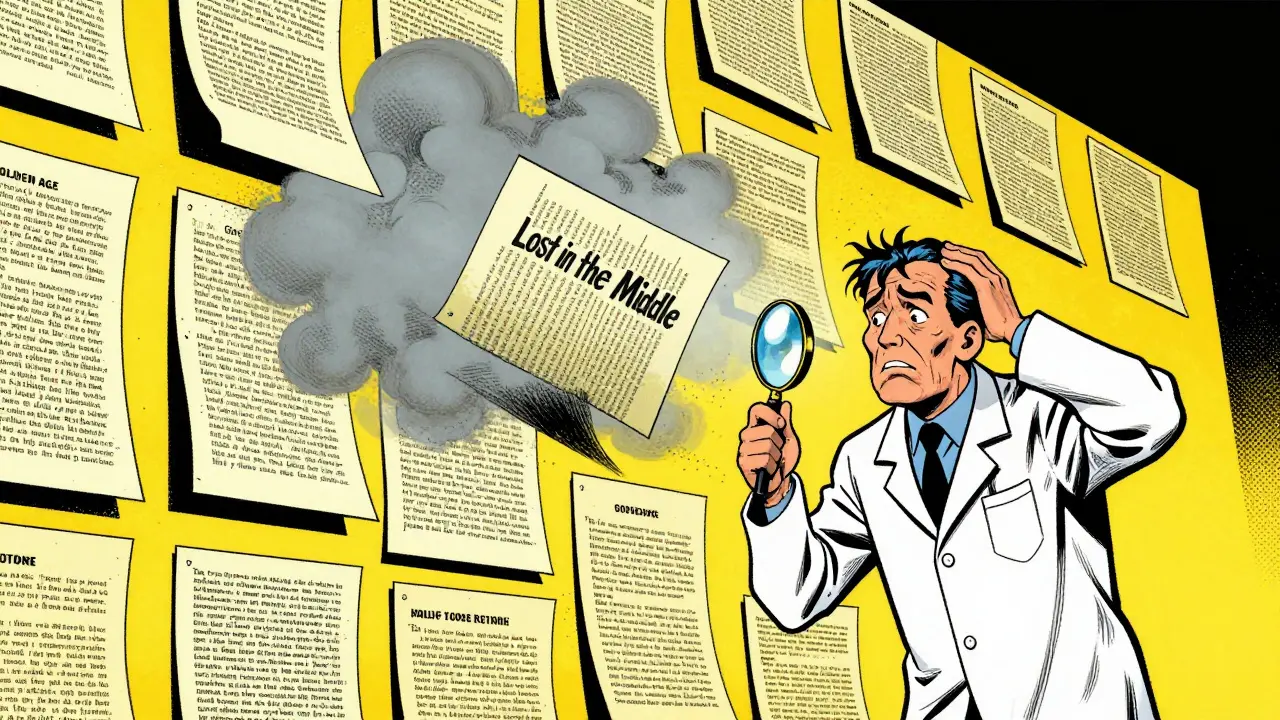
You've probably felt the frustration: you feed a massive document into a state-of-the-art LLM, you know the answer is definitely in there, but the model tells you it can't find it or, worse, makes something up. It's not that the model can't "read" the tokens-modern systems can handle hundreds of thousands of them-it's that the model is effectively ignoring the middle of your text. This is the core challenge of long-context prompt design.
The reality is that LLMs don't treat every word in a prompt with equal importance. There is a systemic bias in how they allocate attention, and if you don't strategically position your critical information, your most important data ends up in a cognitive blind spot. To get reliable results, you have to stop treating the prompt like a bucket and start treating it like a curated map.
The "Lost in the Middle" Phenomenon
If you've noticed a dip in accuracy as your prompts get longer, you're likely seeing the "Lost in the Middle" effect. This was famously detailed in research by Liu et al. (2023), which uncovered a U-shaped performance curve. Essentially, LLMs are great at remembering the beginning of a prompt (the primacy effect) and the very end (the recency effect), but they struggle significantly with information buried in the center.
Lost in the Middle is a performance degradation pattern where LLMs fail to retrieve or utilize information located in the center of a long input context. This isn't just a fluke; it's baked into the architecture. Most modern LLMs are decoder-only models, which use a left-to-right attention mechanism. Because the model is trained on documents where the most important parts-like titles, abstracts, and conclusions-are at the boundaries, it develops a "positional prior." It simply expects the high-signal information to be at the start or the end.
It's important to realize that length itself is also an enemy. A 2024 study (arXiv:2510.05381) found that sheer input length can degrade performance even if the evidence is in an optimal position. This means that while positioning helps, adding "fluff" or irrelevant data still hurts your accuracy.
Strategic Positioning Techniques
Since we know where the model's attention drops off, the goal is to move critical data out of the "danger zone" and into the high-attention boundaries. Here are the most effective ways to do that:
- Query-First Prompting: Instead of putting your question at the very end after 10,000 words of context, put it at the top. By placing the objective first, you anchor the model's attention on the task before it ever starts processing the background data.
- The Bookend Method: Also known as query-aware contextualization, this involves placing key points or the specific question both at the beginning and the end of the context. This reinforces the goal and ensures that as the model reaches the end of its processing, the task is fresh in its "mind."
- Segmentation and Summarization: If you have a massive dataset, don't just dump it. Break the content into smaller chunks and provide a brief summary at the start or end of each segment. These summaries act as cognitive anchors, helping the model navigate the larger structure.
- Chronological Ordering: For historical data or logs, keep things in temporal order. While it seems intuitive to humans, it also helps the model maintain narrative coherence, which can mitigate some of the disorientation caused by long contexts.
| Strategy | Best For... | Attention Target | Complexity |
|---|---|---|---|
| Query-First | Task-oriented retrieval | Primacy (Start) | Low |
| Bookending | Complex reasoning | Primacy & Recency | Medium |
| Segmentation | Massive documents | Distributed Boundaries | High |
| Re-ranking | RAG Pipelines | Top-k Priority | Medium |
Optimizing RAG Pipelines for Attention
If you are building a RAG (Retrieval-Augmented Generation) system, you can't just rely on a vector database to give you the "top 10" results and dump them in a list. If the 4th and 5th most relevant documents are the ones containing the actual answer, they will likely be "lost in the middle."
The pro move here is re-ranking. After your initial retrieval, use a secondary, more precise model to rank the documents. Then, arrange them so the absolute highest-relevance chunks are at the very beginning and very end of the prompt, pushing lower-relevance (but still necessary) context into the middle. This aligns the data with the model's natural attention bias.
Additionally, consider a sliding window approach or hierarchical aggregation. Instead of sending one giant block of text, you send smaller, high-density summaries first, and only dive into the full text once the model has identified which specific segment contains the answer.
When Does Position Bias Actually Matter?
You don't need to over-engineer every prompt. If your input is a few hundred words, the U-shaped curve is negligible. However, you should start applying these design patterns when you hit these specific triggers:
- The 4k Threshold: Your prompts regularly exceed 4,000 tokens.
- Document Volume: You are retrieving more than 3-5 separate documents per query.
- The "Missing Citation" Problem: The model claims the information isn't there, but you can clearly see it in the source text you provided.
- Conversation Fatigue: You're in a multi-turn chat where the history has become so long that the model is forgetting the initial constraints you set.
To test if your pipeline is suffering from this, try a "position-aware test." Take a known correct answer, move it from the start of the prompt to the middle and then to the end, and record the accuracy. If the middle position fails consistently, you have a positioning problem, not a model intelligence problem.
The Shift Toward Context Engineering
We are moving away from traditional prompt engineering-which was all about finding the "magic words" (like "think step-by-step")-and toward context engineering. This is the art of curating the smallest possible set of high-signal tokens to achieve a goal.
Newer models, such as Gemini Pro 1.5, have shown significantly better performance in long-context retrieval, suggesting that architectural changes are starting to flatten the U-shaped curve. However, even with these improvements, the principle remains: noise is a pollutant. The more irrelevant text you include, the more you dilute the signal. The goal isn't to maximize the amount of information you give the model, but to minimize the amount of information needed to get the right answer.
What exactly is the "Lost in the Middle" effect?
It is a phenomenon where LLMs are significantly better at accessing and using information located at the very beginning or very end of a prompt than information located in the middle. This creates a U-shaped accuracy curve as the context length increases.
Does this happen with all LLM architectures?
It is most prominent in decoder-only architectures, which are used by most popular LLMs today. While encoder-decoder models have some bidirectional attention that helps, they still exhibit boundary bias when dealing with very long, unstructured text.
How can I quickly test if my prompt is too long for the model?
Try the "needle in a haystack" test: place a random, specific fact in the middle of your long text and ask the model to retrieve it. If the model fails but succeeds when the fact is at the top or bottom, you are experiencing position bias.
Is it better to put the question at the start or the end?
For very long contexts, putting the question (or a version of it) at the start is generally better for anchoring attention. However, the most robust approach is "bookending"-placing the query at both the beginning and the end.
Will newer models eventually solve this problem?
Recent models like Gemini Pro 1.5 show much higher resilience to position bias. While the architectural gap is closing, the fundamental need to reduce noise and organize information logically will always exist to ensure maximum reliability.
Next Steps for Implementation
If you're managing an LLM-powered application, start by auditing your RAG pipeline. Check where your retrieved chunks are being placed. If they are simply appended in the order they were found, you're likely leaving accuracy on the table. Implement a re-ranker to push the most relevant data to the boundaries.
For those writing manual prompts for research or analysis, try the "Query-First" approach today. Move your instructions and your core question to the top of the document, then provide the context, and finish with a brief reminder of what you need. You'll likely see a jump in the model's ability to cite specific evidence without hallucinating.