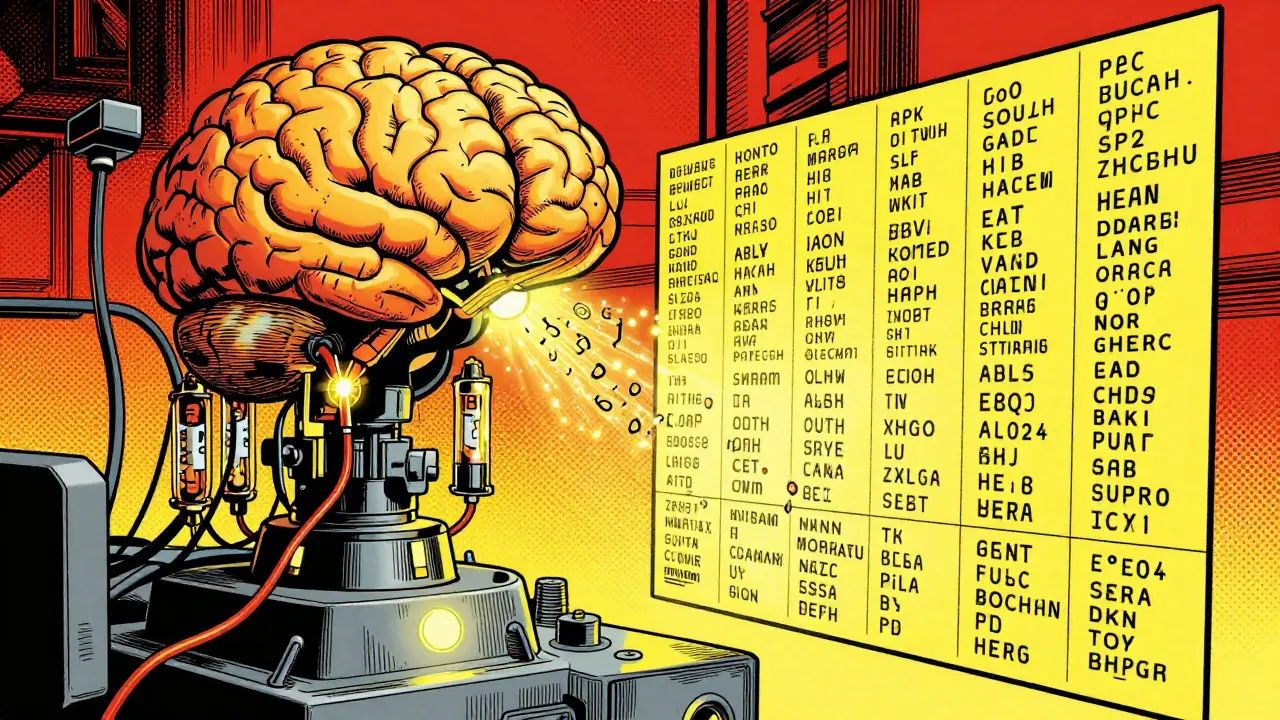
Ever wonder why an AI sometimes sounds like a genius and other times hallucinates a fact that sounds completely believable but is totally wrong? It all comes down to a game of numbers. At their core, Large Language Models is a class of AI systems that predict the next piece of text by calculating the statistical likelihood of various options based on massive datasets. Also known as LLMs, these models don't "know" facts in the way humans do; they just know that given a specific sequence of words, certain other words are mathematically more likely to follow.
Think of it like a super-powered version of the autocomplete on your phone. While your phone might suggest the next word based on your last two typing choices, a model like GPT-4 considers thousands of preceding words and a web of billions of parameters to decide what comes next. This process is called autoregressive generation, meaning the model feeds its own output back into itself as input for the next step.
The Secret Sauce: From Tokens to Probabilities
Before a model can do any math, it has to turn human language into something it can process. This happens through Tokenization, which is the process of breaking down text into smaller chunks called tokens, which can be whole words, syllables, or even single characters. These tokens are then converted into numerical vectors.
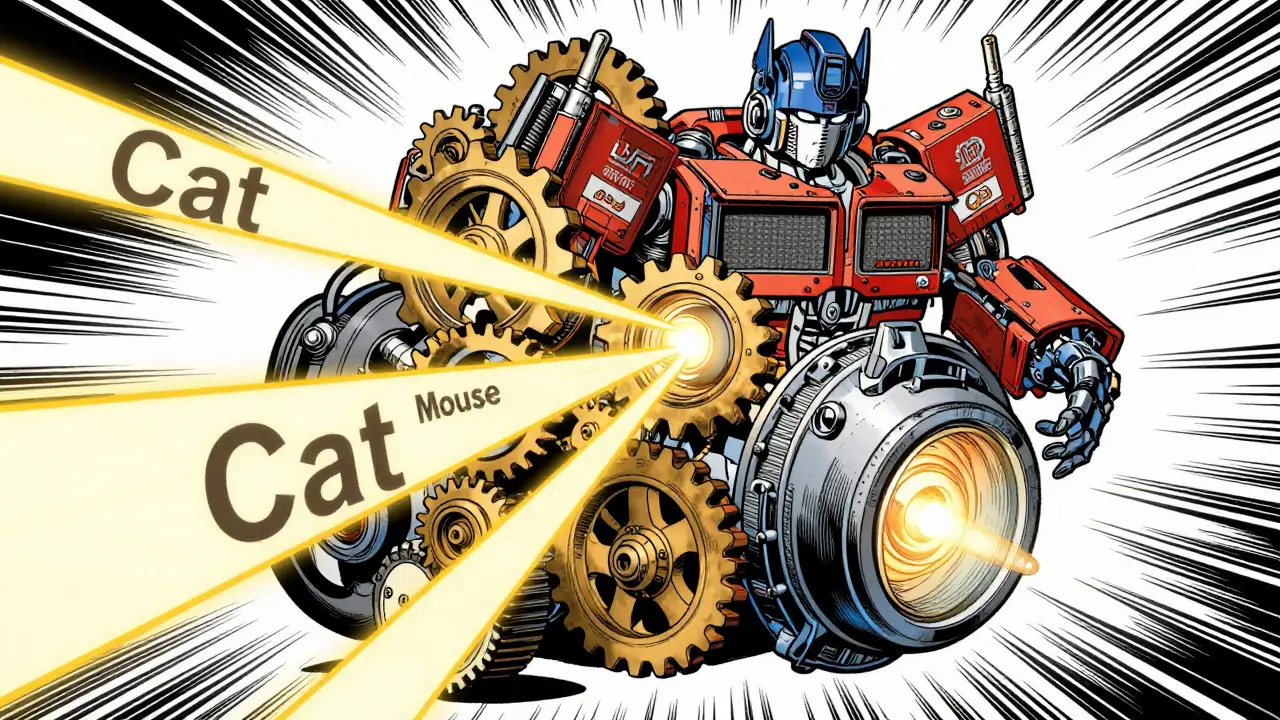
Once the model has the tokens, it uses a Transformer Architecture to analyze the context. Unlike old-school models that only looked at a few words behind them, the Transformer uses a self-attention mechanism to see the entire prompt at once. It assigns weights to different words based on their importance. For example, in the sentence "The cat, which was chasing a mouse, ran away," the model knows that "ran" refers back to the "cat," not the "mouse," because of these attention weights.
The final step of this calculation produces "logits"-basically raw scores for every possible token in the model's entire vocabulary. To make these scores useful, the model applies a softmax function. This turns those raw scores into a probability distribution that adds up to 100%. If the model is predicting the next word after "The capital of France is...", the token for "Paris" might have a probability of 0.85, while "Lyon" might have 0.02, and "Apple" might have 10^-15.
How the AI Actually Picks a Word
Having a list of probabilities is one thing, but actually picking a word requires a "decoding strategy." If the AI always picked the word with the highest percentage, it would become repetitive and boring-a problem known as greedy decoding. To keep things feeling natural, developers use different sampling methods.
| Strategy | How it Works | Best For... | Result |
|---|---|---|---|
| Greedy Decoding | Always picks the top-probability token | Structured data, Math | Precise but repetitive |
| Top-K Sampling | Picks from the top K most likely words | General Chat | Balanced diversity |
| Top-P (Nucleus) | Picks from a set whose total probability exceeds P | Creative writing | Dynamic and natural |
| Beam Search | Tracks multiple likely paths simultaneously | Translation, Summarization | Higher overall coherence |
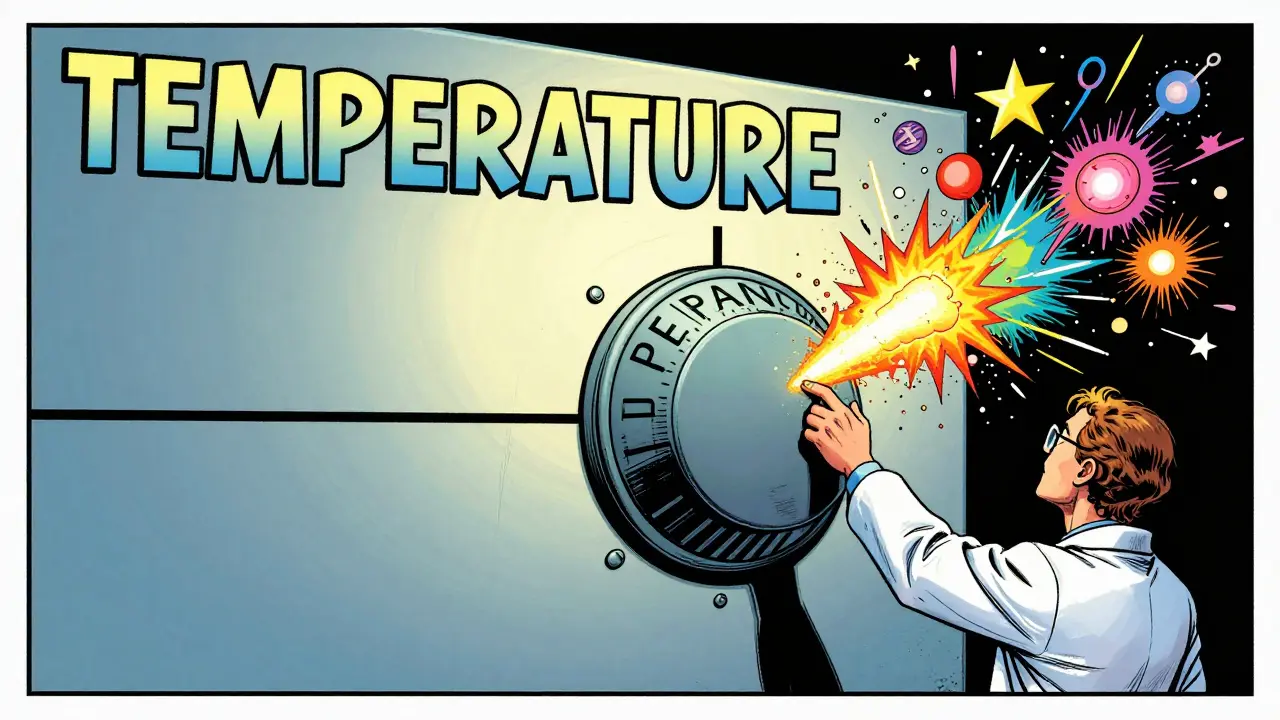
One of the most important knobs developers can turn is Temperature, which is a hyperparameter that controls the randomness of the probability distribution. When the temperature is low (e.g., 0.2), the model becomes very confident and sticks to the most likely tokens. This is great for factual tasks. When the temperature is high (e.g., 1.0), the distribution flattens, giving lower-probability words a better chance of being picked. This is why a "creative" AI setting feels more unpredictable and imaginative.
Why Probabilities Lead to Hallucinations
The probabilistic approach is a double-edged sword. Because the model is optimized for statistical plausibility rather than factual truth, it can confidently generate a sentence that sounds perfectly correct but is entirely made up. This happens because the model has learned that certain words often appear together, even if they don't represent a real-world fact in that specific instance.
For example, if a model has seen a million sentences about CEOs and tech companies, it might assign a high probability to a specific name being the CEO of a company, simply because that name and that company often appear in the same context in the training data-even if the person actually works elsewhere. This is why research from the Stanford Center for Research on Foundation Models shows a significant gap between an LLM's ability to predict the next token (often over 90% accuracy) and its ability to solve complex logical math problems, where accuracy can drop significantly.
Real-World Implementation and the Cost of Context
Implementing these probability calculations isn't cheap. The computational cost grows as the conversation gets longer. This is why you might notice a slight lag in responses when you're working with a massive document or a very long chat history. On high-end hardware like NVIDIA A100 GPUs, generation speed can drop by over 30% as the context window expands from 4,000 to 32,000 tokens.
To fight common probabilistic failures, developers use a few tricks:
- Repetition Penalty: If the model starts looping the same phrase, a penalty is applied to those tokens' probabilities, forcing the AI to pick something new.
- RLHF (Reinforcement Learning from Human Feedback): This process, used heavily by companies like Anthropic, adjusts the probability distributions to favor safer, more helpful answers and penalize harmful ones.
- Neuro-Symbolic AI: New frameworks are starting to combine probabilistic guessing with a "knowledge graph," which is essentially a hard-coded map of facts that the AI must check before it commits to a word.
The Future of Word Selection
We are moving away from fixed settings. The next generation of models is shifting toward "Adaptive Probability Thresholding." Instead of using the same Top-P or Temperature for every sentence, the model will decide on the fly: "This is a math question, so I'll use a low temperature" or "This is a poem, so I'll open up the probability pool."
While these systems still struggle with rare technical jargon or niche medical terms because they don't appear often enough in the training data to build strong probability weights, the trend is clear. The goal is to move from simple "guessing the next word" to a more nuanced system that understands when it needs to be precise and when it can afford to be creative.
Does the AI actually understand the words it picks?
No, it doesn't have a conscious understanding. It uses mathematical patterns to determine which token is most likely to follow given the current context. It simulates understanding by being incredibly good at statistical correlation.
What happens if the probability for all words is low?
The model still has to pick something. Even if the top choice only has a 1% probability, it is still the "most likely" option among the millions of possibilities. This is often where the most obvious hallucinations occur.
How does Top-P differ from Top-K?
Top-K picks a fixed number of the best tokens (e.g., the top 50). Top-P is dynamic; it picks as many tokens as needed to reach a certain probability threshold (e.g., 90%). If one word is overwhelmingly likely, Top-P might only pick one word, whereas Top-K would still consider 50.
Why does a high temperature make the AI more creative?
High temperature reduces the gap between the most likely word and the less likely ones. This makes the "long shot" words more likely to be selected, leading to more varied and unexpected vocabulary.
Can these probability errors be completely removed?
Not as long as the models are purely probabilistic. To eliminate them, the AI would need to be integrated with symbolic reasoning or a verified database of facts to override the probability distribution when a factual truth is required.

6 Comments
Kendall Storey
The whole softmaxL gotta be a bottleneck when you're pushing massive context windows. Using A100s is cool, but the KV cache bloat is where the real pain is for real-time inference. Definitely seeing some crazy latency spikes when the token count hits those upper limits.
Janiss McCamish
Temperature settings basically change the AI's confidence level.
Steven Hanton
It is quite fascinating how the transition to adaptive probability thresholding might mitigate the current limitations of static hyperparameters. One wonders if this approach will eventually allow the models to better distinguish between creative expression and rigorous factual retrieval without manual intervention. The integration of knowledge graphs seems like a promising path toward reducing those frustrating hallucinations we see so often in complex queries.
Richard H
Who cares about the math? The real issue is that these models are trained on global datasets that dilute our own values. We need AI that reflects actual national interests, not some watered-down probabilistic average of the entire internet! Total waste of compute if it doesn't prioritize the right data sources.
Pamela Tanner
It is imperative that we emphasize the distinction between statistical correlation and genuine comprehension. While these models excel at mimicking human patterns, the lack of an underlying conceptual framework means they are essentially sophisticated mirrors of their training data. For those entering the field, understanding the nuance of tokenization is the first step toward developing more ethical and transparent AI systems. We must ensure that the pursuit of "plausibility" does not supersede the requirement for accuracy, especially in critical sectors such as medicine or law. The current trajectory toward neuro-symbolic AI suggests a necessary pivot toward more grounded systems. By anchoring probabilistic outputs in verified logic, we can create a safer environment for users who rely on these tools for information. It is also worth noting that RLHF, while helpful, is merely a layer of behavioral grooming rather than a fundamental change in how the model processes truth. True progress will come from architectural shifts, not just better feedback loops. We should all be advocating for open-source benchmarks that hold these corporate models accountable for their hallucination rates. The industry needs a standardized way to measure "truthfulness" across different decoding strategies. Only then can we truly trust the output of a transformer-based system. This transition requires a collaborative effort between linguists and computer scientists to define what "understanding" actually looks like in a machine.
Ashton Strong
I find the explanation regarding Top-P sampling to be exceptionally clear. It provides a wonderful foundation for anyone wishing to understand the delicate balance between coherence and creativity in modern linguistics software.