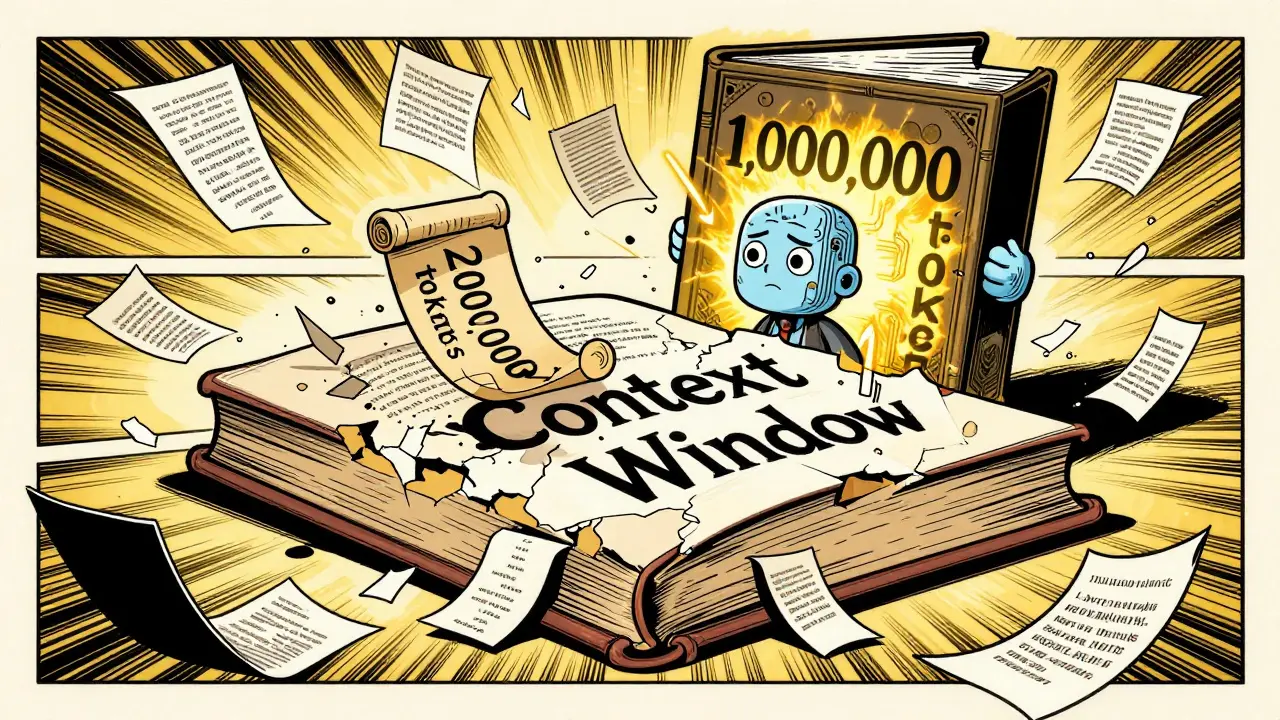
Imagine trying to read a 500-page book, but every 20 pages, the text before it disappears. You can’t go back. You can’t remember what happened in chapter three when you’re on chapter ten. That’s what happens when a large language model hits its context window limit. It’s not a bug-it’s a hard constraint built into how these models work. And as models get smarter, this limit becomes the biggest bottleneck between useful AI and truly powerful AI.
What Exactly Is a Context Window?
A context window is the maximum amount of text a language model can process at once. It’s measured in tokens-chunks of text that can be words, parts of words, or even single characters. For example, the word "unbelievable" might be split into three tokens: "un", "believe", and "able". The model looks at all these tokens together to understand what you’re asking and generate a response.
This isn’t just about how much you can type in. The context window includes everything: your prompt, any past messages in the conversation, and the model’s own output. If you ask a model to summarize a 100-page report and then answer follow-up questions, every word you type and every word it writes counts against that limit.
Early models like GPT-2 had tiny windows-just 2,048 tokens. That’s about 1,500 words, or a short essay. Today, models like Anthropic’s Claude 3.7 Sonnet handle up to 200,000 tokens. Google’s Gemini 1.5 Pro can process up to 1 million tokens in experimental settings. That’s like reading a 300-page book in one go.
Why Bigger Isn’t Always Better
More context sounds great-until it isn’t. Bigger windows come with serious trade-offs. Processing 200,000 tokens takes about 3.2GB of GPU memory and can slow responses to 18-22 seconds per 1,000 tokens. Compare that to models with 8,000-token windows, which respond in 2-3 seconds. That delay adds up fast when you’re working with real-time data or debugging code.
There’s also a quality drop. Anthropic’s own tests show that response accuracy drops 8.3% on average when going from 100,000 to 200,000 tokens. Why? The model’s attention gets diluted. It’s like trying to focus on one conversation in a crowded room where everyone is shouting. The more noise, the harder it is to pick out what matters.
Microsoft Research found that in 63% of long conversations exceeding 150,000 tokens, the model lost track of relevance. It started answering based on outdated or unrelated parts of the conversation. That’s not just annoying-it’s dangerous in fields like healthcare or law, where missing a detail can mean misdiagnosis or legal risk.
How Different Models Compare
Not all models handle context the same way. Here’s how the top players stack up as of early 2026:
| Model | Max Context (Tokens) | Best For | Key Limitation |
|---|---|---|---|
| Google Gemini 1.5 Pro | 1,000,000 (experimental) | Ultra-long documents, research analysis | High error rates without specialized attention |
| Claude 3.7 Sonnet | 200,000 | Legal contracts, codebases, clinical reports | Quality drops after 150,000 tokens |
| GPT-4 Turbo | 128,000 | General enterprise use, coding, summarization | Slower than smaller models; expensive |
| Llama 3 70B | 8,192 | Lightweight tasks, edge devices | Struggles with multi-document reasoning |
Stanford’s CRFM Benchmark shows Claude 3.7 outperforms GPT-4 Turbo by 19.7% in summarizing documents over 100,000 tokens. But in real-world use, it’s not just about accuracy-it’s about cost and speed. Goldman Sachs found that using Claude 3.5 Sonnet cut financial report analysis time by 22% compared to GPT-4 Turbo. But for most businesses, the 47% higher cost per token makes the trade-off harder to justify.

Where Big Context Actually Matters
Long context windows aren’t just a luxury-they’re becoming essential in specific high-stakes fields.
In healthcare, Pfizer’s AI team reduced clinical trial document analysis from 3 hours to 22 minutes by processing entire 200-page reports in one go. Legal professionals using Gemini 1.5 can now review 500-page contracts without stitching together snippets. Developers using Cursor.sh report 73% fewer context resets when working with large codebases-something that used to require constant manual copying and pasting.
But here’s the catch: these benefits only show up when you’re working with truly long inputs. If you’re just asking for a summary of a 5-page PDF, a 32,000-token model works just fine. Pushing for 200,000 tokens when you don’t need it is like buying a 10-lane highway to drive to the grocery store.
Best Practices for Using Long Context Windows
Using a big context window without strategy is like giving someone a library and expecting them to find the right book without a catalog. Here’s what works:
- Chunk and overlap. Break long documents into pieces no larger than 75% of your model’s max context. Add 10% overlap between chunks so key details aren’t lost at the edges. Developers using LangChain report this reduces coherence errors by 31%.
- Summarize before you exceed 80%. If you’re getting close to the limit, ask the model to summarize the previous conversation or document section before adding new input. This keeps the core info alive without bloating the context.
- Always state the context limit. Include the model’s context size in your system prompt. For example: "You have a 200,000-token context window. Only reference information from the most recent 180,000 tokens." This helps the model self-regulate.
- Use Retrieval-Augmented Generation (RAG). Instead of stuffing everything into the context, store documents externally and pull in only the most relevant parts when needed. This is the gold standard for enterprise use.
Swimm.io’s developer survey found that 87% of teams using RAG with context windows saw better results than those relying solely on long-context models. The model doesn’t need to remember everything-it just needs to know where to look.
Common Mistakes and How to Avoid Them
Most problems with context windows aren’t about the model-they’re about how people use it.
- Token miscalculation. 43% of Stack Overflow questions about context windows come from developers who miscount tokens. Use tools like OpenAI’s tokenizer or Anthropic’s token counter. Don’t guess.
- Ignoring output length. If your prompt is 100,000 tokens and you ask for a 50,000-token response, you’re already at 150,000. Always leave room for the answer.
- Assuming bigger = smarter. A model with a 1-million-token window isn’t 5x smarter than one with 200,000. It just has more data to sift through-and often gets lost in the noise.
- Not testing edge cases. Try feeding the model a 190,000-token document and ask a question about the first paragraph. Does it remember? If not, your workflow isn’t built for long context.
What’s Next for Context Windows?
By 2027, McKinsey predicts commercial models will hit 1 million tokens. But NVIDIA’s chief scientist, Bill Dally, warns that scaling context linearly increases computational cost quadratically. That means doubling the context window doesn’t just double the cost-it quadruples it.
Google and Anthropic are betting on smarter attention mechanisms. Anthropic’s new "Dynamic Context Allocation" feature prioritizes relevant text within the window, boosting quality by 14.2% without adding more tokens. Meta’s upcoming Llama 3.1 will use optimized key-value caching to make 32,000-token windows faster and cheaper.
But the real breakthrough won’t come from bigger windows-it’ll come from better memory. Think of it like human memory: we don’t remember every word we’ve ever read. We remember key ideas, and we know how to retrieve details when needed. The next generation of models will work the same way.
Regulations and Real-World Impact
It’s not just tech companies racing to build bigger windows. Regulators are paying attention. The EU’s AI Act now requires companies to disclose context window size for high-risk applications like medical diagnosis or legal advice. That means if you’re using an LLM to analyze a patient’s history or draft a contract, you can’t hide behind "it’s just an AI." You need to know its limits.
And the market is responding. Gartner predicts 89% of enterprise LLM deployments will need windows larger than 32,000 tokens by 2026. Financial services and healthcare are leading the charge-not because they want flashier tech, but because their work demands it.
For most users, though, the takeaway is simple: don’t chase the biggest window. Chase the right one. If you’re summarizing emails, 8,000 tokens is plenty. If you’re analyzing a year’s worth of research papers, then yes-go big. But always test. Always measure. And never assume more context means better results.
What happens when I exceed my model’s context window?
Most models automatically truncate the oldest parts of your input to make room for new text. This can cause the model to "forget" important details from earlier in the conversation or document. Some models, like Claude 3.7, use sliding window attention to preserve key sections, but even then, coherence drops after 150,000 tokens. Always monitor your token usage and avoid pushing past 80% of the limit unless you’re using summarization or RAG.
Is a 1-million-token context window practical for everyday use?
Not yet. While Gemini 1.5 Pro can process up to 1 million tokens in experimental settings, it requires massive hardware, costs significantly more, and shows higher error rates without specialized attention mechanisms. For most users-developers, analysts, or writers-windows under 100,000 tokens are more than enough. The real value of million-token models is in niche enterprise applications like legal document review or scientific research, not casual chat or content creation.
How do I count tokens accurately?
Never estimate. Use the official tokenizer tools: OpenAI’s TikToken, Anthropic’s token counter, or Hugging Face’s transformers library. Different models tokenize the same text differently. For example, "unbelievable" might be one token in one model and three in another. Always check the exact token count of your input before sending it to the model. Many platforms, like LangChain and LlamaIndex, include built-in token counters-use them.
Can I increase my model’s context window by upgrading hardware?
No. Context window size is determined by the model’s architecture and training-not by your GPU or cloud plan. You can’t make GPT-4 Turbo handle 200,000 tokens just by upgrading your server. Only the model provider can increase the window size through architectural changes. Your hardware affects speed and cost, not capacity.
Should I always use the model with the longest context window?
No. Longer context windows are slower, more expensive, and sometimes less accurate due to attention dilution. Use them only when you truly need them-like analyzing a 100-page contract, reviewing a full codebase, or summarizing multiple research papers at once. For most tasks-answering questions, writing emails, or generating short reports-a smaller, faster model will give you better results at lower cost.



7 Comments
Sibusiso Ernest Masilela
This is the most pathetic take I've seen all year. You act like context windows are some kind of sacred cow when everyone with half a brain knows it's just lazy engineering. If your model can't handle 200k tokens without collapsing into a puddle of incoherent gibberish, maybe you shouldn't be building AI at all. I've seen 10-year-old RNNs outperform these overhyped transformers. The industry is drowning in hype and nobody has the guts to say it: we're chasing token counts like it's a fucking Olympics medal. Pathetic.
Daniel Kennedy
Hey Sibusiso, I get your frustration-but let’s not throw the baby out with the bathwater. Yes, bigger context windows come with trade-offs, but they’re unlocking real work in legal, medical, and engineering fields that simply couldn’t be done before. I’ve used Claude 3.7 to parse entire SEC filings and catch inconsistencies no human could spot in under an hour. It’s not perfect, but it’s not magic either-it’s a tool. The key is using it right, not bashing it because it’s not flawless. We’re in the early days of this. Let’s build better systems, not just complain about them.
Taylor Hayes
Daniel’s right. I’ve been working with teams that use RAG alongside 128k-context models, and the difference is night and day. We used to spend hours stitching together snippets from PDFs. Now we feed the whole thing in, summarize the key sections, and let the model pull from external storage when needed. It’s not about having the biggest window-it’s about knowing when to use it. Also, token counting is still a nightmare for most devs. I wish more people would just use TikToken or the built-in counters instead of guessing. That’s where most errors happen, not in the model itself.
Sanjay Mittal
In India, we use Llama 3 70B for local language support and it works fine for small documents. But when we tried to process 100-page legal contracts in Hindi, even 8k context failed. We had to switch to GPT-4 Turbo. The real issue is not the model size-it’s the lack of multilingual optimization. Most big-context models are trained on English data. If you’re working in regional languages, you’re stuck with fragmented results. We need models that understand context in non-English languages, not just bigger windows.
Yashwanth Gouravajjula
Use RAG. Stop stuffing everything in. Done.
Kevin Hagerty
Wow what a revolutionary insight. You mean I shouldn't feed my 1MB PDF into a model that's clearly designed for tweets? Shocking. Next you'll tell me water is wet and gravity exists. I spent 3 hours trying to make GPT-4 Turbo remember my cat's name from 150k tokens in. It called him 'Fluffy' then 'Mr. Whiskers' then 'the thing with fur.' I think it's possessed. Also, I'm pretty sure the author just copied this from a Medium post and pasted it here with some bold tags. Who even writes like this? I'm not paying $20/hr for this nonsense.
Janiss McCamish
Kevin, you’re not wrong about the cost and the noise-but you’re missing the point. This isn’t about being lazy. It’s about efficiency. I used to spend 4 hours summarizing clinical trial docs. Now I do it in 20 minutes with a 100k window + RAG. The model doesn’t need to remember every word-it just needs to find the right ones. And yes, token counting matters. I’ve seen people lose hours because they didn’t check their input length. Use the tools. Test your edge cases. And for god’s sake, don’t assume bigger = better. That’s how you get misdiagnoses.