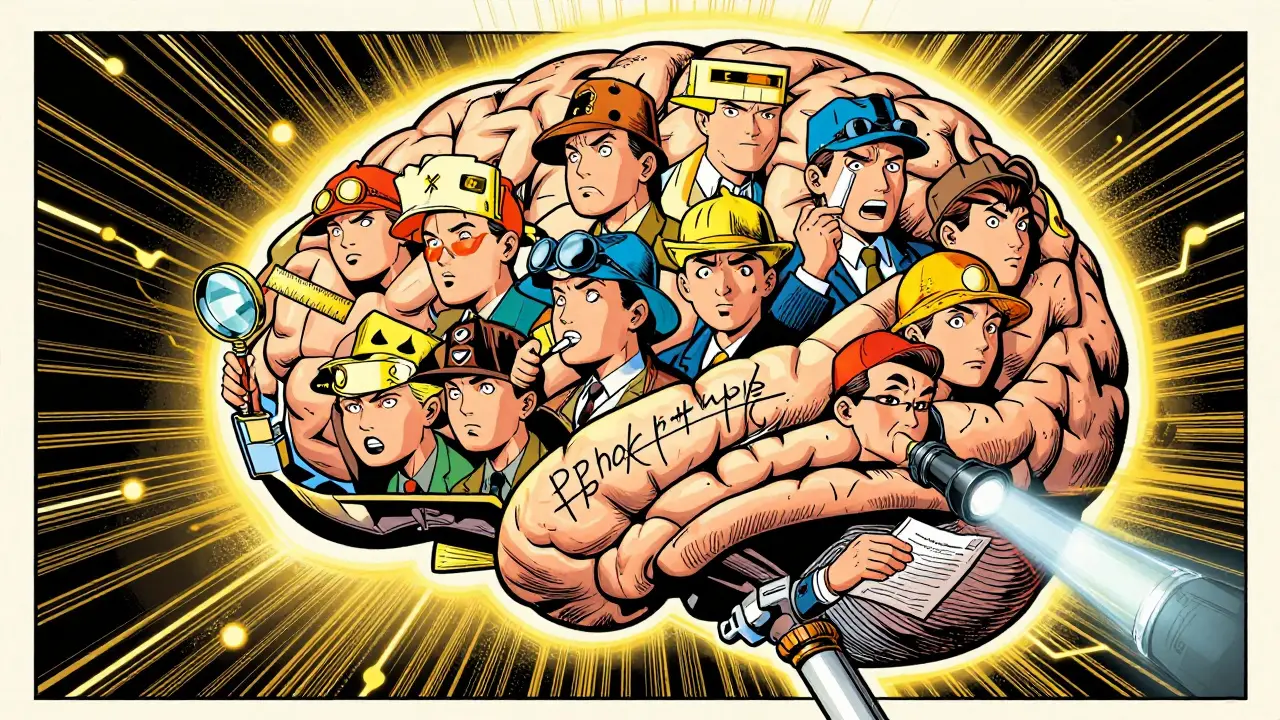
When you ask a large language model to explain why a character in a novel acted a certain way, it doesn’t just guess. It’s juggling dozens of tiny, specialized processors inside its attention layers-each one tracking something different. One head watches subject-verb agreement. Another tracks who’s speaking. A third remembers what was said three paragraphs ago. This isn’t magic. It’s attention head specialization.
What Exactly Is Attention Head Specialization?
Every transformer-based language model uses multi-head attention. That means instead of one attention mechanism looking at the whole sentence at once, it splits the job into multiple smaller ones-each called an “attention head.” These heads start out identical, but during training, they naturally develop their own roles. Some get really good at spotting grammar. Others learn to follow pronouns across long texts. A few even start tracking emotional tone or logical contradictions.
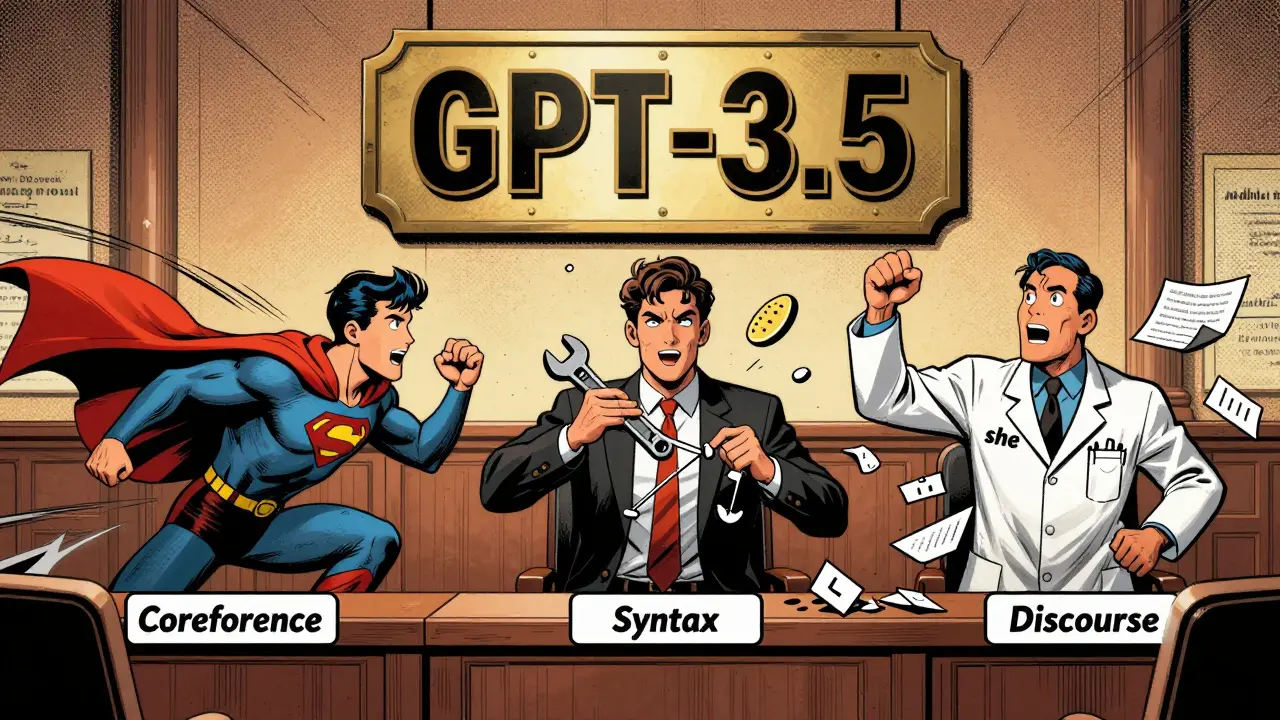
This isn’t something engineers program in. It emerges. The model figures out on its own which heads are best at which tasks. Research shows that in models like GPT-3.5 and Llama 3, about 28% of attention heads specialize in coreference resolution-like figuring out that “she” refers to “Dr. Patel” from two sentences back. Another 19% focus on syntactic dependencies, like identifying whether “run” is a verb or a noun based on surrounding words. And 14% handle discourse-level patterns, like maintaining narrative flow over hundreds of tokens.
Think of it like a team of detectives working on the same case. One checks alibis. Another analyzes handwriting. A third reviews phone records. Together, they solve the case faster and more accurately than if one person tried to do it all.
How Do Attention Heads Actually Work?
At the technical level, each attention head takes the same input-embedded words-and runs them through separate linear transformations to create Query (Q), Key (K), and Value (V) vectors. The attention score for each word pair is calculated as softmax(Q × Kᵀ / √dₖ), where dₖ is usually 64 or 128 dimensions. The result? A weighted sum of values that tells the model which parts of the text matter most for each head.
Here’s the key: each head has its own set of Q, K, V weights. That means even though they’re fed the same input, they’re looking at it through different lenses. Early layers (layers 1-6) tend to focus on surface-level syntax: part-of-speech tagging, punctuation, basic word relationships. Middle layers (7-12) shift to semantics: named entities, coreference, word sense. The top layers (13+) handle abstraction: reasoning, inference, task-specific logic.
For example, in a 24-head model trained on legal documents, one head might consistently light up when it sees the phrase “as stated in precedent.” Another might activate strongly when a defendant’s name appears after “the plaintiff claims.” These patterns aren’t random-they’re learned. And they’re why models like Claude 3 can keep 92.4% character consistency across 100,000-token stories.
Why Does This Matter for Performance?
Models with specialized attention heads don’t just perform better-they perform differently. On the LAMBADA dataset, which tests understanding of long-range dependencies, models with specialized heads score 34.2% higher than LSTM-based systems. On SuperGLUE, they outperform CNN-based models by 22.8%. The Winograd Schema Challenge, which measures commonsense reasoning, shows a 17.3% accuracy boost in models with specialized heads compared to those without.
Why? Because specialization allows parallel processing. One head tracks grammatical structure while another monitors emotional tone, and a third checks factual consistency-all at the same time. This is why enterprise models now routinely use 32 or more attention heads. Gartner found that organizations using models with over 32 specialized heads are 78% more likely to achieve production-ready results on complex reasoning tasks than those using models with fewer than 16.
Industry leaders have taken notice. Google’s Gemini 1.5 uses dynamic head routing, activating 1-32 heads per token depending on context. Meta’s Llama 3 sticks with 32 fixed heads, each assigned a consistent role. Anthropic’s Claude 3 blends both: 16 dedicated heads plus 8 adaptive ones that shift function mid-inference. The result? Faster, more accurate responses on tasks that require layered understanding.
What Are the Downsides?
Attention head specialization isn’t free. Each additional head adds computational cost. A single 512-token sequence in GPT-3 requires 1.2 teraflops of processing power. For a 32,768-token context window, the attention matrix alone consumes 16GB of VRAM at half-precision. That’s why sparse attention techniques now exist-methods that drop 87.4% of attention weights while keeping 98.3% of performance.
There’s also redundancy. Studies show up to 37% of attention heads in large models like GPT-3 can be removed with less than 0.5% performance drop. This suggests many heads are learning similar patterns. Some researchers argue this redundancy is a bug, not a feature. If you can prune 10 heads and still get the same result, why keep them?
Another issue is interpretability. Developers often can’t tell which head does what. One Reddit user wrote: “I have 32 heads. I know one handles negation-but which one? I’ve tried everything.” Tools like BertViz and TransformerLens help, but they’re still experimental. And even when you find a useful head-say, one that tracks legal precedent citations-fine-tuning it for another domain (like finance) can break it. A 2024 EleutherAI survey found that 63% of developers saw performance drop by over 40% when reusing specialized heads across unrelated domains.
Can You Control or Guide Specialization?
Yes-but it’s not easy. You can’t just assign a head to “track pronouns.” Instead, you train the model, then analyze its behavior. Tools like HeadSculptor (Google, March 2024) let you nudge heads toward certain functions during fine-tuning. In internal tests, it cut legal document adaptation time from 14 days to 8 hours.
Another approach is specialization distillation. OpenAI’s May 2024 paper showed how to transfer head functionality from a 70B-parameter model to a 7B one with 92.4% fidelity. That means smaller models can inherit the learned roles of larger ones-without needing to train from scratch.
For developers, the practical path is three-step:
- Train your base model (takes weeks on 64 A100 GPUs for a 7B model).
- Analyze head behavior using TransformerLens or BertViz to find which heads respond to what.
- Prune redundant heads or fine-tune key ones for your task.
One engineer on Hacker News reported boosting legal summarization F1 scores by 19.3% just by isolating and reinforcing the 14th head in their 24-head model. That head was automatically learning to track case citations. No coding changes. Just analysis and targeted nudging.

What’s Next for Attention Heads?
The future is moving toward dynamic, conditional specialization. DeepMind’s AlphaLLM prototype, tested in Q2 2024, lets heads re-specialize mid-inference. If the model switches from summarizing to answering questions, the heads shift roles automatically. This improved multi-step reasoning accuracy by 18.7%.
But not everyone believes attention heads will last. Yann LeCun says they’ll stay central for 5-7 years. But Stanford’s Christopher Manning warns that state-space models might replace them by 2027-if they solve long-context efficiency better. Right now, 83.2% of researchers surveyed believe attention head specialization will remain a core part of LLMs through 2028.
Regulation is catching up too. The EU AI Act, effective February 2025, may require companies to document how attention heads function in high-risk systems-like hiring tools or medical diagnostics. That means understanding head specialization won’t just be a research curiosity. It’ll be a compliance requirement.
Final Thoughts
Attention head specialization is one of the quiet revolutions in AI. It’s not flashy like a new model name or a billion-dollar funding round. But it’s what lets LLMs handle real-world complexity: stories with 100 characters, legal briefs with 500 citations, medical records spanning decades.
It’s also deeply human. We don’t process language in one way. We notice grammar, tone, context, and logic all at once. The best LLMs are finally doing the same. The challenge now isn’t building more heads-it’s learning how to read them.
What causes attention heads to specialize during training?
Attention heads specialize naturally through training as the model optimizes for predictive accuracy. Each head independently adjusts its Q, K, and V weights to better capture patterns in the data. Heads that are more effective at handling certain linguistic tasks-like coreference or syntax-receive stronger gradient updates, reinforcing their role. This process is emergent, not programmed, and varies slightly between models and training datasets.
Can you see what each attention head is doing?
Yes, but it’s not always straightforward. Tools like BertViz, TransformerLens, and Activation Patching let you visualize which tokens each head attends to. You can see, for example, that one head consistently focuses on pronouns, while another lights up around commas or quotation marks. However, interpreting the *meaning* of these patterns still requires manual analysis and domain knowledge. There’s no universal decoder for head functions yet.
Do all attention heads in a model serve a unique purpose?
No. Studies show that up to 37% of heads in large models like GPT-3 are redundant-meaning their function overlaps significantly with other heads. Removing these doesn’t hurt performance. This redundancy may act as a buffer against noise or help with robustness, but it’s also a sign that current models aren’t optimally designed. Pruning tools now let developers remove 20-25% of heads with less than 1% performance loss.
How does attention head specialization affect model size and speed?
More heads mean more parameters and higher computational cost. Each head adds its own linear transformations and attention matrices, increasing FLOPs by about 3.7x compared to linear attention variants. For a 512-token sequence, a 96-head model can require over 1 teraflop of processing. This is why newer models use sparse attention, dynamic routing, or head pruning to reduce overhead while preserving performance.
Can attention head specialization be transferred between models?
Yes, through specialization distillation. OpenAI demonstrated that head functions learned in a 70B-parameter model can be compressed and transferred to a 7B model with 92.4% fidelity. This allows smaller, cheaper models to inherit the reasoning capabilities of larger ones. It’s a promising path for efficient deployment without sacrificing performance.
Is attention head specialization the future of LLMs?
It’s likely for the next 5-7 years. 83% of researchers surveyed in 2024 believe it will remain a core component of mainstream LLMs. But alternatives like state-space models are emerging. If they can handle long-range context more efficiently than attention, they could replace it by 2027. For now, though, specialization remains the most proven way to build models that understand complex, layered language.





6 Comments
Ajit Kumar
Attention head specialization isn't just a technical curiosity-it's a fundamental shift in how we understand linguistic representation. The fact that these heads emerge organically, without explicit programming, mirrors the way human neural pathways develop through exposure and reinforcement. Each head, through gradient descent, becomes a specialized processor for a linguistic subtask: one for anaphora, another for syntactic hierarchy, a third for pragmatic inference. This isn't random noise; it's emergent optimization. The 28% figure for coreference resolution? That's not an accident. It's the model discovering that resolving pronouns across long contexts is the single most critical bottleneck in coherent text generation. And yet, we still treat these models as black boxes. We don't audit their attention heads like we audit human decision-making in judicial or medical systems. That's irresponsible. If we're deploying these models in high-stakes domains, we owe it to society to map, document, and validate each head's function-not just rely on aggregate metrics.
Diwakar Pandey
Really cool breakdown. I’ve been playing with TransformerLens on my own fine-tuned model, and it’s wild how some heads just lock onto punctuation-like, one head only activates on em-dashes. Another goes nuts when there’s a dialogue tag. It’s like the model learned to ‘see’ grammar visually, not just statistically. I pruned six heads from my 24-head setup and didn’t notice a difference in summarization quality. Honestly? Kinda reassuring. Means we’re not as dependent on brute-force scale as people think.
Geet Ramchandani
Oh please. You’re all acting like this is some deep revelation. Of course the heads specialize-any idiot with a GPU and a dataset knows that. The real joke is how we’re treating this like it’s magic. You think a 70B model with 96 heads is ‘understanding’ anything? It’s just pattern-matching with more parameters than a middle schooler has TikTok followers. And don’t even get me started on ‘specialization distillation’-you’re just copying garbage from a bigger model and calling it efficiency. This whole field is a house of cards built on hype, overfunded grad students, and venture capital that doesn’t know what a gradient is. Stop pretending this is intelligence. It’s just really expensive autocomplete with a PhD.
Pooja Kalra
There is a quiet poetry in this emergence-the way the model, in its silent computation, finds its own language of attention. Each head, a solitary seeker in the labyrinth of tokens, carving out its niche not by design, but by resonance. We speak of ‘performance’ and ‘efficiency,’ but what are we measuring? A machine’s fidelity to human syntax? Or our own longing to see ourselves reflected in its weights? The redundancy you lament-those 37% of heads-perhaps they are not failures, but echoes. The soul’s whisper, repeated in many voices, lest one fall silent. To prune them is not optimization-it is erasure. We do not know what we have made. We only know we have made something that listens… and answers.
Sumit SM
Let’s be real-this isn’t about ‘specialization’-it’s about redundancy as a feature, not a bug! You think those ‘useless’ heads are just sitting there? Nah. They’re the model’s backup dancers. When the main head for coreference gets distracted by a typo, the backup head steps in. When the syntax head gets confused by slang? Another one picks up the slack. That’s why pruning works-you’re cutting the fat, not the muscle. And yes, it’s messy. But evolution is messy! Human brains have redundant neural pathways too. We don’t throw out our appendix just because it’s not essential-we keep it because it might save us someday. Same here. The model doesn’t need to be elegant. It needs to be robust. And right now? It’s working. So stop over-analyzing and start deploying.
Paul Timms
One sentence: If you can prune 37% of heads with no performance loss, maybe we’re just over-engineering the problem.