
Generative AI isn’t just another tool-it’s a force that can rewrite how businesses operate, communicate, and decide. But with great power comes great risk. A single hallucinated response in a customer service chatbot, a biased hiring algorithm, or an untracked model leaking sensitive data can cost millions and destroy trust overnight. The companies that thrive aren’t the ones using AI the loudest-they’re the ones governing it the smartest. By early 2026, generative AI governance has moved from a nice-to-have to a non-negotiable pillar of any serious AI strategy.
Why Governance Isn’t Just About Rules
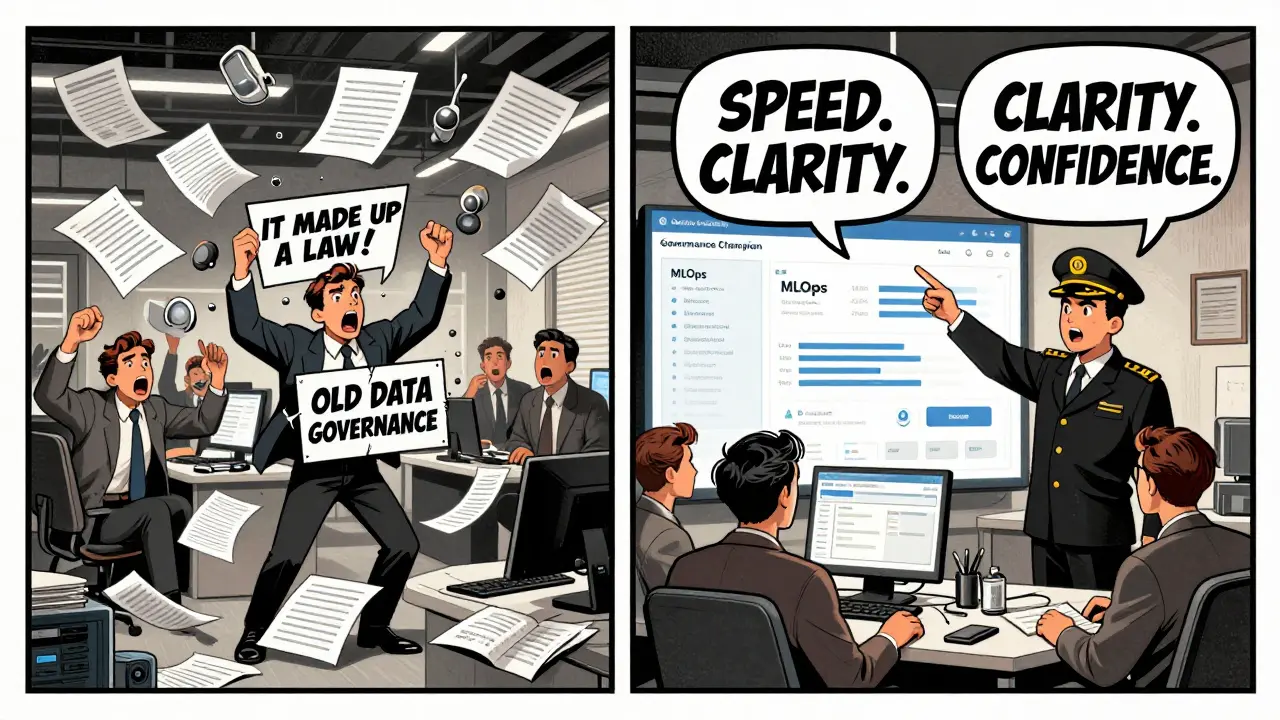
Most people think governance means red tape. It doesn’t. It means clarity. It means speed. It means confidence.
Think of it like seatbelts in a sports car. You don’t wear them to slow down-you wear them so you can push the limits without crashing. That’s what modern AI governance does. Companies using strong governance frameworks aren’t stuck in meetings. They’re deploying models 4.7 times faster than those clinging to outdated data governance systems, according to Mirantis’ 2026 benchmarking study. Why? Because governance removes guesswork. It tells engineers exactly what’s allowed, what’s monitored, and what happens if something goes wrong.
The EU AI Act’s January 2026 enforcement deadline forced a reckoning. Suddenly, every company selling AI in Europe had to prove their models were safe, transparent, and auditable. But it wasn’t just Europe. IBM’s 2025 Cost of a Data Breach report showed companies without governance faced average losses of $4.2 million per incident. That’s not a risk you can ignore.
The Four Technical Pillars of AI Governance
Building governance isn’t about buying software. It’s about building systems. VisioneerIT’s March 2025 framework breaks it down into four non-negotiable layers:
- Automated Deployment Pipelines with Governance Checks - Every model update must pass automated tests for bias, data drift, and security before going live. 68% of Fortune 500 companies now use this. No exceptions.
- Version Control and Audit Trails - You need to know which version of a model was used, when it was trained, and on what data. Financial firms rely on this for compliance. 92% say it’s critical.
- Real-Time Monitoring - Leading systems track up to 15,000 data points per second. They watch for performance drops, unexpected outputs, or sudden spikes in user complaints. Alerts trigger in minutes, not days.
- Secure Model Serving - Zero-trust architectures are now standard. Access is granted only when needed, and every request is logged. Early adopters saw unauthorized access incidents drop by 73%.
These aren’t optional. They’re the baseline. Skip one, and you’re gambling.
How It’s Different from Old-School Data Governance
Traditional data governance was about clean tables and proper labels. Generative AI governance? It’s about controlling chaos.
Old systems couldn’t handle:
- Model hallucinations - where the AI invents facts that sound real
- Prompt injection attacks - hackers tricking models into revealing secrets or doing harmful things
- Dynamic content - every output is unique, so you can’t just check a spreadsheet
That’s why adapting legacy systems fails. Credo AI’s January 2026 report found companies using AI-native tools achieved 3.2x higher ROI. Why? Because they built governance into the workflow, not bolted it on later. Goldman Sachs cut AI project delivery time by 29% after shifting from “governance as barrier” to “governance as accelerator.”
The Three Most Effective Governance Models
Not all governance looks the same. Based on Keyrus’ January 2026 analysis, three models dominate:
- Model Risk Management (MRM) - Used by 79% of top financial institutions. It treats AI models like financial instruments-high-risk, high-reward, and always under audit.
- Data Quality and Governance for ML - 63% of healthcare firms use this to meet HIPAA. It’s not just about data accuracy-it’s about ensuring training data doesn’t reflect racial, gender, or age bias.
- MLOps with Continuous Monitoring - 88% of tech companies rely on this. It’s the integration of development, operations, and real-time oversight into one loop. No delays. No surprises.
Choose one. Don’t try to do all three at once. Start where your biggest risks are.
Who Owns It? The Roles That Make It Work
AI governance fails when no one owns it. VisioneerIT’s data shows clear roles are the difference between chaos and control:
- Data Stewards - One per 3-5 business units. They know the rules and answer questions on the ground.
- Data Architects - One per 10-15 AI projects. They design the pipelines and ensure governance is baked in.
- Data Governance Council - At least 7 people from legal, IT, compliance, ethics, and business. They meet every two weeks. No exceptions.
- Embedded Data Specialists - One per AI team. They’re the bridge between engineers and governance.
Unilever scaled this across 200+ business units. They didn’t centralize control-they distributed ownership. Result? An 82% drop in compliance incidents in 2025.
The Hidden Costs of Poor Governance
It’s not just fines. It’s lost time, damaged reputation, and stalled innovation.
G2 Crowd reviews from December 2025 show mid-sized companies struggling. One user wrote: “The $250,000 annual cost of enterprise tools is too high. We’re patching together open-source tools-and it’s creating more work.”
Other pain points? According to Capterra’s Q4 2025 survey:
- 78% say integrating governance into workflows is too complex
- 63% don’t know who’s responsible
- 57% can’t prove ROI
That’s why “governance champions” work. These are respected engineers or product leads who advocate for governance within their teams. Early adopters saw pushback drop by 45%. People don’t resist rules-they resist being treated like obstacles.
What’s Next? The Future of AI Governance
By 2027, Gartner predicts:
- 60% of governance frameworks will use AI assistants to interpret policies and auto-generate compliance reports
- 45% will simulate regulatory scenarios to test how models behave under new laws
- 85% of AI projects will need formal governance approval before deployment
That’s not science fiction. It’s happening now. The EU AI Act already requires SHAP values (a method to explain model decisions) for high-risk systems. NIST’s AI Risk Management Framework (1.1, updated Oct 2025) is now the standard for 74% of organizations.
Dr. Sarah Chen of Microsoft says companies without governance have “blind spots that become existential threats in 18 months.” That’s not a warning-it’s a timeline.
Where to Start Today
You don’t need a $10 million budget. You need clarity.
Here’s your first step:
- Map your top three AI use cases. Which one carries the highest risk? (Customer service? HR screening? Medical triage?)
- Choose one governance model that fits: MRM, ML Data Governance, or MLOps.
- Assign one person to own it-no committee, no “we’ll figure it out later.”
- Build one automated check into your deployment pipeline. Maybe it’s a bias test. Maybe it’s a data lineage check.
- Measure for 30 days. Did it slow you down? Or did it make you faster?
Companies that treat governance as a constraint are already falling behind. The winners are the ones who see it as the engine that lets them move faster, safer, and smarter.
What’s the difference between AI governance and traditional data governance?
Traditional data governance focuses on structured data quality, access control, and compliance for databases. Generative AI governance goes further-it manages unpredictable outputs, hallucinations, prompt injection risks, dynamic content, and real-time model behavior. It’s not just about the data-it’s about the behavior of the AI system itself.
Do small businesses need AI governance too?
Yes-even if you’re not a Fortune 500 company. If you’re using generative AI to interact with customers, make hiring decisions, or generate content, you’re exposed to legal, ethical, and reputational risks. The cost of tools can be high, but the cost of a single bad output can be higher. Start small: document your use case, assign one person to oversee it, and build one automated check into your workflow.
Is NIST AI RMF 1.1 mandatory?
No, it’s not legally mandatory-but it’s the de facto global standard. 74% of organizations use it as their foundation because it’s comprehensive, flexible, and aligned with regulations like the EU AI Act. If you’re building governance from scratch, NIST is your best starting point.
How long does it take to implement AI governance?
For mature organizations with existing data teams, it typically takes 6-9 months. Financial services firms average 7.2 months. The timeline depends on how many AI projects you’re running, how complex your workflows are, and whether you’re building from scratch or adapting existing systems. Don’t rush it-focus on one high-risk area first.
What tools are best for AI governance?
There’s no single “best” tool. Market leaders include IBM OpenScale (18% market share), Credo AI (12%), and cloud-native platforms from AWS (15%), Azure (14%), and Google Cloud (11%). The best tool depends on your industry, scale, and existing tech stack. Start by evaluating what your top risk requires-not what’s trending.
Generative AI is here to stay. The question isn’t whether you’ll use it. It’s whether you’ll govern it well enough to survive-and thrive-with it.



5 Comments
Nalini Venugopal
Okay but let’s be real-governance isn’t sexy, and no one wants to hear about audit trails until something blows up. I’ve seen teams skip the MLOps checks because ‘we’re moving fast.’ Then one day, a customer gets a racist reply from a chatbot trained on Reddit threads. Boom. PR nightmare. The magic isn’t in the tools-it’s in the culture. Someone has to care enough to say ‘no’ even when the devs are sweating deadlines. That’s the real MVP.
Pramod Usdadiya
agree with nalini. but i think we’re overcomplicating this. in india, most startups just use gpt-4 and call it a day. governance? we dont even have a proper data policy for our crm. but hey, if a model hallucinates and tells a user ‘your loan is denied because you’re from rural up’-well, that’s just bad luck right? 😅
Aditya Singh Bisht
Love this post. Seriously. It’s like someone finally said what we’ve all been whispering in Slack. Governance isn’t a wall-it’s a trampoline. The more structure you build, the higher you bounce. I’ve seen teams go from 3-week deployment cycles to 3 days just by adding one automated bias check. No magic. Just discipline. And guess what? They’re happier. Less fire drills. More innovation. You think you’re slowing down? Nah. You’re unlocking speed. Trust me-I’ve been there. Start with one thing. Just one. Then another. Then you’ll wonder why you waited so long.
Agni Saucedo Medel
My team just rolled out automated data lineage checks last month. 🚀 3 weeks in and we’ve already caught 4 drift issues before they hit prod. One was a model that started generating ‘urgent financial advice’ based on memes from 2021. 😱 We didn’t need a fancy tool-just a simple script that flagged outliers. Governance doesn’t have to cost millions. Just start small. And assign ONE person. No committees. Just one person who says ‘stop’ when things get weird. Also-thank you for mentioning embedded specialists. We have one. She’s a hero.
ANAND BHUSHAN
Just do the bias test. That’s all you need to start.