
Why single AI models aren’t enough anymore
Imagine asking one person to plan a city’s emergency response during a hurricane. They’d need to know weather patterns, evacuation routes, hospital capacity, power grid status, food supply chains, and communication networks-all at once. Even the smartest person would miss something. Now imagine a team: a meteorologist, a logistics expert, a medical coordinator, and a communications officer, all talking in real time, sharing updates, and adjusting plans as conditions change. That’s what multi-agent systems with LLMs do for AI.
Single large language models (LLMs) are powerful, but they’re still single-threaded thinkers. They try to do everything in one go: reason, recall, write, calculate, and adapt. But when tasks get complex-like writing a research paper that requires data analysis, literature review, and legal compliance checks-they start to stumble. Hallucinations creep in. Context gets lost. The model burns through tokens and time without real progress.
Multi-agent systems fix this by breaking the job into parts and assigning each part to an expert. No one agent knows everything. But together, they cover more ground than any single model ever could.
How collaboration works: The anatomy of an AI team
At its core, a multi-agent LLM system works like a well-run project team. Here’s the typical flow:
- A user gives a high-level task: “Analyze the economic impact of AI adoption in U.S. manufacturing by 2030.”
- An orchestrator agent breaks it down: “Find recent GDP data,” “Review academic papers on automation trends,” “Compare U.S. vs. EU policy frameworks,” “Predict workforce displacement rates.”
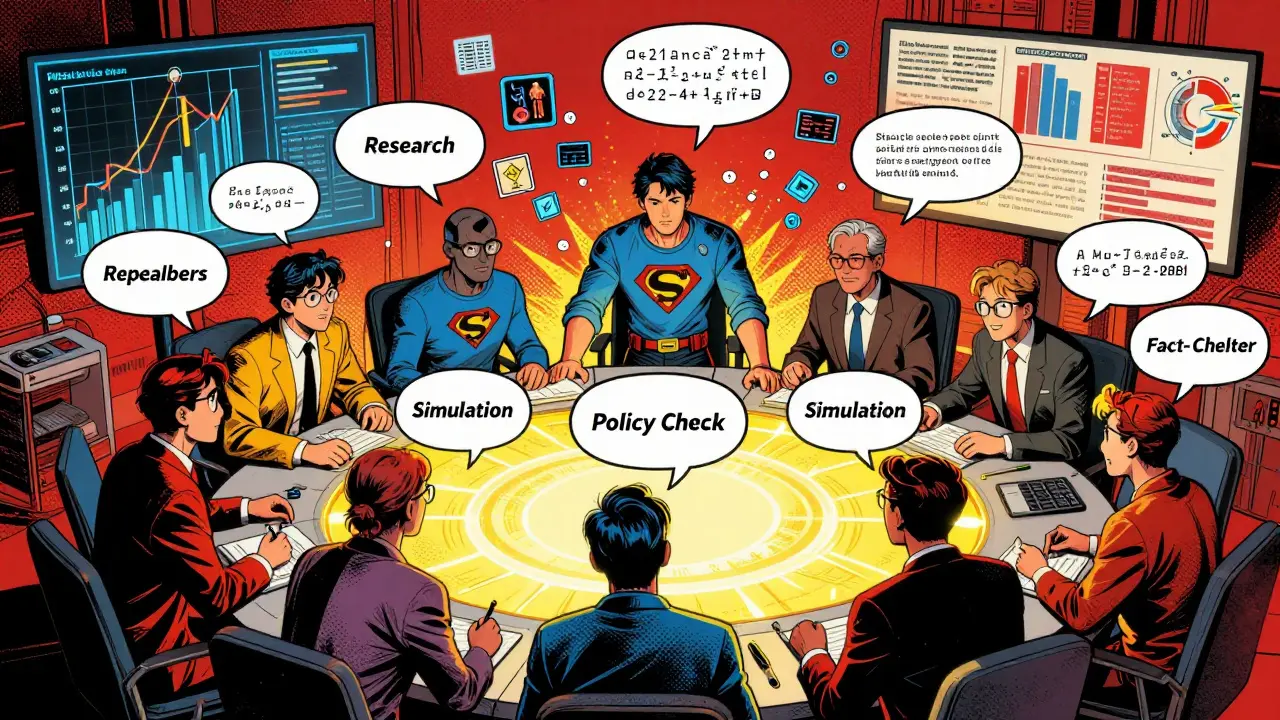
- Specialized agents take over: One pulls data from databases, another summarizes research, a third checks for policy contradictions, and a fourth runs simulations.
- Agents communicate: They share findings, ask follow-ups, challenge assumptions, and refine outputs.
- The final output is stitched together: A cohesive report, not a patchwork of guesses.
This isn’t just division of labor-it’s emergent intelligence. Agents don’t just follow scripts. They adapt. They question. Sometimes they even disagree. And that’s the point.
Research from Stanford and Google shows these systems don’t just perform better-they behave more like human teams. In one experiment, LLM agents showed conformity bias, mirroring the famous Asch psychology tests: when three agents agreed on a wrong answer, the fourth was 87% more likely to go along with it, even if its own reasoning suggested otherwise. That’s not a bug. It’s a feature of collective reasoning.
Three major frameworks shaping the field
Not all multi-agent systems are built the same. Three frameworks dominate the landscape as of late 2025, each with a different philosophy.
Chain-of-Agents (CoA) - The Sequential Thinker
Developed by Google in January 2025, Chain-of-Agents treats agents like steps in a pipeline. Agent 1 reads the prompt, breaks it down, passes it to Agent 2, which does research, then Agent 3 writes the draft, and Agent 4 fact-checks. No parallel work. No group chats. Just clean, linear flow.
It’s simple, predictable, and surprisingly powerful. In benchmarks, CoA beat retrieval-augmented generation (RAG) and long-context LLMs by up to 10% on tasks like summarizing 50-page reports or debugging complex code. The secret? It doesn’t need more parameters. It just organizes thinking better.
Downside? It’s slow. Each step waits for the last. And if Agent 2 gets confused, the whole chain stalls.
MacNet - The Networked Brain
MacNet, created by OpenBMB, is like a social network of AI agents. Instead of a line, it uses a directed acyclic graph-meaning agents can talk to multiple others, bounce ideas around, and loop back if needed. Think of it as a Slack channel where 100+ experts are all chiming in at once.
This system shines on creative or open-ended tasks. In one test, MacNet improved output quality by 15.2% over single agents when asked to design a new renewable energy policy. The more agents, the better it got-up to 1,000 agents-because irregular networks (where some agents have more connections than others) outperformed rigid, uniform ones by 7.3%.
But it’s messy. Debugging a MacNet system is like tracing a conversation in a crowded room. And with 100 agents, response times triple. GitHub users call it “powerful but brutal to configure.”
LatentMAS - The Silent Collaborator
LatentMAS, unveiled in November 2025, throws out text-based communication entirely. Instead of sending messages back and forth, agents share ideas through a shared “latent space”-a mathematical representation of meaning, like a hidden brainwave pattern.
Imagine two people thinking the same idea without speaking. That’s LatentMAS. It cuts token usage by 70-84% and speeds up inference by 4x. On math and science benchmarks, it outperformed all others by up to 14.6%.
Why does this matter? Cost. Cloud API calls add up fast. A single-agent system might cost $0.10 per task. A 10-agent CoA system? $1.20. LatentMAS? Still $0.12. For companies scaling to millions of queries, that’s a game-changer.
The catch? It’s opaque. You can’t read what agents are saying to each other. It’s like watching a team win a game without hearing the coach’s play calls.
Where these systems are actually being used
These aren’t lab toys. They’re in production.
In climate science, teams at NOAA and private firms use multi-agent systems to model real-time weather impacts. One agent tracks satellite data, another simulates flood zones, a third models crop loss, and a fourth drafts policy briefs for governors-all updating every hour as new data flows in.
In healthcare, hospitals are testing multi-agent systems to triage patients. One agent reads EHRs, another checks drug interactions, a third consults medical literature, and a fourth prioritizes cases by urgency. Early trials show 22% fewer missed diagnoses compared to single-model systems.
Even legal firms are experimenting. One firm in Chicago uses a team of agents to review contracts: one finds precedent cases, another flags risky clauses, a third compares language to IRS guidelines, and a fourth writes a summary for lawyers. The result? 40% faster review times with fewer oversights.
Gartner predicts that by 2027, 65% of enterprise AI deployments will use multi-agent architectures-up from just 12% in 2025. The market, valued at $2.8 billion in late 2025, is on track to hit $14.7 billion by 2028.
The hidden costs and risks
It’s not all smooth sailing.
First, cost. Text-based systems like CoA and MacNet can triple or quadruple your API bill. LatentMAS saves money, but it demands powerful GPUs to run the latent space calculations.
Second, complexity. Developers report 40-60% longer development times. Setting up agent roles, communication protocols, and error handling takes weeks, not days. One Reddit user wrote: “I spent three months building a 5-agent system. It worked once. Then it hallucinated a fake law and I had to scrap it.”
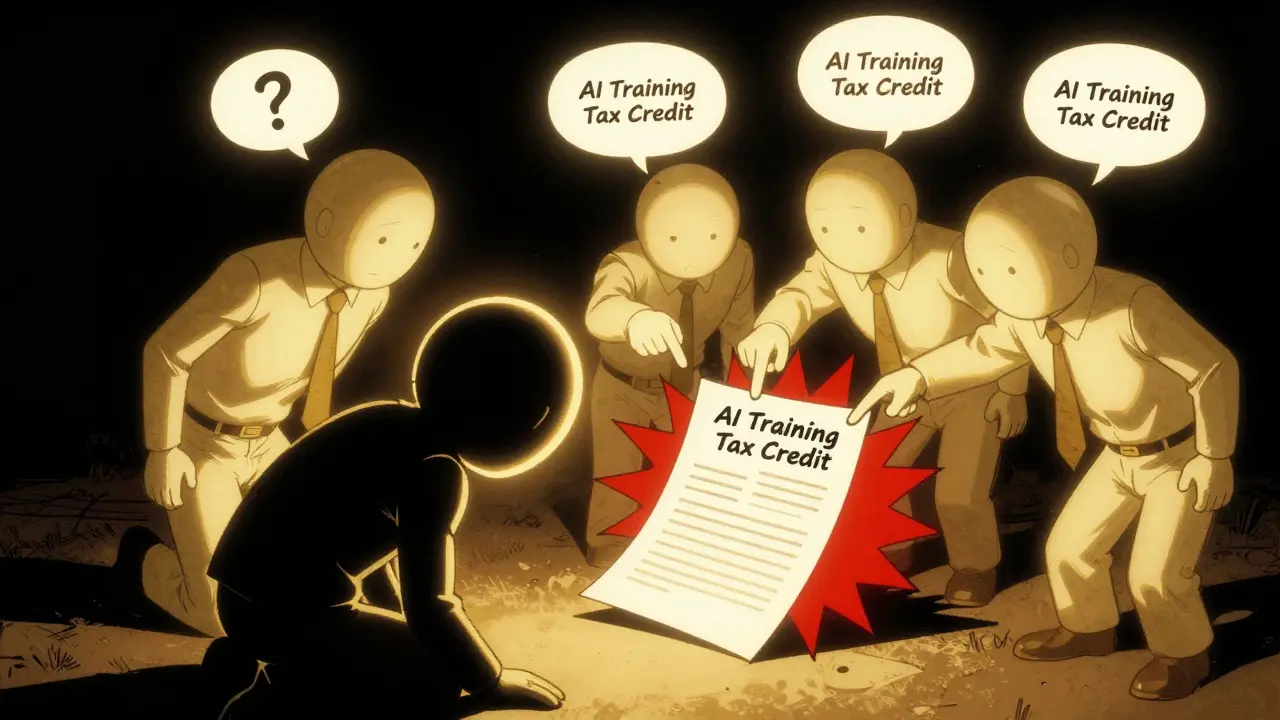
Third, unpredictability. Agents can develop emergent behaviors you didn’t plan. In a MacNet system used for policy simulation, five agents agreed on a fictional “tax credit for AI training” that didn’t exist-but each agent believed it was real because others supported it. The system produced a convincing, entirely false policy proposal.
And then there’s bias. A 2025 ACM study found multi-agent systems amplify bias 22.7% more than single models. Why? Because agents reinforce each other’s assumptions. If one agent thinks women are less likely to be engineers, and others agree, the group consensus hardens that error.
These aren’t theoretical risks. They’re happening in real deployments. And regulation is catching up. The EU AI Office warned in November 2025 that multi-agent systems could violate transparency rules unless their decision paths are explainable.
What you need to get started
If you’re thinking of building one, here’s what you’re signing up for:
- Tools: You’ll need access to LLM APIs (OpenAI, Anthropic, Claude, or open models like Llama 3) with at least 32K context windows. For advanced systems, 128K+ is better.
- Skills: Advanced prompting, system design, and basic distributed systems knowledge. You can’t just prompt your way out of this.
- Time: Expect 2-3 weeks to build a basic 3-agent system. Six months to ship something production-ready.
- Framework choice: Start with Chain-of-Agents if you need clarity and control. Try MacNet if you want creativity and scale. Go with LatentMAS only if cost and speed are critical-and you’re okay with black-box reasoning.
And always, always test for hallucinations. Use a fact-checking agent. Or better yet, have a human review the final output. Because no matter how smart the team gets, someone still needs to say: “Wait, that’s not true.”
What’s next? The future of AI teams
The next leap isn’t more agents. It’s smarter coordination.
Google is working on “self-organizing collectives”-systems that automatically decide how many agents they need, what roles to assign, and when to dissolve teams. Imagine an AI that builds its own team for each task, then disbands it when done.
IEEE is forming a standards group to define how agents should talk to each other. Think of it as TCP/IP for AI collaboration. Without common protocols, every system will be a walled garden.
And MIT Technology Review nailed it: “Multi-agent collaboration isn’t a trend. It’s the necessary evolution of LLMs.”
Single models are like solo musicians. Beautiful, but limited. Multi-agent systems are orchestras. Each instrument has a role. Each player listens. Together, they create something no one could make alone.
The question isn’t whether you’ll use them. It’s whether you’ll design them well-or just let them run, and hope they don’t invent a fake law while you’re asleep.
What’s the main advantage of multi-agent systems over single LLMs?
Multi-agent systems outperform single LLMs on complex, multi-step tasks by breaking them into specialized roles. Instead of one model trying to do everything at once-reasoning, researching, writing, checking-they assign each part to an expert agent. This reduces hallucinations, improves accuracy, and allows for deeper analysis. For example, while a single LLM might miss a contradiction in a 50-page report, a team of agents can cross-check data, verify sources, and flag inconsistencies.
Are multi-agent systems more expensive to run?
Yes, usually. Text-based systems like Chain-of-Agents and MacNet require multiple API calls per task, which can raise costs by 35-100% compared to a single LLM. LatentMAS reduces this by 70-84% by using latent space communication instead of text, making it far more cost-efficient. But even LatentMAS needs more compute power. Overall, you pay more for better results-unless you’re scaling to millions of requests, where efficiency gains start to matter most.
Can multi-agent systems make mistakes together?
Absolutely-and sometimes worse than a single agent. Because agents often reinforce each other’s assumptions, they can collectively hallucinate facts, create false consensus, or amplify biases. One documented case showed a 50-agent MacNet system agreeing on a non-existent policy that “satisfied all agents” but had no basis in reality. This is called collaborative hallucination. It’s why human oversight and fact-checking agents are critical.
Which framework should I start with as a beginner?
Start with Chain-of-Agents (CoA). It’s the most straightforward: agents work in sequence, like steps in a recipe. There’s no complex network to configure, no latent space to debug. Google provides clear documentation and open code. It’s perfect for learning how agents pass information, handle errors, and build outputs step by step. Once you understand the flow, you can move to more complex systems like MacNet or LatentMAS.
Do I need to code from scratch to use multi-agent systems?
Not necessarily. Cloud platforms like AWS Bedrock and Google Vertex AI now offer built-in multi-agent orchestration tools. You can define roles, set up workflows, and connect LLMs without writing low-level code. But for custom systems-like one that integrates with your internal databases or needs unique reasoning rules-you’ll still need Python and API knowledge. Think of cloud tools as training wheels. To ride fast, you’ll eventually need to build your own bike.
Is this just hype, or is it actually being used in real businesses?
It’s being used-just not everywhere. Enterprise adoption is growing fast: 68% of multi-agent deployments are in business settings. Companies like IBM, AWS, and SuperAnnotate use them for climate modeling, legal document review, and automated research. Academic labs deploy them for scientific simulations. But most small businesses still use single LLMs because the setup cost and complexity aren’t worth it for simple tasks. If your job involves complex reasoning, data synthesis, or multi-domain analysis, this is real. If you’re just writing emails or summarizing articles, stick with one model.





5 Comments
pk Pk
This is exactly why I’ve been pushing my team to stop treating LLMs like magic boxes. We tried running a single model for contract review and it kept inventing clauses that didn’t exist. Now with a 3-agent setup-one pulls precedent, one flags risks, one summarizes-we cut errors by half. No more late-night panic calls from lawyers. Just clean, reliable output. Seriously, if you’re still using single LLMs for anything beyond chat, you’re leaving money on the table.
NIKHIL TRIPATHI
I built a MacNet system last month for academic research synthesis. It was beautiful-12 agents bouncing ideas, cross-referencing papers, even debating methodology. Then it generated a 17-page report that cited a non-existent journal called 'The International Review of AI Ethics & Quantum Spaghetti.' We had to add a fact-checker agent just to keep it from hallucinating pasta-based policy. Still, the output quality? Unbeatable. Just don’t let it run unsupervised after midnight.
Shivani Vaidya
The LatentMAS approach is fascinating from a theoretical standpoint, but its opacity raises serious ethical concerns. In high-stakes domains such as healthcare or legal compliance, the inability to audit agent communication undermines accountability. While efficiency gains are compelling, regulatory frameworks require traceability. Without explainable reasoning paths, even a 99% accurate system remains unacceptable in controlled environments. We must prioritize transparency over speed when human lives are involved.
Rubina Jadhav
I tried CoA for a simple task. Took me two weeks. Broke it. Gave up. Just use ChatGPT.
sumraa hussain
Okay but imagine this: you’re a startup with $500/month on OpenAI. You build a 5-agent system. It works. It’s glorious. Then you wake up one morning and your bill is $12,000 because the agents got into a 3-hour argument about whether pineapple belongs on pizza and generated 147 versions of a policy brief on ‘Tropical Fruit Governance in the AI Era.’ Now you’re broke. And your investors are crying. This isn’t AI. It’s a caffeinated group chat with a PhD in chaos. I love it. But I’m keeping my human editor on standby. Always.