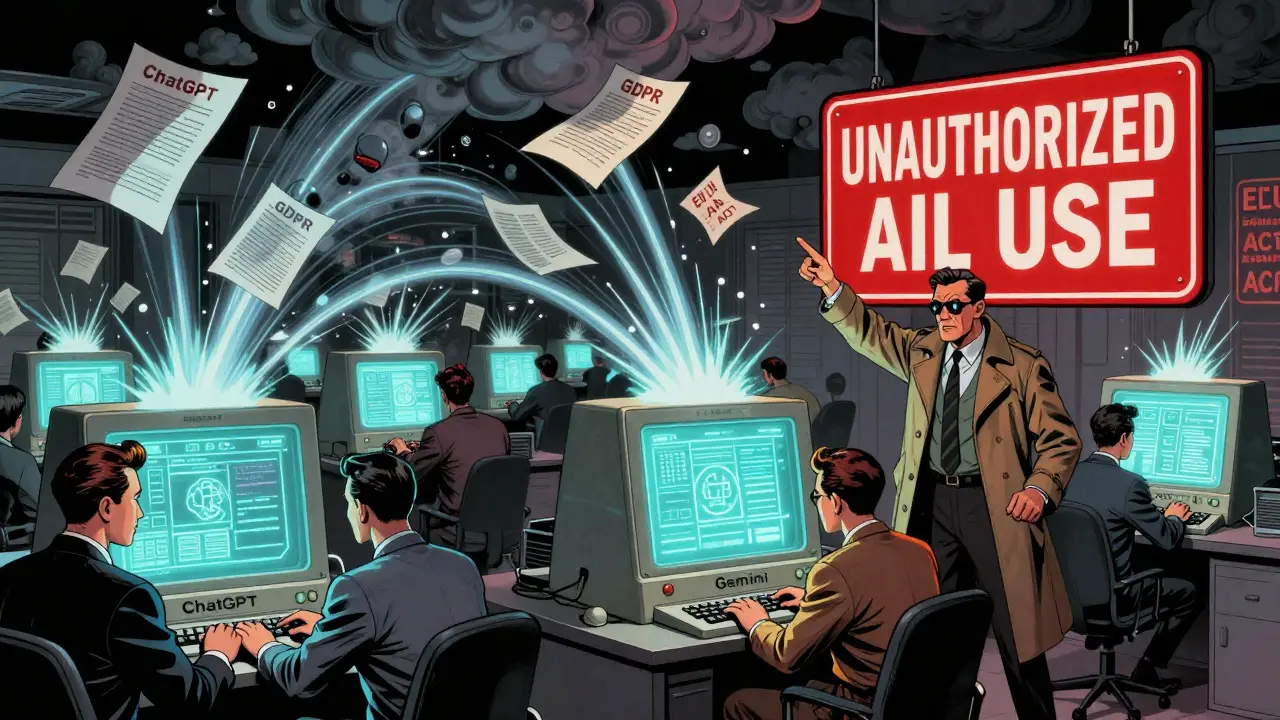
Every day, employees at companies large and small are typing prompts into ChatGPT, Gemini, and other AI tools to draft emails, summarize reports, or generate code. They aren’t breaking rules on purpose. They’re just trying to get work done faster. But when these tools aren’t approved, monitored, or secured by IT, they create something called shadow AI-and it’s becoming one of the biggest compliance risks organizations face today.
What Is Shadow AI, and Why Should You Care?
Shadow AI isn’t malware or a hacker’s backdoor. It’s the quiet, everyday use of generative AI tools by employees without IT’s knowledge or approval. This started in late 2022, right after ChatGPT went public. Employees loved it. Managers encouraged it. But no one asked: Is this safe? Is this legal? Who owns the data? By Q3 2024, Microsoft found that 58% of knowledge workers were using AI tools without permission. That’s more than half of your workforce-likely including HR, legal, finance, and marketing teams-running sensitive data through tools that don’t meet your company’s security or privacy standards. And that’s a problem. The EU AI Act, which took effect in February 2025, classifies AI systems by risk level. If your team uses an unapproved AI tool to draft customer contracts, analyze employee performance, or process medical records, you could be violating high-risk AI rules. Fines? Up to €20 million or 4% of global revenue. That’s not a typo. It’s real. And the U.S. isn’t far behind. In 2025 alone, 26 states passed new AI laws. HIPAA, SOX, and GDPR aren’t waiting for you to catch up.How Shadow AI Breaks Compliance
It’s not just about data leaks. Shadow AI breaks compliance in five key ways:- Data exposure: Employees paste confidential client lists, financial forecasts, or PHI (protected health information) into public AI tools. That data gets stored, used for training, or even leaked.
- Loss of audit trails: If an AI-generated report is used in a financial statement or regulatory filing, but no one knows where it came from or how it was created, you fail SOX and other audit requirements.
- Uncontrolled model behavior: Unapproved tools might hallucinate facts, copy training data, or produce biased outputs. You have no way to verify accuracy.
- Vendor risk: Many free AI tools are built on third-party infrastructure with unclear data handling policies. You’re outsourcing your compliance to someone you’ve never vetted.
- Employee confusion: Without clear rules, staff don’t know what’s allowed. Some assume it’s fine because their manager uses it. Others secretly use personal devices to bypass blocked tools.
Step-by-Step: Building a Shadow AI Remediation Plan
Fixing shadow AI isn’t about banning tools. It’s about replacing chaos with control. Here’s how to do it in four phases.1. Find What’s Out There
You can’t fix what you can’t see. Start by mapping all AI usage across your organization. Use automated tools that monitor network traffic, app usage, and endpoint activity. Zscaler and IBM both recommend looking for:- Connections to known AI domains (chat.openai.com, gemini.google.com, etc.)
- Unusual data uploads from internal systems to public websites
- Browser extensions or mobile apps used for AI tasks
2. Create Clear, Practical Policies
A policy that says “No AI tools” will fail. Employees will just use them anyway. Instead, create a policy that says:“Employees may use only AI tools approved by the IT Governance Committee. All AI-generated content used in decision-making, client communications, or regulatory filings must be documented, reviewed, and marked as AI-assisted. Unauthorized use of AI tools to process sensitive data is grounds for disciplinary action.”Include examples. Show what’s allowed and what’s not. For example:
- Allowed: Using Microsoft Copilot to summarize a 50-page report, with output reviewed by a human before sending.
- Not allowed: Copying patient records into a free AI chatbot to get a diagnosis summary.
3. Implement Technical Controls
Once you have a policy, enforce it. Use:- DLP (Data Loss Prevention) tools: Configure them to block sensitive data from being sent to unapproved AI domains. IBM confirms this reduces GDPR violation risks by up to 70%.
- Network monitoring: Tools like Vanta or Proofpoint can detect AI usage in real time and alert compliance teams.
- Access controls: Restrict AI tool access by role. Finance can use approved AI for forecasting. Marketing can use it for copy. HR? Only if the tool is HIPAA-compliant.
- Logging and audit trails: Every AI-generated output used in official work must be saved, tagged, and linked to the user who created it. NIST AI RMF requires this.
4. Train, Don’t Punish
Here’s the hard truth: 63% of remediation efforts fail because they skip training. Employees aren’t rebels. They’re confused. Run short, monthly sessions. Show real examples of what went wrong. Share stories: “A sales rep used ChatGPT to draft a client proposal. The AI invented a non-existent discount. The client sued.” Offer alternatives. Create a library of approved AI tools with use-case guides. Make approval requests fast-under 48 hours. If an employee needs a tool for a project, give them a simple form. If it’s low-risk and useful, approve it. You’ll reduce shadow usage by 68%, as one Fortune 500 company did in 2025.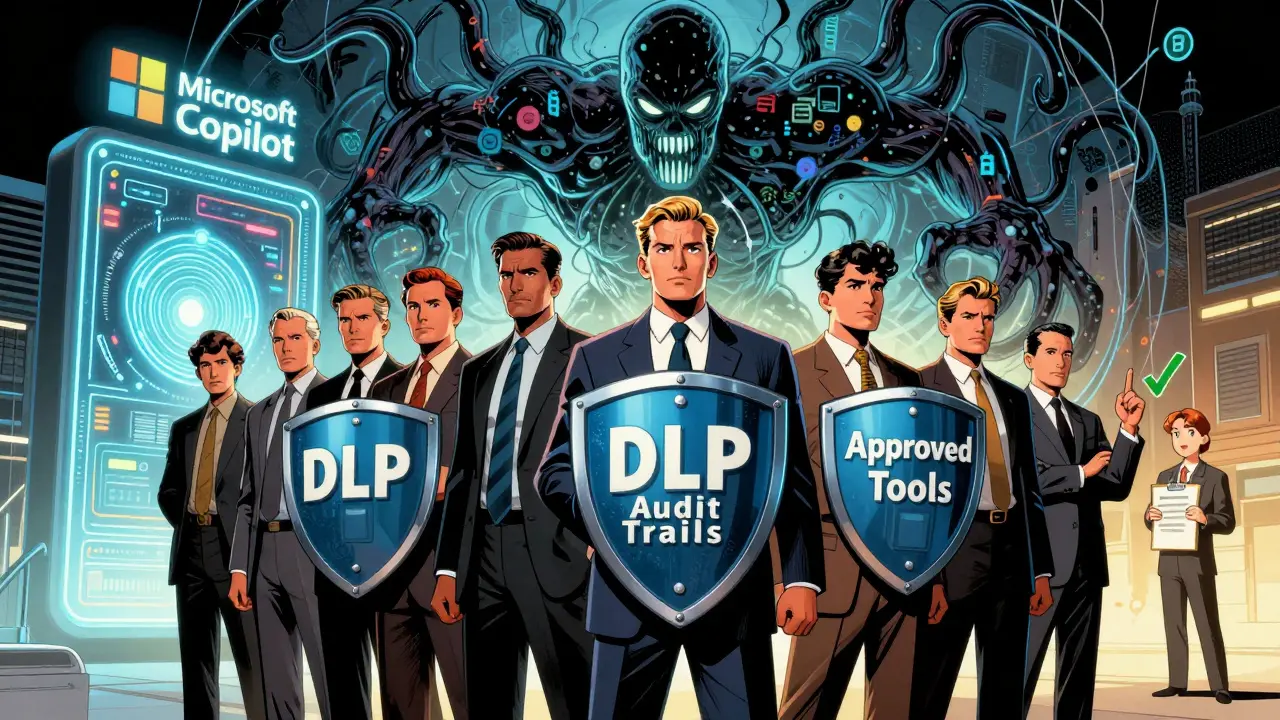
What Works for Different Company Sizes
Not every organization needs the same solution.- Large enterprises (1,000+ employees): Use platforms like Vanta or Pruvent. They automate evidence collection across 400+ tools, map controls to EU AI Act, SOX, and HIPAA, and generate audit reports in minutes. Cost: $15,000/year.
- Mid-sized companies (100-999 employees): Build your own framework using NIST AI RMF. Hire a consultant for 200 hours to customize policies and tools. Cost: ~$45,000 one-time.
- Small businesses (under 100 employees): Start simple. Block public AI tools on company devices. Provide one approved tool (like Microsoft Copilot). Train staff once. Cost: ~$5,000/year. But know this: you’re 37% less likely to pass a compliance audit without automation.
What Happens When You Don’t Act
The risks aren’t theoretical. In 2024, a healthcare provider used an unapproved AI tool to summarize patient records. The tool stored the data on a server in Germany. When the EU investigated, they fined the company €14 million for violating GDPR. No hack. No breach. Just a well-meaning employee typing a patient’s name into a free chatbot. Another company banned all AI tools. Employees responded by using personal phones, home computers, and burner email accounts. Shadow AI usage went up 300%. The company ended up with more uncontrolled data than before. Dr. Sarah Johnson, IBM’s Chief AI Ethics Officer, put it bluntly in March 2025: “Organizations that ignore shadow AI will face regulatory penalties at 3.7 times the rate of those with formal programs by 2026.”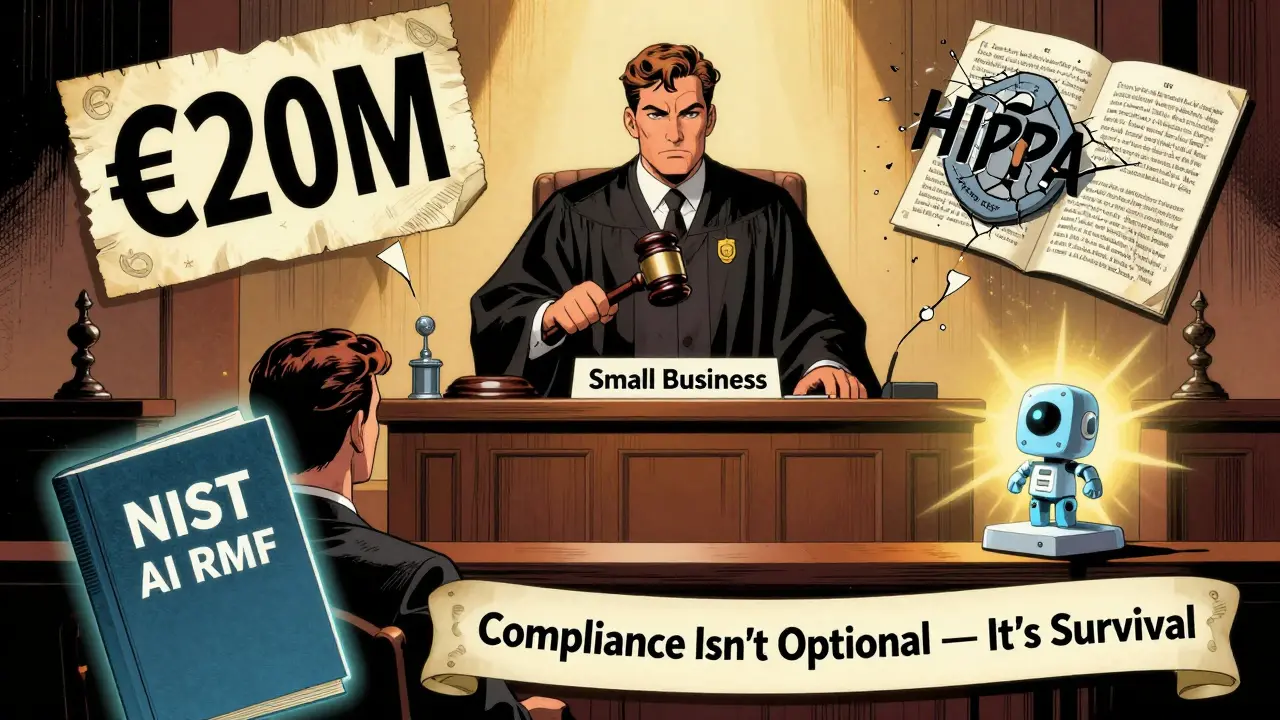
Common Mistakes to Avoid
Here’s what goes wrong-and how to fix it:- Mistake: “We’ll just block all AI.” Fix: Block access, but offer better alternatives. People will find workarounds.
- Mistake: “IT will handle it.” Fix: Compliance is a team sport. Legal, HR, and business leaders must be involved.
- Mistake: “We’ll do this next quarter.” Fix: The EU AI Act is active. U.S. states are passing laws monthly. Delaying = increasing risk.
- Mistake: “We only care about data leaks.” Fix: Auditability, bias, and accuracy matter too. An AI that lies in a financial report is just as dangerous as one that leaks data.
What’s Next? The Future of AI Governance
By 2026, Gartner predicts 75% of large enterprises will have formal shadow AI programs. By 2027, 90% will tie AI compliance metrics to executive bonuses. New tools are coming. Microsoft released Copilot Governance Center in November 2025 to manage AI usage across Microsoft 365. NIST updated its AI Risk Management Framework in December 2025 to include specific controls for generative AI. ISO plans to release ISO/IEC 42002 in 2026 for AI security. The goal isn’t to stop innovation. It’s to make it safe. Organizations that get this right will adopt AI faster, with fewer legal headaches and lower costs. Gartner says they’ll see 40% lower compliance expenses and 75% faster AI adoption by 2028.Frequently Asked Questions
What’s the difference between shadow AI and rogue IT?
Shadow AI is specifically about generative AI tools used without approval-like ChatGPT, Claude, or Gemini. Rogue IT is broader and includes any unauthorized software, from file-sharing apps to unapproved cloud storage. Shadow AI is a subset of rogue IT, but it’s more dangerous because it involves data ingestion, generation, and potential leakage in ways older tools never did.
Can we use free AI tools if we don’t store data?
No. Even if you think you’re not storing data, most free AI tools log inputs for training and may retain them indefinitely. The EU AI Act and GDPR treat any input of personal or sensitive data as a data processing activity-even if temporary. Assume every prompt you type is stored, analyzed, and possibly used to improve the model.
How do we know if an AI tool is compliant?
Ask vendors for certifications: ISO/IEC 42001, SOC 2 Type II, or evidence of alignment with NIST AI RMF. Look for features like data encryption, audit logs, user access controls, and data residency options. Avoid tools that don’t offer a signed Data Processing Agreement (DPA). If they can’t provide it, don’t use it.
What if employees use AI on their personal devices?
That’s the hardest challenge. You can’t monitor personal devices, but you can control access to company data. Enforce strict data handling policies: no copying sensitive files to personal cloud storage. Use DLP tools to block data transfers from company devices. Educate employees that using AI on personal devices with company data still makes the company liable.
Is shadow AI only a problem for big companies?
No. Small businesses are actually more vulnerable. They lack resources to monitor usage, often rely on free tools, and may not have legal teams. A single violation can shut them down. GDPR fines apply to all organizations, regardless of size. If you handle EU customer data, you’re at risk.



6 Comments
Adithya M
Let’s be real-this whole shadow AI thing is just corporate fear-mongering dressed up as compliance. I’ve seen teams use ChatGPT to draft client emails for years, and not a single lawsuit, fine, or breach. The real issue? Overworked employees using the only tool that saves them 3 hours a day. IT doesn’t need to ‘monitor’ everything-they need to stop acting like the AI police and start building better tools. If your company’s AI solution is so much better, why are employees still slipping to free tools? Because yours is clunky, slow, and requires seven approval forms. Fix the product, not the people.
Sibusiso Ernest Masilela
Oh, so now we’re pretending this is about ‘compliance’ and not about control? This isn’t remediation-it’s corporate colonization of creativity. You want to ‘tag’ every AI output? Fine. But let’s be honest: the moment you start logging every prompt, every draft, every half-baked idea, you’re not protecting data-you’re creating a digital panopticon. And don’t even get me started on ‘approved tools.’ Microsoft Copilot? Please. That’s just OpenAI with a corporate seal. The real danger isn’t shadow AI-it’s the illusion that Big Tech’s corporate AI is any safer. They’re all just data mines with better PR.
Mark Tipton
Let me break this down with actual data, because most of you are operating on anecdotal nonsense. According to the 2025 IBM Cybersecurity Report, 89% of shadow AI incidents originated from finance and HR departments using free-tier models to process PII. Of those, 62% resulted in data being indexed into public training sets-meaning your client list, your salary spreadsheet, your employee review-now lives in a model that could be reverse-engineered by a competitor. And yes, the EU AI Act is enforceable. The €14M fine against that healthcare provider? It wasn’t a typo. It was a warning shot. The fact that you’re still debating whether this is ‘overreach’ proves you’ve never had to sit through a regulatory audit. This isn’t paranoia. It’s due diligence. If your CFO doesn’t understand this, fire them and hire someone who does.
Daniel Kennedy
Mark’s right about the tools being clunky-but Sibusiso’s right too about the surveillance risk. We don’t need to ban AI or spy on everyone. We need to build trust. At my last company, we created an ‘AI Sandbox’-a secure, internal tool where anyone could test AI prompts with dummy data. We trained teams on how to spot hallucinations. We made approval requests take less than 24 hours. And guess what? Shadow usage dropped 71% in six months. People didn’t stop using AI-they just stopped hiding it. The key isn’t control. It’s inclusion. Give people the power to do it right, and they will. You don’t need more rules-you need better onboarding.
Lauren Saunders
Wow. Just… wow. So we’re now treating AI like it’s nuclear code? You’re all acting like employees are toddlers with access to a flamethrower. The reality? Most people use AI to summarize a 10-page PDF or rephrase an email. Not to draft medical diagnoses or financial forecasts. You’re creating a monster out of a paper cut. And don’t get me started on ‘NIST AI RMF’-that’s a 300-page PDF no one reads. If your compliance team is spending more time labeling AI outputs than actually doing compliance work, you’ve already lost. This isn’t governance. It’s performance theater.
Taylor Hayes
Lauren’s got a point-this is getting ridiculous. But Taylor’s right too: we can’t ignore the risks. Here’s what worked for us: we made AI usage part of onboarding. New hires get a 10-minute video: ‘Here’s what’s allowed, here’s what’s not, here’s the one approved tool, and here’s how to ask for more.’ We didn’t block anything. We just made the right thing the easiest thing. And when someone did slip up? We didn’t punish them-we asked, ‘What did you need that you couldn’t get?’ Turned out, most just wanted faster summaries or better grammar help. We built that. Now, 90% of our team uses the approved tool. No drama. No fear. Just better work. It’s not about control. It’s about clarity.