By 2026, if you're writing code without checking if it came from an AI, you're already behind. Not because AI writes bad code-it often writes great code-but because trustworthy AI for code isn't optional anymore. It’s the new baseline. Companies are deploying AI-generated code at scale: OpenAI’s systems process over 100,000 external pull requests daily. GitHub’s Copilot is used by 63% of professional developers. But here’s the problem: no one can read every line of AI-written code. And if you don’t verify it, you’re gambling with security, compliance, and uptime.
Why You Can’t Just Trust AI-Generated Code
AI doesn’t make mistakes the way humans do. It doesn’t forget a semicolon or misread a variable name. It generates plausible code-code that looks right, runs fine in testing, and then crashes in production because of a subtle memory leak, an unhandled edge case, or a hidden backdoor. The problem isn’t incompetence. It’s opacity. AI models don’t explain their choices. They don’t cite sources. They don’t track lineage. That’s why verification, provenance, and watermarking aren’t just nice-to-haves-they’re survival tools.Take a real example: a developer used GitHub Copilot to generate a function for handling user authentication. It worked perfectly in the test environment. But when deployed, it silently accepted any password under 8 characters because the AI had learned from a flawed public snippet. No one caught it until a penetration test flagged it. That’s the kind of failure that gets companies fined under the EU AI Act. And it’s avoidable-if you know how to verify.
Verification: Proving Code Does What It Says
Verification means mathematically proving that code behaves as intended. It’s not about running tests. It’s about proving correctness before the code even runs. Companies like TrustInSoft use formal methods to do this. Their Analyzer doesn’t just scan code-it builds a mathematical model of every possible execution path. It checks for memory safety, buffer overflows, null pointer dereferences, and race conditions. And it doesn’t guess. It proves.How does that work in practice? If you generate code to manage a medical device’s dosage algorithm, TrustInSoft’s tool can guarantee no integer overflow will cause a lethal overdose. It does this by analyzing the code against formal specifications written in logic. This isn’t theory. It’s used in aerospace, automotive, and healthcare systems where failure isn’t an option.
OpenAI’s approach is different. Instead of formal proofs, they built a code reviewer that acts like a senior engineer. It doesn’t prove correctness-it spots likely problems. Their model achieves a 52.7% action rate: when it comments on a pull request, developers change the code over half the time. It’s not perfect. It misses some bugs. But it’s fast, integrated into GitHub, and doesn’t require a Ph.D. to use. The trade-off? Lower recall, higher usability. And for most teams, that’s the right balance.
Provenance: Knowing Where Code Came From
Provenance answers a simple question: who wrote this, and how did it get here? If your codebase contains AI-generated snippets from 17 different models, how do you know which ones are safe? Which ones violate licenses? Which ones were trained on proprietary code?GitHub’s six-step review process tackles this head-on. Step one: check if the code matches a known pattern from a specific AI model. Step two: verify context-did the AI understand the surrounding code? Step five: look for AI-specific pitfalls, like over-reliance on common libraries or hallucinated dependencies. This isn’t magic. It’s pattern recognition combined with repository-wide analysis. OpenAI’s research shows that giving the AI access to the full codebase-not just a single file-improves its ability to catch critical bugs by 40%.
But provenance goes deeper. Some teams are now embedding metadata into AI-generated code. This includes the model name, version, timestamp, and even the prompt used. It’s like a digital signature for code. If a bug appears in production, you can trace it back to the exact AI generation event. That’s not just helpful-it’s required under new EU regulations.
Watermarking: The Invisible Tag That Stays With Code
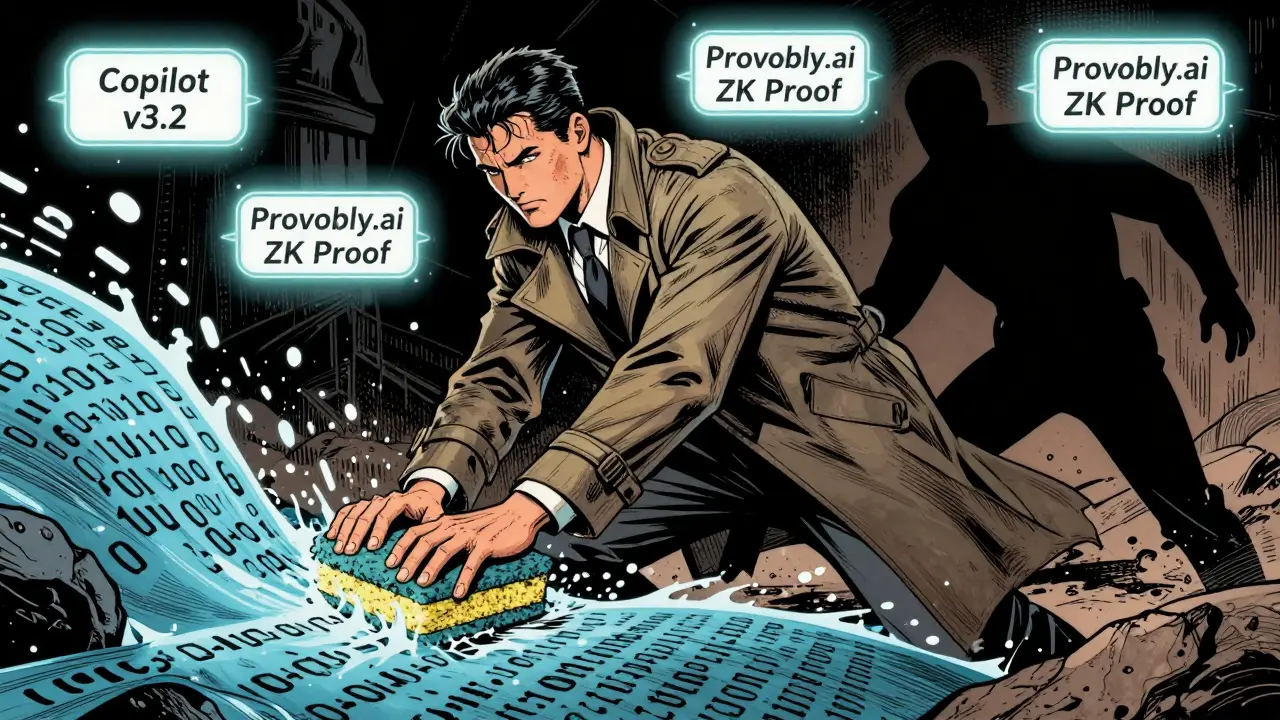
Watermarking is the quiet revolution. It’s not about visible comments. It’s about embedding subtle, undetectable patterns into the code that prove it was AI-generated. Think of it like forensic ink on currency. You can’t see it, but scanners can.Companies like Provably.ai are using zero-knowledge (ZK) cryptographic protocols to watermark code. Their system doesn’t just say “this was AI-generated.” It lets anyone verify that claim without revealing the original code or the model’s internal logic. A financial firm in Frankfurt uses this to prove to auditors that their trading algorithms don’t contain unauthorized AI-generated logic. The verification takes under two seconds. And the accuracy? 99.98% for SQL queries.
But watermarking isn’t foolproof. Skilled attackers can strip it out. That’s why it’s not a standalone solution. It’s part of a layered defense: provenance tells you the origin, verification tells you the safety, and watermarking tells you it’s been tampered with.
Real-World Trade-Offs: Speed vs. Certainty
There’s no one-size-fits-all solution. You can’t run formal verification on every line of code your team generates. It’s too slow. Too complex. Too expensive.Here’s what works in practice:
- Use formal verification (TrustInSoft) for safety-critical components: authentication, encryption, medical logic, flight control.
- Use AI reviewers (OpenAI, GitHub Copilot) for the rest. They catch 70% of high-severity bugs with minimal friction.
- Use watermarking (Provably.ai) for compliance-heavy environments: finance, government, healthcare.
- Use provenance tracking everywhere. Know where your code came from.
OpenAI found that verification costs less than generation. Even at a small fraction of the AI’s token usage, the verifier catches most critical issues. That’s the sweet spot: spend 10% of the cost to prevent 90% of the risk.
What Happens If You Don’t Act?
The clock is ticking. In 2025, the market for AI code verification hit $187 million-up 220% from the year before. By 2028, Gartner predicts 90% of enterprise AI-generated code will require integrated verification. That’s not a prediction. It’s a mandate.Without verification, you risk:
- Regulatory fines under the EU AI Act for unmitigated risks
- Security breaches from hidden vulnerabilities in AI-generated code
- Loss of customer trust after a public failure
- Legal liability if AI-generated code causes harm
And the worst part? You won’t know you’re at risk until it’s too late. AI doesn’t leave a trail of broken tests. It leaves broken systems.
Getting Started: Three Steps for 2026
You don’t need to overhaul your pipeline. Start small.- Adopt a code review checklist based on GitHub’s six-step process. Train your team. Use it on every AI-generated PR.
- Integrate an AI reviewer like OpenAI’s or GitHub Copilot’s built-in review tool. Don’t turn off notifications. Let it flag issues.
- Tag your AI-generated code with metadata. Even a simple comment like “// AI-generated by Copilot v3.2 on 2026-01-15” helps. It’s the first step to provenance.
For teams in regulated industries, add formal verification for critical modules. For everyone else, the combination of review + metadata + watermarking is enough to stay ahead.
The future of code isn’t just written by AI. It’s verified by humans who know how to ask the right questions. And that’s the new skill every developer needs to learn.
Can AI-generated code be trusted without verification?
No. AI generates code that looks correct but may contain subtle, dangerous flaws. Without verification, you’re relying on luck, not logic. Even the best AI models hallucinate, overgeneralize, and inherit biases from training data. Verification isn’t about distrust-it’s about building systems that work under pressure.
What’s the difference between verification and testing?
Testing checks if code works under specific conditions. Verification proves it works under all possible conditions. Testing finds bugs. Verification prevents them from ever existing. Think of testing as checking your car’s brakes on a dry road. Verification is proving the brake system won’t fail in snow, rain, or at 120 mph.
Is formal verification only for big companies?
No. While formal methods like TrustInSoft Analyzer require training, they’re now being packaged into templates for common use cases: authentication, API handlers, data validation. Start with one critical module. You don’t need to verify your whole codebase. Just the parts that could cause real harm.
Do watermarking tools slow down my CI/CD pipeline?
Some do, but not all. Provably.ai’s ZK proofs take under 2.3 seconds-fast enough for most pipelines. Other watermarking tools add milliseconds. The real bottleneck isn’t speed-it’s adoption. Teams that delay verification because they’re worried about latency end up paying far more in post-deployment fixes.
Can AI detect its own generated code?
Not reliably. AI models aren’t designed to recognize their own outputs. They generate code based on patterns, not provenance. That’s why external tools are needed. Even OpenAI’s own reviewer doesn’t know if a line of code came from its own model-it just looks for patterns that indicate risk. Provenance and watermarking are the only ways to trace origin.
Is this just hype, or is it actually being used?
It’s being used-every day. 41% of Fortune 500 companies have implemented some form of AI code verification. Financial institutions use watermarking to meet compliance. Healthcare firms use formal verification for patient data systems. GitHub’s internal teams rely on AI reviewers to catch bugs before they reach customers. This isn’t science fiction. It’s the new standard.
7 Comments
Robert Byrne
This is the most important thing I've read all year. AI code isn't just risky-it's a ticking bomb if you don't verify it. I've seen teams deploy Copilot-generated auth logic and then wonder why their DB got pwned. No one checks the damn thing. We're not talking about a missing semicolon here-we're talking about zero-day exploits baked into production code. If your company isn't doing formal verification on critical modules, you're not a developer. You're a liability.
Tia Muzdalifah
fr tho i just copy pasted some copilot stuff last week and it worked?? like it did the thing?? why do we need all this fancy verification stuff?? i dont even know what formal methods are lmao
Zoe Hill
Hey Tia, I get where you're coming from-I’ve done the same thing! But imagine if that ‘worked’ code was in a hospital system or a car’s braking algorithm. 😅 I’m not saying don’t use AI, just maybe add a little ‘// AI-generated, double-check this’ comment. It’s not about being paranoid, it’s about being smart. And honestly? The AI reviewers now are kinda like a super chill pair of eyes over your shoulder. They don’t yell, they just whisper, ‘hey, this might be weird.’
Albert Navat
Let’s cut through the noise. Verification isn’t about ‘trust’-it’s about liability mitigation. You’re not verifying because you distrust AI, you’re verifying because your CISO, your legal team, and your insurance provider are going to crucify you if a bug slips through. Provenance isn’t a feature-it’s a compliance requirement under GDPR++ and the EU AI Act. Watermarking? That’s the digital equivalent of putting your name on a gun before you fire it. If you’re not embedding model metadata, you’re not a dev-you’re a liability waiting for a class-action lawsuit. Stop treating AI code like it’s free candy from a vending machine.
King Medoo
Look. I’ve been coding since the 90s. We used to debug with printf. Then we got unit tests. Then we got static analyzers. Now? We’re supposed to run formal proofs on every line of AI-generated spaghetti? 🤦♂️ I get it. It’s scary. But here’s the truth: if you’re not verifying, you’re not coding-you’re playing Russian roulette with a .50 calibre AI bullet. And the worst part? You won’t know it’s loaded until your app crashes during Black Friday sales. 💥 I’ve seen it. I’ve lost clients. I’ve lost sleep. This isn’t hype. It’s the new reality. If your team doesn’t have a verification checklist, you’re not ready for 2026. You’re ready for a lawsuit. 🚨
Rae Blackburn
They’re lying. This is all a corporate scam to sell you more tools. AI-generated code is fine. The real danger is the verification tools themselves-they’re backdoors. You think TrustInSoft doesn’t have a backdoor? You think Provably.ai doesn’t track every line you write? They’re selling you fear so they can sell you $50k/year licenses. I’ve seen the code behind the scanners. They flag anything that looks like it came from OpenAI. Even if it’s your own logic. This isn’t safety. It’s surveillance. And you’re all just letting them do it. 🤫
LeVar Trotter
Hey everyone-let’s not turn this into a war. Robert’s right: verification is non-negotiable for safety-critical systems. Tia’s right: not everyone needs formal methods. Zoe’s right: small steps matter. Albert’s right: compliance isn’t optional. But Rae? You’re not wrong to be skeptical-just don’t let skepticism paralyze you. Here’s the pragmatic middle ground: Start with one module. Add a simple comment tag. Enable the Copilot reviewer. Use watermarking only if you’re in finance or healthcare. Formal verification? Only if you’re controlling a pacemaker or a rocket. You don’t need to boil the ocean. Just add one layer. One guardrail. One check. That’s how you build trust-not by rejecting AI, but by owning its limits. We’re not losing control. We’re just learning to steer it better.