
California Leads the Nation with Sweeping Generative AI Rules
California isn’t just home to Silicon Valley-it’s now the epicenter of AI regulation in the U.S. Between 2024 and 2025, Governor Gavin Newsom signed over a dozen AI bills into law, turning the state into the strictest testing ground for generative AI rules in the country. These laws don’t just ask companies to be careful-they demand proof, transparency, and accountability.
The California AI Transparency Act (AB853), signed in September 2025, forces any platform, app, or device that uses AI to generate content to make it obvious. That means visible watermarks, hidden metadata, and clear labels so users can tell if they’re reading, hearing, or seeing something made by a machine. The law applies to companies with over one million monthly users, but it also reaches down to manufacturers of cameras and voice recorders that feed data into AI systems. Enforcement? The California Attorney General can hit violators with daily fines. And here’s the kicker: implementation was pushed from January 1, 2026, to August 2, 2026, giving companies a little more time-but not much.
Then there’s AB 2013, the Training Data Transparency Act. It doesn’t just apply to new AI tools. It goes back to systems modified after January 1, 2022. That means companies who built AI models two years ago now have to dig up every dataset they used-where it came from, what it included, whether it had biased or copyrighted material-and document it all. Fines can hit $5,000 per violation. One startup in San Francisco spent $1.2 million and six months just rewriting their data tracking system to comply.
Healthcare got its own set of rules. AB 489 bans AI developers from pretending they’re licensed doctors. SB 1120 says no AI can approve or deny insurance claims without a real physician reviewing it. Kaiser Permanente trained 12,000 doctors on how to supervise AI tools, spending $8.7 million just on training. And AB 2602 gives people control over their digital likeness. If a company wants to use your face or voice in an AI-generated video, they need your signed consent-and ideally, a lawyer or union rep present.
California’s push doesn’t stop at consumer protection. The state is also building its own AI supercomputer. SB 53 directs the government to create CalCompute by 2027-a public cloud cluster for AI research. It’s not just regulation. It’s investment.
Colorado: Narrow Rules, Big Gaps
Colorado’s approach to AI is simple: focus on insurance. In 2024, the state passed HB 24-1262, which stops insurers from using AI to unfairly deny coverage or set prices based on race, gender, or zip code. If an insurer uses AI to make underwriting decisions, they must tell you. That’s it.
There’s no rule about deepfakes, no requirement to label AI-generated ads, no oversight for chatbots or hiring tools. A September 2025 survey by the Denver Business Journal found 78% of insurance companies liked the law-it was manageable. But legal experts on the Colorado Bar Association forum warned that businesses outside insurance are left in the dark. What if a Denver marketing firm uses AI to write fake customer reviews? What if a startup builds an AI recruiter that filters out women? No law covers it. The Center for Democracy & Technology called Colorado’s approach “leaving significant gaps in consumer protection.”
There’s talk of change. In 2025, lawmakers introduced HB 25-1047, which would require companies to label AI content in ads and online. But as of December 2025, it’s still in committee. For now, Colorado’s AI rules are like a speed bump-not a stop sign.
Illinois: Deepfakes and Biometrics, Not General AI
Illinois has been ahead of the curve on privacy-but not because it’s targeting AI broadly. Its laws focus on two things: biometric data and political deepfakes.
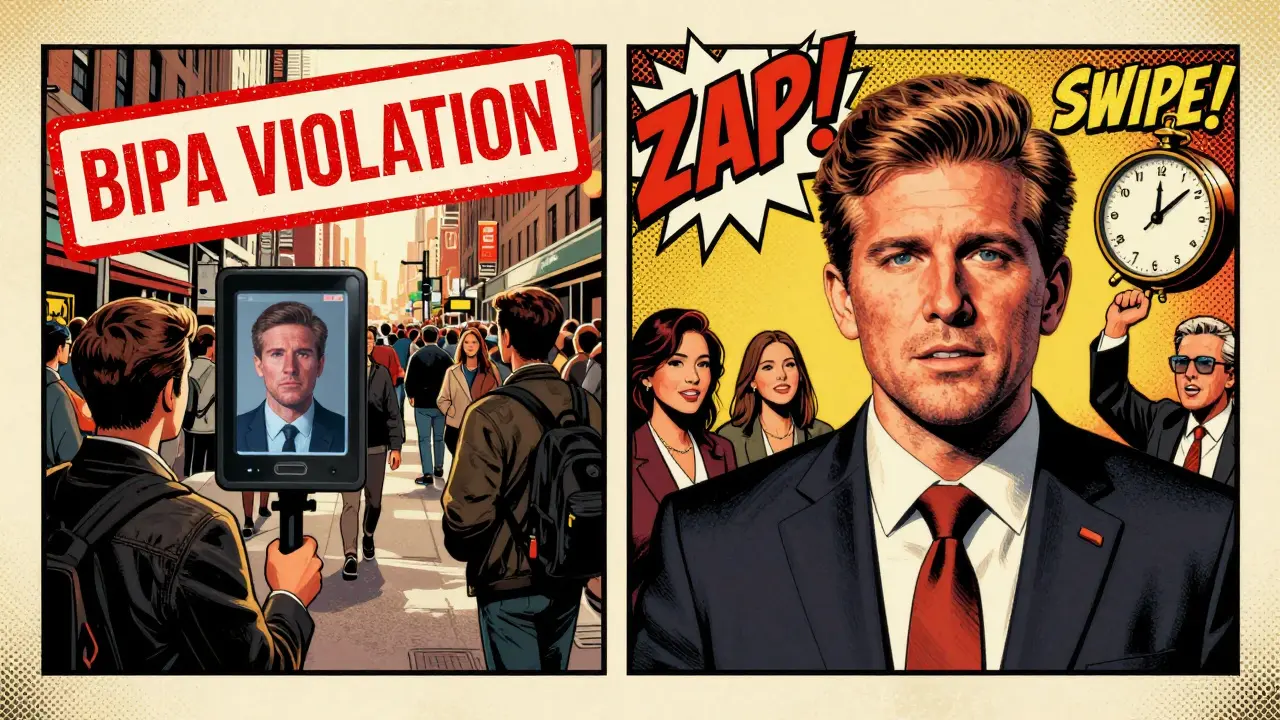
The Biometric Information Privacy Act (BIPA), updated in 2023, requires companies to get written consent before collecting facial scans, voiceprints, or fingerprints. That includes AI tools that analyze your face to guess your mood, age, or emotions. In October 2025, a Chicago marketing firm was fined $250,000 for using AI to scan faces in public without permission. That’s BIPA in action.
Then there’s S.B. 3197, the Artificial Intelligence Video Recording Act. It bans creating deepfakes of political candidates within 60 days of an election. It’s a direct response to fake videos that could sway votes. But here’s the problem: it doesn’t touch AI-generated fake news, customer service bots, or AI-written job applications. The Illinois Policy Institute called this law “reactive rather than proactive.”
Lawmakers introduced S.B. 2891 in January 2025-a bill that would require disclosure of AI-generated content in commercial settings. But as of December 2025, it’s still stuck in committee. Illinois has strong tools for specific harms, but no comprehensive AI strategy.
Utah: Waiting for a Framework
Utah’s stance on AI is simple: wait and see. The state’s main privacy law, the Utah Consumer Privacy Act (UCPA), took effect in December 2023. It gives residents the right to delete data and opt out of targeted ads. But it says nothing about generative AI, deepfakes, or algorithmic bias.
In January 2025, lawmakers introduced S.B. 232, the Artificial Intelligence Policy Act. Its goal? To create a task force that studies AI governance. That’s it. No deadlines. No enforcement. No rules. As of December 2025, the bill was delayed until the 2026 legislative session. The Salt Lake City Technology Council warned that Utah risks falling behind in the AI economy without clearer guardrails.
A November 2025 poll by the Salt Lake Tribune showed 63% of tech companies want more clarity. But the state’s political culture favors minimal regulation. While California is building AI infrastructure and enforcing transparency, Utah is still drafting a study group. For now, Utah businesses follow federal guidelines-if they follow anything at all.
Who’s Really Being Affected?
These laws don’t just affect tech companies. They ripple through every industry that uses AI.
Healthcare providers in California now need legal teams to review every AI tool used in patient care. Marketing agencies must audit their AI-generated content for compliance. Startups building chatbots for schools have to add age verification and consent flows. Even small businesses using AI to write emails or design logos are now in legal gray zones if they operate in California.
Companies that sell AI tools nationwide are caught in the middle. Many are adopting California’s rules as their default standard. The International Association of Privacy Professionals found 67% of global firms now use California’s AI standards as their baseline. Why? Because it’s easier to build one system that meets the strictest rules than 50 different ones for each state.
But that’s expensive. Davis Wright Tremaine’s September 2025 report found compliance costs range from $250,000 for small businesses to $2.5 million for large platforms. That’s not just a tax on innovation-it’s a barrier to entry.

What’s Next?
California isn’t done. In October 2025, Newsom signed SB 243, the Companion Chatbot Law, which requires chatbots that talk to minors to disclose they’re not human. He vetoed a stricter bill that would have banned harmful chatbots altogether, saying it was too vague.
On January 1, 2026, California’s AI Enforcement Division launches with 45 full-time staff. They’ll audit companies, investigate complaints, and issue penalties. The California Privacy Protection Agency is also releasing draft rules for the Transparency in Frontier AI Act-requiring top AI developers to submit annual reports on how they follow safety standards.
Other states are watching. Vermont and Connecticut passed AI laws in 2025. New York, Washington, and Florida are drafting bills. But none match California’s scope. Analysts at Forrester predict at least 15 more states will pass similar laws by 2027.
Meanwhile, the lack of federal rules means businesses face a patchwork. A company in Texas selling AI tools to schools in California, Illinois, and Colorado must juggle three different sets of rules. The Chamber of Commerce of New York called it “a compliance nightmare.”
What Should You Do?
If you’re a business operating in California: start now. You’re not just complying-you’re preparing for the future. Audit your AI tools. Document your training data. Label your content. Train your staff. Keep records for seven years.
If you’re in Colorado, Illinois, or Utah: don’t assume you’re safe. Your customers might be in California. Your vendors might be subject to California law. Your brand reputation might suffer if your AI is used in a scandal.
Ask yourself: Are you using AI to generate content? To make decisions? To analyze people? If yes, you’re already in the regulatory crosshairs-even if your state hasn’t passed a law yet.
Do California’s AI laws apply to businesses outside the state?
Yes-if your AI tools are used by California residents or sold in the state. California’s laws follow the consumer, not just the company. If a Colorado-based startup sells an AI chatbot to a school in Los Angeles, it must comply with California’s transparency and consent rules. This is why most national companies adopt California’s standards as their default.
What happens if I don’t comply with California’s AI laws?
Penalties can be severe. Under the California AI Transparency Act, violations can cost up to $5,000 per incident. The Attorney General can sue, and city attorneys can too. Companies have already faced class-action lawsuits over unmarked AI content. Beyond fines, reputational damage can be worse-consumers are becoming more aware of AI manipulation and are quick to call out non-compliant brands.
Are there any federal AI laws in the U.S.?
No. As of early 2026, there is no comprehensive federal law regulating generative AI. The U.S. government has issued voluntary guidelines and executive orders, but no enforceable rules. That’s why state laws-especially California’s-are becoming the de facto national standard.
How long do I need to keep AI compliance records?
In California, you must keep documentation of AI training data, usage logs, and consent forms for at least seven years. This includes everything from dataset sources to physician oversight logs. Failure to produce records during an audit can result in additional penalties.
Is Utah likely to pass strong AI laws soon?
Unlikely in the near term. Utah’s pending bill, SB 232, only creates a study group with no deadlines or enforcement power. The state has a history of resisting heavy regulation, especially in tech. Unless consumer pressure grows or a major AI scandal occurs in Utah, comprehensive AI laws are not expected before 2027.
What’s the biggest mistake businesses make with AI compliance?
Assuming that if a law doesn’t exist in their state, they’re safe. Many companies don’t realize that selling a product to a customer in California triggers California’s rules-even if the company is based in Texas. Another common mistake is thinking AI documentation is optional. California’s retroactive requirements mean even old AI models you thought were “done” now need full disclosure.



8 Comments
Andrew Nashaat
California’s laws are insane but necessary. Watermarks? Metadata? Signed consent for your voice? YES. I’ve seen AI-generated fake testimonials ruin small businesses. Companies think they can just slap on a bot and call it a day. Nope. You’re not a tech startup-you’re a public-facing entity. And if you’re using AI to interact with humans, you owe them transparency. The $5k fine? That’s a coffee budget for Google. But for a mom-and-pop shop? That’s a mortgage payment. Still. Better than getting sued for deepfake revenge porn. I’m tired of being lied to by algorithms.
Gina Grub
California’s regulatory overreach is a textbook case of solutionism masquerading as governance. They’re not regulating AI-they’re regulating perception. Watermarks don’t prevent harm, they just make users feel safer. Meanwhile, Colorado’s insurance-only approach is pragmatic. Why regulate every AI use case when the actual harm is concentrated in underwriting? The real issue is algorithmic bias, not whether your chatbot says 'I'm an AI'. And let’s be honest-most consumers don’t care. They just want their loan approved. The rest is performative compliance.
Nathan Jimerson
This is why global companies are adopting California’s rules. It’s not about fairness. It’s about efficiency. Imagine managing 50 different compliance systems. Impossible. So they pick the strictest and call it standard. That’s capitalism. And honestly? It’s better than nothing. In India, we have no AI laws. We rely on ethics. But ethics don’t scale. California’s rules might be heavy, but at least they’re clear. Companies now know what to build. That’s progress.
Sandy Pan
What are we even trying to protect here? Autonomy? Truth? Dignity? California’s laws treat AI like a monster under the bed-label it, scare it away, pretend that makes it go away. But AI isn’t evil. It’s a mirror. It reflects our data, our biases, our laziness. The real problem isn’t the watermark. It’s that we stopped asking who gets to define what’s 'fair' or 'transparent'. Who decides what data is 'biased'? Who audits the auditors? We’re building a legal scaffolding around a philosophical void. And we’re calling it progress.
Meredith Howard
The patchwork nature of state regulation presents a significant challenge for interstate commerce and consumer protection. While California’s comprehensive approach establishes a robust baseline for accountability, the absence of federal harmonization creates operational inefficiencies and legal uncertainty for entities operating across multiple jurisdictions. It is imperative that policymakers prioritize interoperability and scalability in regulatory frameworks to ensure equitable enforcement and sustainable innovation.
Yashwanth Gouravajjula
India has no AI laws. But we have 1.4 billion people using WhatsApp. If AI starts spamming us with fake political videos, we’ll burn down the servers. Laws come after chaos. California is trying to stop the fire before it starts. Respect.
Kevin Hagerty
Wow. So now I need a lawyer to write a damn email? And if my AI bot says 'hey' instead of 'hello' am I violating AB853? This is the dumbest thing since the 'no emoji in corporate emails' memo. I’m a small business owner in Ohio. I use AI to write product descriptions. I don’t even know what 'training data' is. Now I’m supposed to archive it for 7 years? And if I don’t? I get fined? For what? Being lazy? Chill out. The real AI threat isn’t deepfakes. It’s regulators who think they can code ethics.
Janiss McCamish
If you’re using AI to make decisions about people, you owe them transparency. Full stop. Whether you’re in Utah or Texas. If a chatbot denies someone a loan, they deserve to know why. If your AI scans faces in a store, you need consent. This isn’t overregulation. It’s basic human respect. California’s rules are hard, yes. But they’re the bare minimum. The rest of us are just catching up.