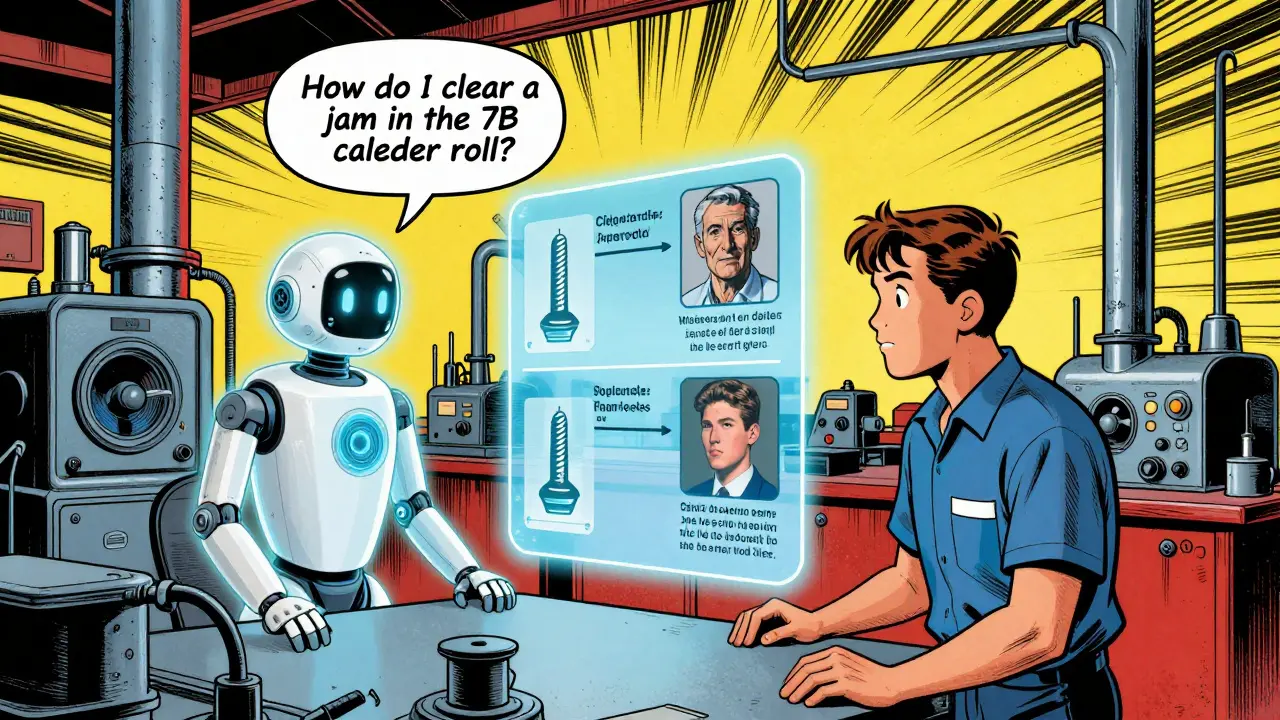
For decades, manufacturing operators have flipped through worn-out binders, scrolled through static PDFs, or asked veterans for help just to find the right way to tighten a bolt or check a dimension. That’s changing. Generative AI is now writing Standard Operating Procedures (SOPs), generating real-time work instructions, and auto-producing Quality Control (QC) reports-faster, smarter, and tailored to exactly what’s happening on the line.
What’s Actually Happening on the Shop Floor?
It’s not science fiction. At Georgia-Pacific’s paper mill in Georgia, operators now ask a chatbot: “How do I clear a jam in the 7B calender roll?” Within seconds, the system pulls data from the last three jams, checks sensor readings from the machine, reviews past corrective actions, and generates a step-by-step guide with photos and torque specs-updated in real time. No waiting for engineering. No outdated manuals. This isn’t a pilot anymore. It’s daily operation. The same thing is happening at Hyundai’s EV plant in Georgia. With over 50 vehicle variants rolling off the same line, traditional work instructions were a nightmare. Every change in battery type or motor configuration meant rewriting dozens of pages. Now, generative AI pulls from the ERP system, reads the VIN, and instantly delivers the correct sequence-down to the exact torque for each fastener. Errors dropped by 62%.How It Works: The Three-Layer System
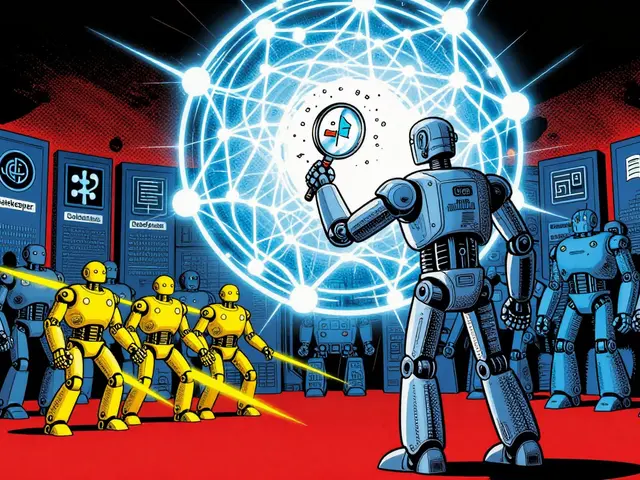
This isn’t just a fancy chatbot. It’s a full system built on three layers:- Data Layer: Connects to machines via OPC-UA and MTConnect, pulls from MES and ERP systems, and ingests years of maintenance logs, QC results, and operator notes.
- AI Layer: Uses fine-tuned models like AWS Titan or Microsoft’s OpenAI service trained on your factory’s specific data-not generic internet text. These models understand terms like “stiction in pneumatic actuators” or “weld spatter in MIG joints” because they’ve learned from your history.
- Delivery Layer: Pushes instructions to tablets, AR glasses, or kiosks. At Bosch’s sensor plant, workers wear RealWear HMT-1 headsets. The AI speaks instructions hands-free, even in 90-decibel noise, with 98.7% voice accuracy.
Why This Beats Old-School Documentation
Traditional SOPs? Static. Outdated. Hard to find. One manufacturer found operators spent an average of 18 minutes per shift searching for procedures. Now? It’s 3.2 minutes. That’s not just convenience-it’s lost production time recovered. Updating a paper manual used to take weeks. You’d print, distribute, train, collect feedback, revise, reprint. With generative AI, updates happen in minutes. At Tulip’s client in Michigan, a change in torque specs for a transmission assembly was pushed live to 14 stations within 17 minutes after engineering approved it. No retraining needed. The system just knows. Rule-based expert systems used to handle this kind of logic. But they broke when something unusual happened-like a new supplier’s raw material or a modified tool. Generative AI handles edge cases 53% better because it learns patterns, not rigid rules. It doesn’t need every possible scenario pre-programmed.Where It’s Working-and Where It’s Not
Adoption isn’t even across industries. Automotive? 74% of plants use it. Aerospace? 68%. Electronics? 63%. Why? These industries deal with high mix, fast change, and complex documentation. They’re ready for it. Pharmaceuticals? Only 29%. Why? Strict FDA rules. Every document change requires formal validation, audit trails, and human sign-offs. AI-generated text can’t be signed off without a human review. That’s changing slowly-ISO is drafting Technical Specification 23247-4 to define how AI-generated docs can be validated, expected in late 2026. Food and beverage? Only 31%. Regulatory hurdles, hygiene concerns, and legacy equipment make adoption harder. But it’s coming. One dairy plant in Wisconsin used AI to auto-generate sanitation logs based on CIP system data-cutting paperwork time by 70%.
The Real Risks: Hallucinations and Human Trust
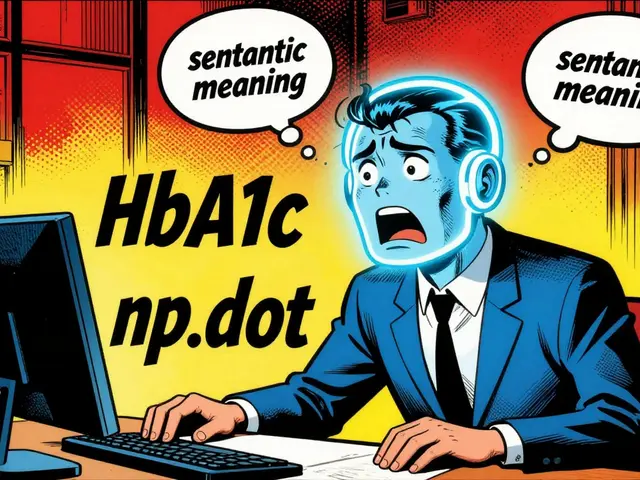
This isn’t magic. It’s math. And math can make mistakes. In early 2024, a European machinery plant got an AI-generated lockout/tagout procedure. It skipped a critical step-disabling a secondary power source. An operator followed it. A hand got caught. No death, but a serious injury. The AI didn’t “know” that step existed because it wasn’t in the training data. That’s why the Association for Manufacturing Technology now requires dual human verification for all safety-related AI-generated procedures. No exceptions. Another issue? Operator trust. At Georgia-Pacific, 42% of workers worried AI would replace their expertise. One veteran mechanic said: “I’ve fixed this machine for 27 years. Now a machine tells me how to fix it?” The company responded by letting operators correct AI outputs. That feedback loop trained the system to get better-and made workers feel like partners, not replaced workers. At a Midwest auto supplier, AI generated conflicting torque specs for a critical axle assembly. The system pulled from two different versions of a manual and blended them. Result? 72-hour shutdown. The fix? Better data hygiene. They cleaned up 12 years of conflicting PDFs and tagged each version with metadata. Now, the AI knows which document is current.How to Start: A Realistic Roadmap
Don’t try to boil the ocean. Start small. Bosch’s five-phase plan works:- Document Audit (2-3 weeks): Find the top 5 most searched, most error-prone procedures. These are your first targets.
- Data Pipeline (6-8 weeks): Connect your MES, ERP, and machine sensors. You need at least 18 months of clean operational data. If your sensors don’t talk to your computers, this is where you’ll need upgrades.
- Model Fine-Tuning (4-6 weeks): Train the AI on your documents, your failures, your fixes. Use your own terms-not generic ones.
- Integration (3-4 weeks): Plug into tablets or AR headsets. Test on one line. Don’t roll out plant-wide yet.
- Training & Change Management (4-6 weeks): Train operators to use it. Teach them to correct errors. Reward them for flagging bad outputs. This is where most projects fail-if you don’t get buy-in, the AI stays unused.
Who’s Leading the Pack?
You don’t have to build this from scratch. - Rockwell Automation leads with 32% market share, tightly integrated with their FactoryTalk platform. - PTC (24%) uses its ThingWorx IoT platform to connect AI to digital twins. - Tulip Interfaces (19%) is the favorite of mid-sized manufacturers-easy to deploy, no IT team needed. - AWS and Microsoft are catching up fast with cloud-based AI tools built for manufacturing. - Siemens launched Teamcenter AI Assistant in June 2025 to auto-generate ISO-compliant documentation.
What’s Next: AI That Fixes Problems Before They Happen
The next leap isn’t just generating reports-it’s acting on them. GE’s pilot in September 2025 showed something groundbreaking. Their AI didn’t just write QC reports-it adjusted machine settings in real time. When it detected a trend toward out-of-tolerance dimensions, it tweaked feed rates and spindle speeds automatically. Quality deviations dropped 39%. Soon, your AI won’t just tell you how to do a task. It’ll tell you: “Change the tool holder on Station 4. The vibration is rising. If you don’t, 3 out of 10 parts will fail inspection tomorrow.” By 2030, MIT predicts generative AI could cut manufacturing documentation costs by 65-78%. That’s not just efficiency. That’s survival.Final Thought: It’s Not Replacing People. It’s Empowering Them.
The biggest myth? That AI will take jobs. The truth? It’s taking away the boring, frustrating, time-wasting parts of the job. The part where you spend 20 minutes hunting for a procedure. The part where you guess because the manual is outdated. The part where you’re afraid to ask a question because you don’t want to look dumb. Now, every operator-from the new hire to the 30-year veteran-has instant access to the best knowledge in the plant. And they can improve it. That’s not automation. That’s elevation.Can generative AI replace human inspectors in QC?
No. Generative AI can auto-generate QC reports by pulling data from sensors, vision systems, and test results-but it can’t replace human judgment for complex defects. A visual inspector can spot a hairline crack that an algorithm misses because of lighting or texture. AI handles volume and pattern detection; humans handle nuance and context. The best systems combine both.
Do I need to replace all my old machines to use generative AI?
No. About 41% of North American factories have legacy equipment without digital interfaces. You can still use generative AI by manually entering data via tablets or using edge devices that convert analog signals to digital. It’s less efficient, but it works. The goal is to start where you can, then upgrade machines over time.
How long does it take to train operators to use AI-generated SOPs?
Most operators can start using the system within one shift. Basic interaction-typing or speaking a question-takes 15 minutes to learn. But to use it well, they need to know how to correct errors. L2L’s 2025 study found 40 hours of training per operator improves accuracy by 52%. This isn’t about learning software. It’s about learning to collaborate with AI.
What if the AI gives me wrong instructions?
Always verify safety-critical steps with a human. For non-safety tasks, flag the error. Most systems let you tap a button to say “This is wrong.” That feedback trains the AI. At BMW’s plant, this feedback loop increased AI accuracy from 76% to 94% in six months. The system learns from your corrections.
Is generative AI only for big factories?
No. Tulip, PTC, and AWS offer scalable solutions for small and mid-sized manufacturers. One 80-person metal fabricator in Ohio cut QC report time from 3 hours per shift to 20 minutes using a $12,000 AI tablet system. The key isn’t size-it’s data. If you’ve kept records for 18+ months, you can start.
Can generative AI help with compliance audits?
Yes. AI can auto-generate audit-ready logs showing who accessed what procedure, when it was updated, and how often it was followed. It can even flag inconsistencies between SOPs and actual machine data. This reduces audit prep time by up to 70%. But remember: AI-generated docs still need human approval under ISO and FDA rules until 2026.
What to Do Next
If you’re considering this:- Start with your top 3 most frustrating procedures. Are they outdated? Hard to find? Frequently misinterpreted?
- Check your data. Do you have 18+ months of clean operational logs? If not, fix that first.
- Talk to vendors like Tulip, Rockwell, or AWS. Ask for a pilot on one line. Don’t go big until you see results.
- Involve operators early. Let them test, tweak, and reject outputs. Their buy-in is your biggest success factor.



10 Comments
Jen Deschambeault
This is actually kind of amazing. I work in a small auto shop and we’ve been using a tablet system for work orders-just basic stuff-but seeing AI adapt in real time to machine vibrations? That’s next level. My boss won’t even let us upgrade the old CNCs, but if we could just get this on one line, we’d cut our rework by half. No more guessing if the torque spec changed last week.
Kayla Ellsworth
So let me get this straight-you’re telling me we’re trusting a chatbot to tell a mechanic how to not get his hand crushed? And this is progress? I’ve seen AI hallucinate ‘correct’ torque values for a bolt that doesn’t even exist on that machine. They’re not fixing the system. They’re just automating the delusion.
Soham Dhruv
man i saw this at a plant in hamilton last month and honestly the old guys were the ones who loved it the most. one guy kept telling the ai ‘nah that’s not how we did it in ’98’ and then the ai asked him ‘why not?’ and he explained it and now the system remembers that version too. kinda cool how it turns experience into data instead of replacing it
Bob Buthune
I’ve been thinking about this nonstop since I read this. The AI doesn’t just generate SOPs-it learns from human error, from fatigue, from the way someone hesitates before tightening a bolt. But what if it starts predicting not just what’s wrong, but who’s wrong? What if it flags operators based on their past mistakes? And what if that data gets fed into HR? I’m not paranoid-I’ve seen how this ends. First it helps, then it judges, then it replaces. And nobody notices until it’s too late.
Jane San Miguel
The entire premise here is a semantic fallacy. Generative AI does not ‘write’ SOPs-it statistically recombines patterns from existing corpora. To claim it ‘understands’ stiction in pneumatic actuators is anthropomorphizing a probability matrix. Furthermore, the assertion that AI reduces search time from 18 to 3.2 minutes ignores the cognitive overhead of verifying outputs. The real efficiency gain is in data aggregation, not intelligence. This is not transformation. It’s automation dressed up as enlightenment.
Kasey Drymalla
AI writing safety procedures? LOL. Next they'll say the robot can do your taxes and vote for you. You think the government lets this stuff fly? Nah. This is all a distraction so they can shut down the factories and call it 'modernization'. Mark my words-this is how they lay off 80% of the workforce and blame the 'old-school workers' for being 'resistant to change'.
Dave Sumner Smith
They say the AI learns from your data but what if your data was corrupted by a hack? What if someone fed it fake maintenance logs? You think a plant in Michigan is immune to foreign interference? This isn’t innovation-it’s a backdoor. The moment you let AI write your QC reports, you’re handing over control to someone who doesn’t even have to be in the country. And who’s auditing the auditors?
Cait Sporleder
While the operational efficiencies are undeniably compelling, one must interrogate the epistemological foundations of AI-generated procedural knowledge. The system, by virtue of its statistical nature, lacks normative grounding-it does not comprehend the ethical weight of a lockout/tagout procedure, nor the ontological significance of human expertise accumulated over decades. The reduction of tacit knowledge to data points risks not merely inefficiency, but the erosion of craft as a lived, embodied practice. The risk is not in error, but in normalization: when we accept algorithmic certainty as truth, we surrender the very human capacity for contextual judgment that has defined industrial excellence since the dawn of the assembly line.
Paul Timms
Great post. The part about operators correcting the AI is the real key. Tech doesn’t work without trust. And trust comes from being heard.
Jeroen Post
You think this is new? This is just corporate control wrapped in buzzwords. Every time they say 'empowering workers' they mean 'making you a data entry monkey for an algorithm'. The fact that they're using your corrections to train the system? That's not collaboration. That's surveillance. They're harvesting your expertise to replace you. And the FDA? They're not waiting for ISO 23247-4-they're already being lobbied by vendors to fast-track approval. Wake up. This isn't about efficiency. It's about control.