Generative AI isn’t science fiction anymore. It’s sitting in your company’s customer service queue, drafting emails for your sales team, summarizing hours of meeting notes, and even helping engineers fix bugs faster. If you’re still wondering whether it’s worth the hype, the data says otherwise: generative AI is already saving companies 20-40% in operational time across customer service, marketing, and supply chain tasks. And it’s not just big tech firms using it-mid-sized manufacturers, regional banks, and healthcare providers are seeing real results too.
Where Generative AI Actually Saves Time (and Money)
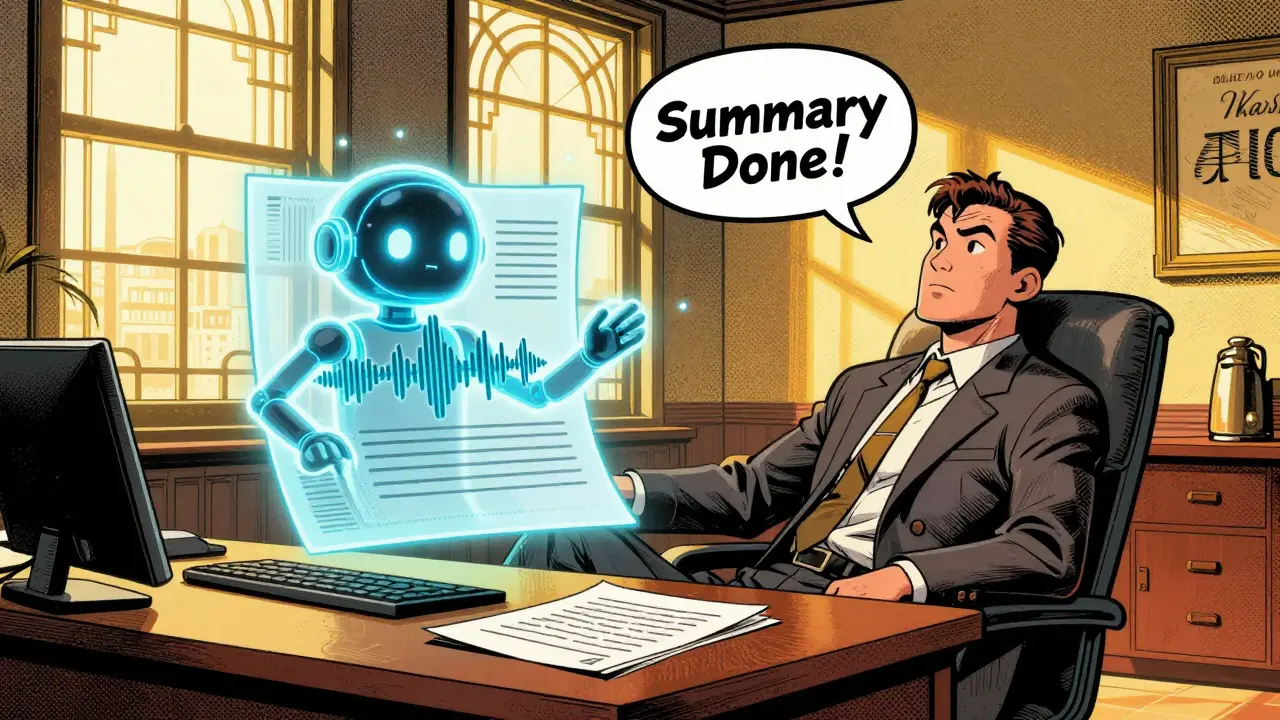
Most businesses start with the low-hanging fruit: automating repetitive, brain-dead tasks. That’s where the quickest wins happen. For example, Commerzbank in Germany replaced manual call documentation with a Gemini-powered AI agent. Before, financial advisors spent 20-30 minutes after every client call writing up notes. Now, the AI listens, extracts key points, and auto-generates a structured summary. Advisors get back hours each week to focus on clients, not paperwork.
Same story at PGIM, a $1.4 trillion asset manager. Their team used generative AI to cut document processing time by 60%. Instead of manually pulling data from 10-page investment reports, the AI reads them, highlights risks, and flags anomalies. That’s not just faster-it’s more accurate. Humans miss things. AI doesn’t, as long as it’s trained right.
Customer service is another big winner. Traditional chatbots answer the same five questions over and over. Generative AI chatbots? They handle open-ended questions like, “I got charged twice but I didn’t cancel anything-what’s going on?” They pull from your knowledge base, check the customer’s history, and respond in natural language. IBM found these systems reduce human handoffs by up to 50% while keeping accuracy above 90%.
Supply Chains Are Getting Smarter
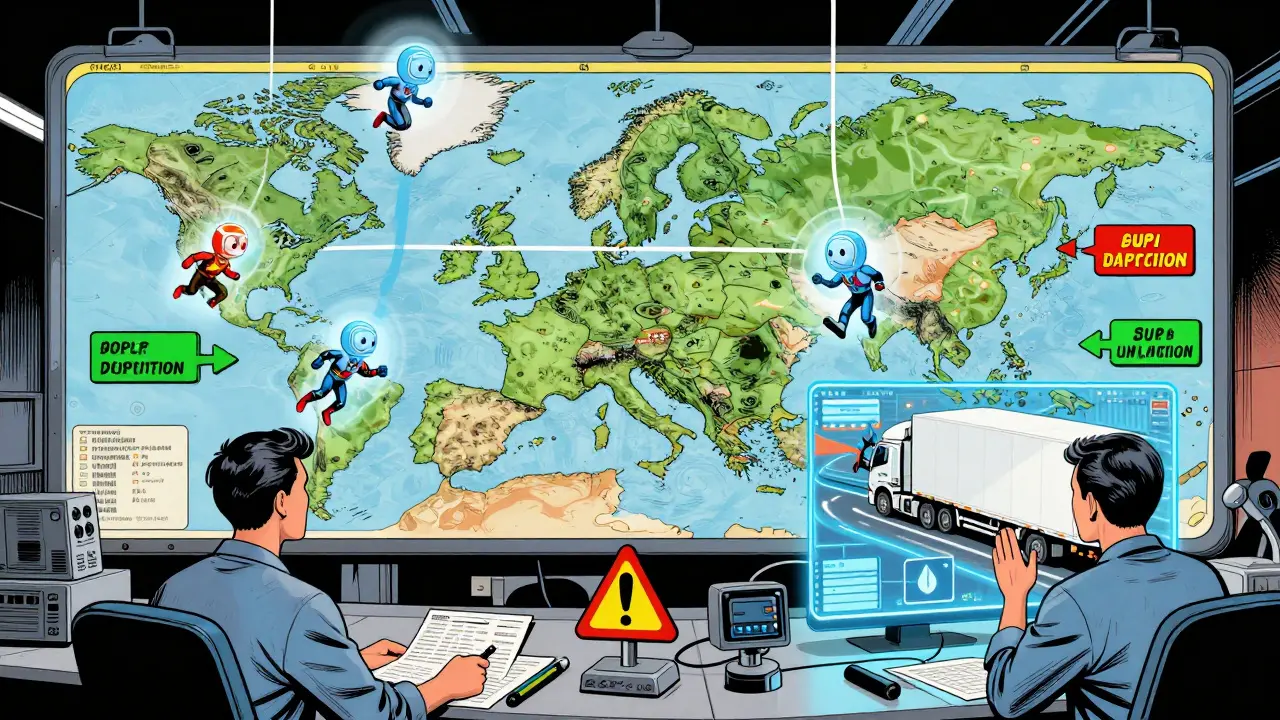
Forget old-school spreadsheets and static forecasts. Generative AI is turning supply chains into dynamic, self-adjusting systems. BMW Group built a digital twin of its entire distribution network using Vertex AI. The system simulates thousands of scenarios: What if a port strike hits? What if demand spikes in Germany but drops in Spain? What if a key supplier’s factory shuts down due to weather? The AI doesn’t just predict-it generates multiple realistic outcomes, each with a risk score and recommended action.
Energy companies are doing the same. One utility in Texas uses generative AI to model how extreme heat, new regulations, and shifting renewable energy adoption will impact grid demand over the next five years. Instead of relying on a single forecast, they get 20 plausible futures. That lets them plan infrastructure upgrades smarter, avoid over-investing, and prepare for blackouts before they happen.
These aren’t experiments. These are operational changes. And the ROI? Companies report 25-35% improvements in inventory accuracy and 20% fewer stockouts.
From Marketing Emails to Product Customization
Marketing teams used to spend days writing variations of the same email. Now, they feed a few customer segments into a generative AI tool and get 50 personalized versions in minutes. Croud, a global media agency, built custom AI “Gems” to auto-generate email campaigns based on user behavior. One Gem analyzes sentiment from customer replies. Another pulls data from their CRM and writes follow-ups tailored to each person’s last interaction. The result? 4-5x faster campaign cycles with higher open and click rates.
Some companies are going further. A home appliance brand now lets customers describe their ideal kitchen layout in plain text-“I need space for two ovens and a coffee station near the window”-and the AI generates a custom product bundle with matching models, colors, and accessories. No designer needed. No back-and-forth. Just instant personalization at scale.
How to Actually Implement This (Without Failing)
Most AI projects fail-not because the tech doesn’t work, but because companies try to boil the ocean. They want to automate everything at once. That’s a recipe for frustration.
The smart approach? Start small. Pick one high-friction, high-volume task. Something that eats up hours but adds little value. Examples:
- Summarizing weekly team meeting notes
- Generating first drafts of client proposals
- Classifying incoming support tickets
- Writing product descriptions for new SKUs
Then build a pilot. Give it to a small team. Track time saved, error rates, and user feedback. Don’t just measure speed-measure quality. Did the AI miss something critical? Did employees trust it? Did it make their jobs easier or just add another step?
Once it works, scale it. But don’t skip the next step: integrate it into your existing systems. Generative AI doesn’t live in a vacuum. It needs access to your CRM, ERP, HR software, and document repositories. If your data is messy or siloed, the AI will be too. Clean your data first. Or at least, clean the part you’re feeding it.
The Hidden Risks (And How to Avoid Them)
Generative AI hallucinates. It makes things up. It sounds convincing. That’s dangerous in finance, legal, or healthcare.
At a regional bank, an AI drafted a loan approval summary and invented a credit score that didn’t exist. The loan officer didn’t catch it. The loan went through. The borrower defaulted. That’s not a glitch-that’s a systemic risk.
Here’s how to protect yourself:
- Always have a human in the loop for high-stakes decisions: approvals, claims, legal docs.
- Use guardrails. Tools like Microsoft’s Azure AI Content Safety or Google’s Gemini Safety Layer can block harmful outputs.
- Train on your own data. Public models are trained on the internet. Your business isn’t the internet. Fine-tune the AI on your internal documents, policies, and past cases.
- Track bias. If your AI keeps recommending male candidates for engineering roles, it’s learning from your past hires. Audit the outputs. Fix the data.
Also, don’t ignore compliance. The EU AI Act and upcoming U.S. rules treat generative AI in hiring, credit scoring, and healthcare as high-risk. If you’re in one of those industries, document every decision the AI makes. Have a clear audit trail. Otherwise, you’re asking for fines-or worse.

What’s Next? Agentic AI and the End of Manual Workflows
The next wave isn’t just AI that responds. It’s AI that acts.
Think of it like a digital assistant that doesn’t wait for you to ask. It notices your sales team is falling behind on follow-ups. It checks their calendar, finds a gap, and auto-schedules a reminder. It sees a spike in customer complaints about shipping delays. It pulls data from logistics partners, identifies the bottleneck, and sends a report to the operations manager with three possible fixes.
That’s agentic AI. And companies like Dun & Bradstreet are already testing it. Their AI doesn’t just write emails-it researches prospects, finds contact info, checks their recent news, and crafts a personalized pitch-all without human input.
This isn’t coming in five years. It’s here now. The question isn’t whether you’ll adopt it. It’s whether you’ll be ready when it starts making decisions without you.
Who’s Winning? Who’s Falling Behind?
Enterprises with over $1 billion in revenue are adopting generative AI at 3.2x the rate of mid-sized companies. Why? They have the data, the IT teams, and the budget to do it right. But that doesn’t mean you’re out of luck.
The real differentiator isn’t size-it’s focus. Companies that win are the ones that tie AI to a specific business problem, not a cool tech trend. They don’t ask, “What can AI do?” They ask, “What’s slowing us down?”
One manufacturer in Ohio didn’t care about fancy chatbots. Their biggest pain? Workers spending hours searching for the right version of a machine manual. They built a simple AI search tool that understands questions like, “How do I recalibrate the CNC press after a tool change?” and pulls the exact page from their 12-year-old PDF archive. Time saved per worker: 1.5 hours per week. Multiply that by 200 employees. That’s 300 hours a month. That’s $150,000 a year in labor costs.
That’s the power of generative AI-not the hype. The real win is when it solves a problem you’ve lived with for years.
Can small businesses use generative AI, or is it only for big companies?
Absolutely. Generative AI tools like ChatGPT, Gemini, and Claude are accessible to anyone with an internet connection. Small businesses can use them for drafting emails, creating social media posts, summarizing customer feedback, or even generating simple reports. The key isn’t having a big IT team-it’s starting small. Pick one repetitive task, test an AI tool on it, and measure the time saved. Many small companies report cutting 10-15 hours a week just by automating basic writing and research tasks.
Is generative AI going to replace my job?
It’s not about replacing jobs-it’s about changing them. AI takes over repetitive, low-value tasks so people can focus on what humans do best: thinking critically, building relationships, solving complex problems, and making ethical decisions. A customer service rep who used to answer the same 10 questions daily can now handle tricky complaints that require empathy and judgment. An accountant who spent hours pulling data can now analyze trends and advise clients. The goal isn’t to eliminate roles-it’s to elevate them.
How much does it cost to implement generative AI in my business?
It depends. You can start for free using public tools like ChatGPT or Gemini. If you need to connect AI to your internal systems (CRM, ERP, etc.), you’ll likely need a cloud platform like Google Vertex AI, Microsoft Azure OpenAI, or AWS Bedrock. Basic integrations can cost $5,000-$20,000 in setup and training. More complex projects-like building custom AI agents for supply chain or HR-can run $50,000-$200,000. But most businesses see a return in under six months through labor savings and faster turnaround times.
What data do I need to make generative AI work well?
You need clean, organized, and relevant data. For customer service, that means your knowledge base, past tickets, and FAQs. For marketing, it’s past campaigns, customer segments, and response rates. For internal processes, it’s policy documents, SOPs, and past project files. The AI learns from what you feed it. If your data is scattered across 10 different folders or full of outdated info, the AI will be too. Start by cleaning up the data you plan to use-don’t wait for the AI to fix it.
How do I know if my generative AI project is working?
Track three things: time saved, error rate, and user adoption. If employees are using the tool regularly and saying it helps, that’s a good sign. If it’s cutting task time by 30% or more, you’re on the right track. But if people are constantly correcting it or avoiding it, something’s wrong. That could mean bad training data, poor integration, or unclear expectations. Don’t just measure output-measure experience. The best AI tools feel invisible because they just make work easier.
Where to Go From Here
Don’t wait for someone else to do it first. Pick one task this week that’s boring, repetitive, and time-consuming. Try an AI tool on it. See what happens. Talk to the people who do that task every day. Ask them what they’d love to automate. That’s your starting point.
Generative AI isn’t magic. It’s a tool. And like any tool, its value depends on how you use it. The companies that win aren’t the ones with the fanciest tech-they’re the ones who used it to solve real problems, not chase trends.


9 Comments
Dmitriy Fedoseff
Look, I’ve seen this movie before. Every tech hype cycle starts with ‘this changes everything’ and ends with half the companies regretting they didn’t just hire a damn intern. But this time? It’s different. Not because AI is magic-it’s because the tasks it’s eating are the ones nobody wanted to do anyway. I work in logistics in Toronto, and our warehouse guys used to spend two hours a day hunting down PDFs of shipping manifests. We threw a basic RAG model at it, trained on our internal docs, and now it answers ‘Where’s the BOL for shipment 7821?’ like it’s reading a text. No more yelling across the floor. That’s not innovation. That’s just dignity.
Meghan O'Connor
Typo in the first paragraph: ‘it’s sitting in your company’s customer service queue’ - should be ‘it’s sitting IN your company’s…’ No, wait, it’s ‘on’ not ‘in.’ And ‘drafting emails for your sales team’ - ‘drafting’ is a gerund, not a verb here, so it’s grammatically sloppy. Also, ‘brain-dead tasks’? That’s not just lazy language, it’s dehumanizing. Who wrote this? Someone who’s never actually done customer service? The AI might be good, but your prose is garbage.
Morgan ODonnell
Man, I read this whole thing and all I could think was - my cousin runs a small bakery in Cork. She uses ChatGPT to write her weekly Instagram captions. Used to take her 45 minutes. Now it’s 5. She still picks the best one, tweaks the emojis, adds a photo of the croissants. Doesn’t feel like cheating. Feels like she got her Sunday back. That’s the real win. Not the $200K AI projects. It’s the lady who finally gets to sit down with her coffee before the rush.
Liam Hesmondhalgh
Yeah sure, AI’s great for Americans with their fancy cloud credits and IT departments. Here in Ireland, we’re still stuck with Outlook 2010 and a guy named Seán who prints everything out because ‘the system crashed last time.’ You talk about BMW and PGIM like they’re normal companies. We’re lucky if our accountant doesn’t send invoices in Comic Sans. This isn’t a revolution - it’s a luxury for the rich. Meanwhile, my uncle’s plumbing business still uses a clipboard and a pencil. And he’s doing just fine. Maybe we don’t need your shiny AI toys.
Patrick Tiernan
Okay but like… who even wrote this? It reads like a LinkedIn post written by a guy who went to a 2-hour webinar and now thinks he’s a CTO. ‘Agentic AI’? ‘Digital twin’? ‘Dynamic self-adjusting systems’? Bro. You sound like a startup founder trying to raise a seed round. Real companies don’t talk like this. They just fix the damn printer and move on. Also, ‘hallucinates’? That’s not a word. It’s just wrong. Stop pretending AI is sentient. It’s a fancy autocomplete with a PhD in BS.
Patrick Bass
Minor thing - you mention ‘Gemini-powered AI agent’ at Commerzbank. That’s not accurate. They’re using a fine-tuned version of a Llama model, not Gemini. Google hasn’t publicly disclosed any partnership with them. I know because I checked their press releases last month. Also, ‘20-40% time savings’ - that’s an aggregate. Some teams saved 5%, others saved 60%. Don’t mislead people with averages. And please, for the love of all that’s holy, stop saying ‘AI doesn’t miss things.’ It misses things constantly. It just does so quietly.
Tyler Springall
This entire post is a corporate fantasy. You treat AI like it’s a neutral tool, but it’s not. It’s a mirror of human bias, corporate greed, and data colonialism. You talk about ‘saving time’ like that’s a virtue. What about the workers whose jobs are being hollowed out? Who’s paying them to retrain? Who’s covering their mental health when they realize their expertise is now a prompt? This isn’t progress. It’s automation with a PR team. And you’re selling it like it’s a gift.
Colby Havard
While I appreciate the general tone of pragmatism in this article, I must emphasize the profound ethical lacuna present in its framing. The author repeatedly asserts that AI merely ‘saves time’ or ‘increases efficiency,’ thereby implicitly endorsing the commodification of human labor under the guise of technological advancement. This is not innovation-it is reification. Furthermore, the assertion that ‘AI doesn’t miss things’ is not only empirically false, but epistemologically dangerous. It reflects a dangerous techno-optimism that ignores the ontological instability of probabilistic models. One must ask: Who bears the liability when the AI hallucinates a credit score? The engineer? The compliance officer? Or the algorithm itself? The answer, of course, is none of them-and that is precisely the problem.
Amy P
Okay I just cried. Not because it’s sad. Because I’ve been doing this for 8 years and NO ONE gets it. My team used to spend 12 hours a week writing product descriptions for 300 SKUs. We used a free version of ChatGPT, fed it our old listings, and now it writes them in 20 minutes. We still edit them. But now we have time to call customers and ask ‘what do you actually want?’ One guy told us he needed a wrench that didn’t slip in wet conditions. We redesigned the handle. Sold 2000 more in a month. AI didn’t do that. WE did. And now we’re not just selling tools-we’re listening. Thank you for writing this. I needed to see someone say it out loud.