
Generative AI Is Changing How Governments Work
Think about the last time you called your local government office. Was it easy to get help? Did you wait days for a reply? Did you have to dig through pages of confusing forms just to apply for a permit or check your tax status? For millions of people, dealing with public services still feels like navigating a maze with no map. But in 2026, that’s starting to change-not with more staff, not with bigger budgets, but with generative AI.
It’s not science fiction. Cities and states are already using AI to answer questions, write policy drafts, and sort through thousands of records. The goal isn’t to replace people. It’s to give overworked government employees a helping hand so they can focus on what matters: helping real people.
Citizen Services: AI That Answers When You Need It
Imagine calling your city’s housing department at 10 p.m. on a Sunday because your heat went out and you’re not sure if you qualify for emergency aid. Instead of voicemail, you get a clear, calm voice that asks: "Are you looking for emergency heating assistance?" Then it walks you through eligibility, pulls up your application history, and even schedules a follow-up call with a caseworker-all in under two minutes.
This isn’t hypothetical. In cities like Chicago and Seattle, AI-powered chatbots now handle over 60% of routine citizen inquiries. These systems don’t just repeat scripts. They understand context. If you mention you’re a senior on a fixed income, they adjust recommendations. If you’re a parent asking about school lunch programs, they link you to the right forms and even remind you of deadlines.
Platforms like Salesforce’s Government Cloud use something called the Einstein Trust Layer to make sure data stays secure and private. That’s critical. People don’t trust AI if they think their personal info is being shared. The best systems are built with strict access controls, audit trails, and compliance with federal privacy laws like HIPAA and FERPA.
And here’s the kicker: voice AI is becoming the great equalizer. Older adults, people without smartphones, and those who aren’t comfortable typing-all can now interact with government services using just their voice. In North Carolina, a pilot program let residents call a toll-free number and ask, "How do I apply for food stamps?" The AI responded in plain language, offered translation options, and even mailed a paper application if requested. Usage jumped 40% in three months.
Policy Drafting: AI as a Co-Pilot, Not a Judge
Writing laws and regulations used to mean stacks of paper, endless meetings, and last-minute edits. Now, AI helps draft policy faster-without taking over.
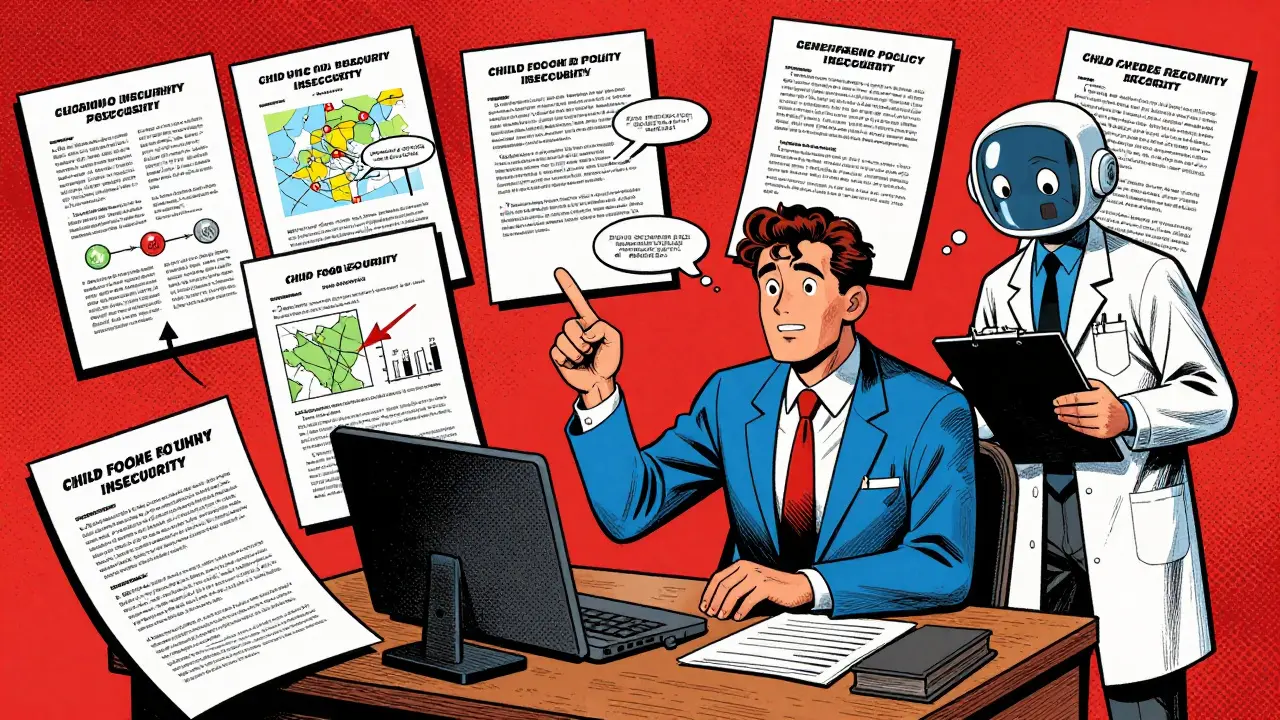
Here’s how it works: A policy analyst types in the goal: "Reduce child food insecurity in rural counties by 25% in two years." The AI doesn’t write the law. Instead, it generates five possible approaches-each with different funding models, eligibility rules, and delivery methods. It pulls in data from past programs, compares outcomes in similar states, and flags potential loopholes or unintended consequences.
Deloitte calls this "generative design." It’s not about automation. It’s about expanding options. Human experts still choose the final path. But now they’re not starting from a blank page. They’re reviewing smart suggestions backed by real data.
In Washington, D.C., the city’s policy team used AI to draft a new childcare subsidy program. The AI suggested including transportation vouchers-a detail human staff had overlooked. The final policy included it. Enrollment rose 30% in the first quarter.
And it’s not just about writing. AI helps predict impact. Before a new zoning law goes live, it simulates how it might affect traffic, housing prices, or small business survival. That kind of foresight used to take months. Now it takes hours.
Records Management: Turning Chaos Into Clarity
Government agencies sit on mountains of paper and digital files. Birth certificates. Tax returns. Police reports. School records. Many are stored in formats no one can easily search. Finding a single document can take days.
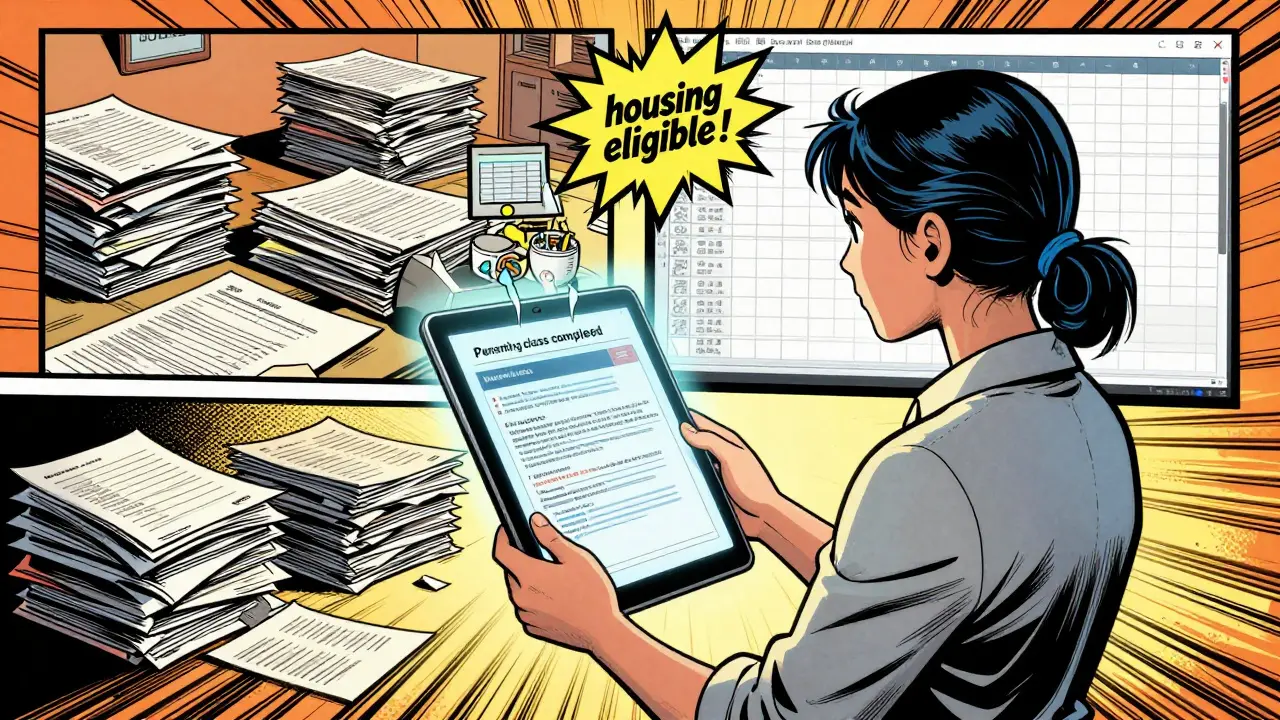
Generative AI is changing that. It can read, summarize, and tag documents automatically. A social worker handling a child welfare case no longer has to flip through 50 pages of past reports. The AI pulls out key facts: "Child was removed in 2023 due to neglect. Mother completed parenting class in Jan 2025. Father has no criminal record. Family eligible for housing support."
Even better, it connects the dots. If a family applies for unemployment and then later for food assistance, the AI flags that as a possible pattern of economic stress. That triggers a proactive outreach-not a reactive form.
States like Utah and Georgia are using AI to process thousands of permit applications a month. Instead of humans checking every line, AI scans for missing signatures, incorrect addresses, or outdated codes. It flags only the risky ones for review. The result? Processing time dropped from 14 days to under 48 hours.
And it’s not just about speed. It’s about fairness. AI can detect if certain groups are consistently getting denied permits or delayed responses-something humans might miss due to bias or workload. When the system found that applications from Spanish-speaking neighborhoods were taking twice as long, the city added automated translation and assigned bilingual reviewers. Wait times evened out within weeks.
Why 2026 Is the Turning Point
For years, AI in government was all about pilots. A few departments tested chatbots. One agency tried summarizing meeting notes. But in 2026, something shifted. Pressure is mounting-from taxpayers, from elected officials, from staff drowning in paperwork-to show real results.
Will Weatherford, former Florida House speaker and now a public sector advisor, says it plainly: "2026 will bring more pressure on AI-from financial backers, government officials and skeptical residents-to produce results."
And it’s working. In Michigan, a pilot program using AI to handle unemployment claims saved $12 million in labor costs in its first year. In California, AI-driven alerts reduced missed vaccine appointments by 58% in low-income areas. In Texas, a system that auto-summarized police reports cut report-writing time by 70%-freeing officers for patrol.
But here’s what most people don’t realize: the biggest wins aren’t in the numbers. They’re in the moments. A single mother gets her SNAP benefits approved in hours, not weeks. A veteran finds his disability paperwork processed without having to call six different offices. A small business owner gets a building permit without hiring a lawyer to decode the rules.
These aren’t tech upgrades. They’re dignity upgrades.
The Real Challenge: Trust, Not Tech
There’s no shortage of tools. The real hurdle is trust.
People worry AI will make mistakes. Or worse-make unfair decisions. And they’re right to worry. If an AI denies someone housing because it misreads a past eviction as fraud, that’s life-altering.
That’s why the best public sector AI systems are built with transparency in mind. They don’t just spit out answers. They show their work. If you ask, "Why was my application denied?" the system doesn’t say "Algorithm rejected." It says: "Your income was below the threshold for this program. You may qualify for Program B. Here’s the link. Would you like help applying?"
Training matters too. AI learns from data. If the data is biased-say, older records that undercounted minority applicants-the AI will be too. Leading agencies now require bias audits before any AI tool goes live. Microsoft’s Azure OpenAI Service and Salesforce’s Einstein Trust Layer both include built-in fairness checks.
And then there’s the human factor. No government should ever rely on AI alone. The best systems are designed as copilots. A social worker still makes the final call. A mayor still signs the law. But now they’re doing it with better information, less stress, and more time to listen.
Where This Is Going Next
By 2027, expect AI to start predicting needs before they arise. If your child’s school has a pattern of low attendance, the system might automatically send a family support worker a note: "Family with two children has missed 8 days this semester. Suggested outreach: transportation assistance or childcare referral."
Or imagine a system that notices a spike in utility shutoff notices in a neighborhood and proactively offers energy assistance before anyone even applies.
This isn’t about surveillance. It’s about care. It’s about making government feel less like a bureaucracy and more like a neighbor who shows up when you need them.
The tech is ready. The data is there. The question now isn’t whether governments can use AI. It’s whether they’ll use it wisely-and fast enough to help the people who need it most.
Can generative AI replace government workers?
No. Generative AI is designed to assist, not replace. It handles repetitive tasks like answering FAQs, summarizing documents, or drafting initial policy versions. This frees up human workers to focus on complex cases, emotional support, and decisions that require judgment. For example, an AI might flag a child welfare case needing attention, but a social worker still makes the final call on intervention. The goal is to reduce burnout and increase impact-not eliminate jobs.
Is generative AI in government secure?
Security is the top priority. Leading platforms like Salesforce’s Einstein Trust Layer and Microsoft’s Azure OpenAI Service are built with government-grade encryption, access controls, and compliance with federal regulations like FISMA and NIST. Data never leaves secure government clouds. Audits are required before deployment, and systems are designed to avoid training on sensitive personal data. No AI tool is approved without passing strict cybersecurity reviews.
How do governments pay for AI systems?
Many AI tools are funded through efficiency savings. For example, if an AI reduces call center staffing needs by 40%, that money can be redirected to fund the AI platform. Federal grants, state tech innovation funds, and partnerships with vendors like Microsoft and Salesforce also help offset costs. Some agencies start small-testing AI on one service like permit applications-and scale only after proving cost savings and improved service delivery.
What happens if AI makes a mistake?
Every AI system in government must have a human review path. If an AI denies a benefit, misreads a record, or gives wrong advice, citizens can appeal-just like with any other government decision. The system logs every action, so errors can be traced and corrected. Agencies also run regular audits and update training data to reduce future mistakes. Transparency is key: citizens should always know when they’re interacting with AI and how to reach a person if needed.
Which government services are using AI right now?
As of 2026, AI is actively used in citizen service chatbots, tax filing assistants, unemployment claims processing, permit applications, child welfare case summaries, police report drafting, and public health alert systems. Cities like Chicago, Seattle, and Washington, D.C., and states like Utah, California, and Michigan have rolled out live systems. The most common focus is on high-volume, rule-based tasks where speed and accuracy matter most.
5 Comments
deepak srinivasa
I’ve seen AI chatbots in India handle ration card queries, but they still choke on regional accents. If this works in Chicago, why not in Bihar? The tech’s ready - it’s the infrastructure that’s not.
NIKHIL TRIPATHI
My cousin works in a municipal office in Lucknow. She says they tried an AI tool for property tax queries last year. It cut her workload by half, but old-timers still refused to use it. Said it "didn’t understand our way of asking." But once they let it learn from actual calls - not scripted examples - it got way better. Real training data beats perfect algorithms every time.
Shivani Vaidya
The most profound shift here is not technological but cultural. Governments have spent decades treating citizens as cases, not people. Generative AI, when implemented with humility, forces a reorientation: it must respond clearly, patiently, and with context. This is not automation. It is accountability made audible. The systems that succeed will be those that prioritize clarity over cleverness, and human dignity over efficiency metrics.
Rubina Jadhav
My mom used the voice bot for food stamps. She didn’t even know what AI was. She just said, "It talked nice and didn’t rush me." That’s all that matters.
Jitendra Singh
I work in public health in Hyderabad. We tested an AI that flagged missed vaccine appointments. It worked so well we started sending SMS reminders to parents. But then we noticed it only sent them in English. Turns out, the training data was mostly from urban centers. We added Hindi, Telugu, and Urdu. Now uptake’s up 40%. The lesson? AI doesn’t need to be smart. It needs to be inclusive. And that’s harder than coding.