
Your monthly bill for Large Language Models is likely spiraling out of control. You aren't alone. In 2025, enterprises began reporting production deployment costs exceeding $250,000 per month. The problem isn't that the models are too expensive; it's that most companies are using a sledgehammer to crack a nut. They route every single query-whether it’s a simple "Hello" or a complex legal analysis-to their most powerful, expensive model.
Fixing this doesn't mean settling for worse answers. It means making smarter architectural decisions. By implementing specific patterns like intelligent model routing, semantic caching, and right-sizing, organizations can cut these bills by 30% to 80% while maintaining 95-98% of the original output quality. This guide breaks down exactly how to build that architecture without sacrificing performance.
1. Right-Sizing: Stop Using GPT-4 for Everything
The first and easiest mistake to fix is defaulting to the biggest model available. Model Right-Sizing is the practice of selecting the smallest parameter-efficient model that meets your specific quality thresholds. Think about it: do you need a supercomputer to tell a customer what your return policy is?
Data from FutureAGI’s 2025 analysis shows that standard customer service queries make up about 78% of interactions. For these tasks, a model like GPT-3.5-turbo performs nearly identically to its larger counterparts but at 30% of the cost. DeepChecks’ 2024 benchmarking confirms that simply switching from a default large model to a right-sized one reduces token costs by 25-40% immediately.
To implement this, you need to define your quality metrics. Use F1-scores for classification tasks or BLEU scores for translation. If a smaller model hits 95% of the score of the larger model on your specific dataset, use the smaller one. Save the heavy hitters for when they are actually needed.
2. Intelligent Model Routing: The Traffic Cop Approach
If right-sizing is step one, Intelligent Model Routing is a tiered processing system where a lightweight classifier directs queries to different models based on complexity. This is widely considered the highest-impact architectural decision you can make.
Here is how it works in practice:
- The Classifier: You deploy a tiny, cheap model (often around 125 million parameters) whose only job is to read the incoming query.
- Tier 1 (Simple): Greetings, FAQs, and confirmations go to ultra-cheap models like Claude Haiku ($0.00015 per 1K input tokens).
- Tier 2 (Standard): General conversations and moderate reasoning go to mid-tier options like GPT-4o-mini ($0.00075 per 1K input tokens).
- Tier 3 (Complex): Only deep reasoning, coding, or nuanced creative tasks hit premium models like GPT-4 ($0.03 per 1K input tokens).
Dr. Sarah Chen from Stanford HAI noted in her 2025 IEEE paper that this approach can reduce costs by 40% while maintaining 97.3% of the top model's performance on 80% of queries. Maxim AI’s 2025 benchmarks validate this, showing 37-46% cost reductions in production environments. The trade-off? It takes 2-3 weeks of engineering effort to build the classifier and tune the routing logic, but the ROI is immediate once live.
3. Prompt Engineering as Cost Control
You might think prompt engineering is just about getting better answers, but it’s also a massive lever for cost reduction. Every token you send and receive costs money. Prompt Optimization is the technique of reducing token consumption through concise phrasing, context truncation, and explicit output constraints.
DeepChecks documented a 40% token reduction in enterprise deployments simply by removing redundant context from prompts. Instead of pasting an entire 50-page document into the context window, summarize the relevant sections first. Alexander Thamm measured an additional 20-40% savings just by adding output length constraints, such as telling the model, "Limit your response to two sentences."
This is the fastest win. You don’t need new infrastructure. You just need your engineers to audit their prompts. However, be careful. Dr. Elena Rodriguez from MIT warned in 2024 that aggressive context truncation can degrade accuracy by 15-20% on complex tasks. The solution? Use summarization pipelines instead of hard cuts. Summarize the context before sending it to the main model. This maintains 98% accuracy while still cutting token usage significantly.

4. Semantic Caching: Don't Pay Twice for the Same Answer
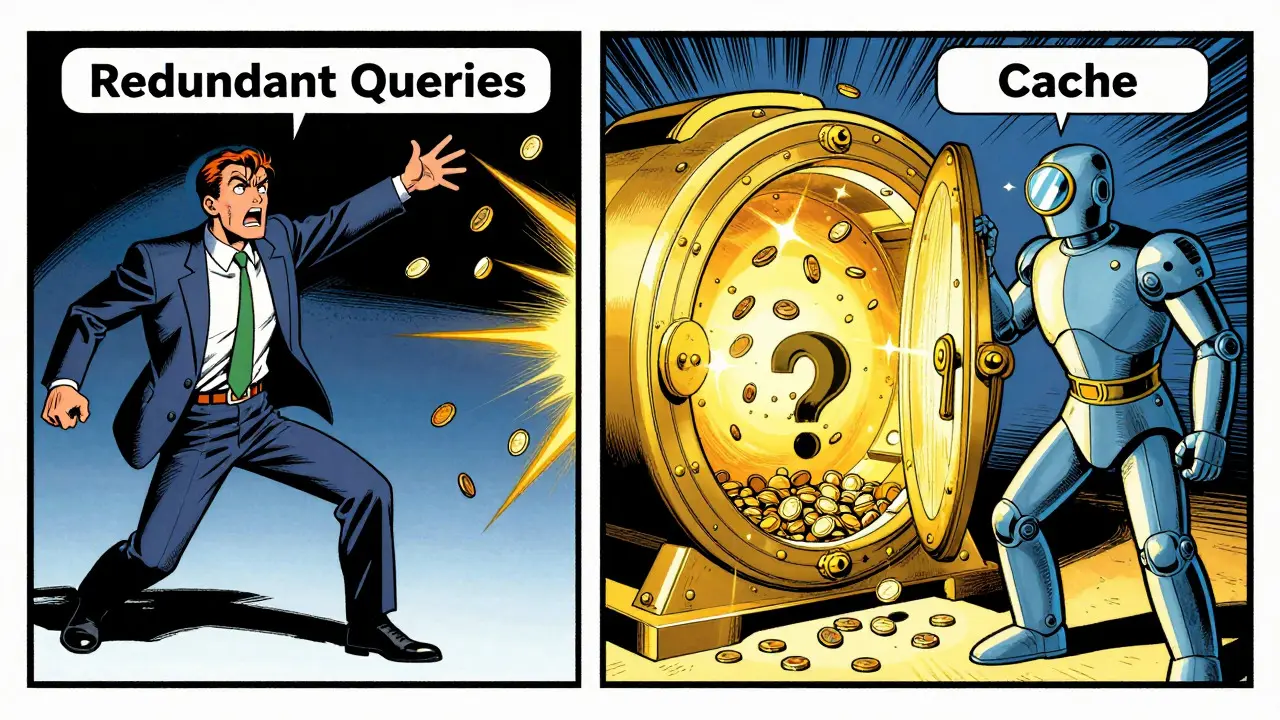
How many times does a user ask, "What are your business hours?" Probably thousands. If you pay the LLM API for every single instance, you are throwing money away. Semantic Caching is a storage layer that identifies similar previous queries and returns cached responses without hitting the LLM.
Unlike traditional exact-match caching, semantic caching uses embeddings to understand intent. If a user asks "When do you close?" and another asks "What time do you shut down?", the cache recognizes them as semantically identical and serves the stored answer from a database like Redis.
A Shopify engineer reported on Reddit in April 2025 that implementing Redis semantic caching dropped their monthly bill from $82,000 to $31,000 with zero user complaints. For applications with high query repetition (like customer support), savings of 40-60% are common. Leanware’s 2025 case studies show that even modest caching strategies deliver 15-30% overall cost reductions across mixed workloads.
5. Quantization: Shrinking the Model Footprint
If you are running open-source models locally, Quantization is the process of reducing model weight precision from 32-bit to 8-bit or 4-bit to decrease memory usage and speed up inference. This is less about API calls and more about hardware efficiency.
By converting weights to lower precision, you can reduce memory footprint by 75-90%. This allows you to run larger models on cheaper hardware or fit multiple models on a single GPU. DeepChecks’ 2024 benchmark showed that quantizing Llama-2-70B to 4-bit using GGUF format accelerated inference by 2-4x.
However, there is a risk. A healthcare startup shared a cautionary tale on HackerNews in May 2025: they aggressively quantized their medical diagnosis model to 3-bit, causing a 12% accuracy drop that cost them $250k in remediation. Stick to 4-bit or 8-bit quantization for critical tasks. Use engines like llama.cpp or vLLM which handle this efficiently. Avoid going below 4-bit unless you are doing non-critical, edge-case testing.
Comparison of Architectural Strategies
| Strategy | Cost Reduction Potential | Implementation Effort | Best For |
|---|---|---|---|
| Right-Sizing | 25-40% | Low (1-2 weeks) | All workloads |
| Model Routing | 37-46% | Medium (2-3 weeks) | Mixed-complexity apps |
| Prompt Optimization | 20-40% | Low (Immediate) | Quick wins, all teams |
| Semantic Caching | 15-60% | Medium (2-4 weeks) | High repetition queries |
| Quantization | 75-90% (Memory) | High (Requires MLOps) | Local/Edge deployments |
Building the Layered Architecture
The magic happens when you combine these techniques. Redis’ 2026 LLMOps Guide recommends a specific layered flow to maximize savings without breaking user experience:
- Semantic Cache: Check if a similar question was asked recently. If yes, return the cached answer.
- Prompt Cache: Store and reuse frequent prefix contexts to avoid re-processing unchanged data.
- Model Router: Analyze the query complexity and assign it to the appropriate model tier.
- Inference Engine: Run the query on the selected model (using quantization if local).
- Response Cache: Store the final output for future semantic matches.
Maxim AI’s side-by-side testing of 15 enterprise deployments found that this layered approach outperforms single-technique implementations by 18-22% in total cost savings. It creates a funnel where cheap solutions catch the majority of traffic, leaving the expensive models to handle only the truly difficult problems.
Common Pitfalls to Avoid
Even with the best plan, things can go wrong. Alexander Thamm’s 2025 checklist highlights three major failure points:
- Insufficient Logging: 63% of failed implementations lacked proper query logging. If you don't log which queries hit which models, you can't measure your savings or tune your router.
- Poor Fallback Logic: 37% of service interruptions happened because the router failed silently. Always have a fallback to a reliable model if the classifier crashes or misbehaves.
- Ignoring Quality Metrics: 22% of quality degradation cases occurred because teams focused only on cost. Set a hard threshold: if accuracy drops below 95% of the baseline, revert the change.
Collaboration is key. Dr. Michael Wu from FutureAGI emphasized that technical fixes alone rarely exceed 20% savings. Product and Engineering teams must work together to identify waste patterns. Engineers optimize the code; Product defines what "good enough" looks like for each task type.
Next Steps for Implementation
Start small. Audit your current logs to see what percentage of queries are simple vs. complex. Implement prompt optimization today-it requires no code changes, just better instructions. Next, set up a basic semantic cache using Redis. Once those are stable, invest the 2-3 weeks needed to build a model router. Monitor your costs and quality metrics weekly. The goal is not just to spend less, but to spend wisely, ensuring every dollar contributes to a better user experience.
How much can I realistically save on my LLM bill?
Most enterprises see a 30-50% reduction in costs by implementing a combination of right-sizing, prompt optimization, and caching. More comprehensive architectures including model routing can push savings to 40-60%. Specific results depend on your query mix; high-repetition workloads benefit most from caching.
Does model routing affect response latency?
Minimal impact. The lightweight classifier adds only milliseconds to the initial processing time. Because simpler queries are routed to faster, smaller models, the overall end-to-end latency often improves for the majority of users.
Is semantic caching safe for dynamic content?
It depends on the TTL (Time-To-Live) settings. For static information like FAQs or product specs, it is very safe. For real-time data like stock prices or weather, you must set short TTLs or exclude those queries from the cache to ensure freshness.
What is the risk of quantization on model accuracy?
Quantizing to 4-bit or 8-bit typically results in a negligible accuracy drop (1-3%) for general tasks. However, specialized domains like medical or legal QA may see drops of 5-12% if quantized too aggressively (e.g., to 3-bit). Always benchmark on your specific dataset before deploying.
Do I need a dedicated MLOps team to implement these strategies?
Not for the basics. Prompt optimization and right-sizing can be done by any developer. Semantic caching and model routing require some infrastructure knowledge but can be implemented by senior backend engineers. Full automated pipelines and advanced quantization may benefit from MLOps expertise.




7 Comments
Chandan Singh
Look, the theory is sound but in practice most teams just slap a classifier on top and call it a day without proper evaluation metrics. The real issue isn't the routing logic itself but the lack of rigorous A/B testing against the baseline model for every single tier. You think you're saving money but you're actually bleeding quality on edge cases that your tiny 125M parameter model can't even comprehend. It's not about being cheap it's about having the engineering discipline to measure what matters instead of just looking at the invoice.
Brannen Hall
This is all just hype recycled from last year. Nobody wants to spend three weeks building a router for marginal gains when they could just pay the API provider and move on with their lives. The ROI calculations are always skewed by optimistic assumptions that never hold up in production chaos. Stop trying to fix architecture problems with more code and just accept that LLMs are expensive because they are powerful tools not free utilities.
tiffany King
I love this perspective because it empowers us to take control rather than just paying the bill blindly. Implementing semantic caching was such a win for our team and seeing those numbers drop felt amazing. It really shows that we don't have to sacrifice quality if we just get creative with how we structure our requests. Keep sharing these insights because they make the tech feel so much more manageable and less scary!
Brenna Gonedrman
It is absolutely shocking how many companies are still burning cash like there is no tomorrow. I saw a startup go bankrupt last month just because they didn't read a basic guide like this one. They were using GPT-4 for simple greetings and then wondered why their runway vanished. It is tragic really because the solution was right there in front of them all along. We need to stop acting like geniuses when we are just being lazy with our infrastructure choices.
Onyinyechi Nwosu
i feel like people forget that behind these bills are real teams trying to do their best with limited resources its easy to criticize but hard to implement when deadlines are tight and pressure is high maybe we should be kinder to ourselves while learning these new systems
Courtney Wagstaff
The idea of a traffic cop for queries is just brilliant and kind of poetic in its own way. It reminds me of sorting mail where you want the heavy packages handled by the big trucks and the letters zipped through by bikes. There is an elegance to optimizing flow that feels almost artistic when you see the data moving smoothly without bottlenecks. It turns dry engineering into a dance of efficiency and balance that I find deeply satisfying to watch unfold in our dashboards.
Elisabeth Ballet
Let's get this straight: you either implement these strategies now or you stay broke and inefficient. There is no middle ground for mediocrity in 2025. Start auditing your logs today because excuses won't pay your cloud bill. Right-sizing is not optional it is mandatory for any team that wants to survive. Stop waiting for permission to optimize your stack and just do the work because the market rewards speed and precision not laziness and waste.