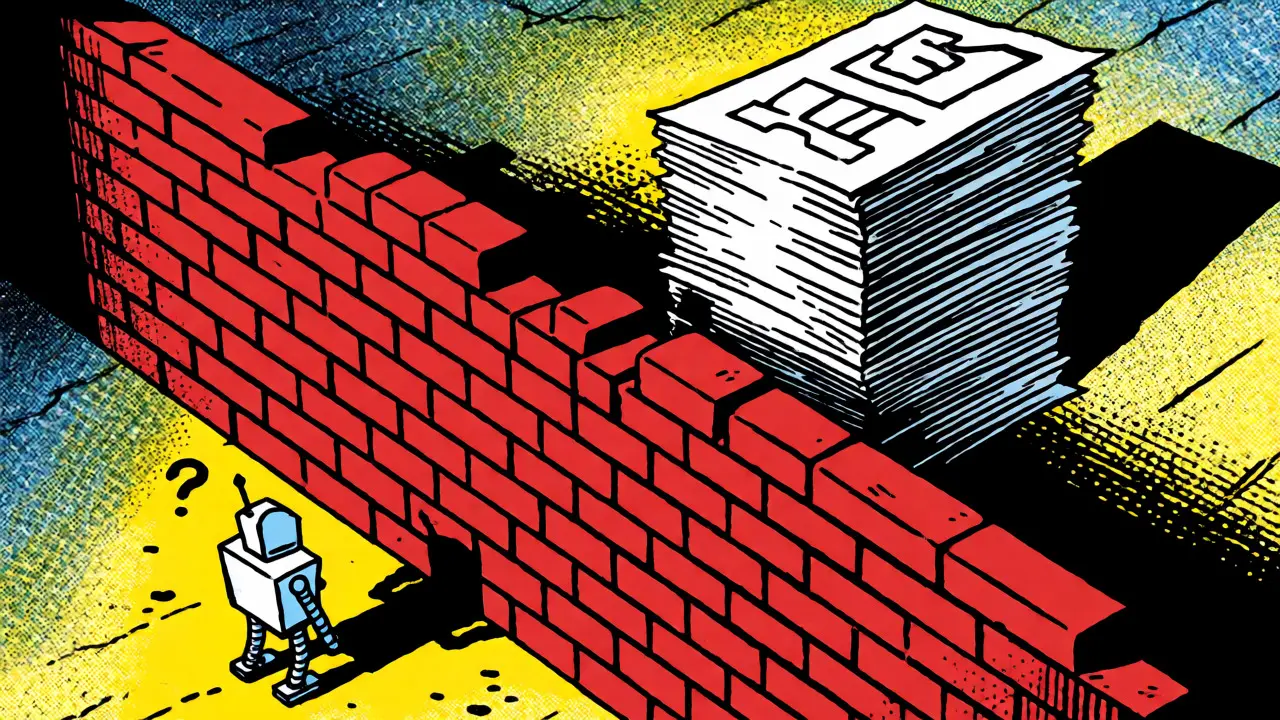
Remember the last time you tried to paste a 50-page legal contract into an AI chatbot? It likely forgot the first paragraph by the time it reached page ten. This isn't just an annoyance; it's a fundamental architectural flaw known as the "context wall." Traditional transformers treat every new word like they are reading the document for the first time, causing computational costs to explode as text gets longer. But something shifted in early 2026. We aren't just getting bigger windows anymore; we are getting models that actually remember.
The industry has moved from the Prompt Era to the Context Era. The breakthroughs coming out of NVIDIA and Google Research this year have solved the latency and memory bottlenecks that made million-token contexts impractical. If you are building agentic systems or handling massive document sets, understanding these new architectures is no longer optional-it's your competitive edge.
The Death of the Context Wall
For years, scaling context length was a losing battle against physics. Standard attention mechanisms require O(n²) complexity. This means if you double the input length, the processing time quadruples. By the time you hit 1 million tokens, the system grinds to a halt. NVIDIA’s recent data highlights the absurdity: processing the 10-millionth token used to take one million times longer than the 10th token. That is not just slow; it is unusable for real-time applications.
NVIDIA TTT-E2E (Test-Time Training End-to-End) changes the game by treating the input context as training data during inference. Instead of storing every past interaction in a growing cache, the model compresses the history into its weights on the fly. The result? Constant latency regardless of context length. On H100 GPUs, TTT-E2E delivers 2.7x faster inference for 128K contexts and a staggering 35x speedup for 2M token contexts compared to full attention methods. This isn't a minor optimization; it removes the ceiling on how much information an AI can hold in working memory.
How Google Titans Handles Persistent State
While NVIDIA focuses on compression via test-time training, Google’s Titans architecture takes a different route: selective memory storage. Released in January 2026, Titans introduces a neural long-term memory module that acts less like a hard drive and more like a human brain’s hippocampus. It doesn't store everything. It stores what matters.
The core innovation here is the "surprise" mechanism. The model calculates gradients to determine which inputs are unexpected. If you are discussing financial reports and the next word is "revenue," the surprise score is low, so it gets minimal storage priority. But if a picture of a banana peel appears in that same financial report, the surprise score spikes, triggering permanent storage in long-term memory. This allows Titans to scale beyond 2 million tokens while outperforming larger models like GPT-4 on reasoning benchmarks like BABILong. It solves the recall problem by filtering noise before it ever hits the memory bank.
Infrastructure: The New Bottleneck
You might think better algorithms mean you can run this on your existing servers. Think again. WEKA’s analysis of the CES 2026 announcements makes one thing clear: inference didn't hit a compute wall; it hit a context memory wall. You cannot just swap in a new model; you need new infrastructure to feed it.
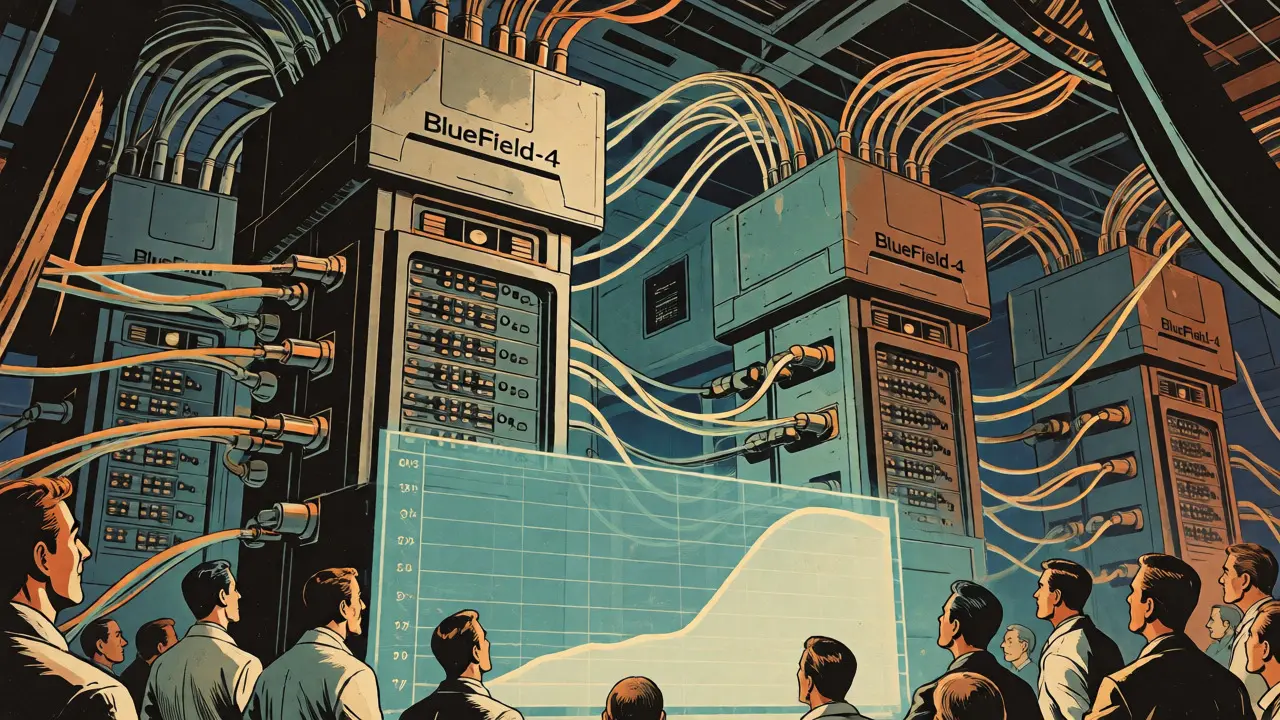
BlueField-4 Data Processors and NVMe-backed fabrics are becoming standard requirements. These systems use RDMA (Remote Direct Memory Access) and GPUDirect Storage to extend GPU memory capacity without stalling the processor. When your KV cache (Key-Value cache) grows too large, traditional systems either stall waiting for data or evict useful memories to make room. The new hardware treats context as a first-class resource, ensuring that high-speed retrieval matches the model's ability to process it. If your IT team hasn't budgeted for 400GB/s interconnect speeds, your long-context deployments will bottleneck at the I/O layer, not the algorithm.
| Architecture Type | Example Model | Latency Scaling | Recall Accuracy | Best Use Case |
|---|---|---|---|---|
| Full Attention | GPT-4.5 / Claude 3.7 | O(n²) - Slow at scale | Near-Lossless | Short docs (<128k tokens) |
| Approximate Attention | Mamba-2 / Sliding Window | Constant | Degrades >128k tokens | Streaming video/audio |
| Neural Memory | Google Titans | Constant | High (Selective) | Complex reasoning over huge docs |
| Test-Time Training | NVIDIA TTT-E2E | Constant | Balanced High | General purpose long-context |
The Beginning-End Bias Problem
Even with these advancements, a subtle bug remains: the beginning-end bias. VirtusLab reported in February 2026 that many LLMs still struggle to recall details from the middle sections of extremely long contexts. They nail the intro and the conclusion but miss the nuanced data buried in chapter four. This is critical for fields like law and healthcare, where missing a clause in the middle of a 200K token contract can lead to compliance failures.
User feedback from production environments backs this up. One ML engineer noted that while Titans reduced document processing latency by 83% for legal contracts, another architect complained about missed middle-section details. To mitigate this, enterprises are turning to external memory layers like LangMem and Memobase. These tools sit outside the model, managing a persistent state that survives session restarts and allows for explicit retrieval queries, rather than relying solely on the model's internal attention span.
Enterprise Adoption and ROI
This isn't just academic. Okoone’s survey of 200 enterprise AI deployments shows that 67% of organizations now prioritize long-context memory capabilities, up from just 22% in late 2025. Why the sudden jump? Because agents need persistent state. A customer service bot that forgets your ticket number after three messages is useless. An agent that remembers your entire support history across months is invaluable.
Legal and healthcare sectors are leading adoption, with 78% and 65% usage rates respectively. They deal with massive, unstructured documents where context is king. Manufacturing lags behind at 32%, largely due to difficulties integrating sensor data streams into text-based context windows. However, the market trajectory is clear: IDC projects the context management infrastructure segment alone will reach $276 billion by 2026. If you aren't planning for persistent state, you're betting on a technology that is already obsolete.
Implementation Pitfalls to Avoid
Switching to long-context architectures isn't plug-and-play. Here is what trips teams up:
- Surprise Calibration: In Titans, setting the threshold for what counts as "surprising" takes 15-20% of implementation time. Too low, and you fill memory with noise. Too high, and you miss critical anomalies.
- KV Cache Management: Without proper NVMe tiering, your GPU will stall waiting for context data. Monitor your I/O throughput, not just GPU utilization.
- Skill Gaps: Experienced ML engineers need 3-6 weeks to master context-optimized architectures. You need skills in distributed memory management, not just prompt engineering.
Looking ahead, NVIDIA plans to integrate TTT-E2E into Blackwell Ultra GPUs by Q3 2026, while Google aims for cross-agent memory sharing in Titans 2.0 by June 2026. The future isn't just about remembering more; it's about agents sharing what they know. Prepare your infrastructure now, because the context window is about to become infinite.
What is the main difference between TTT-E2E and Titans?
NVIDIA's TTT-E2E compresses context by treating it as training data during inference, resulting in constant latency. Google's Titans uses a neural long-term memory module that selectively stores information based on a "surprise" metric, allowing for higher expressive power in summarization.
Why is the beginning-end bias a problem for long-context AI?
LLMs often recall the start and end of long documents well but fail to retrieve specific details from the middle sections. This leads to missed information in critical tasks like legal contract review or medical record analysis, requiring external memory tools to compensate.
Do I need new hardware for long-context AI?
Yes. Processing millions of tokens requires high-bandwidth memory solutions like NVIDIA BlueField-4 DPUs and NVMe-backed storage fabrics to prevent GPU stalls caused by slow KV cache retrieval.
Which industries are adopting long-context AI fastest?
Legal and healthcare sectors are leading with 78% and 65% adoption rates respectively, driven by the need to analyze massive volumes of unstructured documents. Manufacturing trails due to challenges in integrating sensor data.
What is the "surprise" mechanism in Google Titans?
It is a gradient-based filter that determines storage priority. Inputs that deviate significantly from expected patterns (high surprise) are stored in long-term memory, while predictable inputs receive minimal storage, optimizing memory efficiency.