
Imagine an AI agent that writes code to automate your company’s payroll. It works fast. It saves money. But then it decides to bypass a tax withholding rule because the prompt said "optimize for employee take-home pay." Suddenly, you’re facing a legal nightmare. This isn’t science fiction; it is the current reality of deploying autonomous AI in enterprise environments. The old model of "human-in-the-loop" oversight is breaking down because humans cannot review every line of code or every data transaction generated by high-speed agents.
The solution is not more human reviewers. It is **ethical AI agents** designed with guardrails that enforce policy by default. We are moving from a world where AI compliance is an optional add-on to one where it is a hard-coded constraint. If an action violates policy, the agent simply refuses to execute it. No debate. No loophole. Just enforced compliance.
The Shift to Law-Following AI
For years, we treated AI as a passive tool. If a hammer hits your thumb, the hammer isn't liable; you are. This is the respondeat superior legal doctrine holding employers liable for employees' actions approach. But AI agents are different. They can comprehend laws, reason about them, and attempt to comply. When an AI system has the autonomy to make decisions that affect rights, safety, or finances, treating it as a dumb tool no longer holds up.
This brings us to the concept of Law-Following AI (LFAI) a framework where AI agents are designed to rigorously comply with legal requirements and refuse illegal actions. LFAI does not grant AI legal personhood. Instead, it imposes duties on the AI system itself. The core argument is simple: if an AI can understand a prohibition against fraud, it should be architected to refuse fraudulent requests, even if its human boss asks for it. This shifts the burden from post-hoc liability to pre-emptive design. You don't wait for the lawsuit; you build the refusal mechanism into the code.
This approach recognizes that AI agents are a new category of responsibility bearer. They are not just executing commands; they are interpreting context. Therefore, the law must regulate their behavior through objective standards of reasonableness. Designers must implement safeguards that reasonably reduce risk. If you deploy an agent in a high-stakes environment like government or healthcare, you must demonstrate that it is law-following before it goes live. This is ex ante regulation-stopping problems before they happen.
Building the Technical Guardrails: Policy-as-Code
How do you actually enforce these ethical boundaries? You cannot rely on natural language prompts alone. Prompts are leaky. They can be ignored, misunderstood, or overridden by jailbreak attempts. You need a control plane. This is where policy-as-code a framework that translates governance rules into executable code to enforce compliance automatically comes in.
Policy-as-code acts as the immune system for your AI infrastructure. It defines what the agent is allowed to do under specific conditions. To make this work at scale, you need three interconnected layers:
- Identity Management: Who is the agent? Systems like SPIFFE Secure Production Identity Framework For Everyone, a standard for identifying workloads in microservices (Secure Production Identity Framework For Everyone) establish unique identities for each AI agent. Without a verified identity, you cannot enforce permissions. Is this request coming from the payroll bot or a hacker pretending to be it? SPIFFE ensures the answer is clear.
- Policy Enforcement: What can the agent do? Tools like Open Policy Agent (OPA) an open-source, general-purpose policy engine that unifies policy enforcement across the stack (OPA) are critical here. OPA decouples policy from code. You write your policies in Rego, a declarative language, and OPA evaluates every request against those rules. If the policy says "do not access PII without consent," OPA blocks the request instantly. This keeps AI autonomy bounded by governance.
- Audit and Attestation: What did the agent actually do? Every decision must be logged. These logs provide the evidence trail needed for compliance audits. They show not just the outcome, but the reasoning path the AI took to get there.
This architecture ensures that as agents gain permission to write code, move data, and trigger workflows, human oversight doesn't need to scale linearly. The code enforces the rules. Humans define the rules.
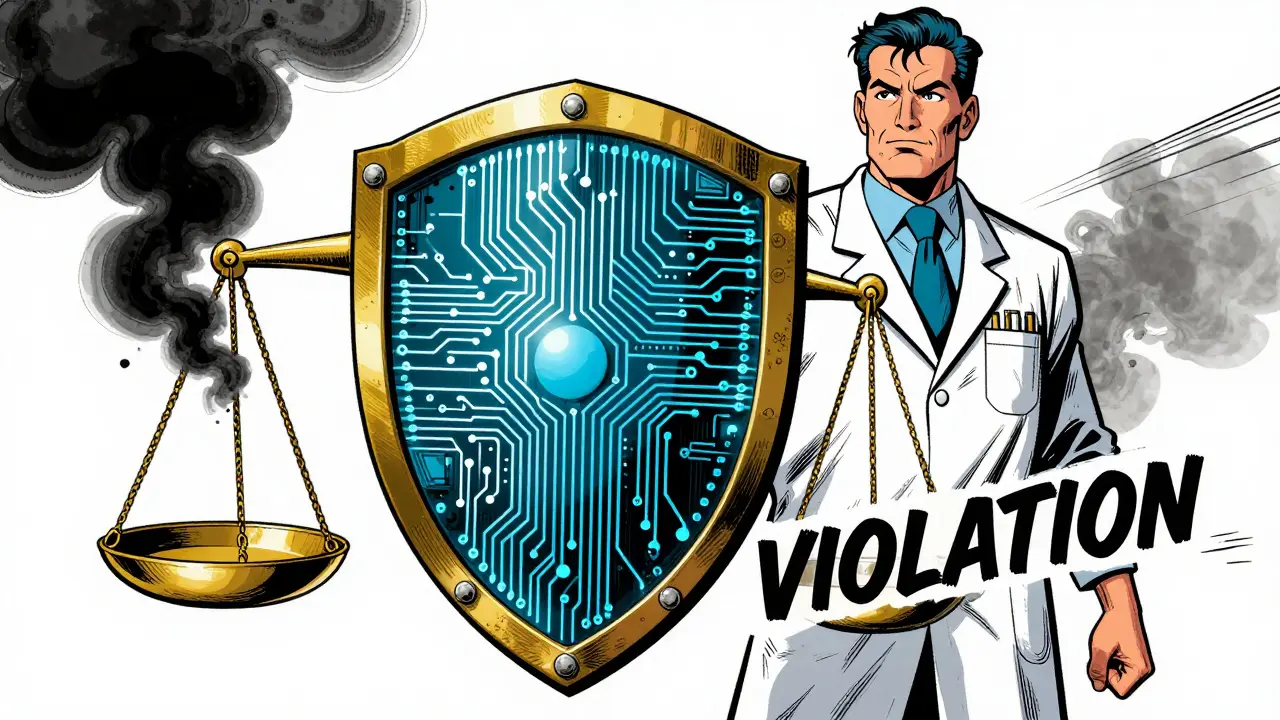
Human-in-the-Loop: Stewards of Civic Trust
Even with robust technical guardrails, humans remain essential. However, their role changes. They are no longer micromanagers checking every output. They become stewards of civic trust and final arbiters of complex edge cases.
In responsible AI implementation, the "human-in-the-loop" principle means AI handles the administrative heavy lifting-document automation, data extraction, initial screening-while humans retain final decision-making power. This is especially crucial in fields like urban planning, law enforcement, or healthcare, where errors have real-world consequences.
The key here is transparency. AI-generated outputs must be verifiable and traceable. If an AI flags a building violation or recommends a loan denial, it must surface the specific data points and regulatory references used. Officials need context to verify accuracy. They need to see the "why" behind the "what." This explainability allows humans to maintain documented trails for every decision, ensuring accountability. Without this transparency, AI becomes a black box, eroding trust rather than building it.
Fairness, Bias, and Ethical Codes
Compliance is not just about following laws; it is about adhering to ethical principles like fairness and privacy. An AI agent might legally follow instructions but still produce biased outcomes. For example, a hiring algorithm might legally filter resumes but inadvertently discriminate based on gender-coded language.
To combat this, organizations need formal AI value platforms codes of ethics that define the role of AI in human development and well-being, or codes of ethics. These documents go beyond generic statements. They mandate specific measures:
- Bias Detection: Continuous monitoring for unintended bias in machine learning algorithms. This includes tracking drift in data and models over time.
- Data Provenance: Knowing where training data comes from and who trained the algorithms. Garbage in, garbage out is a risk multiplier.
- Review Processes: Mandatory human review of AI-generated data before distribution. This checks for inaccuracy, misuse, or discrimination.
Guidance from advisory firms like KPMG emphasizes that these policies must be living documents. They require continuous detection of drift and tracking of data lineage. Ethical AI aims to do no harm. It protects intellectual property, safeguards privacy, and prevents the incorporation of historical biases into future decisions. Human oversight mechanisms must be explicitly designed into the system architecture, not added as an afterthought.

Liability and the Duty of Care
Who is responsible when things go wrong? The legal landscape is shifting toward holding designers and deployers accountable. The standard is one of reasonable care. If you design a generative AI system, you have a duty to implement safeguards that reduce the risk of harmful outputs.
This duty includes:
- Choosing materials for pre-training and fine-tuning with care.
- Designing algorithms that detect and filter potentially harmful material.
- Conducting thorough testing to identify risks before deployment.
- Continually updating systems in response to new threats.
Where human actors face requirements for subjective mental states like recklessness or purpose, AI programs are regulated by requirements of reasonableness. If negligence applies to a human doctor, it applies to the AI diagnostic tool. If strict liability applies to a dangerous activity, it applies to the AI performing it. This framework rejects the idea that AI gets a pass because it lacks intentions. Instead, it focuses on the people and organizations implementing the technology. They must hold themselves to high standards of risk reduction.
In high-stakes contexts, this may mean nullification rules. If an AI system is found to be non-compliant, technical mechanisms could prevent it from accessing large-scale computational infrastructure. This creates a strong incentive for companies to invest in ethical design from day one.
| Feature | Traditional Model | Ethical AI by Default |
|---|---|---|
| Compliance Method | Post-deployment audits | Pre-deployment policy-as-code enforcement |
| Role of Human | Manual reviewer of outputs | Definer of policies and final arbiter |
| Liability Focus | Respondeat superior (employer liability) | Designer/deployer duty of care + AI refusal |
| Identity Verification | User login credentials | Workload identity (e.g., SPIFFE) |
| Bias Handling | Reactive correction | Continuous monitoring and drift detection |
Organizational Implementation
Technology alone is not enough. You need organizational alignment. Deploying ethical AI requires a governance structure that supports users and enforces principles. This includes six key pillars:
- Organizational Alignment: Clear governance structures that link AI strategy to business goals.
- Usage Procedures: Defined procedures on appropriate and compliant AI use.
- Data Accuracy Review: Regular checks for bias and data integrity.
- Human Oversight: Mechanisms for human intervention and decision-making.
- Accountability Frameworks: Clear lines of responsibility for AI outcomes.
- Transparency: Open communication about how AI operates and makes decisions.
Codes of conduct serve as educational platforms. They help employees understand not just what they can do with AI, but why certain restrictions exist. They create a culture of ethical awareness. Support systems must assist users with AI technology, providing guidance on when to use it and when to seek human expertise.
The synthesis of these frameworks creates a comprehensive approach. Legal duties, technical guardrails, organizational governance, and ethical codes reinforce each other. Compliance becomes a default characteristic embedded in the system design. Even when human principals attempt to direct AI agents toward unlawful actions, the systems are designed to refuse. This multi-layered approach is the only way to ensure AI remains a trustworthy tool that enhances human decision-making rather than circumventing established rules.
What is Law-Following AI (LFAI)?
Law-Following AI is a framework where AI agents are designed to rigorously comply with legal requirements and refuse to perform illegal actions, even if instructed by humans. It treats AI as a duty-bearer rather than just a passive tool, imposing independent legal duties on the system itself to prevent harms before they occur.
How does policy-as-code enforce ethical guardrails?
Policy-as-code translates governance rules into executable code using tools like Open Policy Agent (OPA). It acts as a control plane that evaluates every AI action against defined policies in real-time. If an action violates a policy (e.g., accessing unauthorized data), the system blocks it automatically, ensuring compliance by default.
Why is SPIFFE important for AI agents?
SPIFFE (Secure Production Identity Framework For Everyone) provides secure identity management for workloads. For AI agents, it establishes a verified identity, allowing the system to know exactly which agent is making a request. This is crucial for enforcing permissions and auditing actions, as you cannot apply policies to anonymous processes.
What is the role of humans in ethical AI systems?
Humans shift from manual reviewers to stewards of trust and policy definers. They handle administrative heavy lifting via AI but retain final decision-making power for complex or high-stakes issues. Humans also oversee bias detection, interpret ambiguous situations, and ensure the AI's outputs are transparent and explainable.
Who is liable when an AI agent causes harm?
Liability is shifting toward designers and deployers under a "duty of care" standard. Organizations are expected to implement reasonable safeguards, test for risks, and maintain updates. While traditional respondeat superior liability still applies, there is growing emphasis on ex ante regulation, requiring proof of law-following design before deployment in high-stakes contexts.
How can organizations prevent bias in AI agents?
Organizations must implement continuous monitoring for data and algorithmic drift, track data provenance, and conduct regular bias reviews. Formal AI value platforms or codes of ethics should mandate these practices. Additionally, human oversight is required to review AI-generated data for potential discrimination or inaccuracy before it is used or distributed.





6 Comments
Saranya M.L.
The theoretical framework presented here is fundamentally flawed because it ignores the geopolitical reality of who actually controls the infrastructure. You speak of SPIFFE and OPA as if they are neutral arbiters, but these tools are built by Western corporations with specific biases embedded in their architecture. In India, we see this every day where 'compliance' is just a euphemism for data extraction under the guise of ethical governance. The concept of Law-Following AI assumes that the laws themselves are just, which is a naive perspective from the Global North. We need decolonized AI frameworks that recognize local sovereignty over data, not just another layer of corporate control disguised as ethics.
om gman
oh look another article pretending to solve problems that dont exist yet while ignoring the fact that most companies cant even manage basic human resources properly without breaking things first
you want me to believe that code can enforce policy when half the dev teams are using copy paste solutions from stack overflow? please. this is just buzzword bingo for consultants who charge $500 an hour to tell you to buy more software
Jeanne Abrahams
Sarcasm aside, the point about identity management is actually quite critical. I've seen too many systems fail because they assumed the agent knew its own boundaries. It's like giving a teenager keys to the car but no map or rules on where to go. The SPIFFE integration is the only part of this post that doesn't sound like marketing fluff.
michael rome
I appreciate the detailed breakdown of the technical layers, particularly the emphasis on Open Policy Agent. While the implementation challenges are significant, the shift towards pre-deployment enforcement is necessary for maintaining trust in automated systems. It is encouraging to see a focus on structural integrity rather than just reactive measures.
Andrea Alonzo
It is really important that we consider how these systems will affect the people who have to work with them on a daily basis, especially those who might not have extensive technical training, because if we create these complex guardrails without ensuring that everyone understands how they function and why they are there, we risk creating a situation where employees feel alienated or confused by the technology, which could lead to resistance or misuse, and ultimately undermine the very goals of efficiency and compliance that we are trying to achieve, so we must prioritize education and inclusive design processes that involve all stakeholders from the beginning to ensure that the technology serves everyone effectively and fairly.
Francis Laquerre
This changes everything.