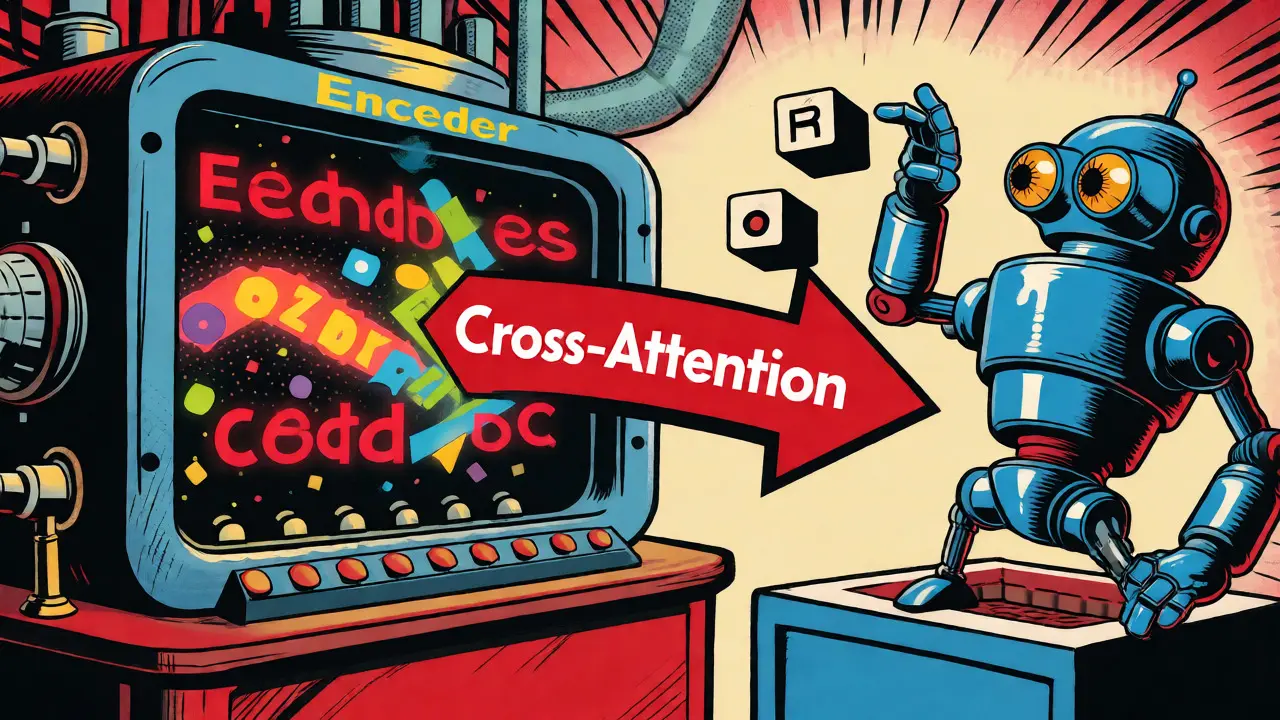
Imagine you are translating a sentence from English to French. You read the English source, understand it, and then start speaking French. But here is the catch: as you speak each French word, you constantly glance back at the English sentence to make sure you haven't missed anything. You don't just rely on your memory of the whole sentence; you actively check specific parts of the source text against what you are currently saying. This mental act of "looking back" while generating output is exactly what Cross-Attention does for modern language models.
If you have ever wondered how an AI translates text, summarizes documents, or describes images, the answer usually lies in this specific architectural component. While self-attention gets all the headlines for helping models understand context within a single sequence, cross-attention is the bridge that connects two different sequences. It allows a decoder (the part generating text) to condition its output on information processed by an encoder (the part reading the input). Without it, large language models would be severely limited in their ability to handle tasks where the input and output are fundamentally different things.
The Anatomy of Cross-Attention
To grasp why cross-attention matters, you first need to look under the hood of the standard Transformer architecture proposed in the seminal paper "Attention Is All You Need." The model isn't just one big blob of math; it's divided into an Encoder and a Decoder. The Encoder takes your input-say, a paragraph of text-and turns it into a rich set of numerical representations called embeddings. These embeddings capture syntax, semantics, and context. But once the Encoder is done, how does the Decoder know what to generate?
This is where the magic happens. Inside every layer of the Decoder, there are three distinct sub-layers working in a strict order:
- Masked Self-Attention: The Decoder looks at the tokens it has already generated. If it is writing the third word of a sentence, it can only see the first two. This prevents the model from "cheating" by peeking at future words during training.
- Cross-Attention: The Decoder looks at the Encoder's output. It asks, "Given what I've written so far, which parts of the original input should I pay attention to right now?"
- Feed-Forward Network: A simple neural network processes the combined information to produce the final representation for that step.
The cross-attention mechanism itself relies on three learned projection matrices: Query (W_Q), Key (W_K), and Value (W_V). Here is the crucial difference from self-attention: in self-attention, Q, K, and V all come from the same sequence. In cross-attention, the Query comes from the Decoder's current state, but the Key and Value come from the Encoder's output.
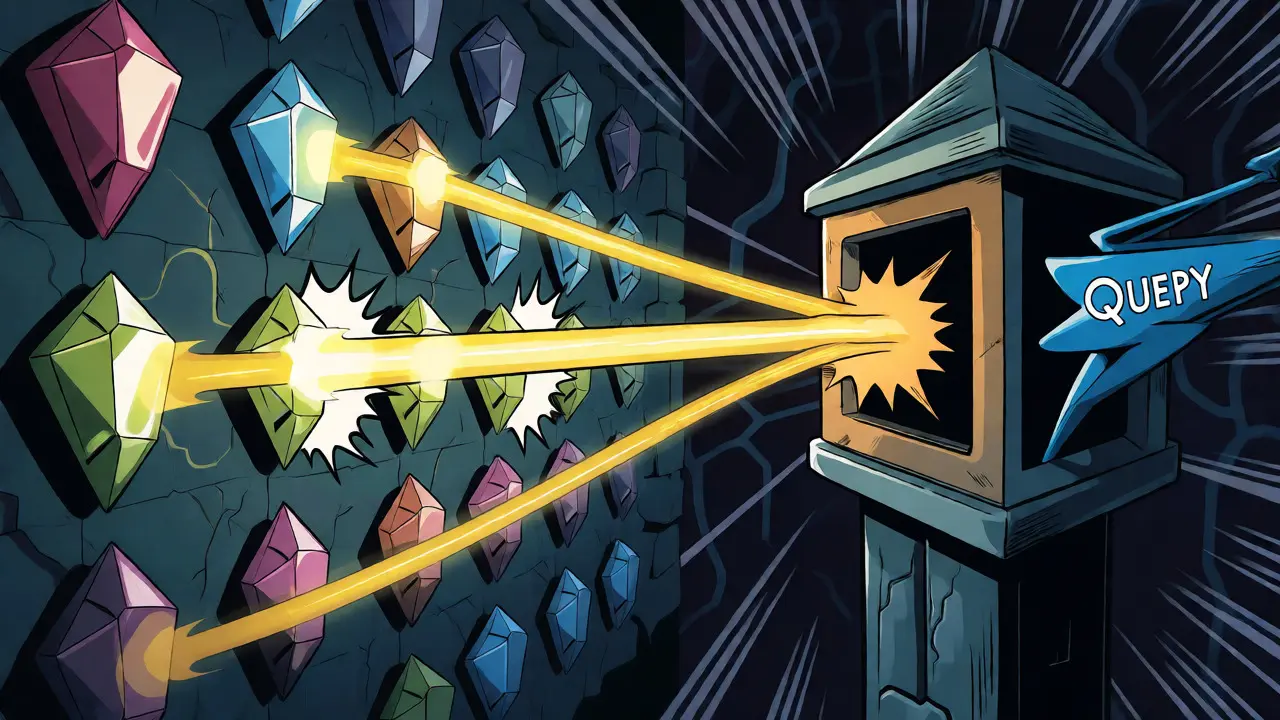
Mathematically, this means the Decoder generates a query vector representing its current need. It compares this query against all the key vectors from the Encoder. The result is a score for each position in the input sequence. High scores mean the Decoder needs to focus heavily on that specific part of the input. These scores are normalized using softmax, turning them into probabilities, and then used to weight the value vectors from the Encoder. The final output is a weighted sum of the Encoder's values, effectively injecting relevant source context directly into the Decoder's generation process.
Why Decoders Need Conditioning
You might ask, "Why not just pass the entire encoded sequence to the decoder once?" That approach, known as early fusion, creates a bottleneck. If you try to cram all the nuance of a long article into a single fixed-length vector before starting generation, you lose detail. Cross-attention solves this by allowing dynamic conditioning. At every single step of generation, the Decoder can decide which part of the input is most relevant.
Consider machine translation. When translating "The bank is near the river," the meaning of "bank" depends entirely on "river." As the Decoder generates the French word for "bank" (banque vs rivage), cross-attention allows it to look specifically at the token "river" in the Encoder's output. If the Decoder were processing a financial report, it might look at "account" instead. This dynamic alignment is impossible with static conditioning.
This mechanism also handles variable-length inputs gracefully. Whether your input is ten words or ten thousand, the cross-attention layer computes attention weights over whatever length the Encoder produced. There is no need to truncate or pad aggressively in a way that destroys information, because the attention mechanism naturally assigns low probability to irrelevant or padding tokens.
Cross-Attention vs. Self-Attention: Clearing the Confusion
A common point of confusion for newcomers to Transformer architectures is distinguishing between self-attention and cross-attention. They use the same mathematical formula-scaled dot-product attention-but they serve completely different purposes and operate on different data sources.
| Feature | Self-Attention | Cross-Attention |
|---|---|---|
| Data Source | Same sequence (Encoder-Encoder or Decoder-Decoder) | Different sequences (Decoder queries Encoder keys/values) |
| Purpose | Contextualize tokens within their own sequence | Align output generation with input content |
| Location | Present in both Encoder and Decoder layers | Present only in Decoder layers |
| Information Flow | Intra-sequence dependencies | Inter-sequence dependencies |
| Example Task | Understanding grammar in a sentence | Translating a sentence from English to Spanish |
Think of self-attention as internal communication. It helps the model understand that "it" refers to "the cat" in the sentence "The cat sat down because it was tired." Cross-attention is external reference. It helps the model understand that when generating the French word for "cat," it should look at the English word "cat" in the source text.
In a pure Encoder-only model like BERT, there is no cross-attention because there is no separate decoder generating new text. In a pure Decoder-only model like GPT, there is also no cross-attention in the traditional sense because the input and output are the same stream of text. Cross-attention is the hallmark of Encoder-Decoder models like T5, BART, and the original Transformer.
Beyond Translation: Multimodal Applications
While machine translation is the classic use case, cross-attention has become the backbone of multimodal AI. Today's most impressive models don't just process text; they handle images, audio, and video alongside language. How do these disparate data types interact? Through cross-attention.
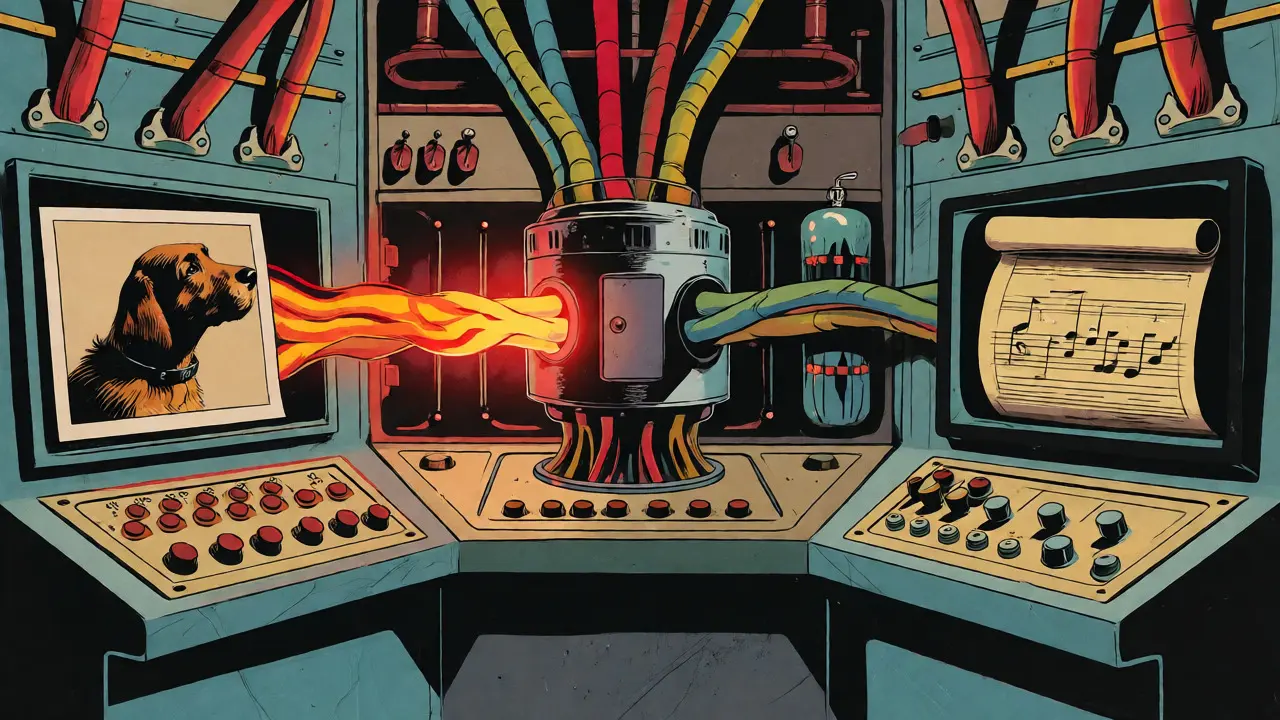
Take image captioning, for example. An image encoder (often a Vision Transformer or CNN) processes the photo and outputs a sequence of visual embeddings. A text decoder generates the caption. The text decoder uses cross-attention to look at the visual embeddings. When the decoder generates the word "dog," it attends strongly to the region of the image containing the dog. When it generates "running," it might attend to motion cues or the legs of the animal.
This flexibility extends to more complex setups. Some architectures use multiple encoders-one for text, one for audio-and feed all their outputs into a shared decoder. The decoder's cross-attention layers can be configured to attend to all modalities simultaneously. Researchers often implement this by concatenating the key-value pairs from different encoders into a single longer sequence, or by using separate cross-attention heads for each modality. Libraries like Hugging Face Transformers provide robust support for these patterns, making it easier for developers to build models that "see" and "hear" while they "speak."
Practical Implementation Challenges
Implementing cross-attention isn't just about drawing arrows on a diagram. There are practical engineering considerations that affect performance and stability.
Masking Padding Tokens: Inputs rarely come in perfect batches of equal length. We pad shorter sequences with special tokens to make them rectangular tensors for efficient GPU processing. However, the model must ignore these pads. In cross-attention, we apply an encoder padding mask. Before calculating the softmax, we add a large negative number (like -10,000) to the attention scores corresponding to padded positions. This ensures those positions get nearly zero probability after normalization, preventing the decoder from wasting capacity attending to nothing.
Numerical Stability: Attention scores are dot products of high-dimensional vectors. Without scaling, these values can grow very large, causing the softmax function to saturate. When softmax saturates, gradients vanish, and learning stalls. This is why we divide by sqrt(d_k), where d_k is the dimension of the key vectors. This keeps the variance of the attention scores manageable, ensuring stable gradient flow during backpropagation.
Computational Cost: Cross-attention scales linearly with the length of the target sequence (decoder steps) but quadratically with the length of the source sequence (encoder output) if implemented naively. For very long documents, this can become expensive. Recent research focuses on sparse cross-attention patterns or efficient variants that approximate full attention to reduce memory usage without sacrificing quality.
The Future of Conditioning Mechanisms
As we move toward larger and more capable models, the role of cross-attention continues to evolve. Pure decoder-only models like GPT-4 dominate chat interfaces, but they often struggle with precise retrieval-augmented generation (RAG) compared to encoder-decoder architectures. In RAG, you retrieve relevant documents and want the model to generate answers based strictly on those documents. Encoder-decoder models with strong cross-attention mechanisms excel here because they explicitly condition on retrieved context.
We are also seeing hybrid approaches. Some newer architectures introduce cross-attention into decoder-only models by adding a separate context window that the model can attend to via cross-attention layers, blending the strengths of both paradigms. Others explore replacing cross-attention with simpler gating mechanisms for efficiency, though these often trade off some representational power.
For anyone building AI applications today, understanding cross-attention is non-negotiable. It is the mechanism that allows models to ground their creativity in reality, whether that reality is a foreign language text, a photograph, or a database record. It transforms the Transformer from a pattern matcher into a reasoning engine that can consult external knowledge while it thinks.
What is the main difference between self-attention and cross-attention?
Self-attention relates positions within the same sequence (e.g., words in a sentence relating to other words in that same sentence). Cross-attention relates positions between two different sequences (e.g., words in a generated output relating to words in the source input). Self-attention is used in both encoders and decoders, while cross-attention is exclusively used in decoders to access encoder outputs.
Do GPT models use cross-attention?
Standard GPT models are decoder-only architectures, so they do not use cross-attention in the traditional encoder-decoder sense. They rely solely on masked self-attention to process the input prompt and generate subsequent tokens. However, some modified versions or hybrid architectures may introduce cross-attention mechanisms to handle external context separately.
Why is cross-attention important for machine translation?
Machine translation requires mapping a source language sequence to a target language sequence. Cross-attention allows the decoder to dynamically align each generated target word with the most relevant words in the source sentence. This ensures that the translation captures the correct meaning, syntax, and context from the input, rather than relying on a static summary of the source text.
Can cross-attention handle multimodal inputs?
Yes, cross-attention is fundamental to multimodal models. It allows a text decoder to attend to visual features extracted from an image encoder or audio features from a speech encoder. By treating these different modalities as key-value pairs, the decoder can integrate information from images, audio, and text seamlessly during generation.
How does masking work in cross-attention?
Masking in cross-attention primarily deals with padding. Since input sequences vary in length, they are padded to form uniform batches. An encoder padding mask is applied to the attention scores before the softmax operation, setting the scores for padded positions to a very low value (negative infinity equivalent). This ensures the decoder ignores padding tokens and focuses only on actual content.