
You just built a killer feature using AI. You described the behavior, the LLM generated the code, you tweaked it for ten minutes, and it’s live. It works beautifully. But here is the problem: you have no idea where that user’s email address went, who has access to it, or if you actually got permission to store it. In traditional development, we wrote unit tests and documented schemas. In vibe-coded systems-where software is assembled through natural language prompts and rapid iteration-those guardrails often vanish. If your app touches EU residents or California consumers, this lack of visibility isn’t just messy; it’s a regulatory landmine.
The General Data Protection Regulation (GDPR) and the California Consumer Privacy Act (CCPA) don’t care how you built your stack. They care about what happens to personal data. When you rely on AI to generate backend logic, database interactions, and API calls, you risk creating "ghost" data flows that never made it into your documentation. This article breaks down how to map data and manage consent in these fast-paced, AI-assisted environments without slowing down your velocity.
Why Traditional Compliance Breaks in Vibe Coding
Vibe coding prioritizes speed and intuition over rigid structure. You ask an AI to "add a newsletter signup," and it might create a new table, modify an existing one, or call a third-party service you forgot existed. The disconnect happens because the developer (or product manager) driving the vibe isn’t always thinking about Article 30 of the GDPR, which requires a Record of Processing Activities (RoPA).
In standard DevOps, you have migration files and schema versions. In vibe-coded prototypes that become production apps, you often have ad-hoc changes. A study by the International Association of Privacy Professionals (IAPP) noted that 76% of privacy professionals find data mapping their biggest challenge, largely due to shadow IT and undocumented third-party integrations. Vibe coding accelerates the creation of shadow features. If your AI assistant suggests integrating Stripe for payments but also silently adds a marketing pixel, you’ve just created a data flow you didn’t explicitly approve.
| Aspect | Traditional Development | Vibe-Coded System |
|---|---|---|
| Data Schema Definition | Explicit SQL migrations, versioned | Implicit via ORM/AI generation, often unversioned |
| Third-Party Integrations | Documented in architecture diagrams | Suggested by AI, may be unvetted |
| Consent Capture | Dedicated UI components with legal review | Ad-hoc checkboxes, often missing granular options |
| Audit Trail | Code reviews track logic changes | Prompt history only, hard to trace data lineage |
Automated Data Discovery as Your First Line of Defense
You cannot manually document every field an AI generates. If you try to update a spreadsheet every time the model adds a `user_last_login_ip` column, you will fail. Instead, you need automated data discovery tools that scan your database and codebase to infer data types. Tools like OneTrust or TrustArc can integrate with modern stacks, but they need hooks to work effectively.
For vibe-coded systems, the key is treating the database schema as the source of truth, not the prompt history. You need a pipeline that runs after every deployment. This pipeline should:
- Scan Database Columns: Identify fields containing PII (Personally Identifiable Information) based on naming conventions and content patterns (e.g., columns ending in `_email` or containing regex matches for phone numbers).
- Trace API Calls: Use middleware to log outgoing requests. If your AI-generated code sends user data to an analytics provider, the middleware should flag this transfer.
- Classify Sensitivity: Automatically tag fields as "Personal," "Sensitive," or "Public." Under CCPA, identifying "Sensitive Personal Information" (SPI) is critical because it triggers stricter opt-out rights.
Dr. Rebecca Herold, a leading privacy expert, warns that automated tools alone are insufficient. They can find the data, but they can’t judge the context. An AI might classify a "medical_condition" field correctly, but it won’t know if you’re processing it for diagnosis (healthcare exemption) or for targeted ads (requires explicit consent). Human oversight remains mandatory.

Designing Consent Flows That Survive Rapid Iteration
Consent is not a static checkbox. Under GDPR, consent must be freely given, specific, informed, and unambiguous. In a vibe-coded environment, features change weekly. If you add a new feature that uses location data, your old consent banner might no longer cover it. This is where dynamic consent management platforms (CMPs) come in.
Instead of hardcoding consent logic into your frontend, decouple it. Use a CMP that injects scripts dynamically. When your AI generates a new feature requiring cookies or tracking, it should call a standardized function, such as `requestConsent('analytics')`, rather than implementing its own cookie logic. This ensures that even if the feature changes, the consent mechanism remains consistent and auditable.
Consider the concept of "purpose limitation." You collected an email address for order confirmation. Can you use it for marketing? Only if you asked. In vibe coding, developers often reuse fields for convenience. To prevent scope creep, implement a strict tagging system in your database. Every piece of data stored should have an associated metadata tag indicating its original purpose. If the AI tries to repurpose that data for a new feature, your application layer should check the tag. If the purposes don’t match, the system should trigger a re-consent request.
Handling DSARs in Dynamic Architectures
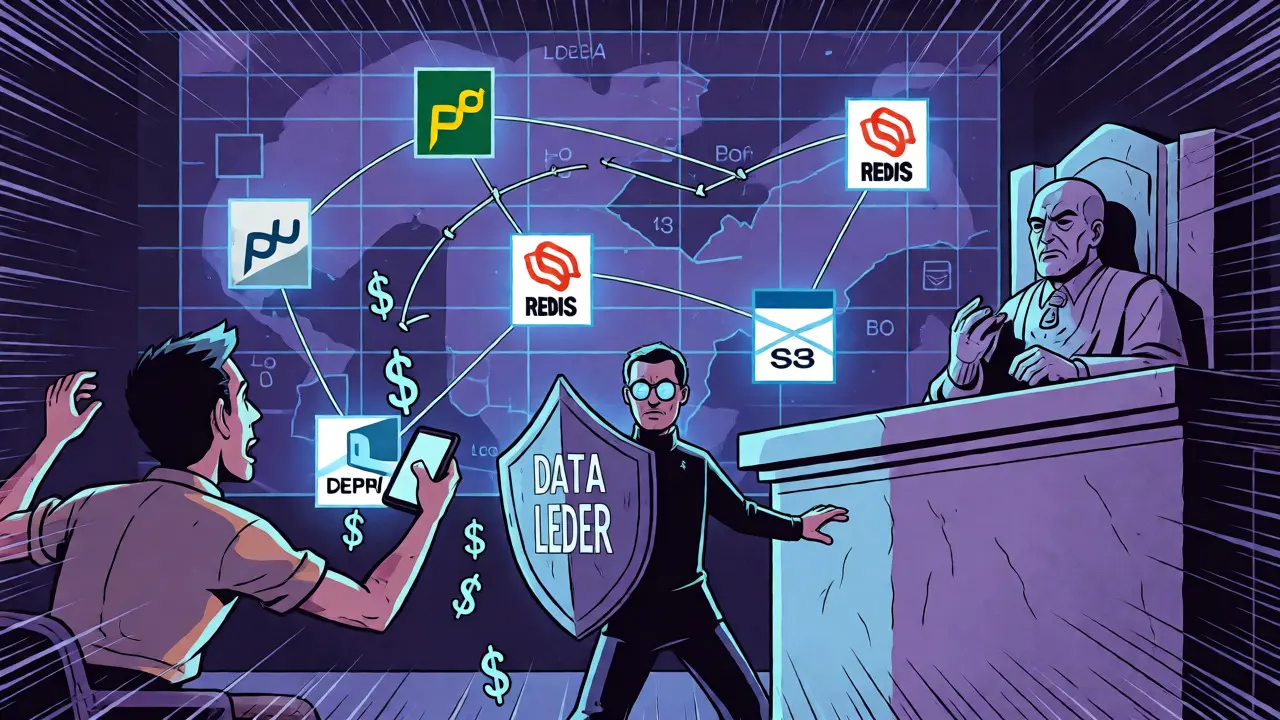
Data Subject Access Requests (DSARs) are the litmus test for your data mapping. A user asks, "What do you know about me?" In a monolithic legacy system, you query three tables. In a microservices-based vibe-coded app, their data might be scattered across a Postgres DB, a Redis cache, a third-party CRM, and an S3 bucket for file uploads.
If your data map is incomplete, fulfilling a DSAR becomes a nightmare. You might miss data held by a vendor the AI integrated last month. To solve this, build a "Data Ledger" abstraction layer. This layer sits between your business logic and your storage providers. It maintains a real-time index of where user data resides. When a DSAR comes in, you query the ledger, not the individual databases. The ledger then orchestrates the retrieval process.
TrustArc’s benchmarks suggest that organizations with activity-level mapping fulfill DSARs 43% faster. For vibe-coded startups, this speed is crucial. Regulatory fines under CCPA can reach $7,500 per intentional violation. If you can’t produce data within 45 days, you’re exposed.
Practical Checklist for Vibe Coders
You don’t need a full-time Chief Privacy Officer to start. You need practical habits that fit into your AI-assisted workflow. Here is a streamlined approach to keeping GDPR and CCPA in check without killing your momentum.
- Pre-Prompt Privacy Constraints: Before asking the AI to write code, specify constraints. Example: "Write a Node.js endpoint to save user preferences. Do not send data to external APIs unless specified. Log all DB writes."
- Standardize Field Names: Enforce a naming convention for PII. Require `pii_` prefixes for sensitive fields. This makes automated scanning easier.
- Vendor Review Gate: Create a simple allowlist of approved third-party services. If the AI suggests a new library or API, check it against the list. If it’s not there, pause and evaluate.
- Dynamic Consent Checks: Ensure every new feature that touches user data calls the central consent module. Code reviews (even if AI-assisted) should flag any direct cookie manipulation.
- Quarterly Map Audits: Once a quarter, run a full data discovery scan. Compare the results against your known data inventory. Investigate any new fields or endpoints that appeared unexpectedly.
The Future: AI-Driven Compliance
The irony of vibe coding is that AI can also help fix the mess it creates. Emerging tools are starting to use Large Language Models (LLMs) to analyze codebases and generate privacy policies automatically. These tools read your code, identify data flows, and draft the necessary disclosures for your privacy notice.
However, don’t outsource liability to the algorithm. The European Data Protection Board’s recent guidelines emphasize that AI/ML data flows require separate documentation. If your system uses AI to profile users, you need to explain the logic behind those profiles. Automated tools can extract the inputs and outputs, but humans must validate the fairness and transparency of the decision-making process.
As we move further into 2026, the line between writing code and managing policy will blur. The most successful teams will be those that treat privacy not as a bottleneck, but as a design constraint. By embedding data mapping and consent checks into the very fabric of your vibe-coding workflow, you build systems that are not just fast, but resilient and trustworthy.
Does GDPR apply if my server is in the US but I use vibe coding?
Yes. GDPR applies based on where the data subject is located, not where your server or developer is. If you serve customers in the EU, you must comply regardless of your tech stack or development methodology.
How does CCPA define "sale" in a vibe-coded context?
Under CCPA, "sale" includes sharing data for cross-context behavioral advertising, even if no money changes hands. If your AI-integrated analytics tool shares user data with ad networks, this likely counts as a sale/share, triggering opt-out requirements.
Can AI tools accurately map data for compliance?
AI tools are excellent at identifying patterns and classifying data types, but they struggle with context. They can tell you a field contains an email, but they cannot determine if you have valid consent to process it. Human validation is still required for legal interpretation.
What is the biggest risk of vibe coding regarding privacy?
The biggest risk is "shadow data flows." Because AI can quickly integrate third-party libraries, developers may inadvertently send sensitive data to vendors they haven't vetted for security or privacy compliance, creating undocumented liabilities.
Do I need a Data Protection Impact Assessment (DPIA) for vibe-coded features?
If a new feature involves high-risk processing, such as systematic monitoring or large-scale processing of sensitive data, yes. Even if the code was generated by AI, the impact assessment is your responsibility to ensure risks are mitigated before launch.