You’ve built a shiny new generative AI tool. It writes emails, summarizes contracts, or maybe even diagnoses patient notes. It feels like magic. But if you’re deploying this in Europe-or serving European customers-you’re walking into a regulatory minefield that most tech teams ignore until the fine letter arrives. The core problem isn’t just about privacy anymore; it’s about proving your AI respects fundamental rights and data protection laws simultaneously.
Here’s the reality: under the EU General Data Protection Regulation (GDPR), specifically Article 35, you need a Data Protection Impact Assessment (DPIA) before you launch. And now, with the EU AI Act fully phasing in through 2026, you likely also need a Fundamental Rights Impact Assessment (FRIA). These aren’t optional paperwork exercises. The French data protection authority, CNIL, found that 78% of AI-related privacy violations between 2021 and 2023 could have been stopped by proper assessments. If you skip them, you’re risking average fines of €1.2 million.
Why Generative AI Triggers Mandatory Assessments
Not every AI project needs a full-blown assessment, but generative AI almost always does. Why? Because it processes personal data in ways traditional software doesn’t. When you feed user inputs into a Large Language Model (LLM), you are engaging in "innovative use" of technology-a specific trigger for high-risk processing under EDPB guidelines.
Under UK GDPR and EU GDPR, a DPIA is mandatory if your system meets any of these criteria:
- Systematic profiling: Your AI evaluates individuals based on health, preferences, or work performance.
- Large-scale special category data: You’re processing sensitive data (like medical history or biometrics) for more than 10,000 individuals per month.
- Innovative technology: You’re using machine learning or deep learning in a way that hasn’t been assessed before.
The European Data Protection Board (EDPB) states that if your processing meets two or more of their nine high-risk criteria, you must conduct a DPIA. Generative AI often hits multiple marks at once: it uses innovative tech, involves scoring or evaluation, and often handles large volumes of unstructured data. If you’re using foundation models trained on public data, assume you need an assessment because you can’t exhaustively identify all potential uses or outputs.
DPIA vs. FRIA: Do You Need Both?
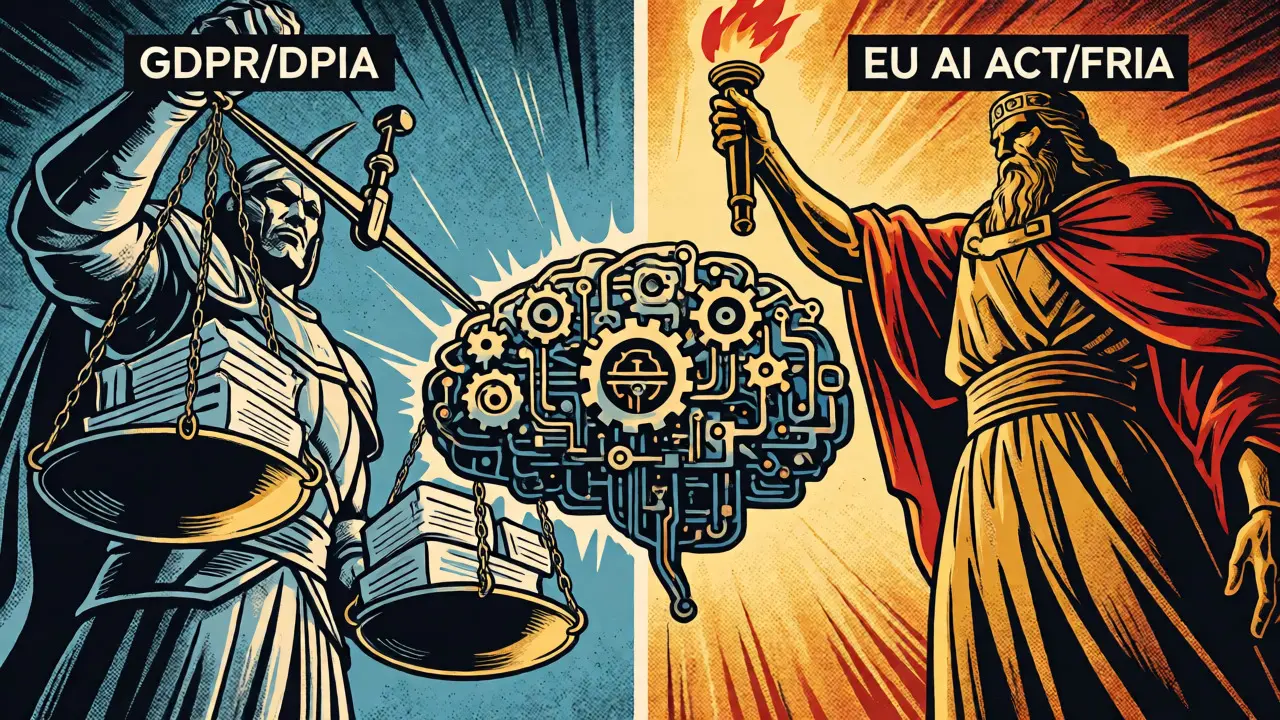
This is where things get tricky. Many organizations think a DPIA covers everything. It doesn’t. Since the EU AI Act entered into force, high-risk AI systems require a Fundamental Rights Impact Assessment (FRIA). While they overlap, they serve different masters.
| Feature | Data Protection Impact Assessment (DPIA) | Fundamental Rights Impact Assessment (FRIA) |
|---|---|---|
| Primary Law | GDPR (Article 35) | EU AI Act (Article 29) |
| Main Focus | Data privacy and security risks to individuals | Impact on fundamental rights (non-discrimination, freedom of expression, etc.) |
| Key Requirement | Necessity and proportionality of data processing | Necessity and proportionality of operations relative to purposes |
| Mitigation | Safeguards and security measures for personal data | Governance mechanisms, complaint handling, and human oversight |
| Who Needs It | Any controller processing high-risk personal data | Deployers of high-risk AI systems (e.g., credit scoring, recruitment) |
According to the IAPP, 87% of European organizations now conduct both assessments for high-risk generative AI. They complement each other. A DPIA asks, "Are we protecting this person's private data?" A FRIA asks, "Is this AI treating this person fairly and respecting their rights?" For example, if your AI rejects loan applications, a DPIA checks if you stored the applicant's financial history securely. A FRIA checks if the algorithm systematically disadvantages a specific demographic group.
Step-by-Step: How to Conduct a Generative AI DPIA
Don’t overcomplicate this. The ICO and TrustArc recommend a structured six-step process. Here is how to actually do it without drowning in bureaucracy.
- Screen for Necessity: Ask yourself: Are we processing personal data? Is it high-risk? If you’re using an LLM to summarize customer support tickets containing names and email addresses, yes, you need a DPIA.
- Describe the Processing: Map out the data flow. Where does the data come from? Who sees it? Does it go to a third-party API provider? Document the volume, variety, and sensitivity. Be specific: "We send 50,000 monthly chat logs to Vendor X."
- Assess Necessity and Proportionality: Do you really need to send raw text to the cloud? Could you anonymize it first? Is there a less intrusive way to achieve your business goal? If not, justify why this method is essential.
- Identify Risks: This is the critical part for GenAI. Look for:
- Memorization: Will the model regurgitate a user’s phone number?
- Hallucination: Could the AI generate false information that harms someone?
- Bias: Does the output reinforce stereotypes?
- Data Leakage: Is proprietary info being exposed?
- Define Mitigations: What will you do about those risks? Examples include implementing input filters, using synthetic data for testing, adding human-in-the-loop review for high-stakes decisions, or encrypting data in transit.
- Sign Off and Consult: Get your Data Protection Officer (DPO) to sign off. If residual high risks remain after mitigation, you must consult your national data protection authority before launching. In France, CNIL requires this consultation for many GenAI projects.
Essential Elements of a Modern Template
You don’t need to write a novel, but standard templates from 2020 are outdated. You need fields that address the unique quirks of generative AI. The EDPS released a specialized template in early 2024 that adds sections for "training data composition analysis" and "output risk assessment." Use these as a baseline.
Your template must include:
- Training Data Analysis: What percentage of your training set contains personal data? Did you obtain consent? If you’re using a pre-trained foundation model, document the vendor’s data practices.
- Prompt Engineering Logs: Show how you prevent sensitive data from entering prompts unnecessarily.
- Output Handling: How long are generated responses stored? Can users delete them? How do you handle requests for erasure when the data is embedded in a model’s weights rather than a database row?
- Human Oversight: Describe the mechanism for humans to intervene. This is crucial for both GDPR automated decision-making rules and AI Act requirements.
Google Cloud reports that using standardized templates with these specific metrics reduces assessment completion time by nearly 30%. Don’t start from scratch; customize existing frameworks from the ICO, CNIL, or EDPS.

Common Pitfalls That Trigger Fines
Regulators are getting sharper. Enforcement actions in Q2 2024 targeted employers who used AI for performance monitoring without DPIAs. Here are the mistakes to avoid:
Ignoring "Black Box" Opacity: If you can’t explain how the AI reached a conclusion, your DPIA is weak. You must assess the interpretability of the model.
Assuming Anonymity Works: Generative AI can re-identify individuals from seemingly anonymous data patterns. If your model can guess who wrote a text based on style, that’s a privacy risk.
Forgetting Third-Party Vendors: If you use OpenAI, Anthropic, or Azure OpenAI, you are a joint controller or processor. Your DPIA must cover the entire chain, including the vendor’s data retention policies.
Static Assessments: GenAI evolves fast. A DPIA signed off in January might be obsolete by June if you switch models or add new features. Schedule quarterly reviews.
Looking Ahead: Compliance in 2026
We are currently in the transition period. By February 2025, DPIAs were required for high-risk systems. As we move through 2026, enforcement will tighten. Gartner predicts that 92% of enterprise GenAI deployments will require formal DPIAs by next year, up from 67% in 2024.
The cost of doing this right is dropping due to automation tools, but the cost of getting it wrong is rising. Expect regulators to focus heavily on "data leakage risks" and "bias in outputs." Start building your assessment culture now. Treat the DPIA not as a barrier, but as a design constraint that helps you build safer, more trustworthy products.
Do small businesses need a DPIA for generative AI?
Yes, if the processing is considered high-risk. Size doesn't exempt you. If you process special category data (like health or race) on a large scale, or if you use AI for systematic profiling that affects people significantly, you need a DPIA regardless of company size.
What is the difference between a DPIA and an AI Impact Assessment?
A DPIA focuses strictly on data protection risks under GDPR. An AI Impact Assessment (often aligned with the FRIA under the EU AI Act) looks broader, assessing impacts on fundamental rights, ethics, bias, and societal effects. For high-risk AI, you typically need to perform both.
How often should I update my generative AI DPIA?
There is no fixed legal frequency, but best practice suggests reviewing it whenever you make significant changes to the system, such as switching base models, adding new data sources, or changing how outputs are used. Given the rapid pace of GenAI, a quarterly review is recommended.
Does using a pre-trained foundation model exempt me from a DPIA?
No. You are responsible for how you use the model. Even if the vendor did their own assessment, you must assess how your specific prompts, fine-tuning, and integration affect personal data. You cannot outsource liability entirely.
What happens if I fail to conduct a required DPIA?
You face administrative fines. Under GDPR Article 83(5), fines can reach up to 4% of global annual turnover or €20 million, whichever is higher. Recent enforcement trends show average fines around €1.2 million for AI-specific non-compliance, plus reputational damage and potential suspension of processing.