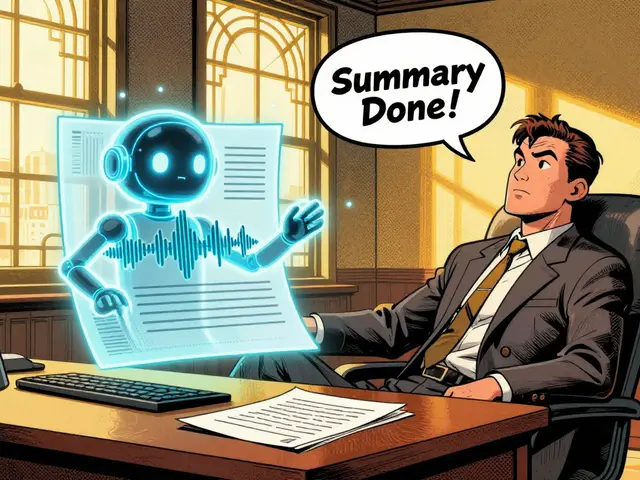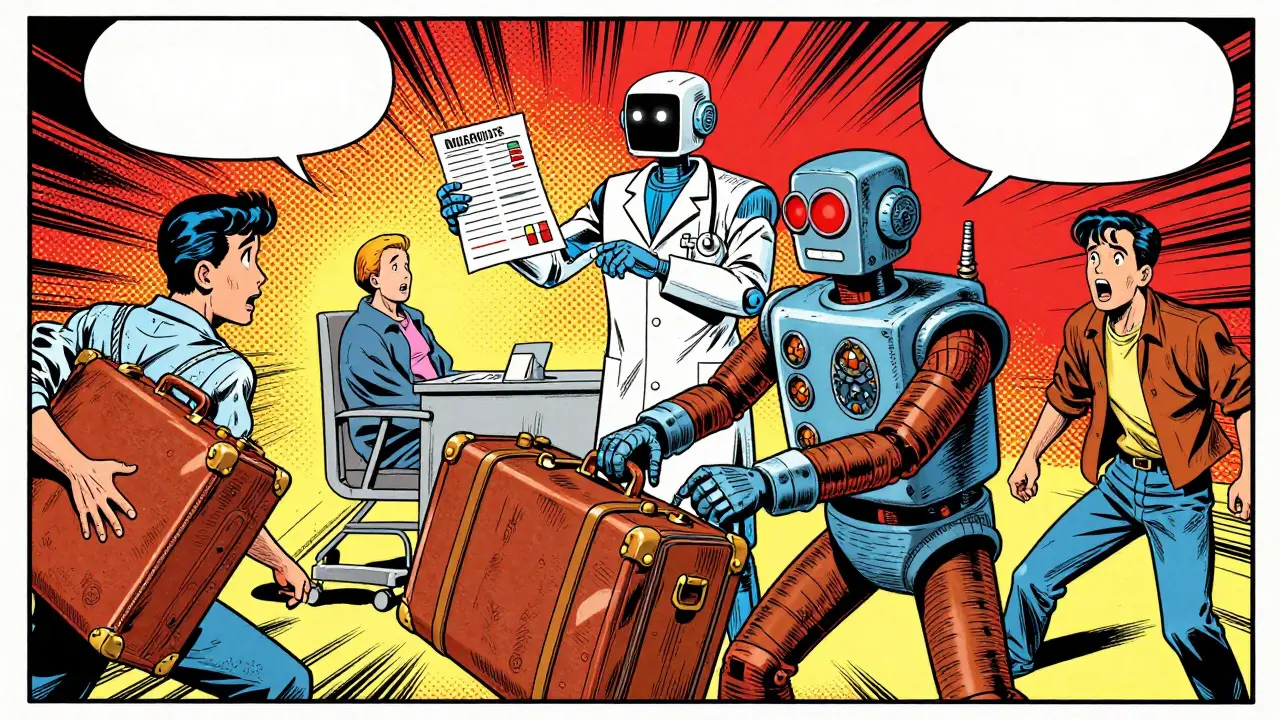
Imagine a customer service chatbot telling a traveler they can bring three large bags on a domestic flight. Or a medical assistant suggesting a dosage that conflicts with a patient's existing medication. These aren't sci-fi scenarios; they are real risks when Generative AI is deployed without proper safeguards. The core problem isn't just that AI makes mistakes-it's that it makes them confidently. This is where Human-in-the-Loop (HitL) review comes in. It’s not about replacing AI with humans, but about inserting a critical checkpoint between the model and the end user to catch errors before they become costly reputational or financial disasters.
As of Q3 2025, 78% of Fortune 500 companies have implemented some form of human review for customer-facing AI applications. Why? Because automated checks alone miss too much. Rule-based filtering catches only 29-38% of problematic outputs, whereas properly designed HitL systems reduce end-user exposure to AI errors by 58-73%. But here’s the catch: if you get the implementation wrong, human review can actually make things worse. Let’s break down how to do it right.
Why Automated Checks Alone Fail
Many organizations assume that if their AI model has high accuracy scores in testing, it’s safe to ship. But testing environments rarely mimic the chaos of real-world usage. Stanford University’s 2024 research on model collapse highlights that generative models can produce technically correct but contextually inappropriate outputs when fed synthetic data or exposed to edge cases. For example, a legal AI might cite a valid statute but apply it to a jurisdiction where it no longer exists. Automated validators often check for syntax or format compliance, not semantic truth.
This gap is dangerous. In Tredence’s analysis of 37 healthcare AI deployments, human reviewers caught 22% of outputs containing subtle medical inaccuracies that standard validation checks completely missed. These weren’t obvious typos; they were nuanced errors that required domain expertise to spot. If you’re deploying AI in high-stakes fields like healthcare, finance, or legal services, relying solely on automation is like driving with your eyes closed and trusting the GPS to warn you before you hit a wall.
The Economics of Human Review: Cost vs. Risk
Let’s talk numbers, because cost is usually the first objection. Manual review costs average $0.037-$0.082 per output. For a system generating millions of responses daily, this sounds expensive. But compare that to the cost of a single major error. A Canadian airline documented by SHAIP in 2024 faced $237,000 in customer compensation after its AI chatbot provided incorrect baggage allowance information. After implementing pre-release human review for policy-related queries, misinformation incidents dropped by 92% within three months.
Here’s a simple decision framework:
- High-Stakes, Low-Volume: Full human review is non-negotiable. Think medical dosages, legal contracts, or executive summaries.
- Medium-Stakes, Medium-Volume: Use confidence thresholding. Only flag outputs below an 85-92% confidence score for human review. This reduces review volume by up to 63% while maintaining 92% error capture.
- Low-Stakes, High-Volume: Skip full human review. Use sampling (e.g., review 5% of outputs) and rely on user feedback loops. Meta’s abandoned 2024 experiment with pre-publishing human review for AI ad copy increased production time by 320% with only an 11% error reduction-a clear signal that full review doesn’t scale for social media content.
Designing a Workflow That Doesn’t Slow You Down
One of the biggest complaints from enterprise users is latency. A Reddit user in r/MachineLearning noted that their customer service chatbot review system created 22-minute response delays, causing 37% customer abandonment. That’s a dealbreaker. To avoid this, your HitL workflow must be optimized for speed without sacrificing quality.
BCG’s benchmarking of 22 financial services AI implementations found that effective systems maintain an average review window of 2.7-8.3 seconds per output. How? By using parallel processing. While one reviewer handles complex, low-confidence outputs, another team reviews high-volume, lower-risk content. Additionally, task rotation is critical. Evaluator fatigue causes a 22-37% increase in error rates after 25 minutes of continuous review. Rotate tasks every 18-22 minutes to keep reviewers sharp.
Consider this architecture:
- Input: AI generates output with a confidence score.
- Filter: Outputs above 92% confidence go straight to the user. Outputs below 85% go to immediate human review. Outputs in between go to a secondary queue for batch review.
- Review: Human reviewers see the output alongside the original prompt and any relevant context. They approve, edit, or reject.
- Feedback Loop: Rejections and edits are logged and used to retrain the model. Average latency for this feedback integration is 4.2 hours.

Avoiding the "Automation Bias" Trap
Here’s a counterintuitive finding: humans are bad at reviewing AI if they trust the AI too much. Dr. Elena Rodriguez, Director of AI Ethics at Stanford, warns that 68% of reviewed implementations suffered from inadequate reviewer training on use case boundaries. Worse, her research shows that automation bias causes reviewers to miss 41% of errors in AI outputs they believe are 68% accurate. If your reviewers think the AI is “mostly right,” they’ll skim instead of scrutinize.
To combat this, Professor David Chen of MIT’s Computer Science department recommends changing the review sequence. When humans make judgments before seeing AI outputs, error detection improves by 37% compared to standard “AI-first” review sequences that create anchor bias. In practice, this means giving reviewers the raw input and asking them to draft a response first, then comparing it to the AI’s output. It’s more work upfront, but it prevents the “yeah, looks fine” reflex.
Training Your Reviewers: Beyond Basic Instructions
You can’t just hire smart people and throw them at the task. SHAIP’s 2025 benchmarking shows that reviewers need 14-21 hours of specialized training to achieve 85%+ error detection rates. Generic instructions like “check for errors” don’t work. Effective training includes:
- Domain Expertise: 73% of effective implementations require specialized knowledge. A nurse reviewing medical AI needs different training than a lawyer reviewing legal AI.
- Critical Thinking Exercises: 94% of successful programs include drills where reviewers identify subtle biases or logical fallacies in sample outputs.
- AI Limitation Awareness: Only 41% of current reviewer training programs adequately address how AI fails. Teach reviewers to look for specific failure modes: hallucinated citations, tone mismatches, or outdated facts.
UnitedHealthcare’s AI documentation system reduced medical coding errors by 61% over six months, preventing an estimated $4.7 million in claim denials. Their success wasn’t due to better software-it was due to rigorous, scenario-based training for their clinical coders who reviewed the AI’s work.

Measuring Success: Metrics That Matter
Don’t just track “number of reviews completed.” Track outcomes. Here are the key metrics to monitor:
| Metric | Target Range | Why It Matters |
|---|---|---|
| Error Reduction Rate | 58-73% | Direct measure of HitL effectiveness vs. baseline. |
| False Negative Rate | <15% | Percentage of actual errors missed by reviewers. High rates indicate training gaps. |
| Review Latency | <10 seconds | Ensures user experience isn’t degraded. Above 20 seconds causes abandonment. |
| Reviewer Fatigue Index | Rotate every 20 mins | Tracks error rate spikes during long sessions. Indicates need for workflow adjustment. |
| In-Use vs. Test Rejection Gap | <5% difference | If in-use rejection rates are much higher than test rates, your model is degrading in production. |
BCG’s 2025 analysis found that organizations comparing in-use rejection rates against testing rejection rates were 3.2x more likely to maintain effective oversight. If your test environment flags 5% of outputs as bad, but your production system flags 20%, something is wrong-either the model is drifting, or your reviewers are inconsistent.
Future-Proofing Your Strategy
The landscape is shifting. Gartner predicts that by 2027, 65% of implementations will use real-time risk assessment to determine review intensity rather than fixed rules. This means dynamic oversight: high-risk queries get instant human review, low-risk ones get sampled. Also, AI-assisted human review tools are emerging. Google’s 2025 pilot showed that highlighting potential issues for reviewers reduced review time by 37%. These tools don’t replace humans-they act as co-pilots, pointing out suspicious phrases or inconsistencies so reviewers can focus on judgment calls.
Regulatory pressure is also accelerating adoption. SEC Rule 2024-17 requires “meaningful human oversight” for AI financial advice, pushing 73% of financial services firms to implement mandatory human review. If you’re in regulated industries, HitL isn’t optional-it’s compliance.
Start small. Pick one high-stakes use case. Implement confidence thresholding. Train your reviewers rigorously. Measure the impact. Then scale. The goal isn’t perfection-it’s reducing risk to an acceptable level while keeping your users happy and your costs manageable.
How much does human-in-the-loop review cost?
Manual review costs average $0.037-$0.082 per output. However, using confidence thresholding to review only low-confidence outputs can reduce total costs by up to 63% while maintaining high error capture rates.
What is the best way to prevent reviewer fatigue?
Rotate tasks every 18-22 minutes. Continuous review beyond 25 minutes increases error rates by 22-37%. Use parallel queues to ensure no single reviewer is overwhelmed, and provide breaks or varied task types.
Is human review necessary for all AI applications?
No. For low-stakes, high-volume applications like social media marketing, full human review is often economically unfeasible. Use sampling and user feedback loops instead. Reserve full human review for high-stakes scenarios like healthcare, finance, or legal advice.
How do I train my human reviewers effectively?
Provide 14-21 hours of specialized training focused on domain expertise and AI limitation awareness. Use scenario-based exercises where reviewers draft responses before seeing AI outputs to reduce automation bias. Avoid generic instructions.
What metrics should I track for HitL success?
Track Error Reduction Rate (target 58-73%), False Negative Rate (<15%), Review Latency (<10 seconds), and the gap between in-use and test rejection rates. A large gap indicates model drift or inconsistent review practices.