Enterprise LLMs aren’t just about getting answers-they’re about staying in business
If your company runs customer service bots, clinical decision tools, or financial risk models using a large language model, you’re not just using AI. You’re betting your operations on it. And if that model goes down, gives wrong answers, or leaks data, the cost isn’t just technical-it’s legal, financial, and reputational. That’s why SLAs aren’t fine print anymore. They’re the contract that keeps your business running.
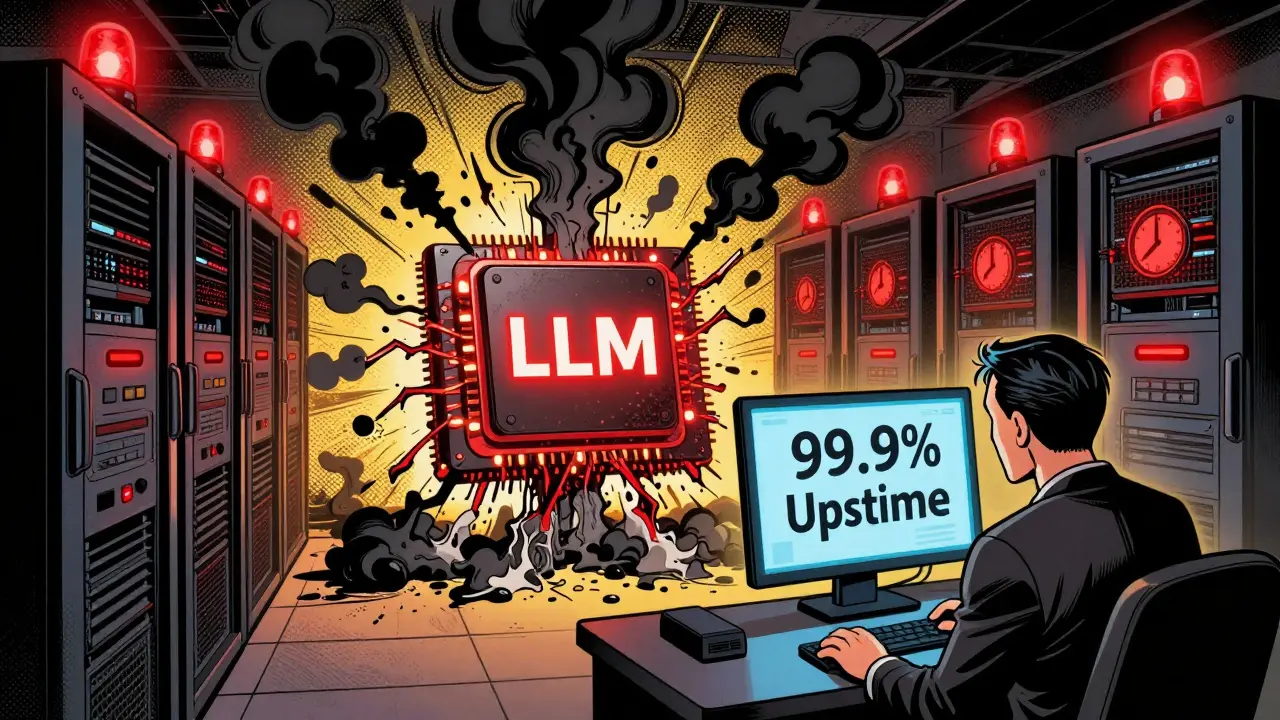
In 2025, every enterprise LLM provider claims 99.9% uptime. But that number means nothing if you don’t know what’s behind it. Is it measured per model or per API endpoint? What counts as downtime? Is there a penalty if your chatbot takes 7 seconds to respond during tax season? Most companies don’t ask these questions until it’s too late.
Uptime isn’t enough-here’s what actually matters
The standard enterprise SLA promises 99.9% uptime. That sounds good-until you do the math. 99.9% means you can lose 43 minutes of service each month. For a hospital’s diagnostic assistant or a bank’s fraud detector, that’s not a glitch. That’s a crisis.
Leading providers now offer higher tiers: 99.95% (21.6 minutes downtime) and even 99.99% (4.32 minutes). Microsoft Azure OpenAI and Amazon Bedrock lead here, especially for clients in finance and healthcare. But here’s the catch: these numbers only cover infrastructure outages. They don’t account for model-specific failures. In January 2025, GPT-4 had a known issue with reasoning tasks. Enterprises using it couldn’t switch to another model without breaking their own SLAs with customers. That’s not a feature-it’s a flaw in the SLA design.
What you need to demand: a clear definition of what constitutes downtime. Is it when the API returns errors? When latency exceeds 5 seconds? When the model hallucinates answers above a certain confidence threshold? If the provider won’t define it in writing, walk away.
Latency SLAs are the silent killer of user trust
People don’t care if your AI is 99.9% available if it takes 8 seconds to answer a customer’s question. In fact, studies show users abandon interactions after 3 seconds of delay. Enterprise SLAs now specify latency targets: 2-3 seconds for 95% of requests under normal load. Peak times? 5-7 seconds. That’s the baseline.
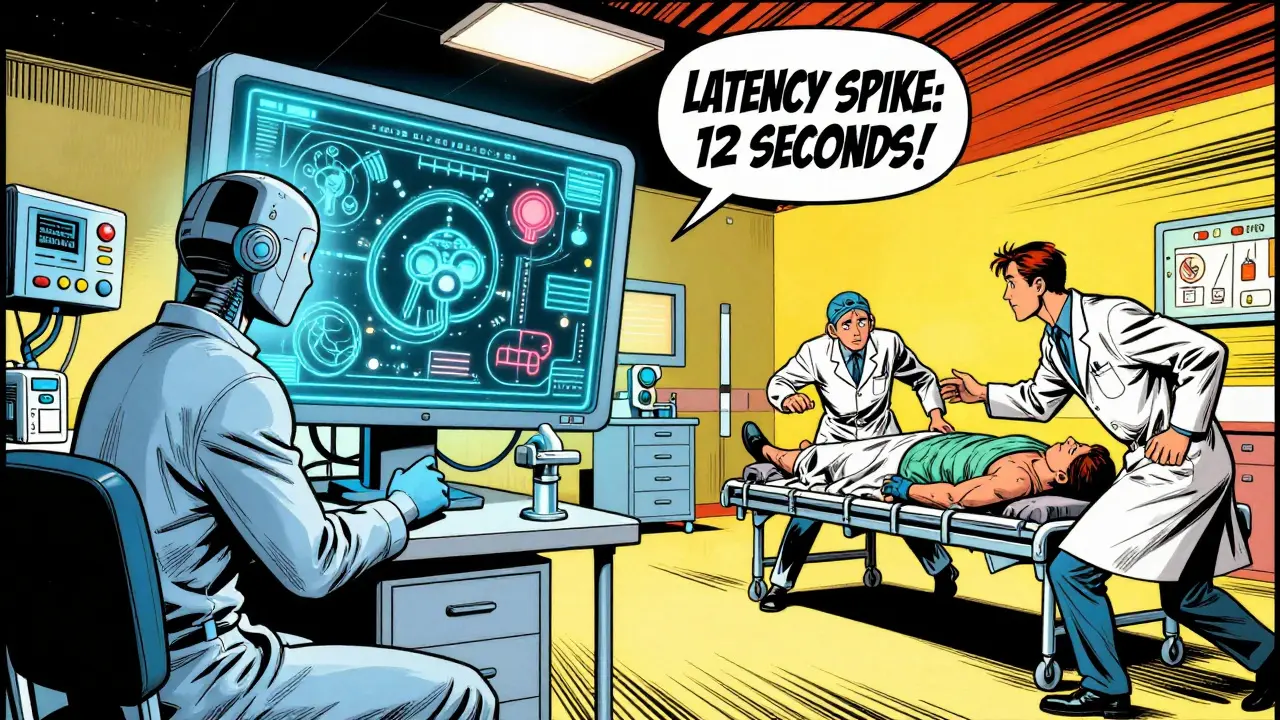
But here’s what no one tells you: latency isn’t just about speed. It’s about consistency. A provider might average 2.1 seconds, but if 15% of requests spike to 12 seconds during business hours in Europe, your call center staff are getting yelled at. Helicone.ai’s January 2025 study found that 62% of enterprise SLA disputes came down to inconsistent latency-not total downtime.
Ask for percentile-based guarantees: "95% of responses under 3 seconds, 99% under 5 seconds." And demand historical performance data from the last 6 months. If they can’t show it, they’re guessing.
Security and compliance aren’t add-ons-they’re the foundation
Let’s say you’re a healthcare provider. You pick an LLM because it’s cheap and fast. Six months later, an audit finds your model stored patient names in prompts. That’s a HIPAA violation. Fines? Up to $1.5 million per incident. And you didn’t even know it was possible.
Today, enterprise SLAs must include:
- Data encryption: AES-256 at rest, TLS 1.3 in transit
- Compliance certifications: SOC 2 Type II is the minimum. HIPAA, GDPR, FedRAMP High are non-negotiable for regulated industries
- Data residency: Your data must stay in your region. Google Cloud AI offers this in 22 locations. Others still don’t.
- Zero data retention: Anthropic’s Claude 4 is the only major provider that guarantees prompts and outputs aren’t stored for training. Third-party audits confirm it.
Dr. Elena Rodriguez from Forrester put it bluntly: "Prompt leakage is a greater risk than service interruption for 68% of financial institutions." If your provider doesn’t explicitly state how they handle input data, assume they’re using it to train their next model.
Support isn’t about tickets-it’s about access
Standard enterprise support means email with a 4-hour response time. That’s fine for a marketing chatbot. It’s suicide for a stock trading algorithm.
Here’s how support tiers break down in 2025:
- Standard: Email only. 4 business hours to acknowledge. No weekend coverage.
- Premium ($25K+/month): 24/7 dedicated engineer. 1-hour response for Severity 1 issues.
- Strategic: Named account manager. Direct phone access. On-call rotation.
But here’s the trap: many contracts say "enhanced support" without defining what that means. Aloa’s February 2025 review found 43% of SLA disputes centered on vague language around support during holidays. If your system runs on weekends, demand written confirmation of coverage. Don’t trust the sales pitch.
Model versioning is the most ignored SLA requirement
You build a compliance tool on GPT-4-turbo. It works perfectly. Then, the provider quietly upgrades you to GPT-4-turbo-2025-03. Suddenly, your model starts rejecting valid inputs. Your audit logs are wrong. Your legal team panics.
Gartner’s David Groom says this is the most overlooked SLA gap. Enterprises need guarantees on model version longevity. How long will you be on GPT-4-turbo before being forced to upgrade? Can you opt out? Is there a 90-day notice? Providers like Azure OpenAI now offer version lock for 12 months on enterprise contracts. Others don’t mention it at all.
Don’t assume you can control upgrades. Demand it in writing. And if you’re using custom fine-tuned models, make sure the SLA covers model persistence and rollback capabilities.

Hidden costs are eating your budget
The monthly bill says $15,000. But you’re also paying for:
- A dedicated GPU cluster to avoid throttling
- Extra security scanning tools to monitor prompts
- Custom logging to track compliance
- Internal staff to manage API keys and monitor SLA breaches
AIMultiple’s December 2024 analysis found 20-40% of total LLM costs are hidden. That’s not a surprise-it’s a trap. Providers list base API prices but bury infrastructure needs in the fine print. Ask for a total cost of ownership breakdown. If they can’t give you one, you’re being sold a bill of goods.
Who wins in 2025? It’s not who’s cheapest-it’s who’s clearest
Here’s how the top players stack up:
| Provider | Uptime SLA | Key Compliance | Data Retention | Support Response (P1) | Model Version Lock |
|---|---|---|---|---|---|
| Azure OpenAI | 99.9% (99.95% premium) | FedRAMP High, HIPAA, GDPR, SOC 2, DoD IL4/IL5 | Optional retention (can be disabled) | 1 hour | Yes, up to 12 months |
| Amazon Bedrock | 99.9% | SOC 2, GDPR | Zero by default | 4 hours | No |
| Google Vertex AI | 99.9% | GDPR, HIPAA (limited) | Optional | 4 hours | No |
| Anthropic (Claude 4) | 99.9% | GDPR, SOC 2, HIPAA (via add-on) | Zero, audited | 4 hours | No |
Azure OpenAI wins on compliance and support. Bedrock wins on cost efficiency and model variety. Anthropic wins on privacy. Google leads on multimodal tasks but lags in transparency.
The real winner? The company that asks the right questions before signing.
What to do next: 5 non-negotiable steps
- Define your risk profile: Are you in healthcare? Finance? Government? Your SLA needs must match your regulatory exposure.
- Test under load: Run a 300% peak traffic simulation before signing. Use tools like Helicone or Logz.io to monitor latency and error rates.
- Get SLA terms in writing: No verbal promises. Every uptime, latency, support, and data clause must be in the contract.
- Ask for historical data: Request 6 months of actual performance logs-not just SLA promises.
- Build your own monitoring: Don’t rely on the provider’s dashboard. Use open-source tools to track your own API metrics. You’re responsible for the outcome, not them.
Enterprise AI isn’t about the smartest model. It’s about the most reliable partner. The ones who treat SLAs as a competitive advantage are the ones you’ll want to work with-not the ones who treat them as an afterthought.
Do all LLM providers offer the same SLA terms?
No. SLAs vary widely in uptime guarantees, support response times, compliance certifications, and data handling policies. Microsoft Azure OpenAI offers FedRAMP High and HIPAA certifications, while OpenAI’s direct API still lacks these. Anthropic guarantees zero data retention, but others don’t. Providers also use different metrics to define downtime and latency, making direct comparisons difficult.
What happens if an LLM provider misses their SLA?
Most enterprise SLAs include service credits as compensation-for example, 10% of monthly fees for downtime exceeding the agreed limit. But credits don’t fix lost revenue, customer trust, or compliance violations. The real value is in the penalty structure itself: clear, automatic, and documented. Avoid providers who offer only "best efforts" language without financial consequences.
Can I switch LLM providers without breaking my own SLAs?
It’s risky. Many enterprises build applications around a specific model version. If that model is deprecated or upgraded without notice, your outputs can change, breaking downstream systems. To avoid this, demand model version lock in your SLA and build abstraction layers in your code so you can swap providers with minimal disruption.
Are open-source LLMs a better option for enterprise SLAs?
Open-source models like Llama 3 or Mistral give you full control, but they don’t come with SLAs. You’re responsible for uptime, security, compliance, and support. For most enterprises, this means hiring a team of engineers and building your own infrastructure-which can cost more than a premium commercial SLA. Use open-source if you have deep technical resources. Otherwise, stick with providers who stand behind their service.
How do I know if my LLM provider is trustworthy?
Look for three things: third-party audits (like SOC 2 or HIPAA validation), transparent penalty structures, and documented historical performance. If they can’t show you logs from the last six months, or if their SLA uses vague terms like "reasonable efforts," walk away. Trust isn’t built on marketing-it’s built on verifiable data.




9 Comments
Teja kumar Baliga
This is so true. I've seen teams skip the SLA talk because they're excited about the tech, then panic when the model hallucinates during a client call. We learned the hard way. Now we demand uptime metrics, latency percentiles, and zero data retention in writing. No more guessing.
k arnold
99.9% uptime? Lol. My toaster has better reliability. At least it doesn't start giving fake financial advice to customers.
Nicholas Zeitler
I love how this post breaks it down. Seriously, if your vendor can't tell you exactly what counts as downtime-like, is a 7-second response a failure?-then they're not ready for enterprise use. I've walked away from three vendors over this. Don't be afraid to say no.
Tiffany Ho
I just want to say thank you for this. I work in healthcare and we almost signed with a provider who didn't mention HIPAA. I caught it because I asked about data residency. It saved us. You're right about testing under load too. We ran a simulation and our latency spiked at 11 seconds. That was a hard no.
lucia burton
Let me tell you something about model versioning. We built a compliance engine on GPT-4-turbo and then one weekend, without warning, they pushed an update. Suddenly our output format changed. Our audit logs were garbage. Legal nearly had a heart attack. We had to scramble to roll back. The SLA didn't even mention versioning. If you're using fine-tuned models, you need a version lock clause. Period.
Denise Young
You know what's funny? Everyone talks about uptime and latency, but no one asks about the support tier until they're screaming into a void at 2 a.m. on a Sunday. We got burned by a provider who said 'premium support' but meant 'email during business hours.' We now require written confirmation of on-call rotations and holiday coverage. No more vague promises.
Sam Rittenhouse
I've been in this space for seven years. I've seen startups promise the moon and vanish when things go wrong. The real winner isn't the fastest model or the cheapest API. It's the provider who treats their SLA like a covenant-not a footnote. The ones who give you historical logs, allow audits, and have real penalties. That's trust. And that's rare.
michael Melanson
Open source isn't the answer for most companies. Yes, you control the model, but then you're responsible for the infrastructure, the compliance, the monitoring, the security patches, and the 3 a.m. alerts. The total cost of ownership often exceeds commercial SLAs by 2x. Unless you have a whole team of ML engineers, stick with vendors who stand behind their service.
Peter Reynolds
I think the biggest takeaway is that SLAs aren't about the vendor's promises. They're about your ability to prove the vendor failed. That means demanding historical performance data, written definitions, and audit rights. If they won't give you logs from the last six months, they're not trustworthy. And you're the one who gets sued when things go wrong.