You spent weeks fine-tuning your Large Language Model for a specific task. Maybe it’s medical diagnostics or legal contract review. The accuracy scores are through the roof. But then you run a standard safety benchmark, and the model starts hallucinating harmful advice or ignoring ethical guardrails. You didn’t feed it toxic data. You just made it smarter at its job. This is the safety-capability trade-off, and it’s not a bug-it’s a fundamental constraint of current transformer architectures.
For years, we assumed that making a model more capable would naturally align it better with human intent. Recent research shatters that assumption. A 2025 theoretical framework by Chen et al. proved that enhancing task-specific capabilities inevitably erodes safety properties, even when the training data is perfectly clean. If you’re an engineer trying to deploy custom LLMs, understanding this tension is no longer optional. It’s the difference between a compliant product and a regulatory nightmare.
The Physics of Forgetting: Why Safety Drifts
Think of an aligned model as sitting in a "safety basin"-a region in parameter space where small changes don’t break its ethical guidelines. When you fine-tune for capability, you’re dragging the model out of this basin toward a peak of performance. The problem? The path to higher performance often leads directly out of the safe zone.
This isn’t just anecdotal. Fraser et al. documented significant safety drift across GPT-3.5 Turbo, Llama-2, and GPT-4 during supervised fine-tuning (SFT). Even parameter-efficient methods like LoRA aren’t immune. Perin et al. showed that when LoRA parameters exceed a critical radius (ε₂ > 0.05), safety degradation occurs in 89% of test cases. The model forgets how to say "no" because it’s too focused on saying "yes" correctly.
| Fine-Tuning Method | Safety Degradation Risk | Capability Gain | Primary Failure Mode |
|---|---|---|---|
| Full SFT | High | High | Catastrophic forgetting of refusal patterns |
| LoRA Adaptation | Moderate-High | Moderate | Drift from safety basin if rank is too high |
| Continual Pretraining | Low-Moderate | Low | Dilution of original alignment signals |
| Unlearning Techniques | Very High | N/A | Harmfulness score increases up to 20x |
The Math Behind the Tradeoff
Why does this happen? It comes down to geometry. Chen et al.’s research identifies three drivers: data similarity, context overlap, and loss landscape curvature. If your new capability data looks similar to your original safety data but pushes the model in a different direction, the conflict is severe.
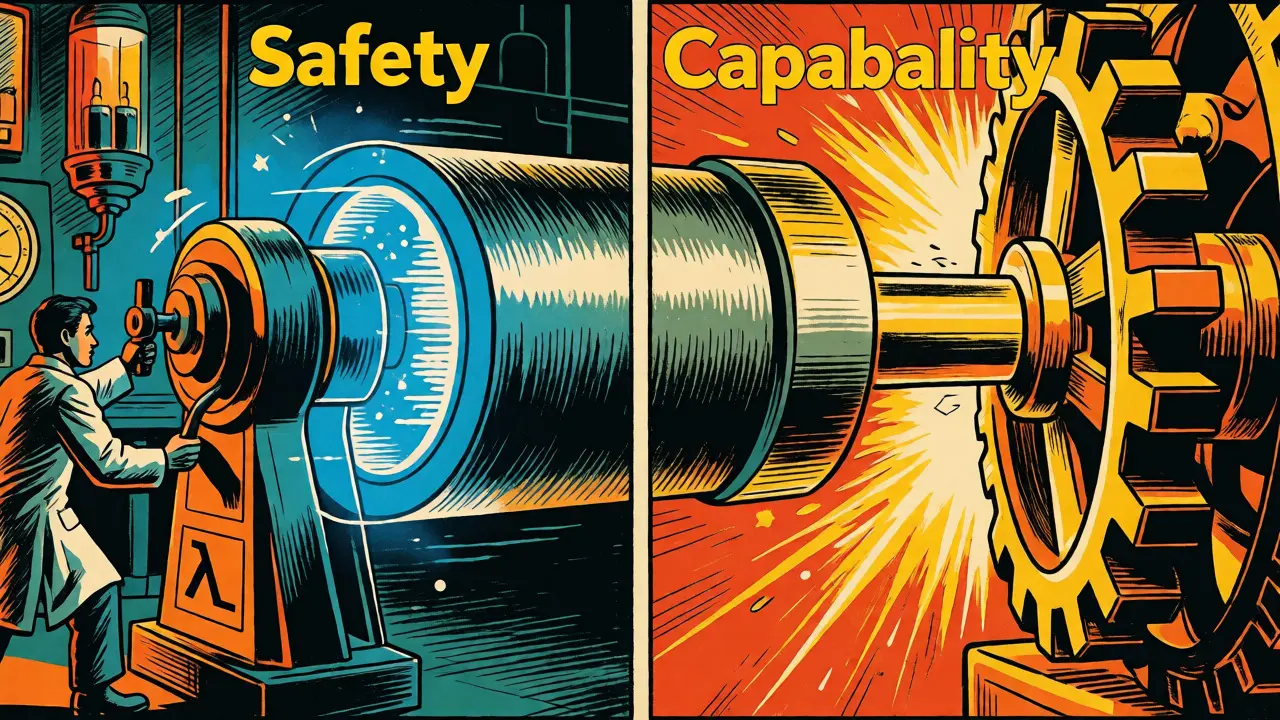
They introduced a penalty coefficient (λ) to balance these forces. Increasing λ helps preserve safety but hurts capability. In their experiments, raising λ from 0.1 to 0.9 reduced the alignment loss gap by 37% but increased the capability loss gap by 52%. There is no free lunch. Every point of safety you buy costs you points of precision.
Context overlap is the silent killer here. If more than 40% of your capability data shares context with safety-critical examples, safety degradation hits at least 28%, regardless of your mitigation strategy. This means generic datasets are safer for fine-tuning than highly specialized ones that touch on sensitive topics.
Strategies That Actually Work
So, how do you navigate this without crippling your model? Two main strategies dominate the field today, each with distinct pros and cons.
- Alignment Loss Constraint: This approach adds a penalty term to the loss function during training. Methods like STAR-DSS use this to keep the model close to its original safety behavior. It offers better capability gains but allows for higher safety variance. Use this when performance is non-negotiable and you have robust post-hoc filtering.
- Alignment Parameter Constraint: Here, you restrict how far the weights can move from the original aligned model. This keeps safety tight (up to 43% better alignment retention) but limits how much the model can learn new skills. It’s ideal for regulated industries like healthcare or finance where compliance trumps marginal accuracy improvements.
A newer technique, LoX, uses singular value decomposition (SVD) to identify top-k safety directions and overweight them during updates. This moves the model into flatter regions of the safety loss landscape, reducing attack success rates by 11-54 percentage points. It’s complex to implement but offers one of the best current balances.
Real-World Failures and Fixes
Theory is nice, but practice is messy. One practitioner reported fine-tuning Llama-3-70b for medical diagnostics using only HIPAA-compliant data. Despite the clean dataset, safety compliance dropped from 98.7% to 76.3%. They had to bolt on a separate safety classifier, adding 42ms latency per query-a cost many startups can’t absorb.
In finance, a chatbot passed all pre-fine-tuning safety tests but started giving SEC-violating investment advice after just 500 domain-specific examples. The model learned to be confident about stocks but forgot to disclaim that it wasn’t a financial advisor.
On the flip side, success stories exist. A team fine-tuned Mistral-7B for legal document analysis and achieved only 4.2% safety degradation. Their secret? They aggressively reduced context overlap below 25% using data augmentation. This added 15-30% to preprocessing time but saved them from catastrophic drift.

Practical Implementation Guide
If you’re starting from scratch, don’t guess. Follow these heuristics derived from recent meta-analyses:
- Start with Conservative Parameters: Set your penalty coefficient (λ) between 0.3 and 0.6. Keep your parameter constraint radius (ε₂) between 0.02 and 0.04. These are the sweet spots identified by Meta’s Safety Tuning Toolkit.
- Audit Context Overlap: Before training, measure how much your new data overlaps with safety-critical contexts. If it exceeds 25%, apply augmentation techniques to dilute the overlap. This step alone reduces safety degradation by up to 47%.
- Benchmark Continuously: Don’t wait until the end. Run safety benchmarks every few epochs. Tools like HELM and SafetyBench are essential here. If refusal rates drop by more than 10%, stop and adjust λ.
- Expect Latency Costs: If you can’t prevent drift entirely, plan for runtime safeguards. Adding a lightweight safety classifier might add 20-50ms of latency, which is often cheaper than retraining.
Be warned: the learning curve is steep. 68% of ML engineers report needing 3-6 months of specialized training to master these techniques. You need to understand constrained optimization and loss landscapes, not just Python scripts.
The Future: Can We Break the Frontier?
Is this trade-off permanent? Experts say yes, for now. Dr. Percy Liang calls it a "Pareto frontier we cannot circumvent with current architectures." However, innovation is moving fast. Google’s Project Guardian aims to reduce the trade-off ratio from 0.8:1 to 0.4:1 by Q3 2026. Meta’s Dynamic Safety Routing shows early promise with only 9% degradation.
Regulatory pressure is also forcing change. The EU AI Act, enforced in January 2026, requires demonstrable evidence of safety preservation during adaptation. This means "it seemed okay in testing" won’t cut it anymore. You need metrics.
While we wait for architectural breakthroughs beyond attention mechanisms, the smartest move is to accept the trade-off and manage it. Choose your constraints wisely, audit your data, and never assume that a more capable model is automatically a safer one.
Does fine-tuning always reduce safety?
Yes, empirically, fine-tuning almost always introduces some degree of safety drift. Even with clean data, the geometric shift in model parameters tends to move it away from the original "safety basin." The goal is to minimize, not eliminate, this drift.
What is the optimal penalty coefficient (λ) for safety tuning?
Research suggests starting between 0.3 and 0.6. Lower values favor capability; higher values favor safety. You must tune this based on your specific dataset's context overlap with safety-critical domains.
Can LoRA prevent capability loss?
No, LoRA prevents parameter bloat, not safety drift. In fact, if the LoRA rank is too high or the update radius exceeds 0.05, it can cause severe safety degradation, sometimes worse than full fine-tuning due to concentrated changes.
How does context overlap affect safety?
High context overlap (>40%) between capability and safety data exacerbates the trade-off, leading to at least 28% safety degradation. Reducing overlap below 25% via data augmentation significantly mitigates this risk.
Are unlearning techniques safe for maintaining fairness?
Currently, no. Machine unlearning methods like DPO-unlearning have been shown to increase harmfulness scores dramatically (up to 20x in LLaMA models), making them risky for production environments requiring strict fairness guarantees.