
It is easy to get swept up in the hype of generative artificial intelligence. We hear about chatbots that write poetry or code that writes itself. But as a business leader, you are not here for the poetry. You are here for the bottom line. The hard truth is that while generative AI is a transformative technology capable of creating text, images, and code has become mission-critical infrastructure, the financial returns have been uneven at best.
In 2023, the IBM Institute for Business Value reported that enterprise AI initiatives achieved an average return on investment (ROI) of just 5.9%. That number was sobering. However, by 2026, the landscape has shifted dramatically. According to Wharton’s 2025 AI Adoption Report, 82% of enterprises now use generative AI weekly, and three-quarters of business leaders report positive returns. How did they do it? And more importantly, why do so many other companies still fail to see those same gains?
The Reality Check: Why Most Pilots Fail
You might think that buying access to a powerful model is enough. It is not. In fact, a stark reality check emerged in late 2025 when Fortune and MIT researchers found that 95% of generative AI pilots fail to achieve rapid revenue acceleration. This failure rate is not due to the technology being broken; it is due to how businesses deploy it.
The biggest mistake early adopters made was misalignment. More than half of all generative AI budgets were thrown at sales and marketing tools because those departments wanted shiny new toys for content creation. Yet, the highest ROI was consistently found in back-office automation-boring, unglamorous work like streamlining operations and eliminating business process outsourcing. When you try to force AI into every corner of your business without a clear strategy, you dilute your resources. As Aditya Challapally from MIT noted, successful implementations pick one specific pain point, execute well, and partner smartly. They do not spread themselves thin.
| Factor | Successful Implementation | Unsuccessful Implementation |
|---|---|---|
| Scope | Focused on one high-impact pain point | Broad, scattered across multiple departments |
| Primary Use Case | Back-office automation & efficiency | Sales/Marketing content generation only |
| Measurement | Formal ROI framework tracking productivity | No formal metrics or vague "productivity" claims |
| Outcome | Measurable cost savings & speed gains | Pilot fatigue with no revenue acceleration |
Case Study 1: Klarna’s Customer Service Revolution
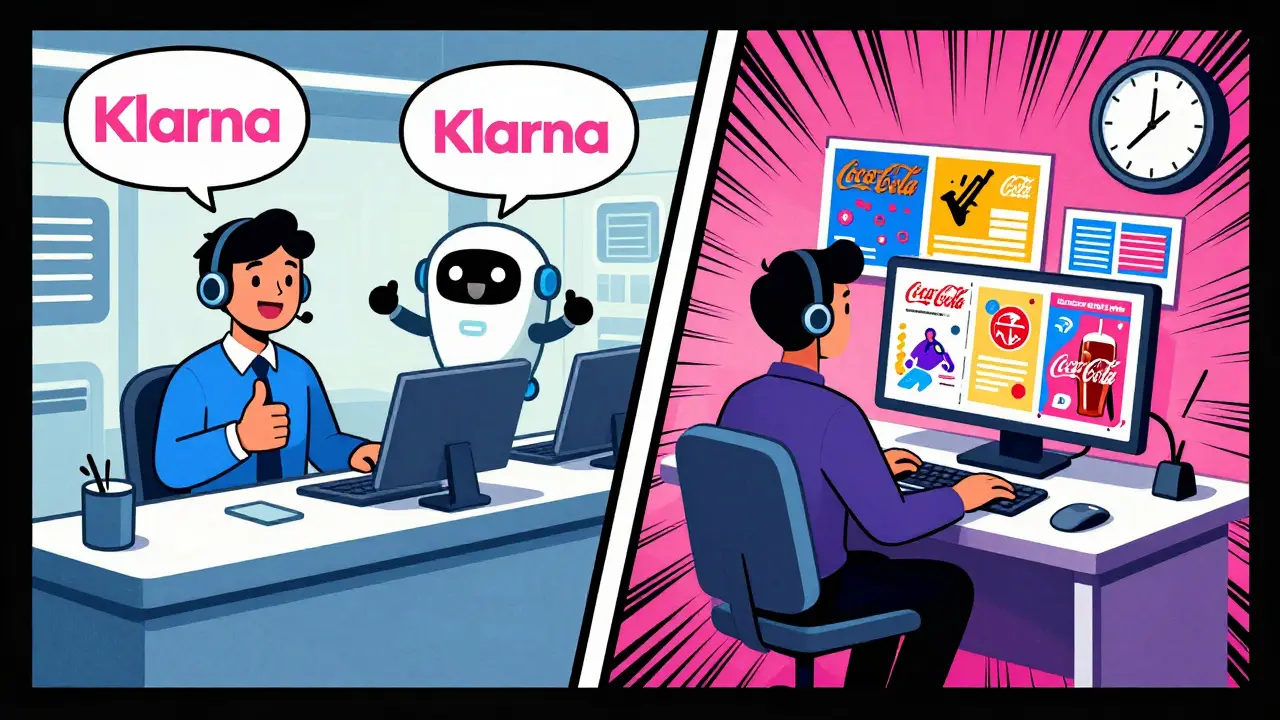
Let us look at a concrete example of what works. Klarna, the fintech giant, faced a classic scaling problem: customer inquiries were skyrocketing, and hiring enough human agents to keep up was unsustainable and expensive. They did not try to replace their entire support team overnight. Instead, they deployed generative AI assistants to handle routine questions.
The results were immediate and measurable. According to Kanerika’s 2025 ROI benchmarks, Klarna saw a 20-30% improvement in customer satisfaction scores. This is significant because customer satisfaction directly correlates with retention and lifetime value. By using AI to enhance human output rather than simply replacing tasks, Klarna turned a cost center into a competitive advantage. The key takeaway here is that AI should augment your existing workforce. When employees can resolve issues faster with AI assistance, they spend less time on repetitive queries and more time on complex, high-value interactions.
Case Study 2: Coca-Cola’s Creative Acceleration
On the creative side, Coca-Cola offers a masterclass in balancing innovation with brand consistency. Marketing teams often struggle with the sheer volume of assets needed for global campaigns. Coca-Cola implemented OpenAI and DALL·E to generate creative concepts and campaign materials. This did not mean letting an algorithm run wild with their iconic branding. Instead, they used the technology to accelerate concept development while maintaining strict global brand guidelines.
The impact was a 50% reduction in campaign development time. For a company that launches hundreds of campaigns a year, cutting that timeline in half allows for more agility and more frequent market engagement. This aligns with IBM’s finding that product development teams following top AI best practices reported a median ROI of 55%. The lesson for marketers is clear: use generative AI to remove the friction from the creative process, not to replace the strategic thinking behind it.
The "Shadow AI" Phenomenon: A Warning Sign
Here is something that might surprise you: some of the best ROI stories come from outside official IT channels. MLQ.ai’s 2025 report documented a surge in "shadow AI," where employees unofficially use generative tools to get their jobs done. Reddit discussions from late 2025 feature marketing professionals claiming 3-5x speed increases in content creation using these tools, despite lacking formal enterprise support.
This is both good news and bad news. It is good because it proves the technology delivers real value when applied to specific tasks. It is bad because it creates security risks and data leakage vulnerabilities. If your IT department is slow to act, your employees will find ways to use AI anyway. The smart move is to create safe, supported environments for these tools. Wharton’s data shows that 89% of organizations agree generative AI enhances employee skills, but 43% of leaders worry about skill degradation. The solution is training, not prohibition. When you empower employees with proper tools and guardrails, you capture that shadow ROI officially.

How to Measure Generative AI ROI Correctly
If you want to replicate these successes, you need to measure correctly. Many companies fail because they look for revenue growth immediately, which is rarely the first outcome. Deloitte’s 2025 survey revealed that only 15% of respondents had already achieved significant, measurable ROI, though 38% expected it within a year. The gap lies in expectation management.
To track true value, focus on these specific metrics:
- Employee Hour Savings: Track time saved on repetitive tasks like drafting emails, summarizing documents, or writing basic code. Companies using ChatGPT-powered assistants report saving hundreds of hours monthly.
- Campaign Development Time: Measure the reduction in time from concept to launch. As seen with Coca-Cola, a 50% cut here is a massive operational win.
- Customer Satisfaction Scores (CSAT): Monitor changes in CSAT after deploying AI assistants. A 20-30% increase indicates better service quality.
- Conversion Rates: Look at whether personalized, AI-driven marketing leads to higher conversion rates compared to generic campaigns.
IBM emphasizes that a holistic view is crucial. Organizations that take a big-picture approach to their content supply chain reported ROI 22% higher for content development and 30% higher for AI integration. Do not look at AI in isolation. Look at how it fits into your entire workflow.
Future-Proofing: From Generative to Agentic AI
As we move through 2026, the conversation is shifting from generative AI to agentic AI. Generative AI creates content; agentic AI takes action. Google Cloud’s research shows early adopters are already using AI agents to drive end-to-end process redesign. Deloitte notes that successful organizations will not treat these as competing priorities. Instead, they leverage generative AI for short-term impact and momentum while laying the foundation for agentic AI’s longer-term transformation.
This means your ROI strategy must evolve. Today, you measure efficiency gains. Tomorrow, you will measure autonomous decision-making and process elimination. Start building those foundations now by ensuring your data is clean and your processes are mapped. Without structured data, even the most advanced AI agent cannot function effectively.
What is the average ROI of generative AI in 2026?
While averages vary by industry, Wharton's 2025 report indicates that three-quarters of business leaders now report positive returns. Specifically, product development teams following best practices reported a median ROI of 55%, according to IBM. However, general enterprise averages were lower in previous years, highlighting the importance of specific implementation strategies.
Why do 95% of generative AI pilots fail?
According to MIT and Fortune research, most pilots fail because they lack focus and misalign resources. Companies often spread budgets too thin across multiple use cases or focus on low-impact areas like general content creation instead of high-ROI back-office automation. Successful pilots solve one specific, painful problem very well.
How does Klarna measure its AI success?
Klarna measures success through customer satisfaction scores (CSAT). By using generative AI assistants to handle routine inquiries, they achieved a 20-30% improvement in CSAT. This metric is crucial because higher satisfaction leads to better customer retention and increased lifetime value, which are direct drivers of revenue.
What is "shadow AI" and why should I care?
Shadow AI refers to employees using unauthorized generative AI tools to improve their productivity. While this can lead to impressive individual results (like 3-5x faster content creation), it poses significant security and compliance risks. Companies should address this by providing official, secure tools and training rather than banning usage entirely.
Is agentic AI different from generative AI?
Yes. Generative AI primarily creates content such as text, images, or code. Agentic AI goes further by taking actions and making decisions within defined parameters. For example, an agentic AI might not just draft an email but also send it and update a CRM record. Experts suggest using generative AI for immediate efficiency gains while preparing infrastructure for agentic AI's deeper process transformations.




9 Comments
Francis Laquerre
Oh my god, the part about 'boring' back-office automation being the golden ticket is just *chef's kiss* perfection. We spent so much time trying to make our marketing emails sound like they were written by a poet from 18th-century France when we should have been fixing our invoice processing pipeline. It’s dramatic, it’s tragic, but honestly? So true.
michael rome
It is imperative that organizations recognize the profound shift in operational paradigms necessitated by these technological advancements. The data presented herein suggests a clear trajectory toward efficiency through focused implementation rather than diffuse experimentation. One must approach this with rigorous discipline and strategic foresight to ensure sustainable growth.
Andrea Alonzo
I think what really resonates with me here is the idea that we need to be empathetic to our own workflows before we try to automate them, because if you don't understand the pain points deeply, you're just adding more noise to an already chaotic system, and I've seen so many teams struggle with this exact issue where they bring in tools without really mapping out how those tools fit into the daily rhythm of their employees, which leads to frustration and burnout instead of relief, so it's crucial to take that extra step of listening to your team first.
Saranya M.L.
The fundamental misalignment observed in Western enterprises stems from a lack of foundational data hygiene and strategic clarity, which is precisely why Indian tech hubs are leading the charge in actual implementation rather than mere pilot fatigue. Your reliance on superficial metrics such as CSAT ignores the deeper structural inefficiencies that require robust backend optimization and precise algorithmic integration for true ROI realization.
om gman
oh look another article telling us to do basic accounting instead of making art lol. i mean sure, if you want to live in a world where spreadsheets rule supreme then go ahead and embrace the beige. but let's not pretend that 'back-office automation' is some revolutionary concept that only now people are discovering. it's boring yes, but at least it pays the bills unlike your failed poetry chatbot dreams
Jeanne Abrahams
Sure, Klarna saved money, but did they save their soul? Just kidding. But seriously, the shadow AI thing is wild. My entire team has been using unauthorized tools for months because IT was too busy writing policies to actually deploy anything. We’re faster, we’re happier, and frankly, we’re terrified someone will audit us. Give us the keys or watch us drive off the cliff ourselves.
Bineesh Mathew
We stand at the precipice of a moral abyss where the very essence of human creativity is commodified by silicon minds, yet we celebrate this degradation as 'efficiency.' Is it progress if the cost is our collective imagination? Or are we merely building a gilded cage of productivity metrics that measure nothing but our own obsolescence? The silence of the machines is deafening, yet we scream louder into the void.
Oskar Falkenberg
i totally agree with the bit about not spreading yourself thin, its kinda like when you try to learn three languages at once and end up speaking none of them properly right? so yeah focus on one thing and do it well, thats the way forward imo, and also typos dont matter if the point is clear lol
Caitlin Donehue
Interesting read.