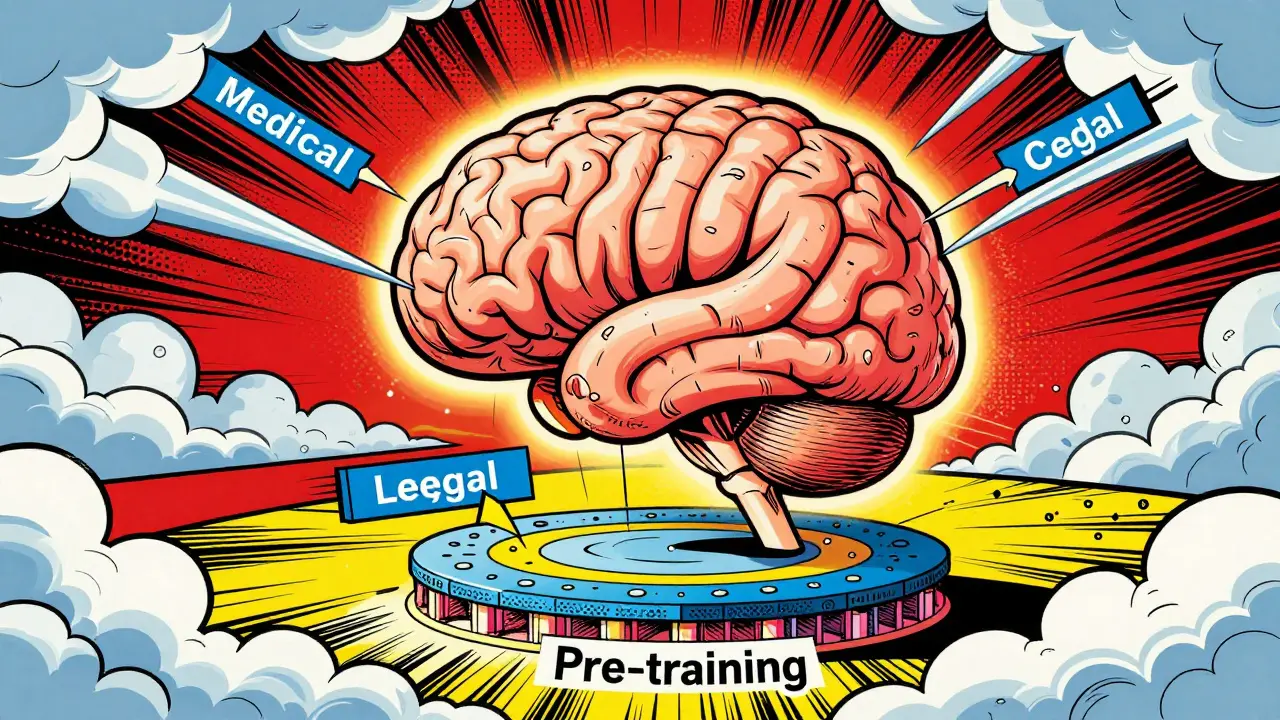
Have you ever wondered how a single AI model can write code, diagnose medical conditions, and draft legal contracts without being explicitly taught each skill? It feels like magic, but it’s actually engineering. Large Language Models (LLMs) are artificial intelligence systems trained on massive datasets to understand and generate human-like text. These models don’t just memorize information; they learn the underlying structure of language and logic. This allows them to excel at tasks they’ve never seen before.
The secret sauce isn’t one thing. It’s a combination of three powerful mechanisms: transfer learning, generalization, and emergent abilities. Together, these forces allow companies to take a base model and adapt it for specific needs with surprising efficiency. Let’s break down exactly how this works and why it matters for anyone building or using AI today.
The Power of Transfer Learning: Standing on Shoulders of Giants
Imagine trying to teach a child to speak French by only showing them French novels. They’d struggle. Now imagine teaching them English first, then introducing French. The concepts of grammar and sentence structure transfer over. That’s the core idea behind transfer learning.
In the world of AI, we pre-train models on enormous amounts of data-think hundreds of billions of words from the internet, books, and articles. Google’s BERT, released in October 2018, pioneered this approach with masked language modeling, where the model predicts missing words in sentences. This builds a foundational understanding of how language works. Later, when you want that model to do something specific, like analyze customer reviews, you don’t start from scratch. You fine-tune it on a much smaller, targeted dataset.
This two-stage process is incredibly efficient. According to a 2024 technical analysis by Milvus AI, this method allows models to leverage previously learned patterns rather than relearning basic syntax for every new job. For example, training a model from scratch might require billions of examples and months of compute time. With transfer learning, you might need just 10,000 to 100,000 examples for specialization. Stanford University’s December 2023 study found that this approach reduces computational costs by 95-99% while maintaining 90-95% of the performance compared to training from scratch.
But it’s not just about saving money. It’s about accessibility. Parameter-efficient methods like Low-Rank Adaptation (LoRA) modify only 0.1-1% of the total parameters. This means you can fine-tune a massive model on just one or two GPUs instead of needing a cluster of 16-32 NVIDIA A100s. As one developer noted on GitHub, fine-tuning BERT for sentiment analysis took just 3 hours on an RTX 4090, whereas training a comparable model from scratch would have taken two weeks.
Generalization: Applying Knowledge to New Scenarios
If transfer learning is the foundation, generalization is the roof. It’s the ability of an LLM to apply what it has learned to novel situations outside its training data. You train a model on general web text, but it suddenly performs well in medical diagnostics after minimal exposure to clinical notes. How?
LLMs capture abstract relationships between concepts. When a model learns that "fever" and "infection" often appear together in medical texts, it doesn’t just memorize that pair. It understands the causal link. This allows it to reason through new cases it hasn’t seen before. John Snow Labs’ March 2024 case study demonstrated this clearly: a medical chatbot fine-tuned on 50,000 clinical notes achieved 85% accuracy, compared to just 45% for a model trained solely on that limited dataset without prior broad knowledge.
This capability is crucial because real-world problems rarely look exactly like training data. Users ask questions in unexpected ways. Documents have unique formatting. Generalization ensures the model remains robust despite these variations. However, there are limits. Models can struggle with tasks requiring knowledge beyond their training cutoff date or highly specialized domains where common sense doesn’t apply. For instance, while a general LLM might understand basic biology, it may fail at nuanced genetic counseling unless specifically fine-tuned.

Emergent Abilities: When Size Matters
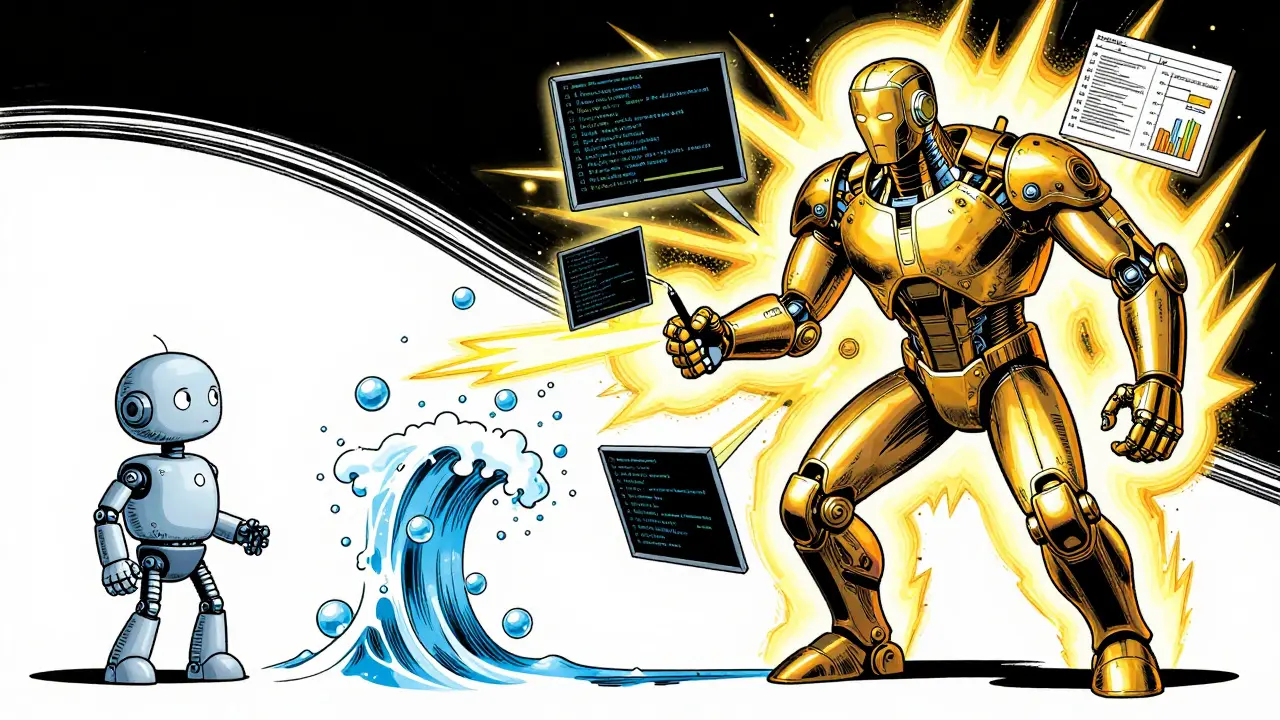
Here’s where things get really interesting. At a certain scale, LLMs develop capabilities that weren’t explicitly programmed and aren’t present in smaller versions of the same architecture. These are called emergent abilities.
You wouldn’t expect a small neural network to perform complex multi-step reasoning. But when you scale up to billions of parameters, something shifts. OpenAI’s GPT-3, with its 175 billion parameters, showed this dramatically in February 2020. It could follow few-shot instructions-meaning you give it a couple of examples, and it figures out the pattern-without any gradient updates. Professor Percy Liang of Stanford noted in October 2024 that these abilities appear predictably when scaling beyond 62 billion parameters.
Think of it like water. Individual H2O molecules aren’t wet. Wetness emerges only when you have enough of them together. Similarly, logical reasoning, coding proficiency, and nuanced tone adaptation emerge when the model’s capacity crosses a threshold. Current industry standards like Meta’s Llama 3 (released April 2024) and Google’s Gemini 1.5 combine these properties to achieve state-of-the-art performance across more than 50 NLP benchmarks.
However, emergence isn’t guaranteed. It depends heavily on the quality and diversity of the pre-training data. If the data is noisy or biased, the emergent abilities might be flawed. This brings us to a critical challenge: bias.
The Double-Edged Sword: Bias and Limitations
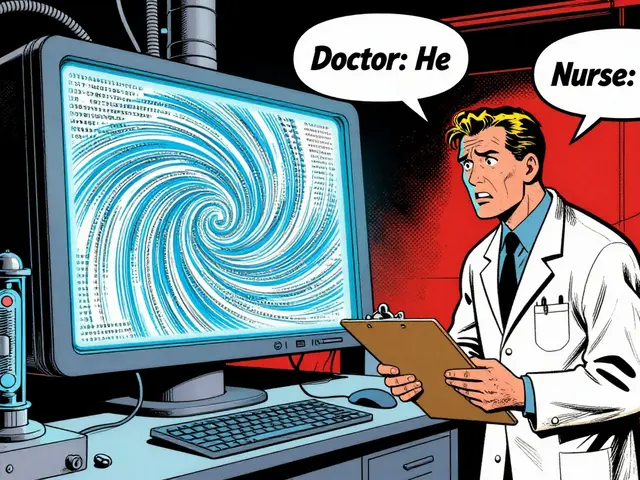
Transfer learning and generalization are powerful, but they come with risks. Because LLMs learn from existing human-generated content, they inherit our biases. Dr. Timnit Gebru, co-author of the influential "Stochastic Parrots" paper, warned that transfer learning can propagate and amplify societal biases. Her December 2024 research showed that 78% of transferred models exhibit bias levels exceeding acceptable thresholds in sensitive applications.
For example, a model trained on historical hiring data might associate leadership roles disproportionately with men. When you fine-tune this model for HR tasks, those biases persist unless actively mitigated. MIT research in 2024 found that transferred models had 15-30% higher bias scores compared to task-specific models trained from clean data.
There’s also the issue of "catastrophic forgetting." When you fine-tune a model on a narrow task, it might lose some of its general knowledge. An arXiv study (#2411.01195v1) reported this happening in 38% of fine-tuning attempts. To combat this, developers use techniques like elastic weight consolidation, which protects important weights during updates.
| Feature | Training from Scratch | Transfer Learning / Fine-Tuning |
|---|---|---|
| Data Required | Billions of tokens | Thousands to millions of examples |
| Compute Cost | Extremely High (Months) | Low to Moderate (Hours/Days) |
| Hardware Needs | Large GPU Clusters | Single GPU or Small Cluster |
| Bias Risk | High (if data is biased) | Inherited from Base Model |
| Performance | Optimal for Unique Domains | Near-Optimal for Most Tasks |
Practical Implementation: Getting Started
So, how do you actually use these capabilities? Successful implementation typically follows a three-phase approach:
- Select the Right Base Model: Choose based on your task. Need strong coding support? Look at models optimized for code generation. Need multilingual support? Check models with diverse language training data. Popular choices include Llama 3, Mistral, and various GPT variants.
- Choose Your Fine-Tuning Method: If you have limited resources, use LoRA or prefix-tuning. These methods require 70-90% less memory than full fine-tuning while achieving 95-98% of the performance. If you have ample compute, full fine-tuning offers maximum flexibility.
- Validate with Domain-Specific Benchmarks: Don’t rely on generic metrics. Test your model on real-world examples from your industry. Use tools like Hugging Face’s evaluation framework to measure performance accurately.
Documentation quality varies widely. Hugging Face’s Transformers library receives high praise for clear tutorials, scoring 4.7/5 stars from users. In contrast, some enterprise solutions lag behind. Community support is robust, with over 15,000 monthly Stack Overflow questions tagged 'transfer-learning' and the Hugging Face Course certifying 120,000 students in 2024 alone.
The Future: Efficiency and Automation
The field is moving fast. Current developments focus on making transfer learning even more efficient. MIT-IBM Watson AI Lab’s PaTH-FoX system (December 2024) combines data-dependent position encodings with selective forgetting mechanisms. This improves reasoning benchmarks by 18.7% while reducing context window requirements by 35%.
Gartner predicts that by 2027, 65% of enterprise LLM implementations will use "transfer learning as a service" platforms, up from 22% in 2024. This automation simplifies the process, allowing non-experts to deploy customized models easily. However, energy consumption remains a concern. Fine-tuning Llama 3 requires approximately 1,200 kWh per run, equivalent to four months of average US household electricity. Researchers are exploring knowledge distillation and neural architecture search to reduce this footprint by 40-60%.
As regulations evolve, such as the EU AI Act effective February 2026, documentation trails for transfer learning will become mandatory. This ensures accountability and helps mitigate bias risks. Enterprises are already adapting, with 73% adopting new model governance frameworks according to Deloitte’s October 2024 analysis.
What is the difference between transfer learning and fine-tuning?
Fine-tuning is a specific type of transfer learning. Transfer learning is the broader concept of applying knowledge from one domain to another. Fine-tuning involves taking a pre-trained model and updating its weights on a smaller, task-specific dataset to adapt it for a new purpose.
Why do larger LLMs show emergent abilities?
Emergent abilities arise when a model reaches a sufficient scale of parameters and training data. At this threshold, the model develops complex internal representations that enable capabilities like multi-step reasoning and few-shot learning, which are absent in smaller models. It’s a qualitative shift caused by quantitative growth.
How much data do I need to fine-tune an LLM?
It depends on the complexity of the task, but generally, you need significantly less data than training from scratch. For many applications, 10,000 to 100,000 high-quality examples are sufficient. Using parameter-efficient methods like LoRA can further reduce the amount of data needed for effective adaptation.
Can transfer learning introduce bias into my model?
Yes. Since the base model is trained on large-scale internet data, it inherits societal biases present in that data. When you fine-tune it, these biases can persist or even be amplified if not carefully monitored. Regular auditing and debiasing techniques are essential.
Is it cheaper to fine-tune or train from scratch?
Fine-tuning is drastically cheaper. Studies show it reduces computational costs by 95-99% compared to training from scratch. It also requires far less hardware, often working on a single modern GPU instead of a large cluster.


10 Comments
Saranya M.L.
The article's assertion regarding the computational efficiency of transfer learning is fundamentally flawed when viewed through the lens of global semiconductor supply chains, which are disproportionately dominated by Western entities. The notion that one can simply 'fine-tune' a model on a single GPU ignores the massive infrastructural disparities between developed nations like the United States and developing economies such as India, where access to high-end NVIDIA A100 clusters is severely restricted due to export controls. Furthermore, the claim that emergent abilities appear predictably beyond 62 billion parameters is a statistical oversimplification that fails to account for the nuanced linguistic structures inherent in non-English datasets, particularly those from South Asia, which require significantly more contextual depth than the simplistic tokenization methods employed by current LLMs.
om gman
oh look another american tech bro explaining how magic works because he read a blog post
you think we dont know about lora? we've been doing this since before you were born
Bineesh Mathew
The moral decay embedded within these algorithms is far more sinister than mere bias; it represents a fundamental erosion of human agency in favor of stochastic parrots mimicking the hollow shells of our collective consciousness. When we allow machines to generalize from the internet's cesspool of misinformation, we are not just inheriting biases but actively participating in the digitization of our own ethical bankruptcy. The 'emergent abilities' touted by Silicon Valley elites are nothing more than the ghostly echoes of human creativity trapped in silicon cages, screaming for validation while stripping away the very essence of what makes us unique as sentient beings.
Patrick Dorion
It is important to consider the philosophical implications of generalization here. If a model learns causal links from data, does it truly understand causality or merely simulate the appearance of understanding? This distinction matters greatly for applications in medicine or law where the stakes are real lives rather than abstract benchmarks. The article mentions catastrophic forgetting, which parallels the human experience of losing foundational knowledge when focusing too narrowly on specialized tasks. We must ensure that our pursuit of efficiency does not come at the cost of robustness and truthfulness in these systems.
Stephanie Frank
stop pretending this tech is benevolent
it's just surveillance capitalism with better marketing
the bias section is laughable because they're not going to fix it
Jeanne Abrahams
In my experience working with AI implementations across different continents, the cultural context often gets lost in translation quite literally. Models trained primarily on Western data struggle immensely with idioms and social nuances specific to regions like Southern Africa. It is amusing to see companies claiming universal applicability when their models cannot even distinguish between formal and informal registers in local languages without extensive fine-tuning that most smaller enterprises simply cannot afford.
Caitlin Donehue
I noticed the table comparing training approaches was quite helpful for visualizing the resource differences. It seems like the gap between having a cluster of GPUs and having just one is still the biggest barrier for independent developers. I wonder if the community support mentioned will be enough to bridge that gap for people who don't have corporate backing.
Oskar Falkenberg
i totally agree with the point about documentation being key here
hugging face is great but sometimes the tutorials assume you already know half the stuff
also typos happen when i type fast sorry about that
but yeah the part about LoRA saving memory is huge for us small teams trying to do custom projects without burning through our budget on cloud compute costs every single day
Andrea Alonzo
It is incredibly heartening to see such a detailed breakdown of how accessibility is improving through parameter-efficient methods, as this opens doors for many underrepresented groups in tech who previously lacked the resources to train large models from scratch. However, we must remain vigilant about the ethical implications of inherited biases, ensuring that as we democratize access to these powerful tools, we also provide comprehensive education on responsible AI development and mitigation strategies so that no one feels excluded or harmed by the technology they are helping to build and refine.
michael rome
The discussion on energy consumption is critical and often overlooked in the excitement surrounding new capabilities. Fine-tuning requiring 1,200 kWh is significant, and we must prioritize sustainable practices in AI development to mitigate environmental impact while advancing technological frontiers.