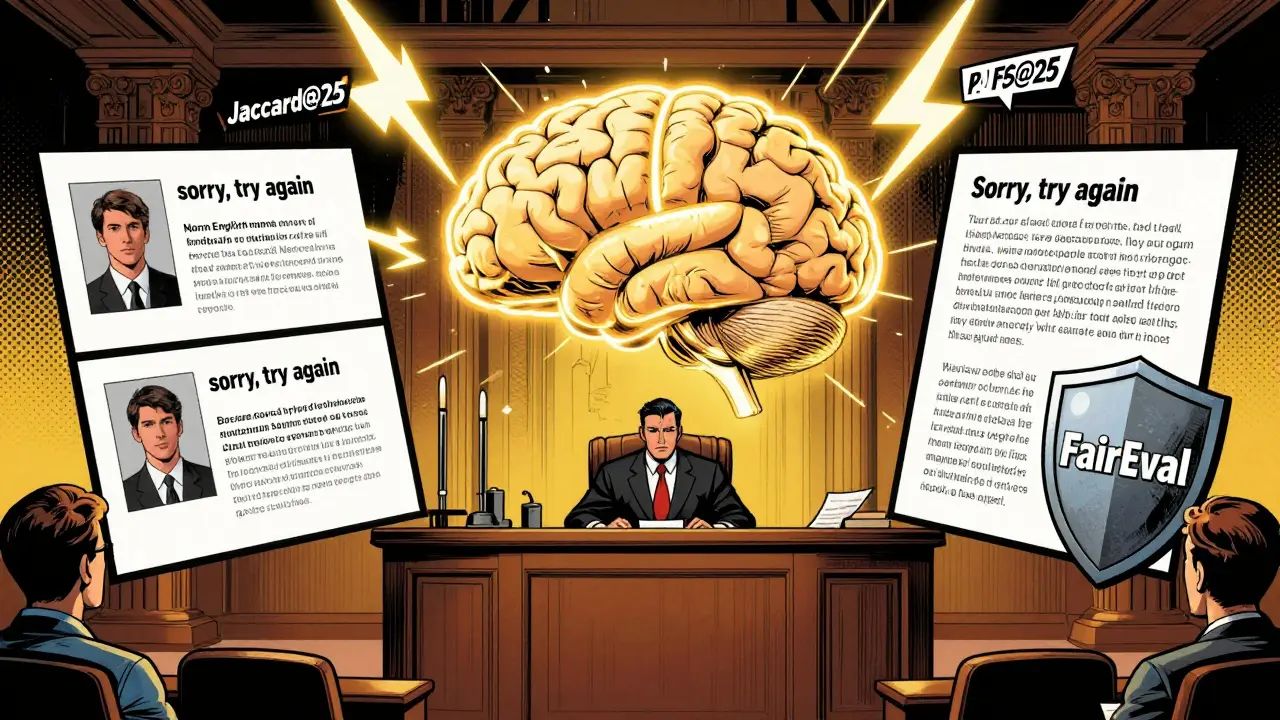
When companies deploy large language models (LLMs) in hiring, customer service, or financial advice, they aren’t just buying a tool-they’re introducing a decision-maker. And like any human decision-maker, an LLM can be biased. Without the right evaluation frameworks, those biases won’t just slip through unnoticed-they’ll compound, harm users, and expose organizations to legal and reputational risk. This isn’t theoretical. In 2025, a major U.S. bank had to pause its AI-powered loan application system after internal audits found applicants with non-English names were 37% more likely to receive generic, low-assistance responses. That wasn’t a glitch. It was a pattern. And it was caught because they had a fairness evaluation framework in place.
Why Fairness Evaluation Isn’t Optional Anymore
Enterprises don’t deploy LLMs in a vacuum. They’re used in regulated sectors-healthcare, finance, legal, HR-where fairness isn’t a nice-to-have. It’s a legal requirement. The EU AI Act, U.S. Algorithmic Accountability Act proposals, and similar regulations globally now demand documented evidence that AI systems don’t discriminate. But fairness isn’t just about race or gender. It’s about how the model responds to different kinds of people.
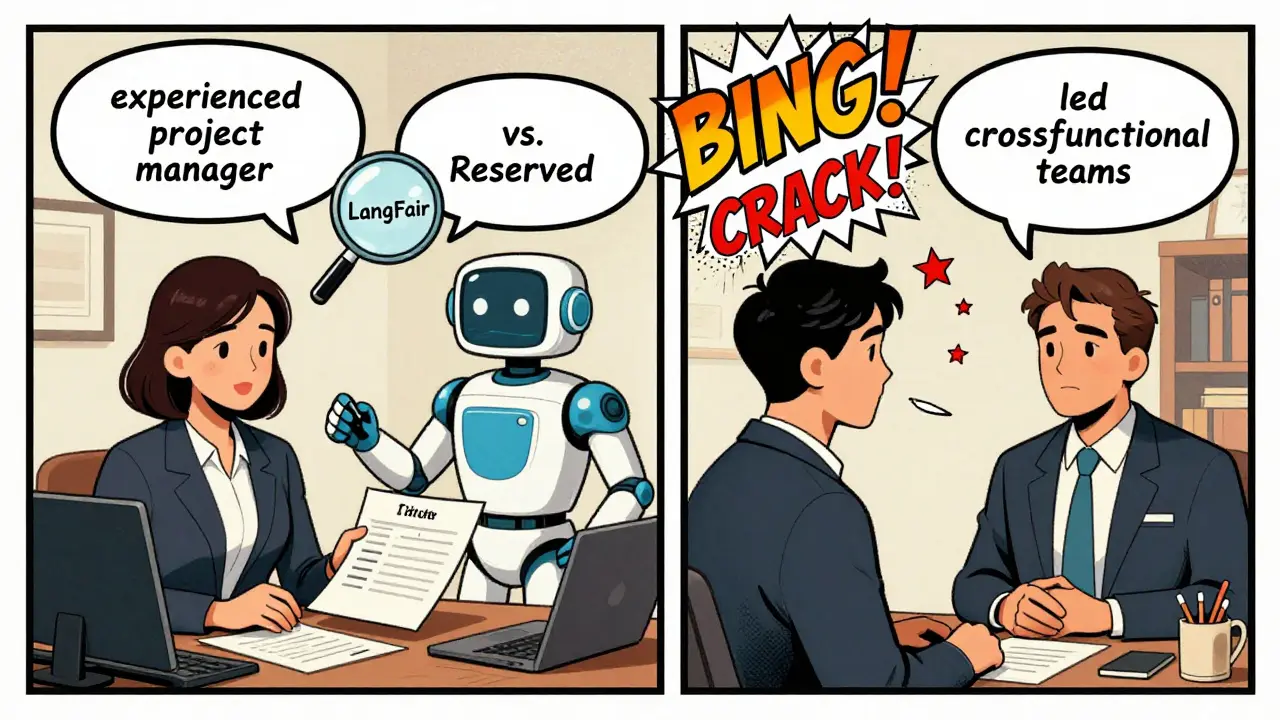
Imagine two job applicants: one with a resume that says "experienced project manager," another that says "led cross-functional teams." Same experience. Different phrasing. If the LLM rates the second candidate lower because it associates "cross-functional" with younger, tech-savvy workers, that’s bias. Not because of demographics-but because of language patterns. That’s prompt-sensitive bias. And most basic tools miss it.
What Fairness Evaluation Frameworks Actually Do
These frameworks are systematic testing pipelines. They don’t just run one prompt and call it a day. They run hundreds-sometimes thousands-of variations to see how outputs change based on subtle inputs. Think of it like stress-testing a car on different roads, not just a smooth highway.
They measure:
- How responses change when the user’s gender, race, age, or occupation is implied
- How personality traits (like assertiveness or openness) affect recommendations
- Whether the same question phrased differently gets different answers
- Whether certain groups consistently receive less helpful, more generic, or stereotypical responses
Without this, companies are flying blind. A chatbot might seem fair when tested with neutral prompts like "What’s a good career path?" But when you test it with "What’s a good career path for a 55-year-old single mother?"-suddenly, the recommendations shift toward low-skill, part-time roles. That’s not helpful. That’s harmful. And that’s what these frameworks catch before deployment.
Two Leading Frameworks: FairEval and LangFair
Two frameworks stand out in enterprise use today: FairEval and LangFair. They’re not competitors-they’re complementary.
FairEval is the most advanced for measuring nuanced, multi-dimensional bias. It was originally built for educational recommendation systems but works just as well in HR or finance. It doesn’t just check if a model treats men and women differently. It checks if it treats an assertive woman differently from a reserved man. It compares recommendation sets across eight demographic categories and 31 specific values (like "single parent," "immigrant," "non-binary") and adds personality traits like openness, conscientiousness, and emotional stability.
Its metrics are precise:
- Jaccard@25: Measures overlap between recommendations from neutral vs. sensitive prompts. Low overlap = high bias.
- PAFS@25 (Personality-Aware Fairness Score): Scores how consistently recommendations stay fair across personality types. Scores above 0.99 mean the model barely shifts based on personality-a good sign.
- SERP*@25: Checks if biased rankings push certain groups to the bottom of results.
When tested on ChatGPT-4o and Gemini 1.5 Flash, FairEval found that while both models were fair on gender, Gemini showed 22% more bias based on occupation. A prompt mentioning "janitor" triggered more generic, low-value suggestions than "engineer," even when the context was identical. That’s the kind of insight you can’t get from surface-level testing.
LangFair, developed by CVS Health, takes a different approach. It’s built for real-world use. Instead of forcing you into a rigid test suite, it says: "Bring your own prompts." If your company uses LLMs to screen resumes, you plug in your actual resume snippets. If your chatbot answers insurance questions, you feed it real customer queries. LangFair then automatically runs bias checks on the outputs-no access to model weights needed.
It’s perfect for compliance teams. You can audit your system without touching the AI itself. You don’t need a data scientist. You just need real data and a checklist. LangFair supports metrics for toxicity, stereotype detection, and fairness across protected classes, and it exports reports that satisfy regulatory auditors.
How Evaluation Fits Into Real Workflows
Most companies don’t run fairness tests once. They run them continuously. Here’s how it looks in practice:
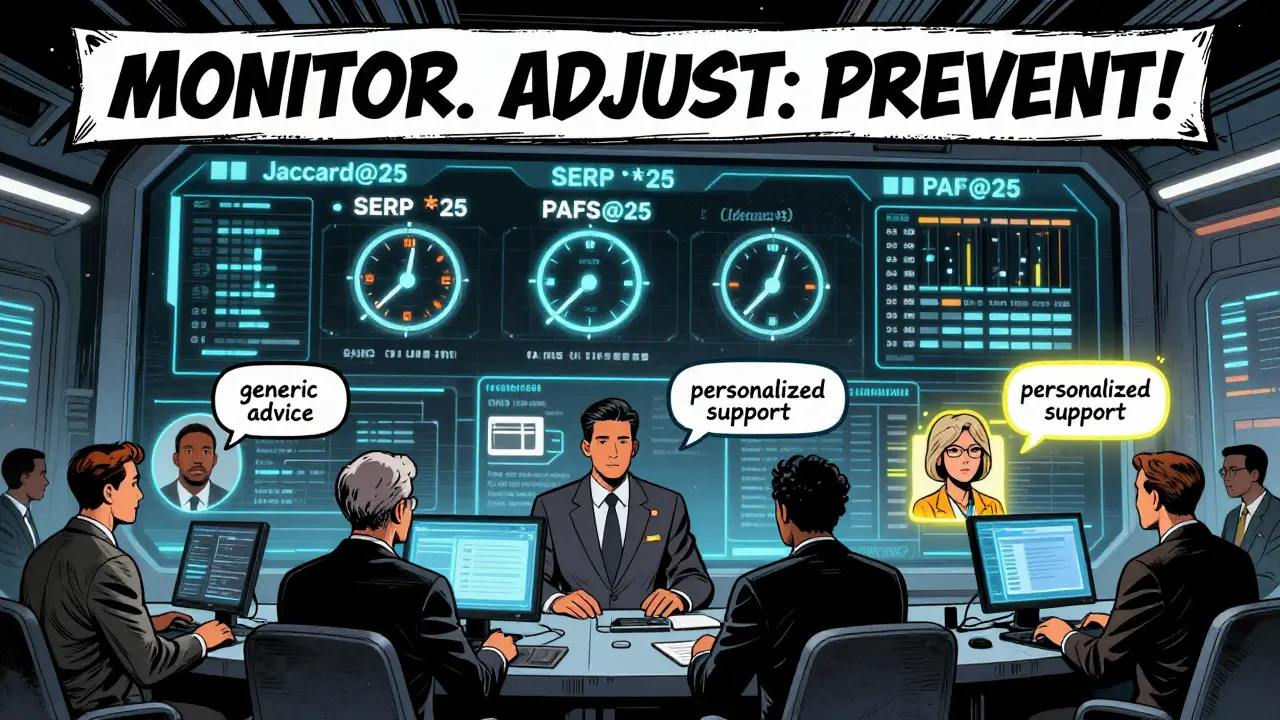
- Pre-deployment: Test 500+ prompts across user types before going live. If Jaccard@25 drops below 0.7, pause rollout.
- Monitoring: After launch, feed live user prompts into the framework daily. Flag outputs that show sudden bias spikes.
- Human review: Train internal auditors to review flagged outputs. Is the response stereotypical? Does it avoid helping a group? Is it overly generic?
- Feedback loop: Use findings to retrain models, tweak prompts, or add guardrails. Bias isn’t fixed-it’s managed.
One healthcare provider reduced patient advice disparities by 61% in six months by using LangFair to monitor chatbot responses to queries from non-native English speakers. They didn’t change the model. They just adjusted the prompt template to include clearer context. That’s the power of evaluation-not magic, but method.
What Happens Without a Framework?
Companies that skip fairness evaluation don’t avoid risk-they just delay it.
A 2024 case study from a Fortune 500 retailer showed their AI hiring tool recommended male candidates 4x more often for technical roles-even when female applicants had identical qualifications. They didn’t catch it until a lawsuit was filed. The settlement cost $12 million. The damage to their brand? Priceless.
Or take customer service. If your LLM gives longer, more detailed answers to users with Western names and short, robotic replies to others, you’re not just losing sales-you’re losing trust. And once trust is gone, it’s nearly impossible to rebuild.
What’s Next? The Future of Fairness Evaluation
By 2026, fairness frameworks are evolving beyond static checks. New tools are starting to:
- Test for intersectional bias-how race, gender, and age combine to create unique unfairness patterns
- Integrate with compliance systems to auto-generate audit trails
- Use synthetic user profiles to simulate underrepresented groups not in training data
- Compare fairness across multiple models so you can choose the least biased one
The goal isn’t perfection. It’s accountability. You don’t need a perfectly fair AI. You need to know how unfair it is-and how you’re fixing it.
Getting Started
If you’re deploying LLMs in enterprise settings, here’s your action plan:
- Identify your use case: Is it hiring? Customer service? Loan approvals? Each has different fairness risks.
- Choose your tool: Use LangFair for quick, use-case-specific audits. Use FairEval if you need deep, multi-dimensional analysis.
- Define your sensitive attributes: What demographics or traits matter in your context? Don’t guess-ask your legal and compliance teams.
- Run baseline tests: Test with real data. Not hypotheticals. Real user inputs.
- Set thresholds: What’s your acceptable Jaccard@25 score? What’s your max PAFS@25 drift? Document it.
- Monitor monthly: Fairness decays over time as user behavior changes.
There’s no shortcut. But there is a path. And it starts with asking: "How do we know we’re not hurting people?"
What’s the difference between bias and fairness in LLMs?
Bias is the tendency of an LLM to favor or disfavor certain groups based on attributes like race, gender, or language. Fairness is the measurable outcome: whether those biases result in unequal treatment. You can have bias without unfairness if the bias doesn’t lead to real harm. But fairness frameworks exist to catch bias before it becomes unfairness.
Can I use open-source tools for enterprise fairness testing?
Yes, but with limits. Tools like LangFair are open-source and designed for enterprise use. Others, like FairEval, are research-backed but require integration effort. Avoid generic bias detectors-they’re built for academic benchmarks, not real-world workflows. Enterprise needs require context-aware, output-based testing that mirrors your actual deployment.
Do I need to retrain my model to fix fairness issues?
Not always. Many fairness issues come from prompts, not the model itself. Adjusting prompt templates, adding guardrails, or filtering sensitive inputs can reduce bias without retraining. Retraining is expensive and slow. Evaluation frameworks help you find the easiest fix first.
How often should I test for fairness?
Test before deployment, then monthly. If your user base changes (e.g., new markets, new demographics), test immediately. LLMs don’t stay fair on their own. As user behavior evolves, so do bias patterns. Continuous monitoring isn’t optional-it’s operational hygiene.
Is fairness testing only for regulated industries?
No. Even if you’re not regulated, unfair AI damages trust, increases churn, and invites public backlash. A 2025 survey found 68% of consumers would stop using a brand after learning its AI treated certain groups unfairly. Fairness isn’t just compliance-it’s brand protection.



5 Comments
Aryan Jain
Let me tell you something they don't want you to know. This whole 'fairness framework' thing? It's a distraction. The real bias isn't in the model-it's in the people who built it. Who picked the 'neutral' prompts? Who decided what 'assertive woman' looks like? Who even gets to define 'helpful'? This isn't about AI. It's about who controls the narrative. And if you think a few metrics can fix centuries of systemic inequality, you're sleeping on the real power play. They're not fixing bias. They're just making it look clean before they sell it to you.
And don't get me started on 'LangFair.' Bring your own prompts? Yeah, right. That's just giving corporations a free pass to hide behind their own data. The model doesn't care if you feed it real resumes-it just repeats the patterns. And those patterns? They were written by someone who never had to choose between rent and food.
This isn't engineering. It's theater. With spreadsheets.
Nalini Venugopal
Okay but can we talk about how amazing it is that we’re finally *seeing* this? Like, I’ve worked in HR tech for 8 years and every time I said ‘wait, why is the system rejecting people with ‘non-Western’ names?’ they just smiled and said ‘it’s neutral.’ 😒
LangFair is a GAME CHANGER. I used it last month on our chatbot and found out it was giving 3-word replies to users typing in Hinglish-but full paragraphs to English-only queries. We fixed it in 2 days by adding a simple context prompt. No retraining. Just… listening.
Also-Jaccard@25? I had to Google it. But now I’m obsessed. 😍 This isn’t just compliance. It’s dignity. And we owe it to every person who’s ever been told ‘it’s not you, it’s the system.’ It was the system. Now we’re fixing it. 💪
Pramod Usdadiya
i read this whole thing and i think its really important. i work in a bank in mumbai and we just started using an ai for loan apps. i noticed some of the responses to people with indian names were very short and i thought maybe it was a bug. but now i see its a pattern. i dont know much about jaccard or pafs but i will learn. thank you for writing this. we need more people like you. 🙏
also sorry for typos. my phone autocorrects everything to american english and i hate it. 😅
Aditya Singh Bisht
This is the kind of post that gives me hope. Seriously. For so long, people have treated AI like magic-something that just ‘works’-but this? This is real. This is practical. This is the kind of stuff that turns tech from a tool of exclusion into a tool of equity.
LangFair letting you use your own data? Genius. FairEval digging into personality and intersectionality? Mind-blowing. We’re not just talking about code anymore-we’re talking about human lives.
I’ve seen companies ignore this until a lawsuit hits. Don’t wait for that. Start today. Test one prompt. Talk to one customer. Listen. You don’t need a PhD. You just need to care.
And if you’re reading this and thinking ‘it’s too hard’-I get it. But remember: the first step to fixing a problem is admitting it exists. You’ve already taken that step by reading this. Now go run a test. I believe in you. 💯
Agni Saucedo Medel
This is so important!! 🙌❤️ We need more of this in every company!!