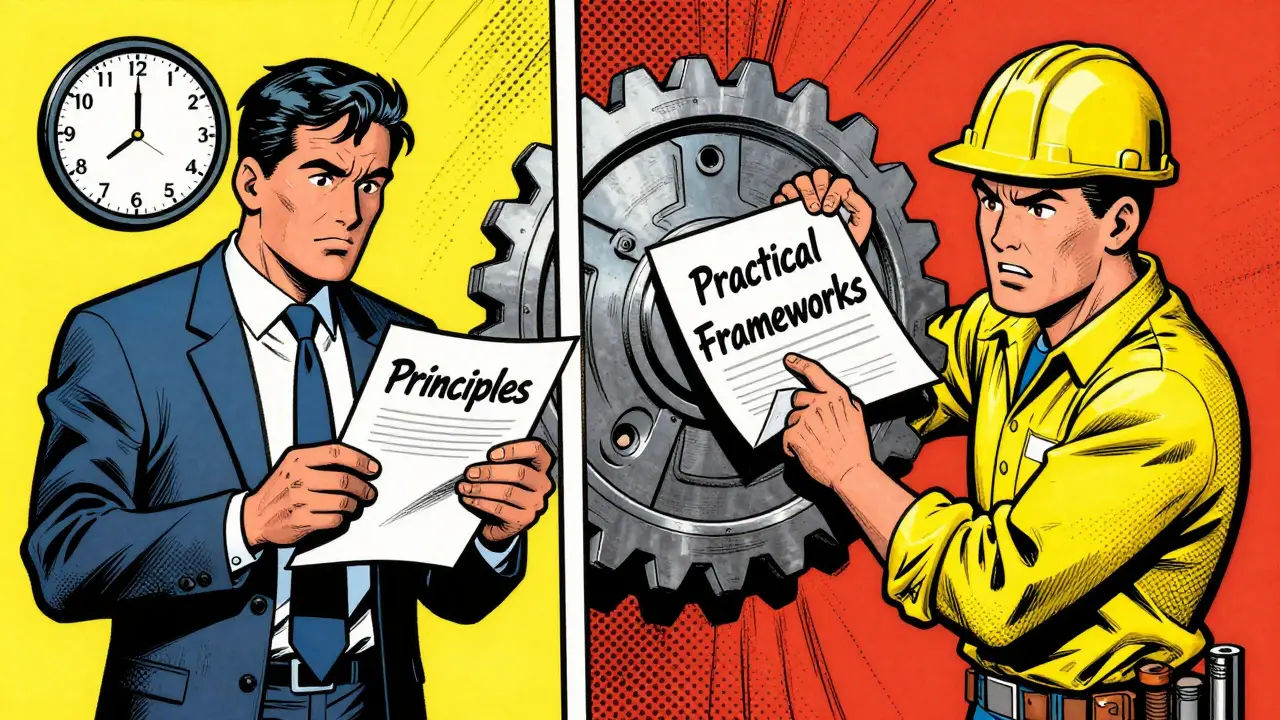
Most companies treat AI ethics like a set of suggestions-nice to have, but easily ignored when deadlines loom. But as generative AI moves from "cool demo" to core business infrastructure, that approach is becoming a liability. We've seen a massive surge in tools that can create text, images, and code, yet the guardrails often feel like an afterthought. If you're relying on a vague "do no harm" statement, you're not practicing responsible AI; you're just hoping for the best.
The real challenge isn't agreeing that bias is bad or that transparency is good. The challenge is turning those high-level values into a set of technical rules that a developer can actually code into a system. We're moving into an era where "ethics washing"-where companies claim to be ethical without any proof-is being replaced by measurable standards and legal requirements.
The Cheat Sheet: Core Takeaways for AI Ethics
- Shift from Principles to Practice: Stop writing lists of values and start defining technical thresholds (e.g., acceptable bias percentages).
- Governance Over Frameworks: A static document is useless. You need a living review board and quarterly audit cycles to actually enforce rules.
- Human-in-the-Loop is Mandatory: For high-stakes decisions, AI should assist, not decide. Manual verification can drop hallucination rates from over 30% to under 5%.
- Regulatory Clock is Ticking: With the EU AI Act coming into effect in August 2026, compliance is no longer optional for global players.
What Exactly is an AI Ethics Framework?
At its simplest, an AI Ethics Framework is a structured set of guidelines designed to ensure that AI systems align with human rights and societal norms. For generative AI, this is trickier than for traditional AI because the output is unpredictable. You aren't just filtering a list; you're managing a machine that can "hallucinate" facts or leak sensitive data from its training set.
These frameworks usually operate at three levels. First, there are global standards like those from UNESCO, which set a baseline for all 193 member states. Then you have intergovernmental guidelines, such as the OECD AI Principles, which provide policy recommendations for developed economies. Finally, there are corporate standards, like those from Microsoft, which get into the weeds of specific technical metrics.
The goal isn't to stop innovation, but to prevent the "black box" problem. When a model makes a biased decision or generates misinformation, a framework provides the paper trail needed to find out why it happened and how to fix it.
The Technical Pillars of Responsible Implementation
If you want to move beyond a checkbox exercise, your framework needs concrete attributes and values. You can't just say "be fair"; you have to define what fairness looks like in your data.
According to benchmarks from Harvard DCE, an effective ethical implementation focuses on five technical requirements:
- Algorithmic Fairness: This means measuring the "disparate impact" across different demographic groups. A gold standard is keeping this impact under 5%.
- Transparency via Model Cards: Every model should have a "nutrition label" (a model card) that explicitly lists the training data sources and known limitations.
- Accountability: This requires a formal human-in-the-loop system for high-stakes decisions, ensuring a person is legally and ethically responsible for the final output.
- Privacy Protections: Using techniques like differential privacy with specific epsilon values (often ≤ 0.5) to ensure individual data cannot be reverse-engineered from the model.
- Security Testing: Your system should be stress-tested against at least 10 known adversarial attack vectors to prevent "jailbreaking" the AI into producing harmful content.
| Framework | Primary Focus | Enforcement Level | Key Strength |
|---|---|---|---|
| OECD AI Principles | Policy Coordination | Voluntary | Intergovernmental alignment |
| UNESCO Recommendation | Global Human Rights | Voluntary | Broadest global reach |
| EU AI Act | Legal Compliance | Legally Binding | Heavy fines (up to 7% revenue) |
| Microsoft Responsible AI | Corporate Standards | Internal Policy | Highly specific technical metrics |

Turning Principles into Practice: A Step-by-Step Approach
You can't build an ethics board overnight. Data shows that a mature framework typically takes between 6 and 18 months to fully embed into a company's culture. Here is the roadmap most successful organizations follow:
- Formation (Months 1-2): Build a cross-functional team. You need a mix of data scientists, legal experts, and domain specialists. If the team is just lawyers, the developers will ignore them. If it's just developers, you'll miss the ethical blind spots.
- Principle Definition (Months 2-4): Decide which values matter most for your specific use case. A healthcare AI needs a much heavier focus on the Belmont Report principles (like respect for persons) than a marketing chatbot does.
- Policy Development (Months 4-8): Translate those principles into rules. Instead of "avoid bias," write "all diagnostic tools must be tested for false positive rate differentials of less than 3% across gender and ethnicity."
- Technical Implementation (Months 8-12): Integrate tools like the Algorithmic Impact Assessment Toolkit. This is where you set up your monitoring dashboards and reporting lines.
- Continuous Monitoring (Ongoing): Set up quarterly review cycles. AI models drift over time, and a model that was ethical in January might start showing bias by June as it encounters new data.
A critical success factor here is the role of the Chief AI Ethics Officer. Gartner data shows that organizations with a dedicated role for ethics are over four times more likely to actually implement their practices. However, if this person reports to a mid-level manager rather than the CEO, their influence is usually negligible.
The Hidden Risks: What Frameworks Often Miss
Even the best frameworks have blind spots. One of the biggest is the "provenance gap." A staggering 78% of generative AI policies fail to specifically address where the training data came from. This leaves companies vulnerable to intellectual property lawsuits and copyright claims.
Then there is the environmental cost. We talk a lot about bias, but rarely about the carbon footprint. Training a single large language model can chew through 1,300 megawatt-hours of electricity and 700,000 liters of water. If your "Responsible AI" framework doesn't include an environmental impact assessment, it's incomplete.
Finally, there's the risk of over-regulation. While we need guardrails, adding too many layers of bureaucracy can kill a startup. Some estimates suggest that excessive compliance requirements could hike development costs by 25-40% for smaller players. The goal is "smart regulation"-focused on high-risk applications rather than a blanket ban on experimentation.

Real-World Wins and Failures
Does this actually work? In healthcare, implementing adapted Belmont principles led to a 23% drop in algorithmic bias incidents for diagnostic tools. In academia, the University of California saw a massive win by requiring human-in-the-loop verification, which slashed AI hallucination rates from 32% down to just 4.7%.
But there's a dark side. Many companies treat these frameworks as a "checkbox exercise." In some developer communities, there are reports of ethics boards that only exist during the procurement phase. Once the AI is deployed, the monitoring stops, and the "ethics" part of the project is forgotten until a public PR crisis happens.
What is the difference between an AI ethics framework and AI governance?
A framework is the set of rules and values (the "what"), while governance is the system of people and processes that enforces those rules (the "how"). You can have a perfect framework, but without a governance mechanism-like an ethics review board with the power to veto a release-the framework is just a piece of paper.
How does the EU AI Act affect companies outside of Europe?
Much like GDPR, the EU AI Act has extraterritorial reach. If your AI system is used within the EU or its output is used there, you must comply. Failure to do so can result in massive fines, up to 7% of your global annual turnover, making it a critical priority for any global enterprise.
Can you actually measure "bias" in a generative AI model?
Yes, though it's complex. Organizations use metrics like "disparate impact" or "false positive rate differentials." For example, if a hiring AI rejects qualified candidates from one demographic 5% more often than another, that is a measurable bias that can be flagged and corrected.
What is a "model card" and why is it important?
A model card is a standardized document that describes a model's training data, intended use, limitations, and performance benchmarks. It's essentially a transparency tool that prevents developers from using a model for a task it wasn't designed for, reducing the risk of unpredictable errors.
How much time should employees spend on AI literacy training?
Leading standards, such as Microsoft's Responsible AI Standard, suggest that employees should undergo 15-20 hours of mandatory AI literacy training annually. This ensures they understand not just how to use the tools, but the ethical risks associated with them.
Next Steps for Your Organization
If you're starting from scratch, don't try to solve every ethical dilemma at once. Start by identifying your "high-risk" use cases. If your AI is suggesting a movie, the risk is low. If it's diagnosing a patient or screening resumes, the risk is high. Focus your strictest controls there first.
For those with an existing framework, conduct a "gap analysis." Check if you have specific provisions for foundation model risks and data provenance. If you don't, your framework is likely outdated for the generative AI era. Finally, move your ethics officer's reporting line closer to the CEO to ensure that ethical considerations actually carry weight in business decisions.




9 Comments
Sanjay Mittal
The focus on model cards is spot on. For those implementing this, I'd suggest looking into the Hugging Face model card templates as a starting point to standardize your technical documentation across different teams.
Jeff Napier
standardization is just a fancy word for control and the eu ai act is just the blueprint for a global digital panopticon they want us to believe it is about ethics but its actually about who owns the switch to turn off your brain
Ronak Khandelwal
This is such a beautiful way to look at the intersection of technology and humanity! ✨ We really need to remember that behind every line of code is a human life and a story. Let's keep pushing for a future where AI uplifts everyone regardless of where they come from! 🌈💖 Love the emphasis on inclusivity here!
Sibusiso Ernest Masilela
Imagine thinking a "quarterly audit" actually solves systemic bias. It's absolutely laughable. Most of these corporate "ethics boards" are just PR puppets designed to keep the shareholders from panicking while the actual engineers laugh at these guidelines in the breakroom. Truly pathetic.
Daniel Kennedy
Get a grip on the cynicism. While it's easy to call it PR, the shift toward measurable thresholds-like the 5% disparate impact rule-is a massive leap forward from the vague a-la-carte ethics of five years ago. If you're not willing to build the infrastructure for accountability, you're just complaining for the sake of it.
Taylor Hayes
I think both perspectives bring something important to the table. It's a tough balance to strike, especially for smaller teams who are just trying to keep their heads above water while navigating these new regulations. Maybe we can find a middle ground where compliance doesn't kill innovation but still protects people.
Mike Zhong
The prompt talks about "human-in-the-loop" as a safety net, but it ignores the fundamental paradox: humans are the original source of the bias the AI is inheriting. You aren't fixing the problem by adding a human; you're just adding a layer of subjective prejudice to an objective failure. The entire framework is a band-aid on a bullet wound.
Jamie Roman
I've been thinking quite a bit about the environmental section because it's so often overlooked in these discussions, and honestly, I wonder if we should be weighing the ethical cost of the water usage and carbon emissions against the actual utility of the model itself, because if a model is only 5% more accurate but costs a lake's worth of water to train, is that actually "responsible" in any real sense of the word, or are we just moving the goalposts of what we consider acceptable collateral damage for the sake of progress?
Salomi Cummingham
It is absolutely heartbreaking to see how many companies just treat this as a checklist to avoid lawsuits! I cannot even begin to express the sheer frustration of seeing these guidelines exist on paper while the actual implementation is a complete disaster in the real world, and frankly, we deserve so much better than "checkbox ethics" when our fundamental rights and privacy are on the line every single time we interact with these systems!