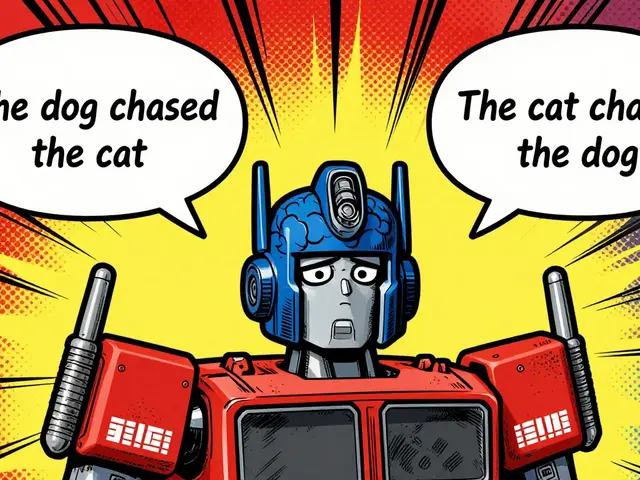
Ever wondered why a powerful AI can solve a complex coding problem but then fail a simple grade-school math word problem? It usually happens because the model tries to jump straight to the answer. When an AI guesses the final result in one go, it often misses a critical logical step, leading to a confident but completely wrong answer. This is where Chain-of-Thought Prompting is a prompt engineering technique that guides large language models to generate intermediate reasoning steps before providing a final answer comes in. By forcing the model to "show its work," we can dramatically increase the accuracy of complex tasks without needing to retrain the model from scratch.
Why Standard Prompting Fails at Logic
Standard prompting is like asking a student to solve a multi-step calculus problem and only write down the final number. If they make one tiny error in the middle, the whole answer is wrong, and you have no way of knowing where they tripped up. In the AI world, this results in "flat scaling curves." Research shows that simply making a model bigger-say, moving from 100 million to 118 million parameters-barely nudges the needle on complex reasoning tasks, often providing less than a 2% improvement.
The problem isn't necessarily a lack of knowledge, but a lack of process. Without a structured path, models struggle with factuality control and logical consistency. They tend to predict the most likely next token based on patterns, not based on a rigorous step-by-step derivation. When the problem requires three or four logical leaps, the probability of a "hallucination" or a logic gap increases with every step.
How Chain-of-Thought Prompting Actually Works
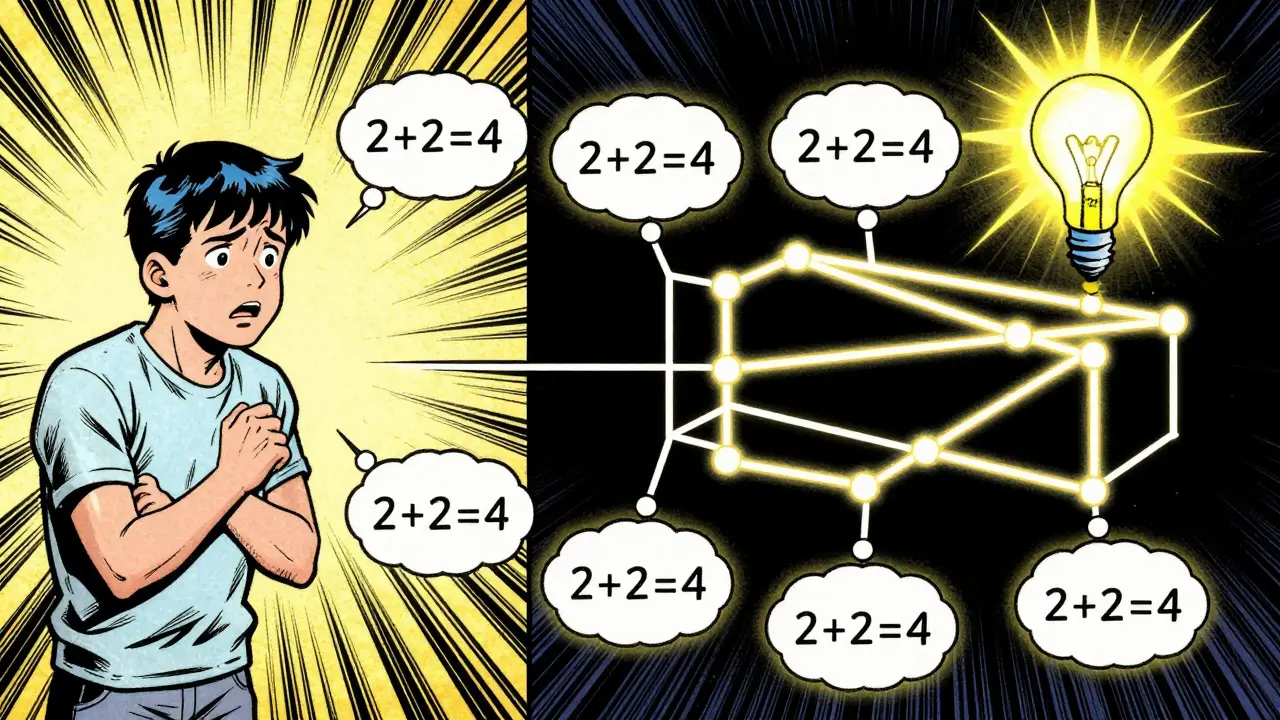
Think of CoT as a few-shot learning strategy. Instead of just giving the AI an input and an output, you provide a few examples (exemplars) that illustrate the thinking process. For instance, if you want a model to solve a math problem, you wouldn't just show it "Question: 2+2, Answer: 4." Instead, you'd show it: "Question: If I have 2 apples and buy 2 more, how many do I have? Reasoning: I started with 2 apples. I added 2 more. 2 plus 2 is 4. Answer: 4."
This simple shift mimics human cognition. By decomposing a problem into smaller, manageable parts, the model uses its own generated text as a "scratchpad." Each single step is easier for the model to get right than the entire complex problem. When the model writes down the first step, that step becomes part of the context for the second step, and so on, creating a logical chain that leads to a more reliable conclusion.
| Benchmark | Standard Prompting Accuracy | CoT Prompting Accuracy | Improvement |
|---|---|---|---|
| GSM8K (Math Word Problems) | 26.4% | 58.1% | +31.7% |
| CommonSenseQA | 66.9% | 76.9% | +10.0% |
| MultiArith (Arithmetic) | 17.9% | 78.7% | +60.8% |
| Date Understanding | 68.9% | 73.4% | +4.5% |
The "Scale" Secret: Why It Doesn't Work for Every Model
Here is the catch: CoT isn't a magic wand for every AI. It is an emergent property, meaning it only starts working once a model reaches a certain size. If you try this with a small model (under 100 billion parameters), you'll likely see almost no benefit. For example, on the StrategyQA benchmark, small models showed less than a 5% improvement when using CoT. However, once you hit the scale of a model like PaLM is a 540-billion parameter large language model developed by Google Research , the gains become massive. This happens because larger models have a better internal grasp of the linguistic patterns required to simulate reasoning.
If you are using a lightweight model for a simple chatbot, CoT might actually be a waste of tokens. It's most effective for "heavy lifting"-symbolic reasoning, complex arithmetic, and multi-step commonsense queries. If the task is simple factual recall (like "Who is the president of France?"), adding a chain of thought won't help much and will just make the response slower.
Implementation Strategies and Best Practices
If you want to put CoT into production, you don't need to be a coder, but you do need to be a precise communicator. The goal is to provide the model with a map. According to industry standards from Google Research is a division of Google focused on advancing the state of the art in AI and machine learning , the sweet spot is usually 3 to 8 high-quality examples. Too few, and the model might not catch the pattern; too many, and you might hit the token limit or cause the model to over-fit on the specific examples provided.
To make your prompts stick, use explicit transition phrases. Instead of jumping between ideas, use words like "First," "Then," "Therefore," and "Because of this." This signals to the model that it is moving through a sequence of logical dependencies. If you're using a framework like LangChain is an open-source framework designed to simplify the creation of applications using LLMs , you can automate these prompts by creating templates that inject these reasoning paths dynamically based on the user's query.
The Trade-offs: Latency, Cost, and Hallucinations
Nothing in AI is free. The biggest downside to CoT is the "token tax." Because the model is writing out its entire thought process, it generates significantly more tokens than a standard prompt. In production environments, this translates to higher costs and slower response times. Some data scientists have reported a latency increase of over 200ms per query, and cloud providers like AWS have noted that inference costs can climb by 35-40%.
There is also the risk of "reasoning hallucinations." This is a dangerous scenario where the model produces a series of steps that look perfectly logical and professional but are based on a factual error in the first or second step. Because the subsequent steps follow the logic of the first mistake, the model arrives at a wrong answer with total confidence. This is why CoT is a tool for improving reasoning, not a replacement for factual verification.

Evolution of the Technique: From Manual to Automatic
Since the original CoT paper arrived in 2022, the community has found ways to make it easier. One popular shortcut is Zero-Shot CoT is a method of eliciting reasoning by simply adding the phrase 'Let's think step by step' to the prompt . You don't need to write examples; you just tell the AI to slow down. While not as accurate as the few-shot method for very complex problems, it's a great quick-fix for 80% of tasks.
We've also seen the rise of Self-Consistency is a technique where the model generates multiple different reasoning paths and chooses the most common final answer . This acts like a "voting system" for the AI. If three different reasoning paths lead to the answer "42" and one leads to "15," the model can feel more confident in 42. More recently, models like Llama 3 is a high-performance open-weights large language model released by Meta have started incorporating these reasoning capabilities directly into their training, making them naturally better at CoT without as much manual prompting.
Does Chain-of-Thought prompting work for all LLMs?
No. CoT is an emergent property that typically only appears in models with roughly 100 billion parameters or more. Smaller models often lack the internal complexity to benefit from intermediate reasoning steps and may even perform worse or show negligible improvement.
What is the difference between Zero-Shot CoT and Few-Shot CoT?
Few-Shot CoT requires you to provide several examples of a problem and its step-by-step solution. Zero-Shot CoT simply adds a phrase like "Let's think step by step" to the prompt. Few-Shot is generally more accurate for highly complex, niche, or symbolic tasks, while Zero-Shot is faster and easier to implement for general use.
Can CoT prompting stop AI hallucinations?
It helps reduce logic errors, but it doesn't eliminate hallucinations. In fact, it can create "reasoning hallucinations" where the logic is sound but based on a false premise. It should be paired with external verification or RAG (Retrieval-Augmented Generation) for total factuality control.
How many examples should I include in a CoT prompt?
Most research and practitioner guides suggest between 3 and 8 exemplars. Providing too many examples can lead to the model ignoring the general logic and simply trying to mimic the specific patterns of your examples, which can actually degrade performance by 12-15%.
Does using CoT increase the cost of using an API?
Yes. Because CoT requires the model to generate a longer sequence of tokens (the reasoning steps) before the final answer, you will pay for more output tokens. Depending on the complexity of the reasoning, this can increase costs by 35% to 40% per request.
Next Steps for Implementation
If you're ready to test this, start with your most "brittle" task-the one where the AI usually gets the answer wrong despite knowing the facts. Write three examples that clearly break down the logic. If the results improve but the speed is too slow, try the "Let's think step by step" zero-shot approach. For those building enterprise-grade apps, consider implementing a self-consistency loop where you sample three different paths and take the majority vote to ensure the highest possible factuality.