
You trained a massive language model on millions of user conversations. It’s brilliant at context, but it has a memory problem. Ask it about a specific medical symptom mentioned by one patient in 2019, and it might spit out the exact sentence, complete with the doctor's name. That’s not just a quirk; it’s a privacy breach waiting to happen. Differential Privacy is the mathematical shield designed to stop this from happening. It doesn't hide data by deleting it; it hides individuals by adding calculated noise. This ensures that whether your specific data point was in the training set or not, the output remains statistically indistinguishable. For Generative AI, this isn't optional anymore-it’s the difference between a compliant product and a lawsuit.
The Core Mechanism: How Noise Protects Individuals
Most people think anonymization means removing names. But researchers Narayanan and Shmatikov proved in 2008 that you can deanonymize Netflix users just by cross-referencing their movie ratings with public IMDb profiles. Differential Privacy (DP) goes deeper. It guarantees that an adversary cannot determine if a specific individual’s data contributed to the final model. The framework relies on two parameters: epsilon ($\epsilon$) and delta ($\delta$). Think of $\epsilon$ as your privacy budget. A lower $\epsilon$ means more noise, stronger privacy, and usually, less accuracy. A higher $\epsilon$ means less noise, better utility, but weaker guarantees. Most organizations settle between $\epsilon=2$ and $\epsilon=5$ for production deployments after extensive testing.
When applied to Generative AI, specifically Large Language Models (LLMs), the challenge intensifies. These models memorize patterns aggressively. If you don’t control the information flow during training, the model essentially copies its training data. DP solves this by modifying the learning process itself, ensuring that the influence of any single example on the final model weights is bounded. This mathematical bound is what regulators like those enforcing GDPR Article 32 look for when assessing "safeguards" for sensitive data.
Training Phase: Implementing DP-SGD
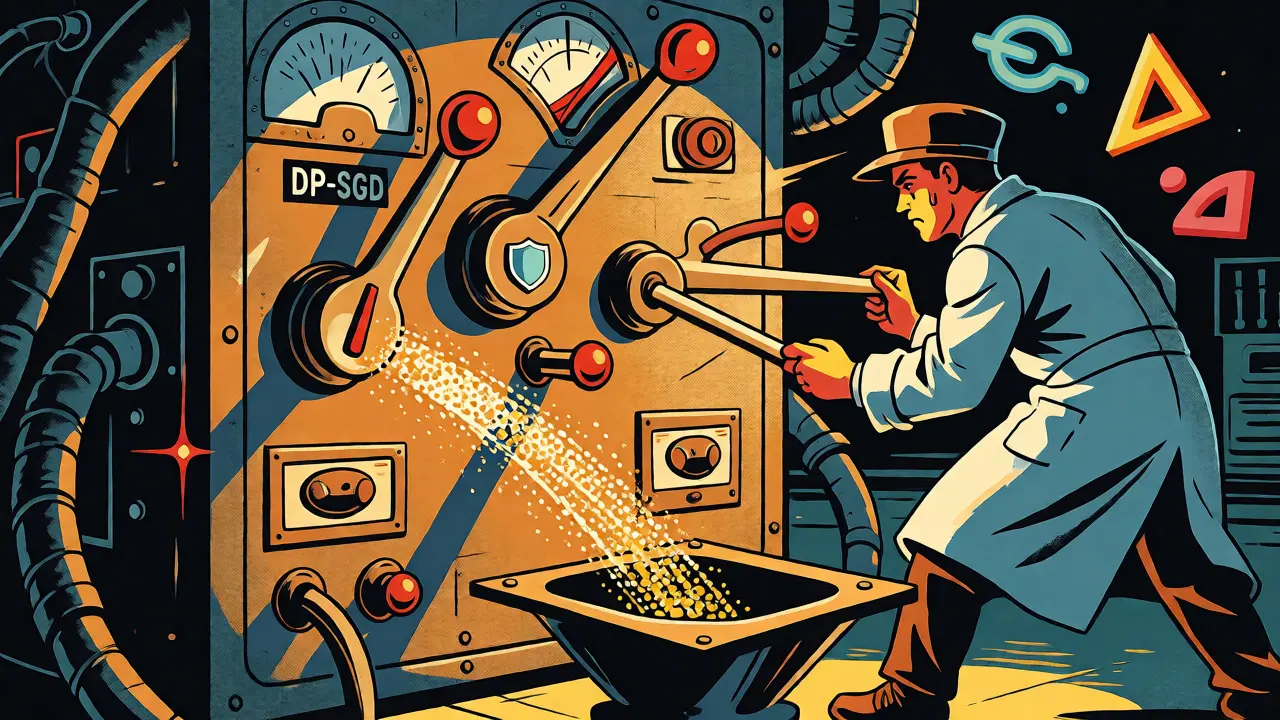
The standard workhorse for private deep learning is Differentially Private Stochastic Gradient Descent (DP-SGD). Unlike traditional SGD, which updates weights based on the average gradient of a batch, DP-SGD introduces two critical changes. First, it clips per-example gradients to a maximum L2 norm. This step limits the sensitivity-essentially capping how much one bad or extreme data point can swing the model’s direction. Second, it adds calibrated Gaussian noise to the aggregated gradients before updating the weights.
Here is the practical reality of implementing this:
- Gradient Clipping: You must choose a clipping norm. For text data, norms between 0.5 and 5.0 are common. Too low, and you discard useful signal; too high, and you fail to limit sensitivity. Adaptive clipping strategies, which adjust the norm based on real-time gradient distributions, have become popular to automate this tedious tuning.
- Noise Addition: The amount of noise added is proportional to the clipping norm and inversely proportional to $\epsilon$. Google Research noted in October 2024 that this noise scale is non-negotiable for the mathematical guarantee to hold.
- Privacy Accounting: Tracking how much privacy budget you’ve spent over thousands of iterations is complex. Tools like TensorFlow Privacy and Opacus handle this, but debugging "privacy accounting" issues accounts for nearly 70% of implementation problems reported on GitHub.
Frameworks like Opacus (for PyTorch) and TensorFlow Privacy make this accessible. However, they come with costs. Expect 20-30% more training time due to the overhead of computing per-example gradients rather than batch averages. For a team used to rapid iteration, this slowdown is the first hurdle to clear.
Inference Phase: Generating Private Outputs
Protecting data during training is only half the battle. What happens when the model generates text? Standard inference can still leak information if the model confidently reproduces a rare phrase from its training set. During inference, techniques focus on limiting the model’s confidence in specific outputs derived from sensitive contexts.
One emerging approach involves sampling with temperature adjustments and top-k filtering that respects the privacy bounds established during training. If a token sequence has a probability distribution heavily skewed by a single training example, DP-aware decoding can flatten that distribution slightly. This prevents the model from "over-committing" to a unique string that acts as a fingerprint for an individual. While less standardized than DP-SGD, these inference-side mitigations are crucial for chatbots handling live user inputs where the input itself might contain PII (Personally Identifiable Information).
Advanced Frameworks: Moving Beyond Standard DP
Standard $(\epsilon, \delta)$-DP has limitations when dealing with the iterative nature of deep learning. Composition-the accumulation of privacy loss over many epochs-can become loose and overly conservative. Enter Rényi Differential Privacy (RDP). Introduced by Mironov in 2017, RDP provides tighter composition bounds. For a model trained over 100 epochs, RDP can offer 30-40% tighter privacy accounting than standard DP. This means you can achieve the same level of privacy protection with less noise, preserving model utility.
| Framework | Key Characteristic | Best Use Case | Complexity |
|---|---|---|---|
| Standard DP | Simple $(\epsilon, \delta)$ guarantees | Small datasets, simple models | Low |
| Rényi DP (RDP) | Tighter composition bounds | Deep Learning, LLMs, many epochs | Medium |
| Gaussian DP (GDP) | Models privacy loss as Gaussian | Subsampling scenarios, optimal trade-offs | High |
Another variant, Concentrated Differential Privacy (CDP), offers even better tradeoffs for specific subsampling rates. Recent papers suggest CDP and GDP are gaining traction for large-scale models because they reduce the "waste" of privacy budget that occurs in standard DP analyses. If you are building a trillion-parameter model, every bit of efficiency counts, and these advanced frameworks help you squeeze more utility out of your fixed privacy budget.
The Cost of Privacy: Utility vs. Accuracy
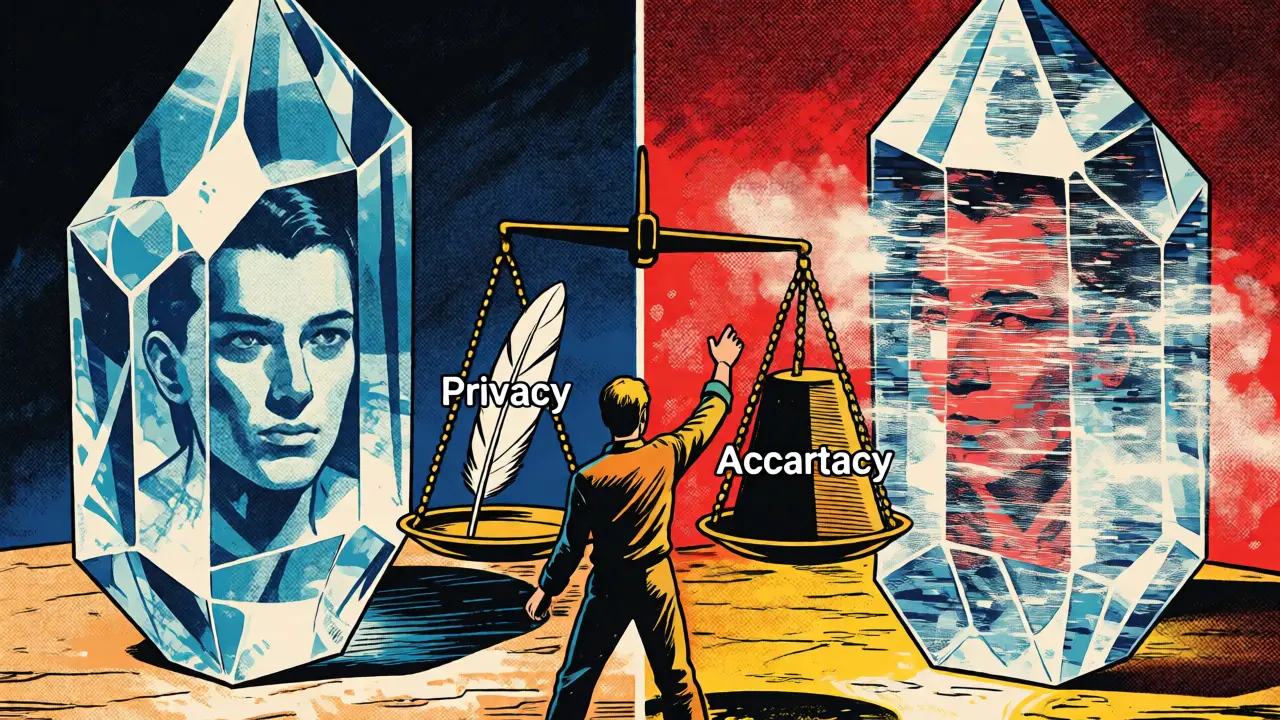
There is no free lunch. Adding noise degrades performance. Google’s 2024 benchmarks showed that image classification accuracy on CIFAR-10 dropped from 95% (non-private) to 80% at $\epsilon=2$, and further to 65% at $\epsilon=0.5$. For Generative AI, the impact is nuanced. Hallucinations might decrease because the model is forced to generalize rather than memorize rare facts. A position paper from Stanford and MIT suggested that DP could reduce factual errors by 22% by preventing overfitting to noisy training examples.
However, for tasks requiring precise recall, such as legal document summarization, this drop hurts. A financial services case study cited by BigID found that while differential privacy reduced data leakage risks by 92%, it maintained only 85% of the model's predictive capability for fraud detection. You must decide: is the risk of a privacy breach worth the 5-15% drop in accuracy? For healthcare, often yes. For creative writing, maybe not.
Implementation Roadmap for Engineers
If you’re ready to implement DP in your GenAI stack, follow this path to avoid common pitfalls:
- Audit Your Data: Identify which fields are sensitive. Do you need full DP, or can you use local differential privacy for input sanitization?
- Choose Your Budget: Start with $\epsilon=8$ for initial experiments. This allows you to see if the architecture works before tightening privacy. NIST guidelines recommend $\epsilon \le 1$ for healthcare and $\epsilon \le 8$ for general commercial use.
- Select the Library: Use Opacus if you are in the PyTorch ecosystem; it integrates well with Hugging Face transformers. Use TensorFlow Privacy for TF/Keras stacks.
- Tune Clipping Norms: Don’t guess. Run a small experiment to measure gradient norms across batches. Set your clipping threshold at the 95th percentile to balance outlier suppression with signal retention.
- Monitor Training Time: Expect a 20-30% increase in compute costs. Factor this into your cloud budget.
Remember, debugging is hard. Most issues aren't code errors but conceptual misunderstandings of how privacy budgets accumulate. Leverage community resources like the Privacy Tools Project forums, where active discussion helps resolve niche accounting bugs.
Frequently Asked Questions
Does differential privacy eliminate all privacy risks?
No, it significantly reduces the risk of membership inference attacks (where an attacker checks if a specific record was in the training data). However, it does not protect against all types of leaks, such as those arising from auxiliary information or poor implementation choices. It is a strong safeguard, not a magic bullet.
How much accuracy do I lose when using DP-SGD?
It depends on the task and the epsilon value. Typical drops range from 5% to 15%. For image classification, a drop from 95% to 80% at epsilon=2 is common. For LLMs, perplexity increases, and generation quality may degrade, especially for rare tokens or long-tail concepts.
Is differential privacy required for compliance with GDPR?
GDPR does not explicitly mandate differential privacy, but Article 32 requires "appropriate technical and organizational measures." Differential privacy is widely recognized by regulators and legal experts as a robust method to meet this requirement, particularly for anonymizing personal data in analytics and AI training.
Can I apply differential privacy to pre-trained models?
Yes, via fine-tuning. Applying DP-SGD during the fine-tuning phase of a pre-trained model (like BERT or Llama) is a common strategy. It protects the new, sensitive domain-specific data you are adding without retraining the entire base model from scratch, saving significant compute resources.
What is the difference between DP and Federated Learning?
Federated Learning (FL) keeps data on local devices, sending only model updates to a central server. FL alone does not guarantee privacy, as updates can leak information. Differential Privacy can be added to FL to provide mathematical guarantees. They are complementary technologies, not mutually exclusive alternatives.