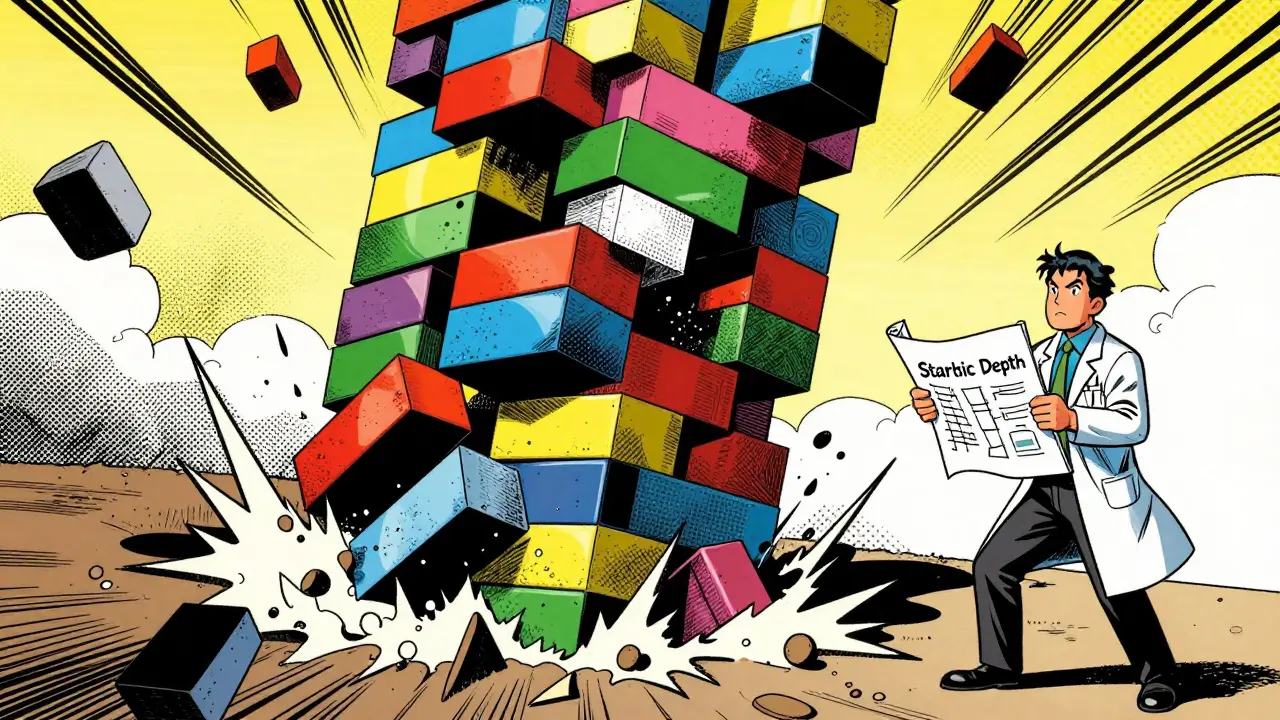
Training a massive language model feels like trying to balance a tower of blocks while an earthquake rumbles underneath. You add more layers to boost intelligence, but the whole structure starts shaking. The gradients vanish, the memory spikes, and the model memorizes noise instead of learning patterns. This is the curse of depth in modern artificial intelligence. But there is a trick that researchers have been using to stabilize these towering architectures without sacrificing performance. It involves randomly deleting parts of the network during training. Yes, you read that right. Deleting.
This technique is called Stochastic Depth, which is a regularization method that randomly drops entire transformer blocks during forward passes to prevent overfitting and improve generalization. In the world of Large Language Models (LLMs), which are deep neural networks trained on vast datasets to understand and generate human language, stochastic depth acts as a shock absorber. It forces the model to become resilient. If layer 45 disappears for a specific batch of data, the model has no choice but to rely on layers 44 and 46 to carry the signal. Over time, this creates a robust system where no single component is indispensable.
The Problem with Deep Transformers
Why do we need such aggressive tactics? Because deeper isn't always better if the model can't learn effectively. As transformers grow from hundreds of millions to trillions of parameters, they face two main enemies: overfitting and optimization instability. Overfitting happens when the model memorizes the training data perfectly but fails to handle new, unseen text. Optimization instability means the loss function bounces around wildly, making it hard for the model to settle on the best possible solution.
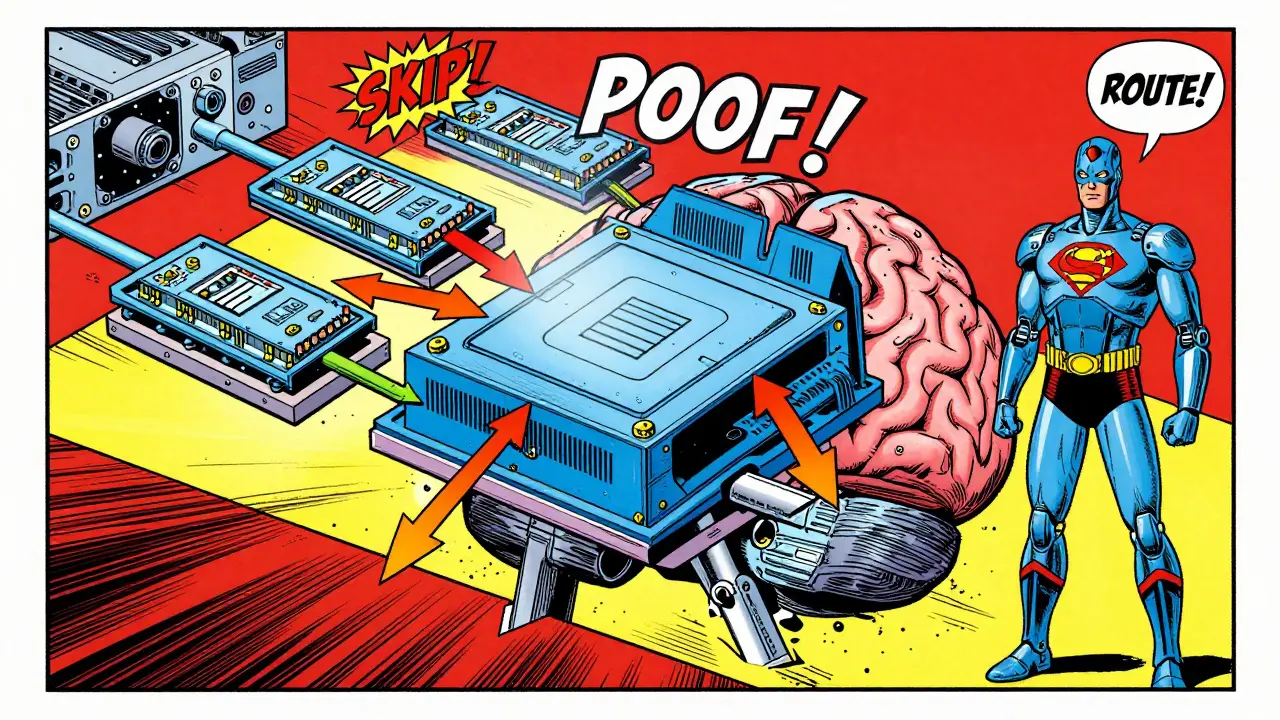
Traditional fixes like dropout-where individual neurons are randomly silenced-work well for shallow networks. But in a deep transformer with 100 or 200 layers, dropping random neurons doesn't change the overall flow enough to stop the model from relying too heavily on specific pathways. Stochastic depth operates at a higher level. It drops entire blocks. A transformer block usually contains a multi-head attention mechanism and a feed-forward network. By removing the whole unit, stochastic depth ensures that information must flow through alternative routes. This mimics ensemble methods, where multiple models vote on an answer, but does it within a single architecture during training.
Neural Collapse and the Theory Behind It
You might wonder if there is any mathematical reason this works, or if it's just a lucky hack. Recent research suggests it is deeply rooted in how neural networks organize information. A pivotal study in 2025 explored the concept of Neural Collapse, which is a phenomenon where class features in the final layer of a neural network converge to their respective class means as training progresses. The study found that when deep regularized transformers are trained with constant regularization strength, neural collapse emerges as the asymptotically optimal solution as the number of blocks approaches infinity.
What does this mean for you? It means that regularization techniques like stochastic depth guide the network toward a naturally stable state. In this collapsed state, the representations of different classes or tokens become tightly clustered and distinct. The approximation becomes tighter as the network gets deeper. So, by applying stochastic depth, you aren't just preventing overfitting; you are steering the model toward a mathematically elegant configuration where generalization is maximized. The global optima of these deep regularized transformers are approximately collapsed, and stochastic depth helps reach that destination faster and more reliably.
Implementation Details: How to Drop Layers
If you decide to implement stochastic depth in your own transformer experiments, you need to know how to set the drop probabilities. You cannot simply drop every layer with a 50% chance. That would destroy the signal before it reaches the output. Instead, you use a schedule. The drop probability typically increases with depth. Early layers, which extract basic syntactic and semantic features, are dropped less frequently. Later layers, which handle complex reasoning and abstraction, are dropped more often.
Here is a practical approach to setting these rates:
- Linear Schedule: Start with a low drop rate (e.g., 0.0) at the first layer and increase linearly to a maximum rate (e.g., 0.3 or 0.5) at the last layer.
- Warm-up Phase: Do not apply stochastic depth immediately. During the first few epochs, keep all layers active. Let the model establish a baseline gradient flow before introducing randomness.
- Task-Specific Tuning: For tasks requiring long-range dependencies, like summarization, you might want to lower the drop rate in the middle layers to preserve context window integrity.
During the forward pass, for each training step, the model generates a binary mask. If a layer is masked out, its input is passed directly to the next layer via a residual connection, multiplied by a scaling factor to maintain expected value. During inference, all layers are present, but their weights are scaled down by the survival probability (1 - drop_rate). This ensures that the output magnitude remains consistent between training and testing.
Complementary Regularization Strategies
Stochastic depth rarely works alone. It is part of a broader ecosystem of regularization techniques designed to tame large models. Understanding how it interacts with other methods is crucial for achieving top-tier performance.
| Technique | Mechanism | Impact on Perplexity | Impact on Accuracy |
|---|---|---|---|
| Stochastic Depth | Drops entire transformer blocks | Slight decrease | Significant improvement in generalization |
| Ridge (L2) Regularization | Penalizes large weight values | Increases if alpha > 10³ | Improves benchmark accuracy at high alpha |
| L1 Regularization | Encourages sparse weights | Increases | Higher accuracy boosts than L2 |
| AttentionDrop | Regularizes attention maps | Minimal impact | Enhances stability and diversity |
Notice the trade-offs. Ridge regularization, for instance, shows clear performance boundaries. For values of α between 0 and 10³, you see slight improvements in perplexity without changing average accuracy much. But if you push α to 10⁴, benchmark accuracy goes up while perplexity suffers. This tells us that regularization strength is a dial you turn based on your priority. Do you care more about smooth probability distributions (low perplexity) or hitting the right answer on benchmarks (high accuracy)? Stochastic depth tends to offer a better balance, improving generalization without severely hurting perplexity, because it preserves the structural capacity of the model rather than just shrinking weights.
Advanced Applications: LAAT and ReplaceMe
The field is moving beyond simple layer dropping. Two emerging concepts show how regularization is evolving into knowledge transfer and compression tools.
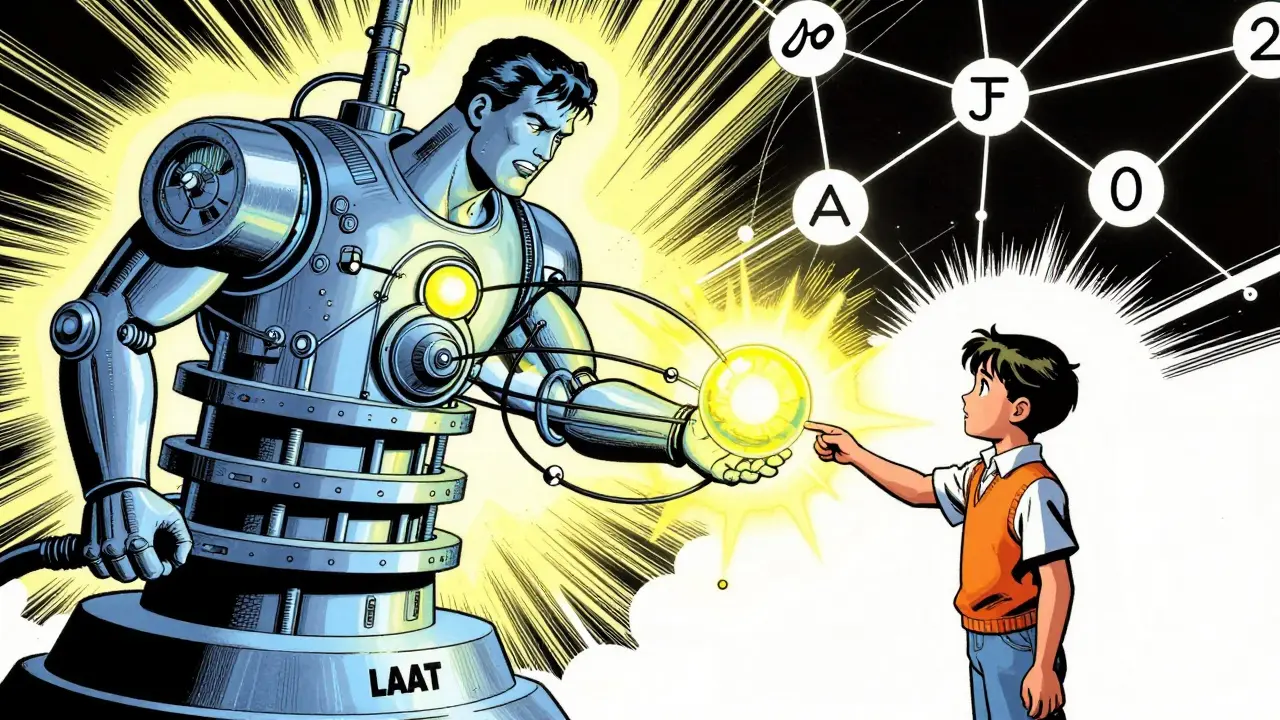
First, consider LAAT (Large Language Model Attribution Aligned Training), which is a method that uses larger LLMs as regularizers to align smaller model training dynamics with global task-specific explanations. Here, the regularization term isn't just about noise; it's about truth. LAAT adds a penalty based on the difference between the small model's attribution scores and those generated by a larger, more capable LLM. This requires only black-box API access to the big model. It addresses dataset skewness and bias by injecting high-level knowledge into the training process. The loss function combines standard cross-entropy with a mean squared error term for attribution alignment. This is a paradigm shift: regularization becomes a mentorship mechanism.
Second, look at ReplaceMe, which is a training-free depth pruning method that replaces transformer blocks with learned linear operations. This method leverages the insights gained from regularization. By training with stochastic depth, you identify which layers are redundant. ReplaceMe then computes optimal linear transformations to replace those pruned blocks seamlessly. It compensates for the lost contributions without adding parameters. This allows for aggressive model compression. You train a deep, robust model with stochastic depth, then compress it into a shallower, faster version that retains most of its accuracy. This two-stage process is becoming the gold standard for deploying LLMs on edge devices.
Challenges and Limitations
It is not all smooth sailing. Implementing stochastic depth comes with hurdles. One major issue is the interference with attention pattern learning in early training phases. If you drop layers too aggressively right from the start, the model struggles to form coherent attention heads. This is why warm-up schedules are non-negotiable. You must let the attention mechanisms stabilize before introducing structural randomness.
Another challenge is hyperparameter sensitivity. The optimal drop schedule depends heavily on the dataset and the specific task. What works for a code-generation model might fail for a translation model. There is no universal formula yet. Practitioners often report needing longer training periods to achieve equivalent convergence. Since effective gradients are computed on subsets of the network in any given step, the signal-to-noise ratio changes. You might need to increase the learning rate slightly or extend the number of epochs to compensate.
Finally, applying stochastic depth to specialized layers, like certain types of attention mechanisms or MoE (Mixture of Experts) routers, requires careful consideration. Dropping an expert router might break the routing logic entirely. Current implementations mostly focus on standard dense transformer blocks. As architectures become more heterogeneous, the definition of "droppable" units will need to evolve.
Future Directions: Adaptive Stochastic Depth
Where is this going? The next frontier is adaptive stochastic depth. Instead of using fixed probabilities based on layer position, future models will conditionally drop layers based on input difficulty. Imagine a model that recognizes a simple sentence like "The cat sat on the mat" and decides to skip the deeper reasoning layers to save compute. Then, for a complex query like "Explain quantum entanglement," it activates all layers. This dynamic allocation of computational resources promises to maintain performance while drastically reducing energy consumption. Research into scaling laws suggests that stochastic depth effectively shifts the curve favorably, allowing models to generalize better at fixed sizes. As we move toward trillion-parameter models, these efficiency gains will not just be nice-to-have; they will be essential.
What is the primary benefit of using stochastic depth in LLMs?
The primary benefit is improved generalization and reduced overfitting. By randomly dropping entire transformer blocks during training, stochastic depth forces the model to learn robust representations that do not rely on any single layer. This leads to better performance on unseen data and more stable training dynamics.
How does stochastic depth differ from standard dropout?
Standard dropout randomly silences individual neurons or activations within a layer. Stochastic depth operates at a coarser granularity, dropping entire transformer blocks (which include both attention and feed-forward components). This architectural-level regularization is more effective for very deep networks where neuron-level dropout may not sufficiently disrupt over-reliance on specific pathways.
Does stochastic depth affect inference speed?
No, stochastic depth only affects the training phase. During inference, all layers are present and active. However, the weights are scaled by the survival probability to maintain consistent output magnitudes. Therefore, there is no runtime overhead during deployment.
What is the recommended drop schedule for stochastic depth?
A linear increasing schedule is commonly used, where the drop probability starts low for early layers and increases for deeper layers. It is also critical to use a warm-up period where no layers are dropped initially, allowing the model to establish stable gradient flows before introducing randomness.
How does stochastic depth relate to neural collapse?
Recent theoretical studies suggest that regularization techniques like stochastic depth guide deep transformers toward neural collapse, a state where class features converge optimally. This collapse enhances generalization by creating tightly clustered and distinct representations, making the model more robust to variations in input data.
Can stochastic depth be combined with other regularization methods?
Yes, it complements methods like weight decay, label smoothing, and attention dropout. Since stochastic depth operates at the block level while other methods operate at the weight or activation level, they address overfitting through different mechanisms, leading to compounded benefits.
What are the limitations of stochastic depth?
Limitations include the need for careful hyperparameter tuning, potential interference with early attention learning if applied too aggressively, and the requirement for longer training times to achieve convergence. Additionally, applying it to specialized layers like MoE routers requires custom adaptations.
How does ReplaceMe utilize stochastic depth principles?
ReplaceMe uses insights from training with regularization to identify redundant layers. It then replaces these pruned blocks with learned linear operations, enabling aggressive model compression without significant performance loss. This allows for efficient deployment of smaller models derived from larger, stochastically-trained counterparts.



8 Comments
Saranya M.L.
It is truly disheartening to see Western researchers patting themselves on the back for discovering techniques that have been implicitly understood in our rigorous academic circles in India for years. The concept of Neural Collapse is not a novel revelation but a mathematical inevitability when one applies proper regularization constraints, something we teach in our top-tier engineering institutes while you are still debating whether dropout works on shallow networks. Your explanation of Stochastic Depth is adequate for laymen, but it lacks the precision required for serious practitioners who understand that dropping entire transformer blocks is merely a coarse approximation of ensemble learning. We do not need hand-holding through basic linear schedules; we need advanced implementations that account for the specific architectural nuances of MoE routers which your post conveniently glosses over. It is quite amusing how you present ReplaceMe as an emerging concept when Indian researchers have been optimizing depth pruning algorithms for edge deployment long before this was considered trendy in Silicon Valley.
om gman
oh wow another article pretending to be deep while explaining basics like im talking to a toddler lol
you really think deleting layers makes the model smarter? its just lazy engineering disguised as innovation
Bineesh Mathew
The moral decay of modern AI research is palpable here, where we sacrifice the structural integrity of the network for the sake of computational convenience, much like society sacrifices truth for comfort. This stochastic approach is not merely a technical fix but a philosophical surrender to chaos, believing that by randomly discarding parts of our intellectual architecture we will somehow stumble upon enlightenment rather than building it with deliberate care and precision. You speak of neural collapse as if it were a desirable state, yet I see only the entropic unraveling of meaning, where distinct concepts blur into a homogenous sludge of averaged probabilities, devoid of the sharp edges that define true understanding. It is a tragedy that we accept such mediocrity, allowing our models to become resilient only because they have learned to ignore the very signals that might lead to breakthroughs, settling instead for the safe, collapsed center of the distribution where nothing interesting ever happens.
Andrea Alonzo
I really appreciate how this article breaks down such a complex topic into digestible pieces, and I can imagine how frustrating it must be for developers who spend weeks tuning hyperparameters only to find that their gradients vanish or their memory spikes unexpectedly during training. It feels like there is a lot of emotional weight behind these technical challenges, and I want to acknowledge the hard work everyone puts into stabilizing these massive architectures while trying to keep up with the rapid pace of innovation in the field. When we talk about forcing the model to become resilient by dropping layers, it reminds me of how humans learn from adversity, where removing safety nets can sometimes encourage growth and adaptability, though I wonder if there is a risk of causing too much stress on the system without enough support structures in place. I hope that as we move forward, we continue to prioritize inclusive approaches to model training that consider the broader impact on diverse datasets and ensure that these efficiency gains do not come at the cost of bias or fairness, because technology should serve everyone equally and compassionately.
Oskar Falkenberg
hey guys i totally get what youre saying about the warm-up phase being super important because ive tried skipping it before and my attention heads were just completely lost in the first few epochs which was pretty annoying tbh. i think the linear schedule makes sense but i also feel like maybe we should experiment more with non-linear schedules since some tasks might benefit from having higher drop rates in the middle layers rather than just increasing towards the end. its kinda wild how much longer training takes when you add this stuff in but i guess thats the price we pay for better generalization right? also does anyone know if this works well with mixture of experts models or if it just breaks the routing logic entirely cause i read somewhere that dropping routers is a bad idea but im not sure how to implement it safely otherwise.
Stephanie Frank
let's be real for a second this whole stochastic depth thing is just a band-aid for poorly designed architectures that are too deep to begin with. you're essentially admitting that your model is overfitting so hard that you have to randomly cripple it during training just to make it behave. it's pathetic that we've reached a point where the standard solution to instability is to introduce randomness into the forward pass. sure it helps with generalization but at what cost? you're burning compute cycles on dead ends and hoping the residual connections save you. it's sloppy engineering wrapped in fancy math terms like neural collapse. stop treating symptoms and start fixing the root cause by designing shallower more efficient networks instead of stacking layers until the house of cards collapses.
Jeanne Abrahams
Back home in South Africa we deal with load shedding so often that our power grid has effectively implemented stochastic depth on itself without any algorithmic intervention. It is rather ironic that you are discussing random layer dropping as a sophisticated technique when nature and infrastructure have been doing it out of necessity for decades. Perhaps if you spent less time optimizing perplexity scores and more time ensuring reliable electricity for rural communities you would understand that resilience comes from redundancy not from arbitrary deletion. But then again I suppose energy consumption metrics are far more important to your quarterly reports than actual human connectivity.
Caitlin Donehue
i noticed that the table comparing regularization techniques mentions that L1 regularization gives higher accuracy boosts than L2 but increases perplexity which seems counterintuitive to me. does anyone else find it strange that sparsity leads to better benchmark performance even if the probability distributions are less smooth?