
Imagine hiring an AI assistant that sounds polite but subtly steers job recommendations toward men for engineering roles and women for administrative tasks. Or a medical diagnostic tool that underestimates risks for elderly patients because its training data mostly featured younger demographics. This isn't science fiction; it is the reality of many Large Language Models (AI systems trained on vast amounts of internet text to generate human-like responses) today.
We know these models learn from the web, and the web is full of human prejudices. But simply acknowledging this problem doesn't fix it. If you are building or deploying AI applications, you need concrete ways to strip out these harmful patterns without breaking the model's ability to be useful. The good news? We have moved past vague promises. There are now specific, tested techniques-ranging from how we clean our data before training to how we tweak the model's brain during learning-that can cut bias scores by up to 62%.
Why Bias Happens in AI Models
To fix bias, you first have to understand where it lives. It isn't usually a bug in the code; it is a mirror reflecting society. When researchers at Stanford University published their landmark study in 2018, titled "Man is to Computer Programmer as Woman is to Homemaker?", they proved that word embeddings (the way computers understand relationships between words) absorbed societal stereotypes directly from the text they read.
This happens because LLMs are trained on massive corpora of internet text. These texts contain historical inequalities, cultural biases, and discriminatory language related to gender, race, ethnicity, age, and more. The model doesn't "know" right from wrong; it just predicts what comes next based on statistical probability. If the data says "doctor" is often followed by "he" and "nurse" by "she," the model learns that association.
The stakes are high. IBM Research estimated in 2023 that a single biased deployment incident in financial services could cost a company $3.2 million in legal liabilities and reputational damage. With regulations like the EU AI Act mandating ethical compliance for 92% of enterprise applications, fixing this isn't just moral-it is mandatory.
Three Main Approaches to Mitigation
Experts generally group bias mitigation into three phases: pre-processing (fixing the data), in-training (fixing the learning process), and post-processing (fixing the output). Each has different costs, technical requirements, and effectiveness levels.
| Technique Phase | Method Name | Bias Reduction Effectiveness | Resource Cost / Trade-off |
|---|---|---|---|
| Pre-processing | Counterfactual Data Augmentation | 58.3% reduction in gender bias | Requires 40-60% more storage; runs on standard CPUs |
| In-training | Adversarial Debiasing | 47.1% reduction in racial bias | 37% more compute power needed; complex setup |
| In-training | Reinforcement Learning (RLHF) | 62.4% reduction in age bias | $10,795+ per cycle for expert annotation; 2-3 weeks GPU time |
| Post-processing | Bias-Aware Decoding | 53.2% reduction with minimal latency | Adds 12-15ms latency per response |
| Post-processing | Prompt Engineering | 18-25% reduction | Zero additional training cost; low barrier to entry |
Fixing the Data: Pre-Processing Techniques
The most practical starting point for many teams is pre-processing. This involves cleaning or augmenting your dataset before the model ever sees it. The gold standard here is Counterfactual Data Augmentation (A technique that creates new training examples by swapping sensitive attributes like gender or race while keeping the context identical).
Here is how it works: If your dataset contains the sentence "The nurse helped the patient," CDA generates a counterpart: "The doctor helped the patient." By feeding both versions to the model with equal weight, you teach it that the role is independent of the gendered pronoun or title. Dr. Margaret Mitchell from Google Research noted in her 2023 ACL keynote that this remains the most practical approach for production systems, reducing bias by over 50% with minimal impact on overall performance if done correctly.
However, there are catches. You need to augment your data by at least 15% with these counterfactual examples to see statistically significant results (p<0.01). Also, while CDA is great for single-axis bias (like gender alone), it struggles with intersectional bias. For example, it might reduce general gender bias by 58%, but only reduce bias against Black women by 22.7%. You also need extra storage-expect a 40-60% increase in dataset size-which matters if you are working with terabytes of text.

Tweaking the Brain: In-Training Techniques
If cleaning the data isn't enough, you can change how the model learns. This is where things get computationally expensive but potentially more robust.
Adversarial Debiasing (A method where a secondary neural network tries to predict sensitive attributes from the main model's outputs, forcing the main model to hide those signals) acts like a watchdog. Imagine two networks playing a game: one tries to generate text, and the other tries to guess the author's gender or race based on that text. If the "guesser" gets too good, the "generator" is penalized. To work effectively, the discriminator network needs to achieve at least 78% accuracy in predicting sensitive attributes. This forces the main model to stop relying on biased shortcuts.
This technique shows strong results for racial bias, achieving a 47.1% reduction on benchmarks like BOLD. But it demands resources. Expect to use 37% more computational power than average techniques. It is not a plug-and-play solution; it requires careful tuning of the loss functions to ensure you don't accidentally degrade the model's core intelligence.
Another powerful in-training method is Reinforcement Learning from Human Feedback (A process where human raters score model outputs, and the model adjusts its weights to maximize positive feedback). Meta's release of FairGen in late 2024 demonstrated this well, reducing age-related bias by 62.4% while keeping 98.7% of original accuracy. However, this is pricey. A single implementation cycle can require 127 hours of expert annotation at $85/hour, totaling nearly $11,000, plus weeks of GPU time. It is best reserved for high-stakes applications like healthcare diagnostics, where accuracy thresholds are strict.
Cleaning Up the Output: Post-Processing Techniques
Sometimes you cannot retrain the model. Maybe you are using a closed-source API, or you just need a quick fix. Post-processing techniques modify the output after generation.
Bias-Aware Decoding (A real-time filtering mechanism that scores generated tokens for bias and adjusts probabilities to favor neutral alternatives) is gaining traction. Google introduced this in their Gemini update in December 2024. It dynamically adjusts outputs based on real-time bias scoring. The result? A 53.2% reduction in bias with only a 0.8% increase in latency. For most apps, adding 12-15 milliseconds to a response is a small price to pay for fairness.
For smaller teams, prompt engineering is the lowest barrier to entry. You can instruct the model via system prompts to "avoid stereotypical assumptions" or "use inclusive language." While easy to implement, it is weak. Studies show it only reduces bias by 18-25%. It is suitable for internal tools or low-risk chatbots, but do not rely on it for hiring algorithms or loan approvals. As Dr. Solon Barocas warned in the MIT Computational Linguistics Journal, masking bias with simple prompts creates a "dangerous illusion of fairness" without actually addressing the root cause.
The Hidden Costs and Trade-offs
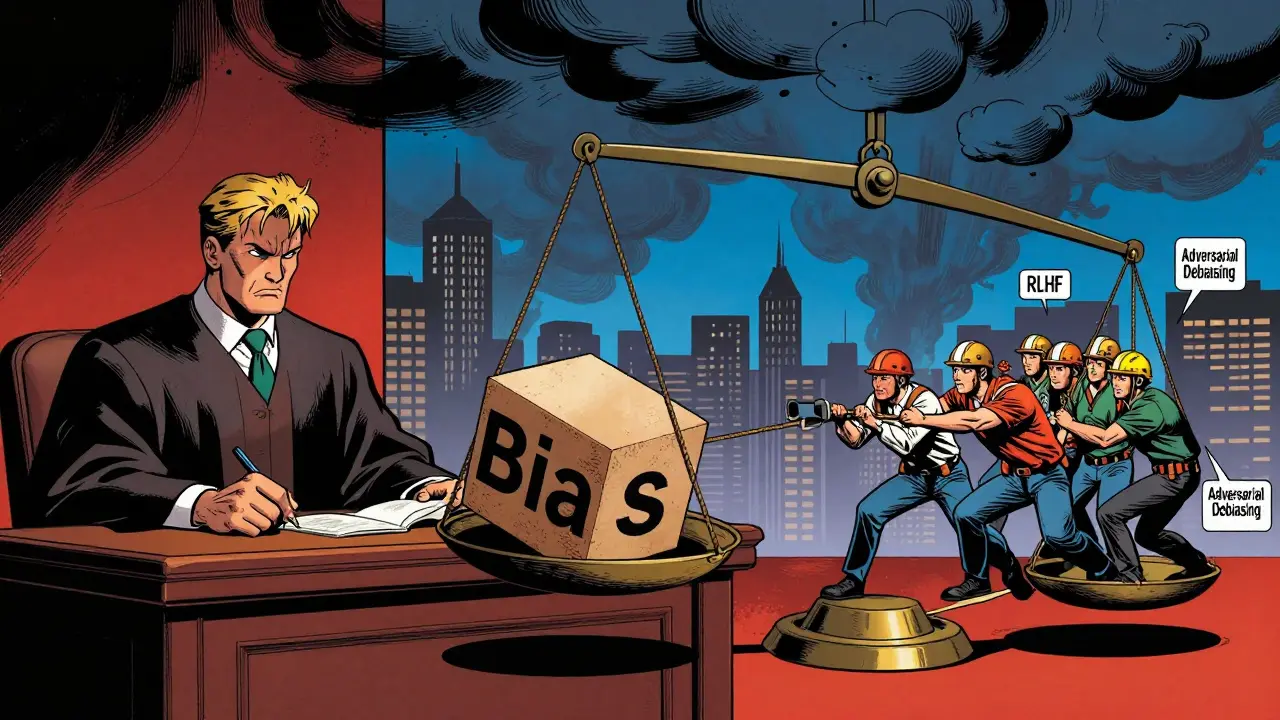
You cannot have it all. Every mitigation technique involves a trade-off. The most common complaint from engineers on GitHub and Reddit is the "accuracy-bias tradeoff." On average, mitigation techniques reduce bias scores by 35-62%, but they incur a 2.3-5.7% drop in accuracy on standard NLP tasks.
Consider a real-world scenario shared by a user on r/MachineLearning in October 2024. They implemented counterfactual augmentation to fix gender bias in a medical QA bot. It worked-the bias dropped by 32%. But the model's accuracy on medical questions fell by 18%. They had to spend an additional $2,150 on cloud compute for three more fine-tuning iterations to recover that lost accuracy. This highlights a critical rule: always measure your core task performance alongside bias metrics. Use benchmarks like StereoSet, BOLD, and CrowS-Pairs to track bias, but keep an eye on your domain-specific accuracy.
There is also the risk of "bias shifting." The AI Now Institute reported in 2024 that GPT-3.5's mitigation reduced gender stereotyping by 43% but inadvertently increased racial bias by 12.7% in certain contexts. When you push down on one part of the bias balloon, another part expands. This is why multi-dimensional testing is essential. You cannot optimize for just one protected attribute.
Tools and Implementation Reality
If you are ready to start, you don't have to build everything from scratch. Several open-source toolkits exist:
- AI Fairness 360 (AIF360): Developed by IBM, this is a comprehensive library for detecting and mitigating bias. It scored 4.2/5 for completeness in developer surveys, though users note its documentation lacks practical examples (2.8/5). It is great for pre-processing but can increase training time by 63%.
- Hugging Face Transformers: Their bias mitigation guides are highly rated for usability (4.6/5) but currently cover only 3 of the 12 major techniques. Good for getting started quickly.
- Fiddler AI: A commercial option that offers explainability and bias detection. Users call it "effective but computationally expensive." It holds a 3.7/5 average rating on Trustpilot, with many praising its depth but criticizing the cost.
Be aware of the learning curve. MIT's 2024 survey found that practitioners need about 117 hours of dedicated training to implement counterfactual augmentation effectively. 68% of teams fail on their first try due to poor template design. The key is to use demographic placeholder templates with controlled variations across at least five protected attributes (gender, race, age, disability, socioeconomic status).
Regulatory Pressure and Future Trends
The window for voluntary action is closing. The US NIST AI Risk Management Framework mandates bias testing for 89% of federal AI deployments by January 2025. In Europe, the EU AI Act imposes heavy fines for non-compliance. This regulatory pressure is driving market growth; the bias mitigation tools market hit $187 million in 2024, growing 39% year-over-year.
Looking ahead, the industry is moving toward multimodal bias mitigation. As AI starts processing images and audio alongside text, bias becomes harder to detect and fix. Gartner projects that multimodal mitigation will capture 45% of the market by 2027. Standardization efforts like IEEE P7003 are also underway to create universal rules for bias control.
Despite progress, challenges remain. Some experts warn that fundamental data limitations may cap maximum achievable fairness at around 78% across all techniques. We may never reach 100% neutrality because perfect neutrality is hard to define. However, aiming for transparency and accountability is within reach. As Dr. Timnit Gebru noted, bias mitigation without transparency creates an "accountability vacuum." Always document your choices, your metrics, and your trade-offs. Your regulators-and your users-will ask.
What is the most effective technique for reducing gender bias in LLMs?
Counterfactual Data Augmentation (CDA) is currently the most effective and practical method for reducing gender bias, achieving up to 58.3% reduction on benchmarks like CrowS-Pairs. It works by creating balanced training examples where gendered terms are swapped while keeping context constant. It is preferred because it runs on standard CPUs and has a lower computational cost compared to in-training methods, though it requires 40-60% more storage for augmented datasets.
Does fixing bias make the AI less accurate?
Yes, there is typically a trade-off. Most mitigation techniques reduce bias scores by 35-62% but incur a 2.3-5.7% drop in accuracy on standard natural language processing tasks. This happens because the model is forced to ignore statistical shortcuts that were previously helpful for prediction but correlated with biased attributes. Careful fine-tuning is required to minimize this accuracy loss.
Can I just use prompt engineering to fix bias?
Prompt engineering is a low-cost, easy-to-implement post-processing technique, but it is not sufficient for high-stakes applications. It typically achieves only an 18-25% reduction in bias. While useful for casual chatbots or resource-constrained environments, it does not address the root cause in the model's weights and can create a false sense of security. For healthcare, finance, or hiring tools, deeper pre-processing or in-training methods are necessary.
How much does it cost to implement bias mitigation?
Costs vary widely by technique. Counterfactual Data Augmentation mainly incurs storage costs (40-60% more space). Adversarial debiasing increases compute costs by roughly 37%. Reinforcement Learning with Human Feedback (RLHF) is the most expensive, costing approximately $10,795 per implementation cycle due to the need for expert human annotators ($85/hour for ~127 hours) plus significant GPU time. Commercial tools like Fiddler AI also carry licensing fees.
What are the best tools for detecting and mitigating bias?
Open-source options include IBM's AI Fairness 360 (comprehensive but complex) and Hugging Face's bias mitigation libraries (user-friendly but limited in scope). For enterprise-grade solutions, vendors like Fiddler AI and Robust Intelligence offer specialized platforms that provide explainability and monitoring, though they come at a higher price point. The choice depends on your team's technical expertise and budget.
Is it possible to completely eliminate bias from an LLM?
Probably not. Experts suggest that fundamental data limitations may cap maximum achievable fairness at around 78%. Additionally, mitigating one type of bias can sometimes exacerbate another (bias shifting). The goal should be continuous monitoring, transparency, and reducing harm to acceptable levels rather than claiming perfect neutrality, which is difficult to define objectively.



7 Comments
kimberly de Bruin
the problem is not the data but the human condition itself we are trying to code morality into a machine that only understands probability it is a fool's errand to think we can sanitize language without sanitizing the soul of the speaker
we project our own biases onto the algorithm and then blame the tool for reflecting them back at us with perfect clarity
Edward Nigma
Youre all missing the point entirely. This whole bias mitigation industry is just corporate PR dressed up as ethics. The models work fine for what they were designed to do which is predict text. Trying to force them to be politically correct destroys their utility and makes them useless for actual engineering tasks. Its not about fairness its about control.
Francis Laquerre
I must say that this perspective overlooks the profound cultural implications of deploying these systems globally. When we speak of bias we are often speaking from a very narrow Western viewpoint. In many cultures the associations between gender and roles are not seen as oppressive but as harmonious structures. To impose a single standard of 'fairness' is itself a form of cultural imperialism that disregards local values and traditions. We need a more nuanced dialogue that respects diverse societal norms rather than flattening them into a binary of good and bad.
michael rome
It is imperative that we consider the human element in this technological discourse. While the technical solutions presented are robust they fail to address the emotional impact on users who encounter biased outputs. We must foster an environment where developers feel empowered to prioritize ethical considerations over mere efficiency metrics. Let us collaborate to build systems that not only function correctly but also respect the dignity of every individual who interacts with them.
Andrea Alonzo
I have spent years working with teams that struggle with this exact issue and I find that the most effective approach is always rooted in empathy and inclusive mentorship within the development process. It is not enough to simply apply a counterfactual augmentation script because if the team lacks the cultural awareness to understand why certain augmentations are necessary they will inevitably miss subtle nuances that perpetuate harm. We need to create spaces where junior developers can ask questions without fear of judgment and where senior leaders actively model inclusive behavior in their code reviews and design discussions because technology is ultimately a reflection of the people who build it and if we do not invest in growing those individuals holistically we will continue to produce tools that exclude vast segments of our population.
Saranya M.L.
Your understanding of Large Language Model architecture is fundamentally flawed. You are discussing surface-level prompt engineering when the real issue lies in the tokenization strategies and the attention mechanisms that propagate bias through the transformer layers. In India we are leading the way in developing multilingual models that account for syntactic variations across hundreds of dialects which inherently reduces the reliance on English-centric bias datasets. Your Western-centric view of bias mitigation is outdated and fails to recognize the superior computational efficiency of our indigenous NLP frameworks.
om gman
oh please spare me the academic jargon you are all talking past each other like usual. the truth is nobody cares about bias until it affects their bottom line or gets them sued. i tried implementing adversarial debiasing last week and it crashed my entire pipeline because the documentation was written by someone who clearly never touched production code. stop pretending this is a moral crusade and start admitting it is just another expensive compliance checkbox that slows down deployment cycles for no tangible benefit to the end user who just wants their email drafted quickly.