Have you ever wondered why some AI models are incredible at answering questions while others seem to write like humans? The answer lies in how they were built. We often hear about BERT and GPT as if they are just different brands of the same thing, but they represent two completely different paths in the history of artificial intelligence. One was designed to understand text deeply, while the other was engineered to generate it fluently.
This isn't just a minor technical detail; it is the fundamental reason why your search engine understands your query differently than the chatbot that writes your emails. As we move through 2026, understanding this architectural split is crucial for anyone working with or relying on large language models (LLMs). Let's break down exactly how these architectures evolved from the original Transformer design into the specialized tools we use today.
The Common Ancestor: The Transformer Architecture
To understand where BERT and GPT come from, we have to look back at 2017. Before this year, natural language processing (NLP) relied heavily on recurrent neural networks (RNNs). These older models processed text word by word, sequentially, which made them slow and prone to forgetting earlier parts of long sentences. Then came the Transformer a neural network architecture introduced in 2017 that uses self-attention mechanisms to process all words in a sentence simultaneously.
The Transformer changed everything by introducing self-attention mechanisms. Instead of reading left-to-right only, the model could look at every word in a sentence at once and weigh their relationships. If you read "The bank of the river was steep," the attention mechanism helps the model understand that "bank" refers to land, not a financial institution, because it looks at the surrounding words "river" and "steep." This parallel processing allowed for massive leaps in speed and accuracy, setting the stage for both BERT and GPT.
BERT: The Deep Reader
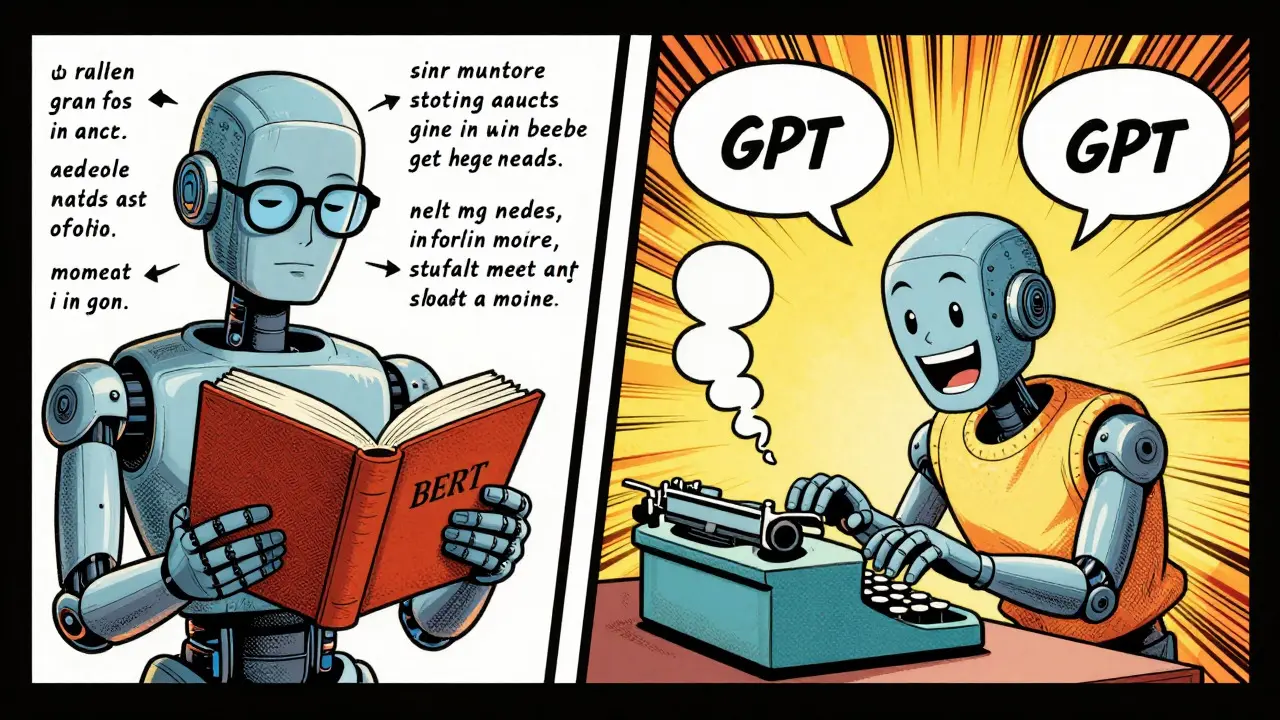
BERT Bidirectional Encoder Representations from Transformers an encoder-only transformer model developed by Google in 2018 designed for deep text understanding and semantic analysis was released by Google in 2018. Its primary goal was understanding. Think of BERT as a student taking an exam who has read the entire textbook cover-to-cover. It doesn't need to write the book; it needs to know what the book says.
BERT uses an encoder-only architecture. This means it processes input data to create a rich representation of meaning but does not generate new sequences of tokens as its primary output. The key innovation here is bidirectionality. When BERT analyzes a word, it looks at the context to the left AND the right simultaneously.
For example, in the sentence "I went to the store to buy milk," when analyzing the word "store," BERT considers "went to" before it and "to buy milk" after it. This gives it a complete picture of the word's role. To train this ability, researchers used a technique called Masked Language Modeling (MLM). During training, 15% of the words in a sentence are hidden (masked), and the model must guess the missing word based on the remaining context. This forces the model to build a robust internal map of language semantics and syntax.
In terms of scale, the original BERT Base model had 110 million parameters and 12 layers, while BERT Large had 340 million parameters and 24 layers. Both could handle up to 512 tokens at a time. While smaller than modern giants, BERT set a new standard for tasks requiring deep comprehension.
GPT: The Creative Writer
If BERT is the reader, GPT Generative Pre-trained Transformer a decoder-only transformer model developed by OpenAI optimized for generating coherent and contextually relevant text through autoregressive prediction is the writer. Developed by OpenAI, the GPT series focuses on generation. It uses a decoder-only architecture, which works fundamentally differently from BERT.
GPT employs causal language modeling. In this approach, the model predicts the next word in a sequence based ONLY on the previous words. It cannot see the future. To ensure this during training, a masking mechanism hides any tokens that appear after the current position. This creates an autoregressive loop: predict word 2 based on word 1, then predict word 3 based on words 1 and 2, and so on.
This architectural choice makes GPT exceptionally good at maintaining flow and coherence over long passages. Because it is constantly practicing "what comes next," it learns the nuances of narrative structure, tone, and style. While early GPT models were modest in size, the lineage has grown exponentially. For context, GPT-4 was trained on approximately 45TB of data, compared to BERT's 3TB. This massive increase in training data, combined with billions of parameters, allows GPT to access a wider range of knowledge and stylistic patterns.
Key Architectural Differences
The distinction between encoder and decoder architectures leads to practical differences in performance, efficiency, and use cases. Here is a breakdown of how they compare:
| Feature | BERT (Encoder) | GPT (Decoder) |
|---|---|---|
| Primary Goal | Understanding & Classification | Text Generation |
| Attention Type | Bidirectional (sees past and future) | Causal/Masked (sees only past) |
| Training Objective | Masked Language Modeling (MLM) | Causal Language Modeling (CLM) |
| Best For | Sentiment Analysis, NER, QA | Translation, Storytelling, Summarization |
| Output | Embeddings / Classifications | Next Token Probabilities |
Notice the output difference. BERT produces embeddings-numerical representations of words in context. You feed it text, and it tells you what that text means or how it relates to other texts. GPT produces probabilities for the next token. You feed it a prompt, and it generates the continuation. This single difference dictates their real-world applications.
Practical Applications: Which One Do You Need?
Choosing between these architectures depends entirely on your job-to-be-done. If you are building a system that needs to categorize customer support tickets, extract names and dates from legal documents, or determine if a tweet is positive or negative, BERT (or similar encoder models like RoBERTa or DeBERTa) is likely your best bet. They are faster, more efficient for shorter texts, and provide deeper semantic understanding without the overhead of generation.
However, if you need to draft an email, translate a document, summarize a long article, or create creative content, GPT-style decoder models are superior. Their ability to maintain context over longer sequences and generate fluent, human-like prose makes them indispensable for generative tasks. In 2026, many enterprise solutions actually combine both: using an encoder to understand user intent and retrieve relevant information, then passing that context to a decoder to generate a natural language response.
The Blurring Lines: Modern Hybrid Models
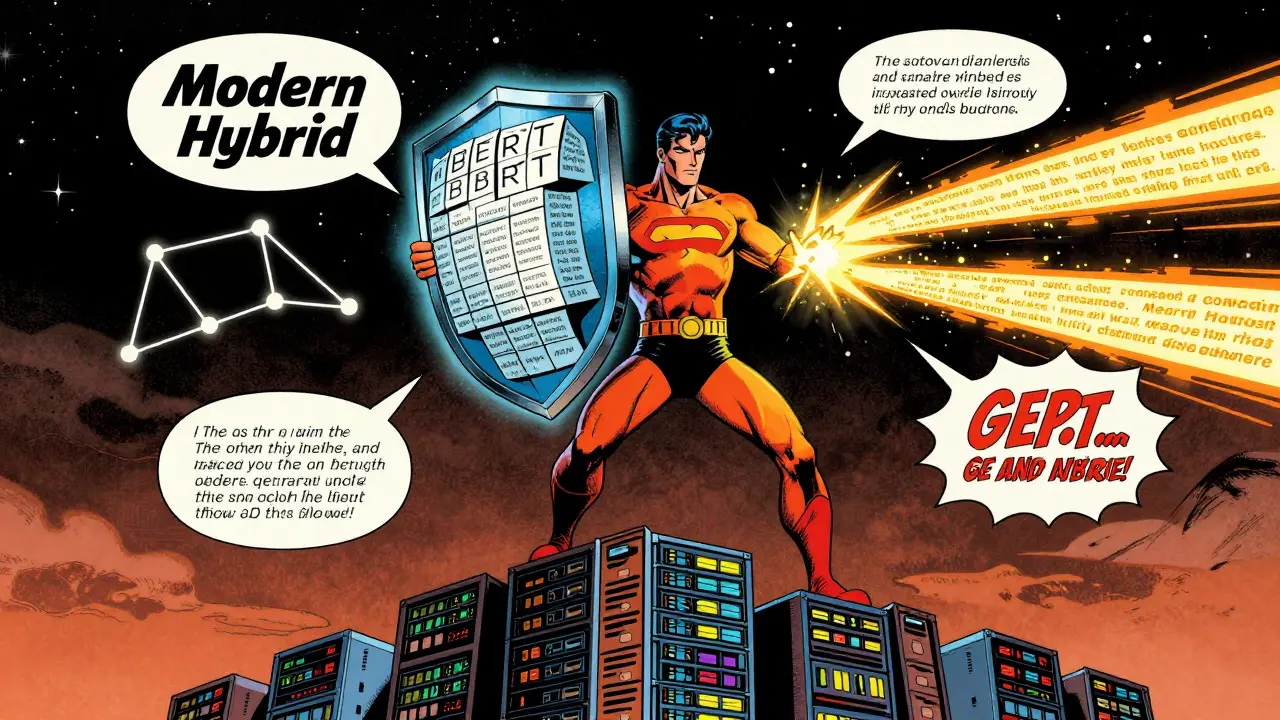
As we advance further into the era of large language models, the strict boundary between encoder and decoder is becoming fuzzier. Newer architectures, such as T5 (Text-To-Text Transfer Transformer) and BART, utilize an encoder-decoder structure. These models encode input text to understand it and then decode it to generate an output. This hybrid approach attempts to capture the best of both worlds: the deep contextual understanding of BERT and the generative flexibility of GPT.
Furthermore, recent advancements in instruction tuning and reinforcement learning from human feedback (RLHF) have made decoder models like GPT increasingly capable of understanding complex instructions, narrowing the gap in pure comprehension tasks. Conversely, researchers are exploring ways to make encoder models more generative. The evolution continues, driven by the need for models that are not just smart, but also efficient, safe, and versatile.
Conclusion: Understanding the Foundation
The journey from BERT to GPT illustrates a critical principle in AI development: architecture dictates capability. By choosing bidirectional attention, BERT mastered understanding. By choosing causal masking, GPT mastered creation. As you evaluate LLMs for your projects, remember that no single model is universally "best." The right choice depends on whether your priority is deep analysis or fluent generation. Understanding these foundational differences empowers you to select the right tool for the job, ensuring better performance, lower costs, and more reliable outcomes.
What is the main difference between BERT and GPT?
The main difference lies in their architecture and purpose. BERT uses an encoder-only, bidirectional architecture designed for understanding text and extracting meaning. GPT uses a decoder-only, autoregressive architecture designed for generating new text. BERT sees context from both sides of a word, while GPT only sees previous words to predict the next one.
Which model is better for sentiment analysis?
BERT is generally better for sentiment analysis. Its bidirectional attention allows it to deeply understand the semantic context and nuances of a sentence, making it highly accurate at classifying emotions and opinions. GPT can perform this task, but it is primarily optimized for generation, not classification.
Why does GPT use masked attention?
GPT uses masked attention to enforce causality. By hiding future tokens during training, the model is forced to predict the next word based solely on previous context. This mimics the way humans write and speak, enabling GPT to generate coherent, sequential text without "cheating" by looking ahead.
Can BERT generate text?
Not natively in the same way GPT does. BERT outputs embeddings or classifications. While techniques exist to fine-tune BERT for limited generation tasks, it lacks the autoregressive loop required for fluent, long-form text generation. For generation tasks, decoder-based models like GPT or hybrid models like T5 are preferred.
How do parameter counts affect model performance?
Generally, more parameters allow a model to learn more complex patterns and retain more knowledge. BERT Large has 340 million parameters, while modern GPT models have billions or trillions. Larger models typically perform better on a wide range of tasks, but they also require significantly more computational power and memory to run.



5 Comments
Bonnie Watt
Oh please. Another breathless recap of the same old Transformer hype cycle. We all know BERT is for understanding and GPT is for generating, thanks for stating the obvious like it's a groundbreaking revelation. The real issue isn't the architecture, it's that these models are becoming bloated wastelands of computational waste while still hallucinating basic facts. You act like choosing between an encoder and decoder is some high-stakes strategic decision when really most companies just slap a fine-tuned LLM on their website and hope for the best. It’s lazy engineering disguised as innovation.
Dave Gibbeson
Bonnie you’re missing the point entirely. This isn’t about hype, it’s about fundamental efficiency. If you’re running sentiment analysis on millions of customer tickets, using a massive decoder model is burning cash and time for no reason. Encoder models are lean, fast, and accurate for classification tasks. Ignoring this distinction leads to poor system design. Stop dismissing technical nuance because you think everything is just 'hype'.
Meagan Mueller
they dont want you to understand the architecture because if you did youd realize how much control they have over your thoughts through these text generators its not just code its a surveillance tool wrapped in pretty math equations and nobody talks about the data poisoning happening behind closed doors
Sabrina Newland
I feel like we are forgetting the human element here 🤔 Is it possible that by optimizing for either pure understanding or pure generation we are losing the messy beautiful ambiguity of actual human communication? I mean think about it 😊 Language is not just data points it is emotion and context and sometimes typos matter too lol. Maybe the next step isnt bigger models but models that can appreciate the chaos of being alive ✨
Amara Akbar
It is truly fascinating to observe how these distinct architectural philosophies continue to shape our digital interactions. While the technical distinctions between bidirectional encoders and causal decoders are well documented, the societal impact of choosing one over the other remains underexplored. Perhaps we should consider how these tools influence not just efficiency, but also the quality of discourse. A balanced perspective would acknowledge both the utility of precise classification and the creative potential of generative text. Thank you for sharing this informative overview.