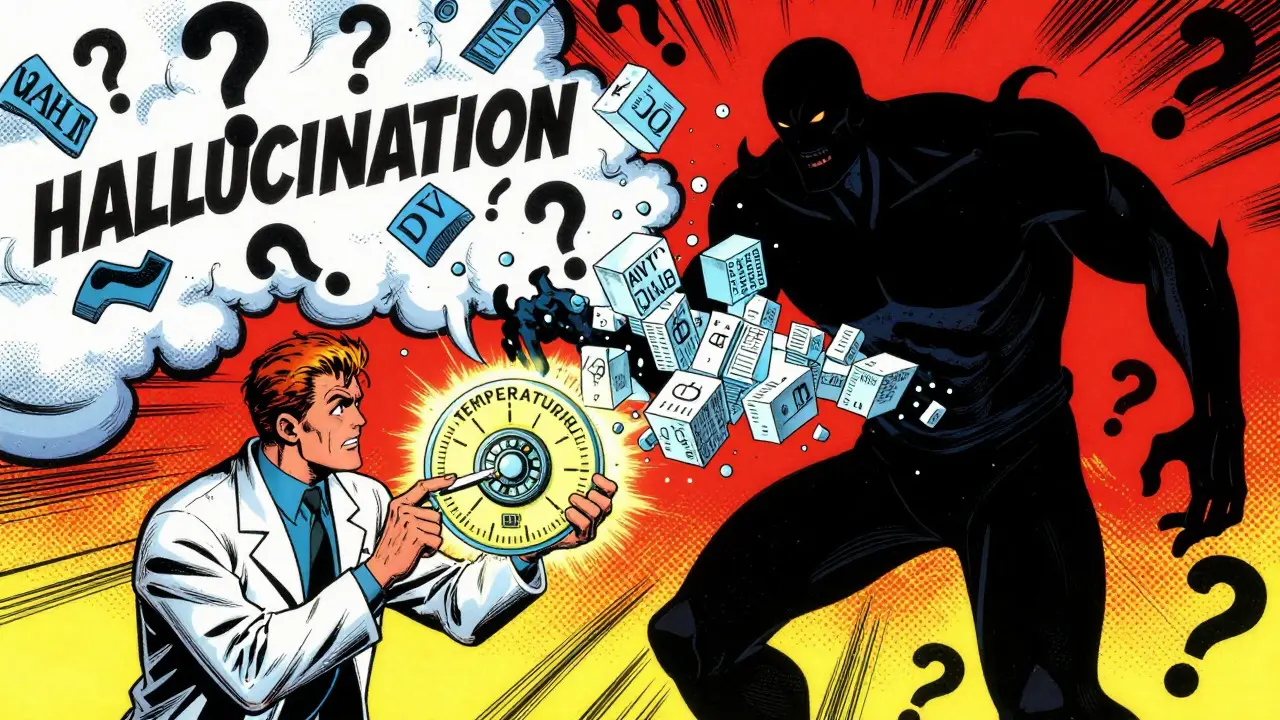
Have you ever asked an AI model a simple factual question and received a confident, completely made-up answer? You are not alone. This phenomenon, known as LLM hallucination, is the generation of unfaithful, fabricated, or nonsensical content that lacks grounding in input data or factual reality, remains one of the biggest hurdles for anyone deploying large language models (LLMs) in production. While we often blame the model's training data or architecture, the immediate trigger for many of these errors lies in how the model generates text token by token. Specifically, your choice of sampling methods controls the randomness-accuracy tradeoff during generation.
If you are building applications where trust matters-like customer support bots, medical assistants, or financial advisors-you cannot afford random errors. The good news is that you do not need to retrain the entire model to fix this. Adjusting sampling parameters is one of the most accessible, high-impact changes you can make today. Let’s look at exactly how these settings work and which ones actually reduce hallucinations without killing the quality of the output.
The Mechanics of Generation and Randomness
To understand why hallucinations happen, you first need to see what the model is doing under the hood. An LLM does not "know" facts in the way humans do. Instead, it predicts the next most likely word (or token) based on the words that came before it. At every step, the model assigns a probability score to thousands of possible next tokens.
Sampling methods determine how the model picks from those probabilities. If the model always picked the single highest-probability word, the text would be incredibly boring and repetitive. If it picked completely at random, the text would be gibberish. Sampling sits in the middle. However, when the model is uncertain about the correct fact, a loose sampling strategy allows it to pick a plausible-sounding but incorrect word. That is the moment a hallucination is born.
Research from OpenAI has shown that LLM training methodologies inherently reward guessing over acknowledging uncertainty. When combined with high-randomness sampling, this creates a perfect storm for fabrication. By tightening the sampling constraints, you force the model to stick closer to its highest-confidence predictions, which are statistically more likely to be factually grounded.
Temperature Scaling: The First Line of Defense
Temperature scaling is a technique that adjusts the logits (raw prediction scores) before they are converted into probabilities via softmax. Think of temperature as a dial for creativity versus caution. A low temperature makes the probability distribution sharper, meaning the top choices become much more likely than the rest. A high temperature flattens the distribution, giving rare or unlikely words a better chance of being selected.
Data clearly shows the impact here. In research conducted by Datadog in October 2024, reducing the temperature from a standard 0.7 down to 0.3 decreased hallucination incidence by 37% across nearly 15,000 test cases in the HaluBench dataset. For factual tasks, Professor Andrew Ng recommends keeping temperature between 0.2 and 0.5.
However, there is a catch. If you set the temperature too low (close to 0), you get greedy decoding. While this minimizes hallucinations-with up to 98.7% factual accuracy in some benchmarks-it produces robotic, repetitive text. Evidently AI found that such rigid outputs fail in 73% of conversational use cases because users find them unnatural. The key is finding the sweet spot where the model is cautious enough to be accurate but flexible enough to sound human.
Top-K and Nucleus Sampling: Smarter Constraints
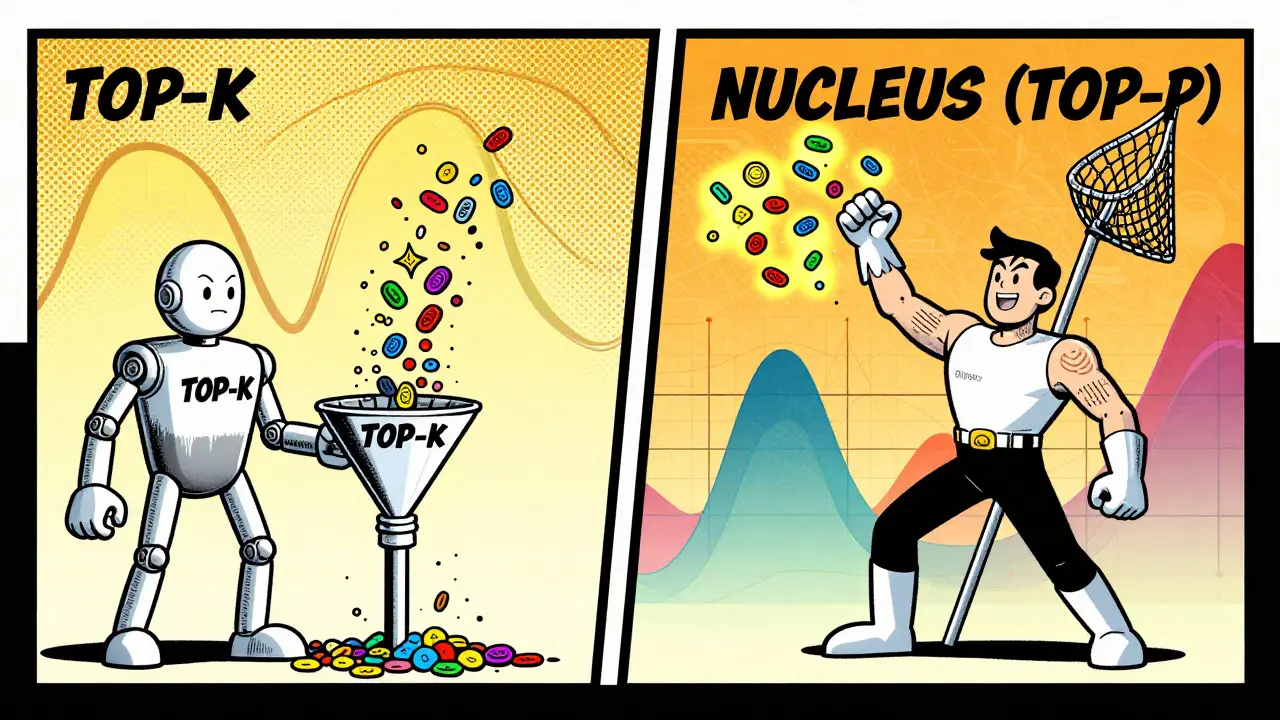
Temperature alone is often not enough. This is where Top-k sampling restricts the selection pool to the k most probable next words comes in. By eliminating the long tail of low-probability tokens, you remove the noise that often leads to nonsense. Raga AI’s experiments showed that setting k=40 instead of k=100 decreased factual errors by 28%. But Top-k has a flaw: if the top 40 words don’t include the right one, the model is forced to choose poorly.
A more adaptive approach is Nucleus sampling (also known as top-p), which dynamically selects from the smallest set of words whose cumulative probability exceeds a threshold p. This method adjusts itself based on how confident the model is. If the model is very sure, it picks from a small group. If it is unsure, it widens the net slightly.
In practice, nucleus sampling often provides the best balance. Appsmith reported that setting p=0.90 rather than p=0.95 reduced hallucinations by 22% in customer support apps while keeping dialogue natural. Datadog’s February 2025 testing found that nucleus sampling with p=0.92 achieved 94.3% accuracy, outperforming Top-k by 2.8 percentage points. Dr. Sarah Chan from Cambridge Consultants calls properly configured nucleus sampling the "single most effective intervention available to practitioners today" for balancing creativity and accuracy.
Comparing Sampling Strategies
| Method | Typical Settings | Factual Accuracy | Hallucination Risk | Best Use Case |
|---|---|---|---|---|
| Greedy Decoding | Temp = 0 | Very High (~98.7%) | Lowest | Code generation, strict formatting |
| Temperature Scaling | Temp = 0.3 - 0.5 | High (~89.4%) | Moderate | General factual Q&A |
| Top-k Sampling | k = 40 - 50 | High (~92.1%) | Moderate-Low | Controlled creative writing |
| Nucleus (Top-p) | p = 0.90 - 0.92 | Highest (~94.3%) | Low | Customer support, chatbots |
| Consortium Voting | Multiple Models | Extreme (>99%) | Minimal | Medical/Legal high-stakes domains |
Domain-Specific Implementation Tips
There is no universal setting that works for every scenario. Your optimal parameters depend heavily on what your application does. According to Gartner’s March 2025 survey, technology and finance sectors implement the strictest constraints, averaging a temperature of 0.35, while media and entertainment companies run higher at 0.65 to allow for creativity.
Here is how to approach different verticals:
- Medical and Legal: Accuracy is non-negotiable. Use low temperatures (0.1-0.3) and tight nucleus sampling (p=0.85-0.90). NVIDIA’s healthcare case studies suggest even lower temperatures (0.15-0.25) for diagnostic assistance tools.
- Customer Support: You need a balance. Start with temperature 0.3-0.4 and p=0.92. This keeps answers helpful and polite without inventing policies.
- Creative Writing: Hallucinations are less critical here, but coherence matters. You might accept higher error rates for the sake of novelty. Temperatures of 0.7-0.9 are common, though expect 2-3x higher hallucination rates.
Dr. Emily Bender from the University of Washington warns against over-optimizing. If you constrain the model too much, you may get factually correct but contextually useless answers. Always test with real user scenarios, not just benchmark datasets.

Advanced Techniques: Two-Stage and Adaptive Sampling
For teams willing to invest more engineering effort, advanced strategies offer significant gains. Datadog developed a two-stage approach that uses low-temperature sampling for the initial factual retrieval, then applies a second pass with slightly higher temperature to refine the language. This reduced implementation time by 40% while maintaining high accuracy.
Another emerging trend is adaptive sampling. Google’s Gemma 3, released in January 2025, introduced features that dynamically adjust parameters based on content type detection. This reduced hallucinations by 44% compared to static settings. Similarly, OpenAI’s API updates now include "hallucination guardrails" that automatically constrain sampling when factual accuracy is deemed critical.
For high-stakes environments, consider consortium voting. This involves running the same prompt through multiple LLM instances and aggregating the results. Cambridge Consultants found this reduces hallucinations by 18-22 percentage points. The downside? It increases computational costs by 300%, so reserve this for legal or medical domains where accuracy thresholds exceed 99%.
Getting Started with Parameter Tuning
You do not need to guess blindly. Establish a baseline using Hugging Face’s recommended starting points: temperature=0.3, top-p=0.9, and top-k=50 for factual tasks. Then, iterate.
- Define your metric: Are you optimizing for pure factual recall or user satisfaction? These often conflict.
- Create a test set: Use a dataset like HaluBench or create 50-100 representative queries from your domain.
- A/B test parameters: Run your test set with different temperatures and p-values. Track both accuracy and readability.
- Monitor entropy: Cambridge Consultants’ "consortium entropy" metrics show that responses with high variance (entropy > 0.45) correlate with 63% higher hallucination probability. Keep your outputs consistent.
Tools like Weights & Biases and AWS SageMaker now offer automated tracking and optimization for these parameters. As McKinsey predicts, automated sampling optimization will become standard in 90% of enterprise deployments by 2027. Starting manual tuning now prepares you for that shift.
What is the best sampling method to reduce hallucinations?
Nucleus sampling (top-p) with a value around 0.90 to 0.92 is currently considered the optimal balance for most applications. It achieves higher factual accuracy than Top-k sampling while maintaining more natural language fluency than greedy decoding. Combined with a low temperature (0.3-0.5), it offers the best trade-off for general-purpose LLM deployment.
Does lowering temperature always stop hallucinations?
Lowering temperature significantly reduces hallucinations by making the model stick to its highest-probability predictions. However, setting it too low (near 0) can result in repetitive, robotic text that fails in conversational contexts. It reduces hallucinations but may hurt user experience if not balanced correctly.
How much can sampling adjustments improve accuracy?
According to Datadog’s technical reports, optimizing sampling parameters can provide 60-70% of the hallucination reduction benefits achievable through more complex techniques like Retrieval-Augmented Generation (RAG) or fine-tuning. In specific tests, adjusting temperature and top-p reduced hallucination rates by 22-37%.
What are the risks of over-constraining sampling parameters?
Over-constraining can lead to "contextual appropriateness" failures. The model may produce factually correct statements that are tone-deaf, overly rigid, or unhelpful for the user's specific query. Dr. Emily Bender notes that this creates new failure modes that can be harder to detect than obvious factual errors.
Is consortium voting worth the extra cost?
Consortium voting aggregates outputs from multiple model runs to reduce variance and hallucinations. It increases computational costs by approximately 300%. Therefore, it is only recommended for high-stakes domains like medicine, law, or finance where accuracy thresholds must exceed 99% and the cost of an error is extremely high.