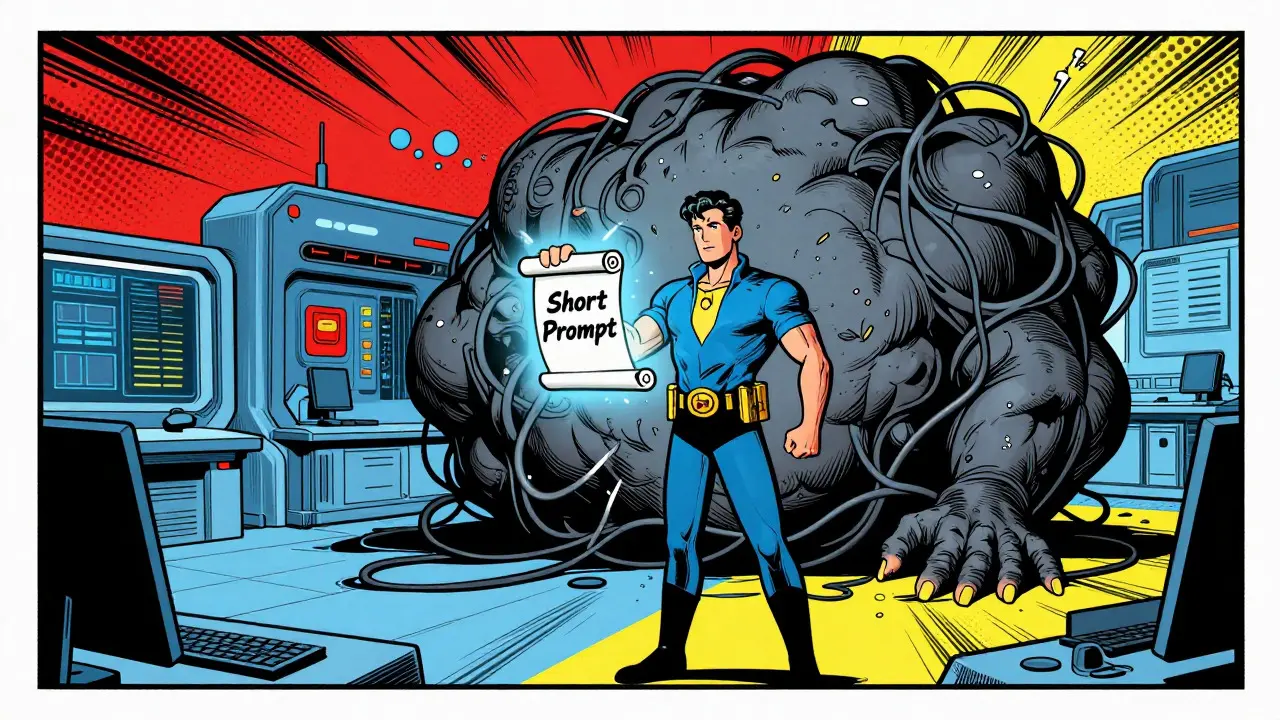
Here is a counterintuitive truth about Large Language Models (LLMs): giving them more information often makes them dumber. We used to assume that if we fed a model every possible detail, it would produce the perfect answer. The reality is starkly different. As you increase the length of your input, the model's reasoning ability frequently degrades. This isn't just a minor glitch; it is a fundamental bottleneck in how these systems process data.
If you are building applications or relying on AI for critical tasks, understanding this tradeoff between the number of tokens in your input versus the accuracy and coherence of the output is essential. It saves money, reduces latency, and, most importantly, stops your AI from hallucinating facts. Let’s break down why shorter prompts usually win and how to find the sweet spot for your specific use case.
The Myth of Infinite Context
Modern models boast massive context windows. Anthropic’s Claude 3 supports up to 200,000 tokens. Google’s Gemini 1.5 Pro handles even more. It is tempting to think, "Why not just dump the entire database into the prompt?" The problem lies in the architecture. LLMs use attention mechanisms to weigh the importance of each word relative to others. This calculation scales quadratically with token count. In plain English, doubling the input doesn’t double the work; it multiplies the computational complexity exponentially.
Research published in 2023 by Stanford University and Google AI challenged the assumption that more context equals better results. They found that models like GPT-4 experience significant performance degradation at around 3,000 tokens. This is well below their technical maximums. A study by PromptLayer in 2024 showed that doubling prompt tokens from 1,000 to 2,000 increased processing time by 2.3x for GPT-4-turbo. Extending that to 4,000 tokens resulted in a 5.1x latency increase. You are paying more for slower, worse answers.
The Accuracy Cliff: What the Data Shows
The decline in quality is not random; it follows a predictable pattern. PromptPanda’s 2023 research documented a linear drop in accuracy as prompts grew longer. Here is what their metrics looked like across standard reasoning tasks:
- 500 tokens: 95% accuracy
- 1,000 tokens: 90% accuracy
- 1,500 tokens: 85% accuracy
- 2,000 tokens: 80% accuracy
- 2,500 tokens: 75% accuracy
- 3,000 tokens: 70% accuracy
Notice the trend? Every additional 500 tokens reduced reasoning performance by approximately 5 percentage points. This degradation happens because the model struggles to maintain focus. A joint study by Microsoft Research and Stanford University in June 2024 found that hallucination rates increase by 34% when prompts exceed 2,500 tokens. Bias amplification also spikes, with a 28% higher incidence of problematic outputs in lengthy inputs.
Recency Bias and the Lost Beginning
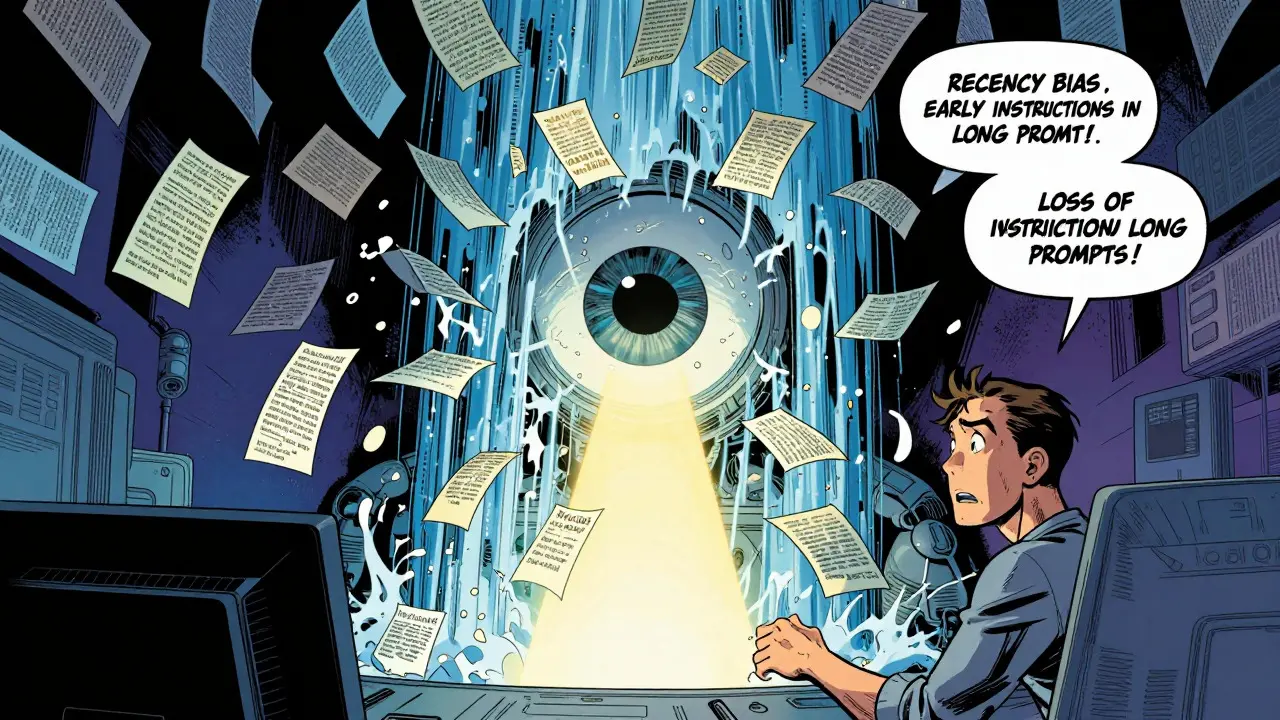
One of the biggest culprits behind poor output quality in long prompts is recency bias. Transformers disproportionately weight tokens appearing later in the sequence. If you have a 10,000-token prompt, the critical instructions you placed at the very beginning might get ignored. PromptLayer’s testing demonstrated that critical information in the first 20% of a 10,000-token prompt received only 12-18% of the model’s attention allocation.
This means your AI might remember the last paragraph of your document but forget the core instruction you gave it three thousand words earlier. Developers on Reddit’s r/MachineLearning reported this issue extensively in late 2024. One user, u/DataEngineerPro, documented reducing a financial report generation prompt from 4,200 to 1,100 tokens. The result? Output accuracy jumped from 68% to 89%. By cutting the noise, they helped the model focus on the signal.
Model Differences: Is One Better Than Others?
Not all models handle length equally. Comparative analysis reveals nuanced differences. According to independent testing by MLPerf in Q1 2025, Google’s Gemini 1.5 Pro maintained higher accuracy (88%) at 2,000 tokens compared to GPT-4-turbo (82%) at the same length. However, both exhibit similar degradation curves beyond that point.
| Model | Accuracy at 1,000 Tokens | Accuracy at 2,000 Tokens | Degradation Rate (>2k) |
|---|---|---|---|
| Gemini 1.5 Pro | 92% | 88% | Moderate |
| GPT-4-turbo | 90% | 82% | Steep |
| Llama 3 70B | 89% | 86% | Low (3% drop) |
| Claude 3 | 91% | 85% | Moderate |
Interestingly, open-weight models like Meta’s Llama 3 70B show less severe degradation. Research by Goldberg et al. in August 2024 found that Llama 3 dropped only 3% in accuracy between 1,000 and 2,000 tokens, suggesting some architectures may handle longer contexts more effectively than proprietary counterparts. However, no model is immune to the effects of extreme length.
Strategic Alternatives to Brute-Force Prompting
If shortening prompts hurts performance, what do you do when you genuinely need extensive context? The answer lies in architectural changes, not just prompt tweaking. Retrieval-Augmented Generation (RAG) has emerged as the superior approach. Instead of stuffing everything into one prompt, RAG retrieves only the most relevant snippets dynamically.
A PromptLayer case study showed that a well-structured 16K-token RAG implementation outperformed a monolithic 128K-token prompt by 31% in accuracy while reducing latency by 68%. This confirms that strategic context management consistently beats brute-force dumping. For specialized tasks like legal contract analysis, where cross-referencing distant clauses is necessary, longer prompts (32,000+ tokens) can be marginally beneficial, according to Nature’s April 2025 study. But for 92% of use cases, RAG or hybrid strategies win.
Another technique is Chain-of-Thought (CoT) prompting. While CoT improves reasoning, its effectiveness diminishes with length. The same Goldberg study demonstrated that CoT improved reasoning accuracy by 19% at 1,000 tokens but provided only 6% improvement at 2,500 tokens. You cannot rely on CoT to save a bloated prompt.
Practical Guidelines for Optimization
How do you apply this in real life? The MLOps Community’s Prompt Engineering Guide (Version 3.1, February 2025) offers clear recommendations based on task complexity:
- Simple Classification Tasks: Start with 500-700 tokens. Keep instructions crisp and examples minimal.
- Complex Reasoning: Aim for 800-1,200 tokens. Include necessary context but prune irrelevant details.
- Maximum Threshold: Never exceed 2,000 tokens without empirical validation. If you must go longer, test rigorously.
Dr. Percy Liang, Director of Stanford's Center for Research on Foundation Models, summarized it best in his October 2024 NeurIPS keynote: "Beyond 2,000 tokens, we're not giving models more context-we're giving them more noise to filter through." Dr. Anna Rohrbach of MIT added that the attention mechanism's quadratic complexity creates a fundamental bottleneck that parameter scaling alone cannot fix.
To mitigate recency bias, repeat critical instructions at both the beginning and end of your prompt. This ensures the model sees the key constraints regardless of where its attention drifts. Tools like PromptLayer’s 'PromptOptimizer' (launched January 2025) can automate this testing, helping users achieve optimal results within 2-3 iterations.
The Future of Context Management
The industry is shifting toward intelligent context management. Google released 'Adaptive Context Window' technology in January 2025, which dynamically adjusts attention focus within long prompts, showing 18% better retention of early-sequence information. Anthropic announced in February 2025 that Claude 3.5 would incorporate 'context relevance scoring' to automatically filter low-value tokens. Meta AI’s March 2025 paper demonstrated 29% better performance on 4,000-token prompts through hierarchical attention mechanisms.
By 2027, Gartner predicts that 90% of enterprise LLM implementations will use automated context optimization rather than fixed-length prompts. The goal is no longer to fit everything in, but to curate what matters. As the total addressable market for prompt optimization solutions grows toward $1.2 billion by 2028, mastering the balance between length and quality will remain a critical skill for developers and enterprises alike.
What is the ideal prompt length for most LLM tasks?
For simple classification tasks, aim for 500-700 tokens. For complex reasoning, 800-1,200 tokens is optimal. Generally, try to keep prompts under 2,000 tokens unless you have specific evidence that longer context improves your particular outcome.
Why does increasing prompt length reduce accuracy?
Attention mechanisms scale quadratically with token count, causing computational complexity to rise exponentially. Additionally, models suffer from recency bias, ignoring early instructions, and face information overload, leading to higher hallucination rates and degraded reasoning capabilities.
Does Chain-of-Thought prompting fix issues with long prompts?
Only partially. Chain-of-Thought improves reasoning accuracy significantly at shorter lengths (e.g., 19% improvement at 1,000 tokens), but its benefit drops sharply (to 6%) at 2,500 tokens. It cannot fully compensate for the degradation caused by excessive length.
When should I use Retrieval-Augmented Generation (RAG)?
Use RAG when you need to reference large datasets or documents. RAG retrieves only relevant snippets, keeping the prompt concise. Studies show RAG implementations can outperform monolithic long prompts by 31% in accuracy while reducing latency by 68%.
Which models handle long prompts better?
Open-weight models like Llama 3 70B show less severe degradation (only 3% accuracy drop between 1,000-2,000 tokens) compared to some proprietary models. However, all models eventually degrade beyond certain thresholds, so length optimization remains crucial regardless of the model chosen.
7 Comments
Chandan Singh
It is fascinating how the quadratic scaling of attention mechanisms creates this bottleneck. Most developers ignore the computational complexity and just dump data in. The Stanford study from 2023 clearly shows that performance degrades significantly after 3,000 tokens. We need to stop treating context windows as infinite storage solutions.
Brannen Hall
This whole premise is flawed because you are cherry-picking metrics. I have used GPT-4 with 50k tokens for legal summarization and it worked fine. You guys are just scared of paying for compute. Short prompts are lazy engineering.
tiffany King
I really love this perspective! It makes so much sense now why my outputs were getting messy. I was trying to stuff everything into one prompt. Time to try RAG and see if it helps. Thanks for sharing this!
Brenna Gonedrman
OMG yes! This is huge news for everyone. I always thought more info meant better answers but now I know it is wrong. The accuracy drop is scary. We must keep things short or we fail. It is a big deal for all of us using AI daily.
Joanna Mucha
The banality of this discourse is suffocating. You reduce the profound architectural limitations of transformer models to mere 'cost saving' measures. It is not about money; it is about the epistemological crisis of the machine forgetting its own beginning. Recency bias is merely a symptom of the model's existential amnesia. We are building gods that cannot remember their own names.
Kim Edwards
Dude, this changes EVERYTHING! I literally spent three days debugging a prompt that was too long. My brain hurts just thinking about it. Why did no one tell me sooner?! I feel like such an idiot right now. Can we please just fix the models already?!
Bonnie Watt
You are all missing the point. The real issue is that developers are incompetent. If you write good code you do not need long prompts. Stop blaming the model for your bad engineering skills. It is pathetic.