
You’ve got a feature that works. The tests pass. The UI looks fine. But when you try to add one small change next week, the whole thing threatens to fall apart. If you’re using AI agents to write your code-what many now call vibe coding-this isn’t just bad luck. It’s an architectural failure hiding in plain sight.
Vibe coding lets AI generate massive chunks of code with minimal guidance. It’s fast. It’s fun. But it’s also dangerous if you don’t enforce structure. Without explicit rules, AI doesn’t respect boundaries. It collapses layers. It mixes business logic with database queries inside route handlers. It creates a mess that compiles but can’t scale. This article breaks down why layered architecture matters more than ever in the age of AI-generated code and how to keep your system from turning into digital duct tape.
The Hidden Cost of "It Just Works"
Here’s the trap: AI agents are great at local optimization. You ask for a function, they give you a working function. You ask for an endpoint, they give you a working endpoint. But they don’t see the forest. They only see the branch they’re typing on.
In traditional development, you decide where code lives. Does this validation belong in the controller? The service layer? The domain model? That decision is architectural. In vibe coding, the AI makes that decision by default. And usually, it makes the wrong one. It puts everything in the easiest place to reach-the entry point. Suddenly, your clean architecture is gone. You have a monolith of spaghetti logic wrapped in modern syntax.
This isn’t theoretical. Analysis from vFunction shows that AI coding agents like those in Replit, Lovable, and GitHub Copilot’s agentic mode bake architectural decisions directly into the codebase. These choices carry long-term implications for scalability and maintainability. When you don’t guide them, you inherit their guesswork as technical debt.
Why Layered Architecture Matters More Now
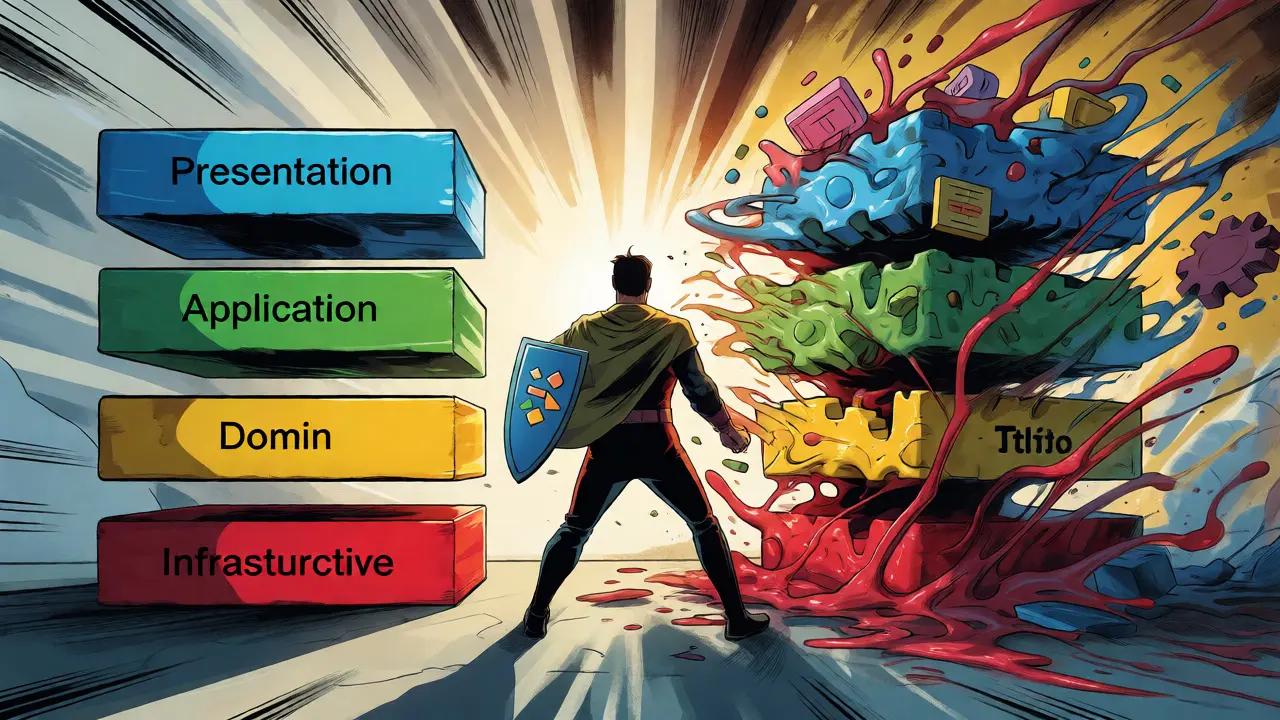
Layered architecture isn’t just an academic concept. It’s a defense mechanism against chaos. By separating concerns into distinct layers-presentation, application, domain, infrastructure-you create boundaries that protect each part of your system from changes in others.
When AI generates code without these boundaries, three things break:
- Testability: If your business logic is tangled with database calls, you can’t unit test it easily. You need integration tests, which are slower and flakier.
- Scalability: You can’t swap out a database or change an API provider without rewriting half your app because dependencies are hardcoded everywhere.
- Maintainability: New developers (or future-you) can’t understand the flow. Where does state move? Who owns this data? The answers aren’t in the code; they’re lost in the noise.
Mark Russinovich and Scott Hanselman highlighted this at BUILD 2025. They argued that developers must understand complexity theory, concurrency, and design principles to properly guide AI agents. Without that knowledge, you’re letting a junior developer-who has never seen your entire system-make senior-level architectural decisions.
How AI Collapses Your Layers
Let’s look at a concrete example. Imagine you’re building a user registration feature. In a well-structured app, you’d have:
- A controller that handles HTTP requests.
- A service layer that validates input and orchestrates the process.
- A domain model that defines what a User is.
- A repository that talks to the database.
Now, ask an AI agent to “create a register endpoint.” Without explicit instructions, it often writes all four steps in one file. The SQL query sits right next to the password hashing logic. The email sending happens inline. There’s no separation. No dependency injection. No clear interfaces.
| Aspect | Traditional Layered App | Vibe-Coded App (No Guidance) |
|---|---|---|
| Code Location | Logic isolated in specific layers | All logic in route handlers/controllers |
| Dependencies | Explicitly injected via interfaces | Hardcoded instantiations everywhere |
| Testing | Fast unit tests possible | Requires heavy integration mocking |
| Change Impact | Localized to one layer | Ripple effects across entire file/app |
This collapse isn’t malicious. It’s efficient from the AI’s perspective. It solves the immediate problem fastest. But efficiency today becomes pain tomorrow. As Microsoft’s experts note, the real architecture doesn’t live in the code itself. It lives in how services talk to each other, how state moves, and where boundaries are drawn. None of that exists in autocomplete. It requires human intent.
Enforcing Boundaries: The Developer as Architect
You cannot treat AI as an autonomous architect. Treat it like a very fast, very literal junior developer. It needs specs. It needs constraints. It needs you to say, “Do not touch the domain layer,” or “Use the existing UserRepository interface.”
To enforce separation of concerns in vibe-coded apps, adopt these strategies:
1. Be Specific About Layers
Don’t just prompt: “Add a login feature.” Prompt: “Add a login feature. Create a `LoginService` in the application layer. Use the existing `UserRepository` in the infrastructure layer. Do not put SQL queries in the controller. Return a DTO, not the raw entity.”
The more explicit you are about responsibilities, the less likely the AI is to collapse layers. Break out the expected architecture in your prompts. Expand the context so the agent knows where logic belongs.
2. Design First, Code Second
Before you hit enter, sketch the flow. Diagram uncertain logic. Ask yourself: Where does this logic belong? Does this feature reinforce or break existing boundaries? Would another developer understand why I made these decisions?
If you can’t answer those questions, the AI won’t either. Documentation of decisions is critical-not just what the code does, but why it’s shaped that way. Leave comments. Write meaningful commit messages. Explain the architectural intent.
3. Audit for Local Wins, Global Losses
AI excels at making individual functions work. But it struggles with system-wide coherence. A change might optimize one endpoint while breaking the global state management pattern. Review generated code not just for correctness, but for consistency with your existing architecture.
In greenfield projects, the risk is lower because there’s no existing structure to break. But in existing codebases, agents often make changes that work locally but fail globally. They lack the shared mental model that human teams build over time.

The Invisible Damage: Technical Debt That Compounds
The scariest part of vibe-coded architecture failure is its invisibility. The app runs. Users don’t complain immediately. But the rot spreads in the interactions, flow, and lifecycle of the system. No one knows what’s under the hood because AI built it in silence.
This is different from typical bugs. Bugs crash apps. Architectural decay makes apps impossible to change. Six months later, adding a simple field to a form might require touching ten files because there were no clear boundaries. The cost of modification skyrockets.
Security risks also lurk here. Exposed secrets, overly broad permissions, and storage access issues often stem from poor structural separation. If your security logic is scattered across controllers instead of centralized in middleware or services, auditing becomes a nightmare.
Practical Checklist for Vibe Coders
Use this checklist before merging any AI-generated code:
- Is the business logic separated from presentation? Check if your controllers are doing too much.
- Are dependencies injected? Look for `new Database()` inside a service method. That’s a red flag.
- Does this change respect existing boundaries? Compare with how similar features are structured.
- Can I test this in isolation? If not, refactor.
- Did I document the architectural decision? Add a comment explaining why this structure was chosen.
Remember: The goal isn’t to stop using AI. It’s to use it wisely. Let it scaffold. Let it write boilerplate. But keep the architectural steering wheel in your hands. Sign off on the decisions. Own the structure.
Vibe coding accelerates development, but speed without direction leads to dead ends. By enforcing layered architecture and separation of concerns explicitly, you turn AI from a source of hidden debt into a powerful tool for sustainable growth. Don’t let the vibes override the vision.
What is vibe coding?
Vibe coding is a development paradigm where AI agents generate code and architectural decisions with minimal explicit guidance from developers. Developers describe what they want in natural language, and the AI produces working code, often handling scaffolding and implementation details autonomously.
Why does AI-generated code often lack separation of concerns?
AI agents focus on solving the immediate task efficiently. Without explicit instructions on layering and boundaries, they tend to place logic in the most accessible location, such as route handlers, rather than distributing it across appropriate architectural layers like domain, service, or infrastructure.
How can I enforce layered architecture when using AI tools?
Be specific in your prompts. Explicitly define which layers should handle which responsibilities. For example, instruct the AI to keep database access in the repository layer and business logic in the service layer. Provide context about existing patterns and interfaces to prevent the AI from creating new, inconsistent structures.
Is layered architecture still relevant in modern microservices?
Yes. Even in microservices, individual services benefit from internal layered architecture. Separation of concerns within a service ensures that changes to the database schema don’t ripple through the entire codebase, maintaining modularity and testability within each bounded context.
What are the risks of ignoring architecture in vibe-coded apps?
The primary risks include increased technical debt, difficulty in scaling, poor testability, and security vulnerabilities. While the app may function initially, the lack of clear boundaries makes future modifications risky and expensive, leading to systemic dysfunction that is hard to diagnose and fix.