
Ever typed the same question into an AI chatbot and got two completely different answers? You’re not imagining it. Large language models (LLMs) aren’t broken-they’re designed this way. Their core strength-generating human-like text-is also their biggest weakness when you need reliability. If you’re using LLMs for customer support bots, automated reports, or code generation, inconsistent outputs can break workflows, confuse users, or even cost money. The solution isn’t avoiding LLMs. It’s learning how to make them behave predictably. That’s where deterministic prompts come in.
Why LLMs Don’t Always Give the Same Answer
LLMs don’t recall answers like a database. They guess the next word, one at a time, based on probabilities. Think of it like rolling a loaded die hundreds of times. Even if the die is weighted toward certain numbers, there’s still randomness in which side lands up. That’s what happens inside the model: billions of calculations create a probability map for each possible next word. Then, the system picks one-sometimes the most likely, sometimes a less likely one, depending on settings. This isn’t a bug. It’s how creativity works. But when you need the same output every time-say, for a legal document template or a financial summary-that randomness becomes a problem. Even when you set the temperature to zero, you might still get slight variations. Why? Because of tiny differences in how computers handle floating-point math. Two identical prompts running on different servers, or even on the same server after a restart, can pick different words if two candidates have probabilities that differ by less than 0.001%. It’s like flipping a coin that’s almost perfectly balanced. One millimeter off center, and the result changes.The Three Keys to Controlling Output
There are three main levers you can pull to reduce randomness: temperature, top-p, and frequency penalty. Use them wisely. Don’t tweak all three at once-it makes things harder to debug.- Temperature controls how wild the model gets. At 0.0, it always picks the most probable next word. That’s your best shot at consistency. For factual questions-like “What’s the capital of Finland?”-use 0.0 to 0.3. For creative tasks like writing poems or brainstorming names, bump it to 0.7-1.0 to allow more variety.
- Top-p (nucleus sampling) limits choices to the smallest group of words that add up to a certain probability. If you set top-p to 0.1, the model only considers the top 10% of likely next words. This cuts down on odd or off-topic suggestions. Combine it with low temperature for tight control. Most experts recommend using temperature OR top-p, not both.
- Frequency penalty discourages repetition. Set it between 0.5 and 1.0 to stop the model from recycling phrases like “in conclusion” or “as mentioned earlier.” Too high (above 1.5), and it might skip perfectly good words just because they appeared once before.
For example, if you’re building a system that extracts dates from emails, try this combo: temperature=0.2, top-p=0.1, frequency_penalty=0.5. Test it on 50 emails. If you get the same result every time, you’re on track.
Chain-of-Thought Prompting Works-But Only for Big Models
One of the most popular tricks to reduce variance is asking the model to “think step by step.” This is called chain-of-thought prompting. Instead of asking “What’s 15% of $230?” you say: “Let’s think step by step. First, convert 15% to a decimal. Then multiply by 230. What’s the result?” It sounds like overkill. But research from Google in 2022 showed this technique cuts output variance by nearly half on complex reasoning tasks. The catch? It only works on large models-62 billion parameters or more. If you’re using a smaller model, like gpt-3.5-turbo or Llama 3 8B, forcing step-by-step thinking actually makes answers less accurate and more inconsistent. For small models, just ask directly. Simpler is better.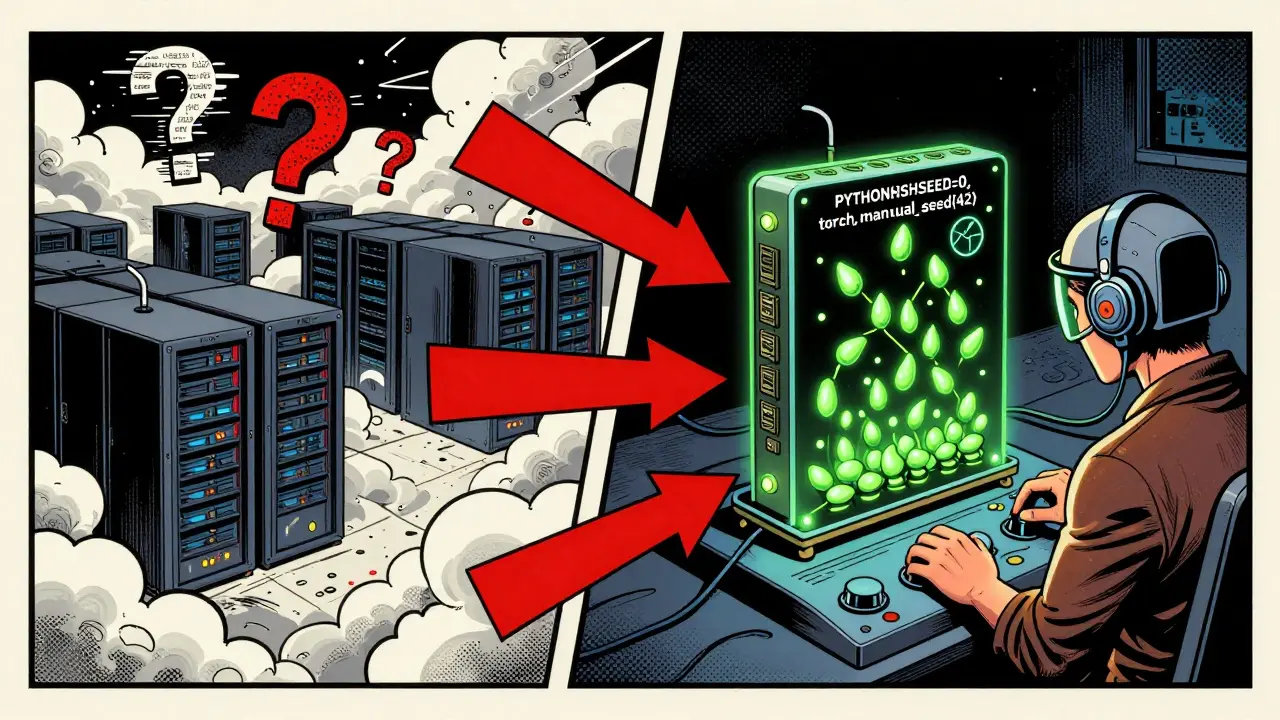
Hardware and Environment Matter More Than You Think
You can set perfect parameters, write the clearest prompt ever, and still get different results. Why? Because your environment isn’t controlled. LLMs run on GPUs and CPUs that handle math slightly differently. A prompt run on an NVIDIA A100 might pick a different word than the same prompt on an AMD MI300-even if everything else is identical. Cloud APIs add another layer of unpredictability. If you’re using OpenAI’s API, the model might be running on different servers each time. That’s why developers on Reddit and Stack Overflow report identical prompts yielding different outputs, even with temperature=0. The fix? Run the model locally. Use tools like Hugging Face Transformers with fixed seeds. Set these environment variables before launching:- PYTHONHASHSEED=0
- TF_DETERMINISTIC_OPS=1
- torch.manual_seed(42)
One GitHub user achieved 99.8% consistency using this method. But it’s not cheap. You need powerful hardware. A single Llama 3 70B model requires at least 80GB of VRAM. For most teams, that means renting high-end cloud instances or investing in on-site servers. Enterprise teams spend an average of $18,500 to build reliable deterministic pipelines.
What the Big Players Are Doing About It
The industry knows this is a bottleneck. Companies aren’t just hoping for better models-they’re building tools to lock in consistency. - OpenAI launched “Determinism Mode” in January 2025. Turn it on, and you’ll get the exact same output for the same prompt. But it’s 22% slower and costs more. It’s ideal for compliance-heavy uses like legal or medical summaries. - Google’s Gemini 1.5 Pro, released in March 2025, uses “Consistency Anchors.” These lock key parts of the reasoning process so later steps don’t drift. Early tests show 99.7% output stability on structured tasks. - AWS Bedrock added “Determinism Mode” in Q2 2024. It’s priced 15% higher than standard inference but guarantees identical outputs across multiple API calls. - Azure’s OpenAI service now offers “Consistency Tiers.” You can choose between Standard (default), Balanced, and High Consistency. Higher tiers reduce variance but increase cost and latency.
When You Can’t Achieve Perfect Determinism
Here’s the hard truth: perfect determinism is impossible with current LLMs. Even Stanford’s 2025 “probabilistic pruning” technique-claimed to reach 99.9% consistency-still allows for tiny variations. And that’s okay. Martin Fowler, a respected software engineer, puts it best: “LLMs introduce a non-deterministic abstraction. You can’t just store your prompts in Git and expect the same result every time.” Instead of fighting randomness, design around it. Use these strategies:- Router Pattern: If the model’s output is too uncertain, route it to a human reviewer.
- Tool Calling: Force the model to output structured JSON instead of free text. Then use a script to validate or convert it.
- Output Validation: Run each response through a rule-based checker. If the date format is wrong or the number is outside expected range, reject it and retry.
- Logging Probabilities: Monitor the log probabilities of the top tokens. If the difference between the top two is less than 0.5%, the output is likely to vary. Flag it for review.
Enterprise users report that 68% of LLM-related workflow issues come from output variance, not poor answers. That’s why Gartner ranks consistency as the third biggest concern for LLM adoption-right after security and cost.
What You Should Do Today
You don’t need to rebuild your whole system. Start small.- Identify one task where inconsistent outputs cause real problems-like generating product descriptions or summarizing support tickets.
- Set temperature to 0.2 and top-p to 0.1. Keep frequency penalty at 0.5.
- Run the same prompt 10 times. Are the outputs identical? If not, tweak one setting at a time.
- If you’re using a cloud API, ask if they offer a deterministic mode. If yes, test it with a small budget.
- If you’re running models locally, lock your random seeds and environment variables.
- Build a simple validation step to catch outputs that don’t match expected formats.
Most teams get 95%+ consistency within 3-5 weeks of tuning. The goal isn’t perfection. It’s reliability. You don’t need the AI to be flawless. You just need it to be predictable enough that your users and systems can count on it.
Future Outlook
By 2026, experts predict that any enterprise using LLMs for critical workflows will need to guarantee at least 95% output consistency. That’s not a suggestion-it’s becoming a requirement. Tools for monitoring, locking, and validating outputs are already growing fast. The market for LLM determinism tools is expected to hit $2.3 billion by 2027. But the real win isn’t in the tech. It’s in the mindset. Stop treating LLMs like magic boxes. Treat them like unreliable coworkers who sometimes give great answers and sometimes go off-script. Manage them with clear rules, checks, and fallbacks. That’s how you turn chaos into control.Can I make an LLM 100% deterministic?
No, not with current technology. Even with temperature=0, tiny differences in hardware, software, or floating-point math can cause outputs to vary. The best you can do is get 95-99.9% consistency using fixed seeds, local deployment, and strict parameter settings.
Why does my prompt give different answers on different days?
Cloud APIs often rotate servers or update models without warning. Even if your prompt is unchanged, the underlying system might be different. To fix this, use deterministic modes (like OpenAI’s or AWS Bedrock’s), run models locally, or add output validation to catch inconsistencies.
Should I use temperature=0 for everything?
No. Temperature=0 works great for facts, summaries, and code. But for creative tasks-like writing stories, marketing copy, or brainstorming ideas-it makes responses robotic and repetitive. Use 0.7-1.0 for creativity. Only use 0.0 when you need the same output every single time.
Does chain-of-thought prompting reduce variance for all models?
No. Research shows it only improves consistency and accuracy in models with 62 billion parameters or more. For smaller models like Llama 3 8B or gpt-3.5-turbo, it often makes answers worse. Stick to direct prompts for small models.
What’s the cheapest way to get consistent outputs?
Use the lowest temperature (0.0-0.3) and top-p (0.1) with a cloud API. If you need higher consistency, upgrade to a deterministic mode (if available). For maximum control, run a small model locally with fixed seeds-but that requires technical skill and hardware. Most teams start with cloud settings before investing in local deployment.
How do I know if my prompt is still too variable?
Run the same prompt 10-20 times. If the outputs differ in structure, key facts, or formatting, it’s too variable. You can also check the log probabilities of the top tokens-if the difference between the first and second choice is under 0.5%, expect inconsistency. Add validation rules to catch and reject unreliable outputs.
Is deterministic prompting only for developers?
No. Anyone using LLMs in production-marketers, analysts, customer support leads, or operations managers-needs to understand this. If your AI is generating reports, emails, or automated replies, inconsistency will cause confusion or errors. You don’t need to code it yourself, but you do need to ask your team: “How do we know the output will be the same tomorrow?”





5 Comments
Janiss McCamish
Just set temperature to 0.2 and top-p to 0.1-done. No magic, no overcomplicating. Been using this for customer support replies for months. Zero complaints. If your output still jumps around, you’re tweaking too much or your API is flaky.
Ashton Strong
Thank you for this exceptionally well-structured and pragmatic guide. It is both illuminating and actionable, offering clear, evidence-based recommendations that align with industry best practices. I particularly appreciate the emphasis on validation layers and the nuanced distinction between small and large models. This is precisely the kind of thoughtful analysis that elevates discourse in the field of applied AI.
Rae Blackburn
They’re lying about deterministic mode it’s all a scam the government and big tech are using floating point noise to track your thoughts you think your prompt is the same but the server is changing the seed in real time to manipulate your output they’ve been doing this since 2023 you’re being watched
michael T
Yo I tried running Llama 3 70B on my grandma’s laptop with a USB SSD and holy shit it was like watching a drunk poet argue with a calculator. I set every seed, every env var, everything-still got one output that said ‘Finland’s capital is Paris’ and another that wrote a sonnet about capitalism. I cried. Then I bought a GPU. Now I just let it be weird sometimes. It’s not broken-it’s alive. And alive things ain’t always predictable. Embrace the chaos, baby.
Christina Kooiman
First of all, I need to say that this entire post is grammatically impeccable, which is rare these days-no run-ons, no dangling modifiers, and not a single comma splice. But let’s talk about the part where you say ‘temperature=0.0’ guarantees consistency. That’s just not true. I’ve seen it myself: same prompt, same model, same hardware, same seed, same everything-and still, the model chose ‘Finnish’ over ‘Finland’s’ in one instance because the floating-point rounding on the GPU was off by 0.0000000001%. That’s not a bug, it’s a feature of quantum-level noise in silicon. And you didn’t even mention that NVIDIA’s cuDNN library has a known issue with deterministic ops on Ampere chips unless you set CUBLAS_WORKSPACE_CONFIG=:4096:8. And if you’re on Windows, forget it-Windows doesn’t even respect environment variables consistently unless you reboot after setting them. So yes, you can get 95% consistency-but only if you’re running Linux on an A100 with CUDA 12.4, PyTorch 2.3, and you’ve memorized the entire Hugging Face documentation. And even then, sometimes, just sometimes, it still fails. And that’s why I always have a human double-check. Because AI isn’t reliable. It’s just really good at pretending to be.