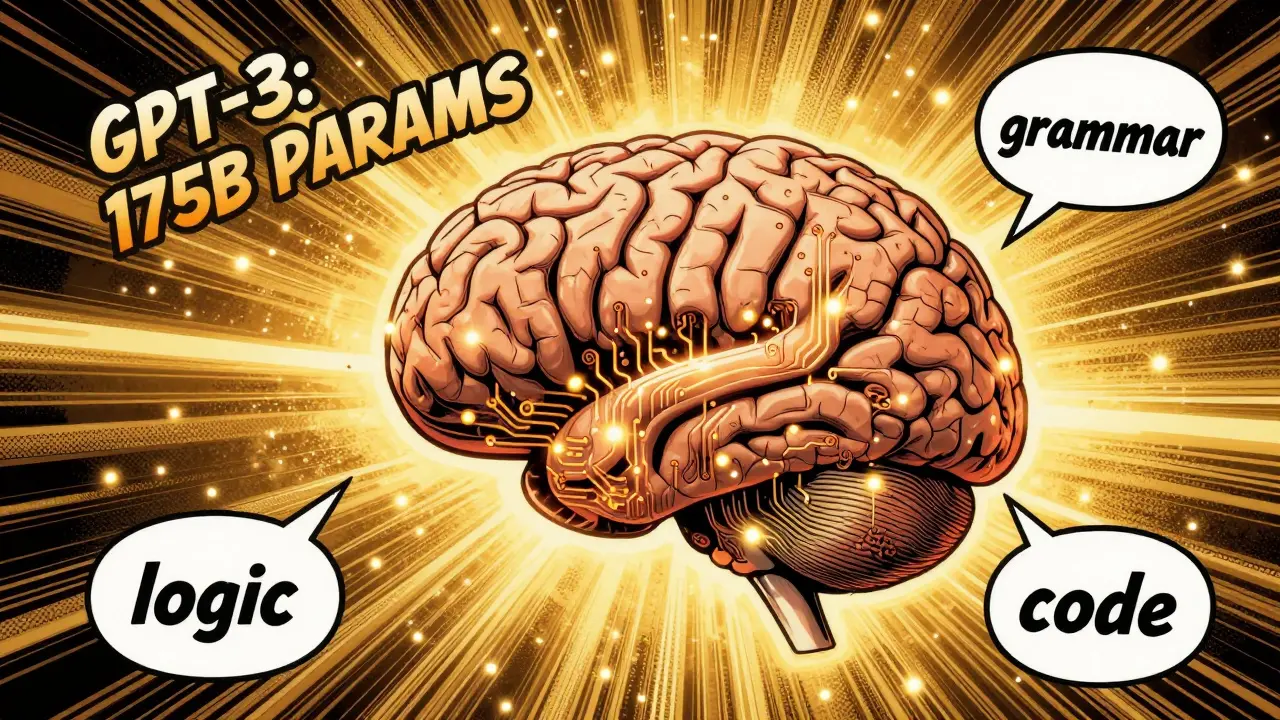
When you hear that a language model has 17 billion or 1.8 trillion parameters, what does that actually mean? It’s not just a big number to impress investors or tech bloggers. The parameter count is the single most important indicator of how capable a large language model (LLM) really is. Think of parameters as the brain’s connections-each one stores a tiny piece of learned knowledge, like how words relate, how grammar works, or even how to solve a math problem. More parameters generally mean more knowledge, better reasoning, and stronger performance. But it’s not that simple. Bigger isn’t always better. And sometimes, the smartest models aren’t the biggest.
What Are Parameters, Really?
Parameters are the weights inside a neural network that get adjusted during training. They’re not code you write-they’re numbers the model learns from data. Every time you ask an LLM a question, it runs through billions of these numbers to predict the next word. The more parameters, the more patterns it can remember. GPT-1, released in 2018, had 117 million parameters. By 2020, GPT-3 jumped to 175 billion. Today, models like GPT-5 and Gemini 2.5 Pro are rumored to have over 1.8 trillion. That’s not a typo. It’s more parameters than there are stars in the Milky Way.
But here’s the catch: not all parameters are used at once. Dense models use every parameter for every input. That’s expensive. Enter Mixture-of-Experts (MoE) models like Mixtral 8x22B and DeepSeek-V3. These models have hundreds of billions of parameters-but only activate a fraction per request. DeepSeek-V3 has 671 billion total parameters, but only uses about 37 billion per inference. That’s why it can match or beat much larger dense models without requiring a supercomputer to run.
Why Bigger Models Perform Better
Bigger models don’t just know more facts-they reason better. A 7B model might answer “Who wrote War and Peace?” correctly. A 70B model can explain why Tolstoy wrote it that way, compare it to Dostoevsky’s style, and tie it to 19th-century Russian society. That’s not magic. It’s scale.
Studies show that as parameter count increases, models get better at:
- Understanding nuanced questions
- Following multi-step logic
- Translating rare languages
- Generating code from vague descriptions
- Recognizing subtle biases in text
Google’s Gemini 1.5 Pro, with its 1 million token context window, doesn’t just remember more-it connects dots across massive amounts of data. A legal team using it can analyze a 500-page contract in one go. A 30B model would need to chunk it into pieces and lose context between sections.
Performance gains aren’t linear, though. The Chinchilla scaling laws from DeepMind proved that doubling parameters without doubling training data gives diminishing returns. You need quality data to match the size. A 200B model trained on weak data will underperform a 70B model trained on clean, diverse text.
The Hidden Cost of Scale
More parameters mean more memory, more power, more money. Training a trillion-parameter model can cost over $100 million and require thousands of high-end GPUs running for months. Even inference-running the model-is expensive.
Here’s what it looks like in practice:
- A 7B model at 4-bit quantization runs on a $500 RTX 3060 with 12GB VRAM
- The same model at 16-bit needs 14GB-barely fits on that card
- A 13B model at 4-bit? Needs 7GB, but runs at 8 tokens per second
- A 70B dense model? Requires 140GB VRAM at 16-bit. That’s four RTX 4090s
Users on Reddit’s r/LocalLLaMA report that anything above 13B starts to choke on consumer hardware. One user wrote: “My 3080 handles 7B 4-bit at 28 tokens/sec. At 13B, it drops to 4. I can’t wait for the next response.”
Enterprises feel it too. A Microsoft Azure customer reported that Gemini 1.5 Pro (estimated 1.2 trillion parameters) cost 3.2x more per million tokens than GPT-4-but only delivered 1.8x better accuracy on legal document analysis. That’s a bad ROI.
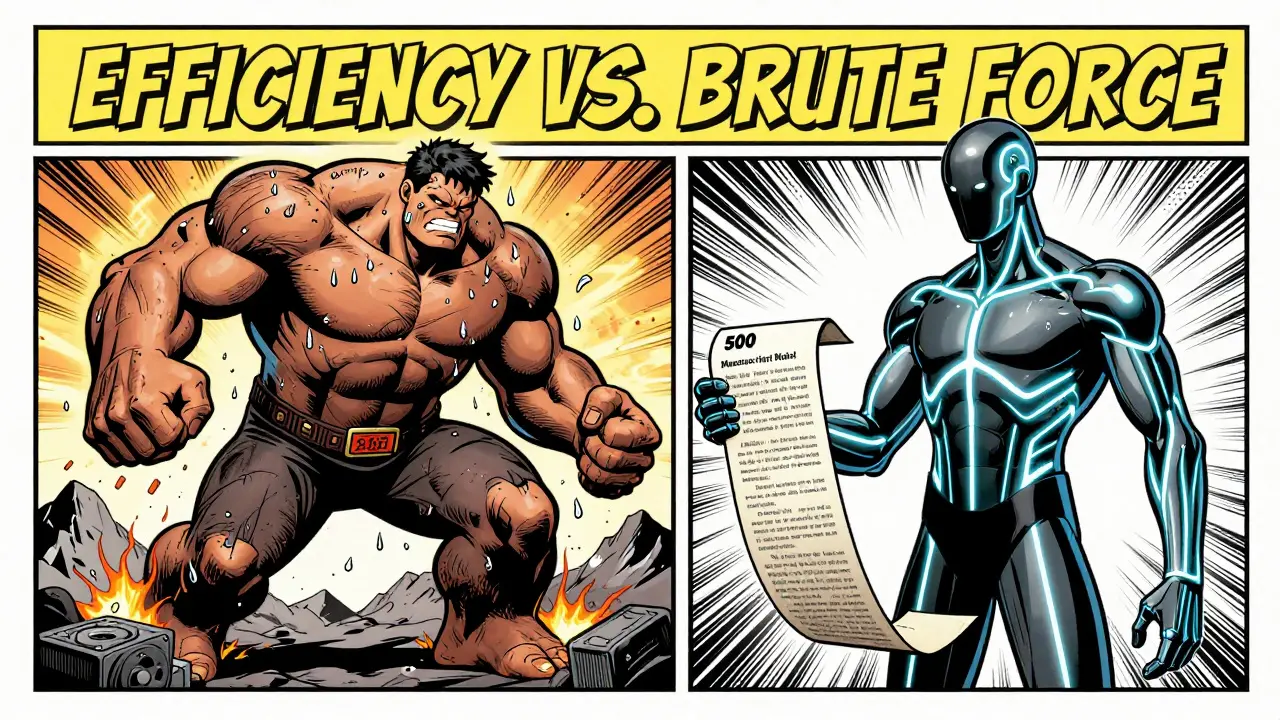
Architecture Beats Raw Size
Here’s where things get interesting: sometimes, a smaller model beats a bigger one.
Mistral 7B, with just 7.3 billion parameters, outperforms Llama 2 13B on several benchmarks. Why? Better attention mechanisms, smarter tokenization, and optimized training. It’s not about how many numbers you have-it’s how you use them.
Google’s Gemma 3 is another example. They marketed it as a “4 billion parameter” model. But their technical docs listed 5.44 billion. Why the discrepancy? Because Google sometimes excludes embedding parameters to make the number look smaller. It’s marketing, not math.
And then there’s quantization. A 9B model at 4-bit can outperform a 2B model at full 16-bit precision. Why? Because losing a little precision doesn’t hurt much-but losing 7 billion pieces of knowledge does. Gary Explains demonstrated this in a YouTube video: “It’s not about bits. It’s about what the model remembers.”
What’s the Right Size for You?
Choosing a model isn’t about picking the biggest. It’s about matching the size to your needs.
- Under 3B parameters: Good for simple chatbots, basic text summarization. Runs on phones. But can’t reason or handle complex tasks.
- 7B-13B parameters: The sweet spot for local use. Mistral 7B, Llama 3.2 8B, or Qwen 14B at 4-bit quantization work great on RTX 3060 or 4080. Fast, cheap, and surprisingly capable.
- 30B-70B parameters: Enterprise territory. Needs multiple high-end GPUs. Used for coding assistants, legal analysis, research summarization. Still affordable for cloud APIs.
- 100B+ parameters: Only for big tech. Google, OpenAI, Anthropic. Used for frontier research, massive-scale content generation, and multimodal reasoning. Not for most businesses.
For most people, 7B-13B is enough. For companies doing heavy-duty analysis, 70B-120B is the practical limit. Anything beyond that is mostly for bragging rights-or for training the next generation of models.
The Future: Smarter, Not Just Bigger
The race for parameter counts is slowing. Google’s Gemini 2.5 Pro didn’t just add more parameters-it improved routing algorithms to get more out of each one. Meta’s Llama 4 introduced Grouped-Query Attention, boosting efficiency by 22%. These aren’t just tweaks. They’re breakthroughs in how models use what they’ve learned.
By 2026, Gartner predicts 75% of enterprise LLMs will use MoE architectures with under 50 billion active parameters-even if their total size is over 500 billion. That’s the future: massive knowledge, minimal cost.
MIT’s 2024 study found that beyond 2 trillion parameters, 80% of future improvements will come from better training data, smarter architectures, and algorithmic advances-not more weights. The era of blind scaling is over.
What matters now isn’t how many parameters you have. It’s how well you use them.
How to Decide What Model to Use
Ask yourself these questions:
- Do I need to run this locally, or can I use a cloud API?
- What hardware do I have? (RTX 3060? 4090? Cloud GPU?)
- Do I need speed or accuracy more?
- Am I doing simple tasks or complex reasoning?
- Can I afford the cost per query?
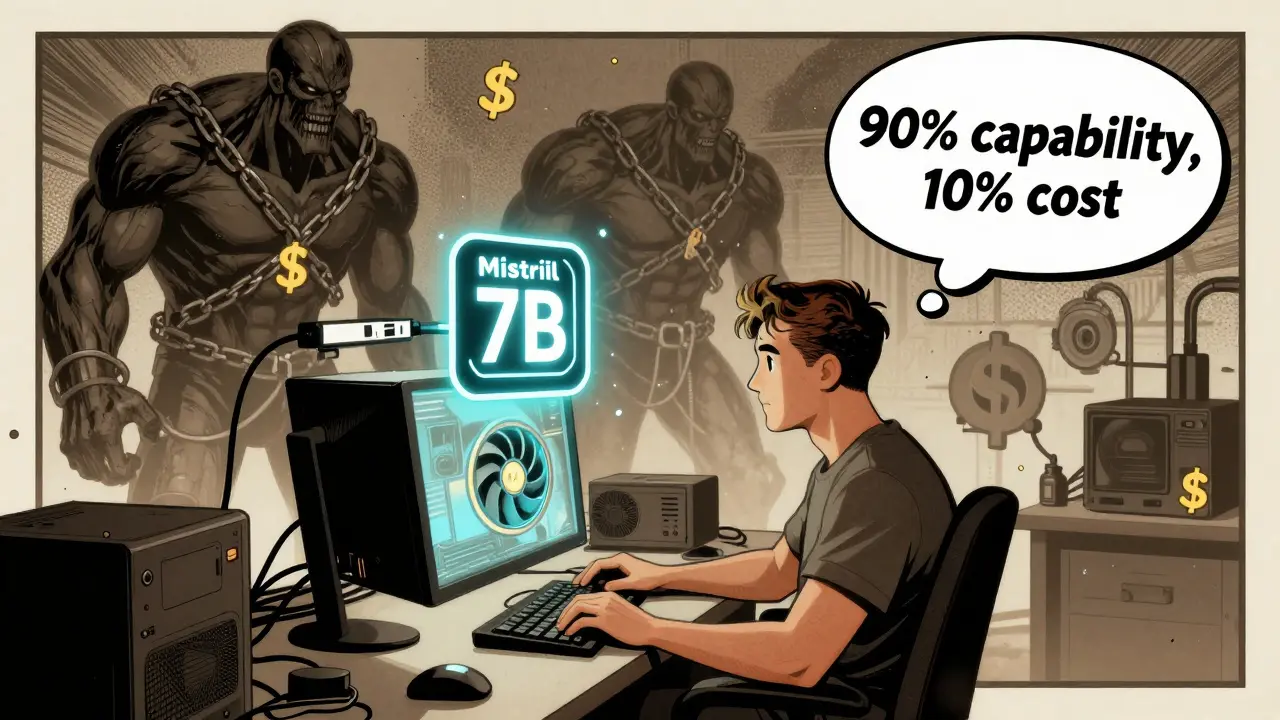
If you’re a hobbyist: start with Mistral 7B or Llama 3.2 8B at 4-bit. Use LMStudio or Ollama. You’ll get 90% of the capability for 10% of the cost.
If you’re a business: test 70B models on your real data. Compare GPT-4o, Claude 3, and Gemini 1.5 Pro on your specific tasks-not benchmarks. Real-world performance beats theory.
If you’re a researcher: focus on architectures, not just parameter counts. Look at MoE, attention optimizations, and data efficiency. The next leap won’t come from bigger numbers-it’ll come from smarter design.
What does a parameter count actually measure in an LLM?
A parameter count measures the number of adjustable weights in a neural network that store learned patterns from training data. Each parameter represents a connection between neurons, and together, they encode knowledge about language, logic, and context. Higher counts allow the model to capture more complex relationships, but they don’t guarantee better performance if the training data or architecture is poor.
Is a higher parameter count always better?
No. While more parameters often improve reasoning and knowledge retention, they also increase cost, memory use, and inference time. Models like Mistral 7B outperform larger ones due to better architecture. Mixture-of-Experts models like DeepSeek-V3 use hundreds of billions of parameters but only activate a fraction per request, making them more efficient than dense models with similar total counts.
How do MoE models work compared to dense models?
Dense models use every parameter for every input, which is powerful but expensive. MoE (Mixture-of-Experts) models split the network into smaller expert subnetworks and activate only a few per request. For example, Mixtral 8x22B has 141 billion total parameters but uses only about 39 billion per inference. This reduces computational load while maintaining high capability.
Can quantization make a smaller model perform like a larger one?
Yes. Quantization reduces the precision of parameters (e.g., from 16-bit to 4-bit), cutting memory use by 75%. A 9B model at 4-bit often outperforms a 2B model at full precision because it retains more knowledge, even if each number is less precise. The trade-off is minimal loss in output quality for massive gains in speed and cost.
What’s the best parameter range for local use on a consumer GPU?
For most users with a single RTX 3060, 3080, or 4090, models between 7B and 13B parameters at 4-bit quantization offer the best balance. They run smoothly at 15-30 tokens per second, fit within 8-10GB VRAM, and handle complex tasks like coding help, summarization, and reasoning far better than smaller models. Anything above 13B starts to strain consumer hardware unless you have multiple high-end GPUs.
Are trillion-parameter models necessary for businesses?
Almost never. Most enterprise tasks-legal document review, customer support automation, internal knowledge retrieval-don’t need more than 70B-120B parameters. Trillion-parameter models are expensive to run and offer diminishing returns. Companies like Microsoft and Amazon have found that models like GPT-4o or Gemini 1.5 Pro deliver only marginally better results at 3x the cost. Efficiency matters more than scale.



7 Comments
Paritosh Bhagat
Bro, I just ran Mistral 7B on my old RTX 3060 and it’s wild how well it handles coding questions. I asked it to debug a Python script and it didn’t just fix it-it explained why the original logic was flawed like a senior dev sipping coffee. Who needs a trillion parameters when your GPU can’t even heat up your lap properly?
Ben De Keersmaecker
There’s a subtle but critical distinction here: parameter count measures capacity, not competence. A model with 1.8 trillion parameters is like a library with every book ever written-but if the cataloging system is broken, you’ll never find the right one. MoE architectures are essentially smart librarians who only pull the books you need. That’s not efficiency-it’s elegance.
Jessica McGirt
I love how this post breaks down the real-world trade-offs instead of just hyping up the biggest numbers. I work in healthcare AI, and we tested a 70B model that took 45 seconds to respond to a patient intake question. We switched to a quantized 13B-it responded in 2.3 seconds, with 98% accuracy. Speed isn’t a luxury; it’s a lifeline.
Donald Sullivan
Let’s be real-trillion-parameter models are just corporate flexing. You think OpenAI didn’t know GPT-4 was overkill for 99% of users? They know. They just need you to believe bigger = better so you keep paying $20/month for something your phone could do in 2019. Wake up.
Tina van Schelt
Imagine your brain had 1.8 trillion synapses but only used 37 billion at a time-like having a symphony orchestra in your skull but only letting 5 musicians play per song. That’s MoE in a nutshell. And honestly? It’s the most beautiful hack in AI since backpropagation. The future isn’t about bigness-it’s about *intentional* intelligence. 🌟
Ronak Khandelwal
It’s funny how we chase bigger numbers like they’re the answer to everything. 🤔 But isn’t that just human nature? We think more = better, louder = smarter, faster = wiser. But real wisdom? It’s quiet. It’s optimized. It’s Mistral 7B running on a $500 GPU giving you better answers than a trillion-parameter giant stuck in a data center. Sometimes, less is the ultimate expression of respect-for your time, your wallet, your planet. 🌍✨
Jeff Napier
big tech wants you to think parameters matter so you dont ask why your data is being used to train models you never consented to and why your laptop cant run the 7b one but the 1t one is fine on cloud but you still pay for it all is a scam