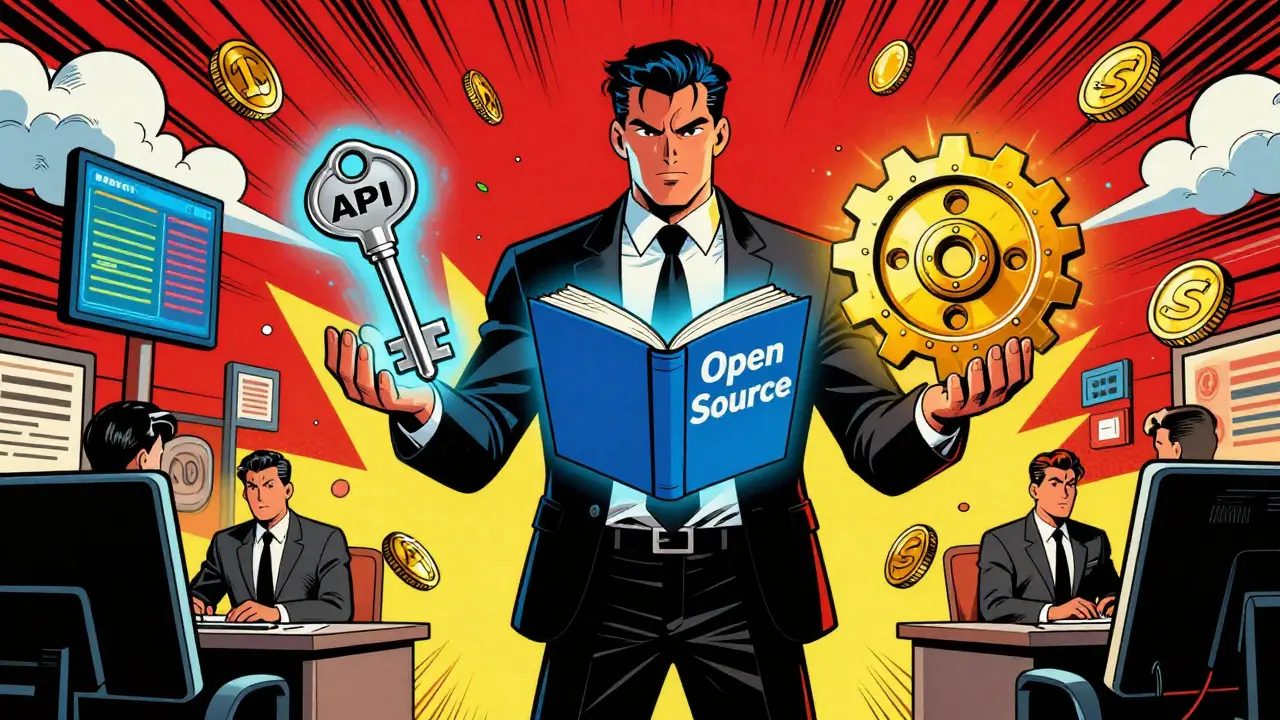
Remember when picking an AI model felt like choosing a smartphone? You just grabbed the fastest one available. That era is over. By early 2026, LLM Portfolio Management is the strategic discipline of balancing commercial APIs, open-source models, and custom-built systems to optimize cost, control, and compliance. It’s no longer about which single model is smartest; it’s about building a diverse toolkit that fits your specific business needs without breaking the bank or violating privacy laws.
The shift has been massive. According to Lumenalta's 2026 CIO survey of 327 technology executives, 87% of enterprises now maintain a formal LLM portfolio strategy, up from just 42% in 2024. Why the jump? Because companies are finally seeing the numbers. Organizations using this balanced approach report a 38-62% reduction in operational costs while maintaining performance standards across critical applications. If you’re still relying on a single provider for everything, you’re likely overspending and underperforming.
The Three Tiers of Your AI Strategy
To manage an effective portfolio, you need to categorize your models based on their role in your organization. Leading enterprises typically divide their models into three distinct tiers, each serving a different purpose.
- Tier 1: Mission-Critical Applications. These require maximum control and highest accuracy. This is where Custom Models are fine-tuned foundation models trained on proprietary data to achieve superior domain-specific accuracy. Think proprietary research analysis or regulated industry applications. They offer the highest domain accuracy-often 12.3% above baseline-but come with high development costs averaging $417,000 per model and 6-9 month cycles.
- Tier 2: Regulated Functions. For tasks that need strict governance but aren't life-or-death, you use domain-specific fine-tuned models. Often built on open-source foundations, these balance control with moderate cost.
- Tier 3: General Tasks. For broad, non-sensitive work like general content generation or initial customer service triage, API-Based Models are commercially hosted large language models accessed via cloud services, offering ease of use but limited data control. Providers like GPT-5, Gemini 3, and Claude 4 dominate here.
This tiered approach prevents you from wasting expensive custom resources on simple tasks, while ensuring sensitive data never leaves your secure infrastructure.
Comparing the Options: Cost vs. Control
You can’t make decisions without hard numbers. Let’s look at how these three types stack up against each other in a real-world 2026 context.
| Feature | API-Based Models | Open-Source Models | Custom Models |
|---|---|---|---|
| Primary Examples | GPT-5, Gemini 3, Claude 4 | Llama 4, Falcon 2, Mistral 8x22B | Fine-tuned Llama/Rope variants |
| Avg. Cost (per 1k tokens) | $0.015 | $0.008 - $0.012 (infra dependent) | $0.018+ |
| Data Privacy Control | Low (78% report compliance issues) | High (94% full governance) | Highest (Full ownership) |
| Domain Accuracy Gain | Baseline | +5-8% | +18.7% |
| Maintenance Effort | Low | High (40% more engineering) | Very High |
Notice the trade-off. API models are cheap to start but expensive at scale if you have high volume. Deploying Llama 4 70B is a popular open-source large language model requiring significant GPU infrastructure investment for enterprise deployment. on-premise might cost $28,500 monthly for equivalent throughput to GPT-5 API usage at $18,200. However, that open-source route gives you total data sovereignty. If your industry is healthcare or finance, that privacy premium is worth every penny.
Why Single-Model Strategies Fail
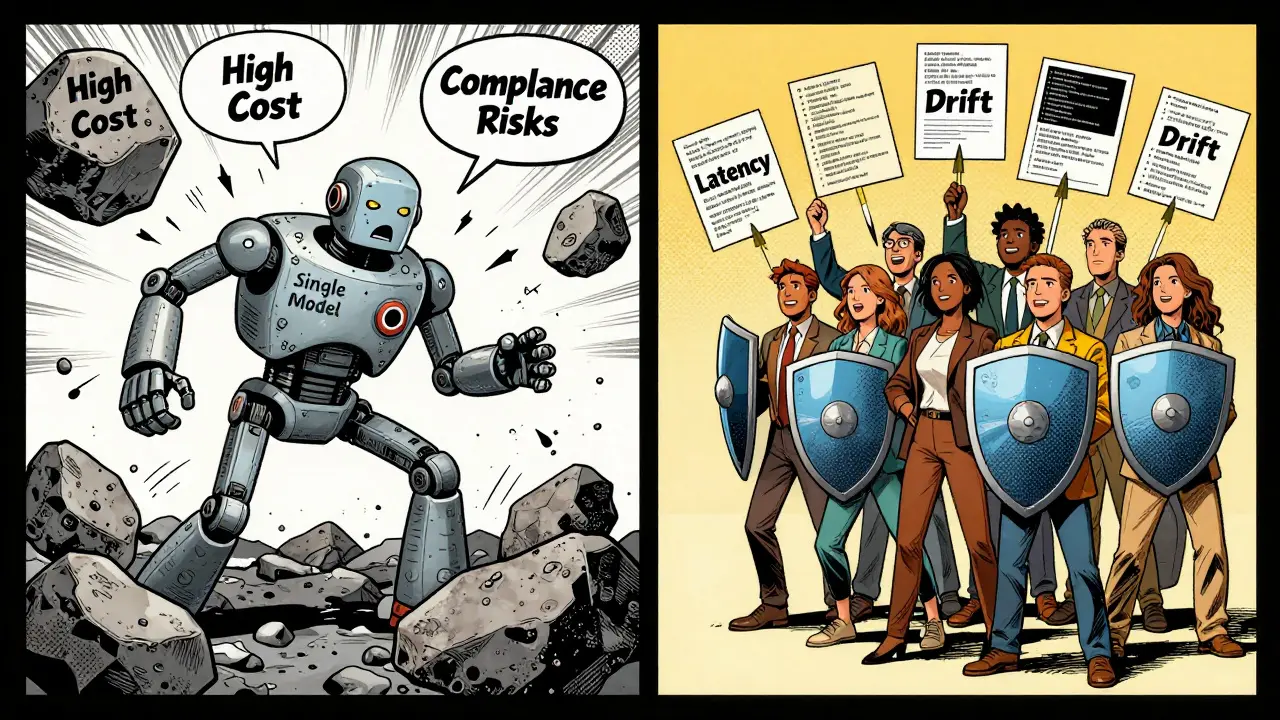
Dr. Andrew Ng warned in his January 2026 TED Talk that enterprises sticking to a single-model strategy face 30% higher operational costs and increased compliance risks. His team’s analysis showed that 63% of companies with single-model strategies failed to achieve ROI within 18 months.
Why does this happen? Because no single model is perfect. API models excel in general knowledge but struggle with niche business logic. Only 37% of business logic can be incorporated into generic API models according to Forrester's Q4 2025 analysis. On the flip side, open-source models give you control but demand heavy engineering lift. A Reddit user “DataEngLead2025” shared a win story: switching from pure GPT-4 to a hybrid of Llama 4 13B and GPT-5 API cut monthly costs from $42k to $27k while improving domain accuracy by 9.3 points. That’s the power of balance.
Building Your Evaluation Framework
You can’t manage what you don’t measure. Effective portfolio management requires a standardized evaluation framework. SAP's 2026 Enterprise AI Maturity Report suggests measuring 12 key metrics, but focus on these four first:
- Accuracy: Use task-specific benchmarks like MMLU-Pro. Aim for a threshold of 78.4% for general tasks, higher for specialized ones.
- Latency: Keep it under 2.3 seconds for user-facing applications. Slow AI kills engagement.
- Cost Efficiency: Track cost per 1,000 tokens. Target $0.0085 for Tier 3 tasks.
- Compliance Risk: Score below 15 on a 100-point scale. This includes data residency and audit trails.
Don’t rely on basic accuracy metrics alone. 89% of successful deployments use custom evaluators beyond standard tests, as noted in Maxim AI's 2026 Observability Report. Implement continuous evaluation frameworks to catch model drift, which top performers reduce by 47%.
Implementation Roadmap: From Pilot to Production
How do you actually build this portfolio? Lumenalta’s 6-phase approach offers a clear path.
Phase 1: Assessment (2-4 weeks). Identify high-value use cases. Focus on repetitive language tasks representing at least 15% of departmental effort. Don’t boil the ocean.
Phase 2: Piloting (4-8 weeks). Collect 300-500 high-quality exemplars with clear inputs/outputs. Test your chosen model tier against these examples.
Phase 3: Evaluation & Integration. This is where many stumble. Common challenges include data quality issues (reported by 76% of implementations). Address this through data clean rooms that join consented sources while keeping raw identifiers out of prompts.
Phase 4: Governance Setup. Establish controls for model selection, evaluation, and retirement. Gartner recommends 14-17 specific controls for mature enterprises. Ensure you meet EU AI Act requirements for model inventory documentation.
Phase 5: Scaling. Expand to 3-5 high-value use cases first. Healthcare organizations prioritize triage systems; financial firms focus on underwriting support.
Phase 6: Optimization. Use tools like Maxim AI’s “Portfolio Optimizer” or LangChain’s “Model Router 2.0” for dynamic model selection based on real-time cost and performance data.

Tools and Technologies for 2026
Your tech stack matters. You’ll need orchestration and observability tools to manage the complexity. The competitive landscape features three primary segments:
- Observability Platforms: Led by Maxim AI is a leading observability platform for monitoring LLM performance, latency, and cost across enterprise portfolios. with 28% market share.
- Evaluation Frameworks: Dominated by LangSmith is an evaluation and debugging tool for LLM applications, helping teams track model performance and errors. at 31% share.
- Orchestration Tools: Where Vellum is an orchestration platform enabling developers to build, test, and deploy LLM workflows with multiple model providers. captured 24% share in 2025.
For open-source deployment, ensure compatibility across major cloud providers (AWS, Azure, GCP) and primary model families (Llama 4, Falcon 2, Mistral). Hugging Face’s new “Enterprise Model Hub” released in January 2026 integrates governance controls directly into the model repository, simplifying compliance.
Risks and Mitigation Strategies
It’s not all smooth sailing. 79% of CIOs cite model fragmentation as a key risk. Having too many disparate models creates maintenance nightmares. Mitigate this by establishing Centers of Excellence that share knowledge across teams. Early adopters report 43% faster deployment cycles with this structure.
Another risk is hidden technical debt from improper open-source evaluations. AI researcher Emily Bender warns that over-reliance on open-source models without proper evaluation creates significant rework. Validate every model against your specific business logic before scaling. And remember, security practices are inconsistent across 68% of enterprises. Implement integrated security frameworks early to protect your proprietary data.
What is LLM Portfolio Management?
LLM Portfolio Management is the strategic practice of selecting, deploying, and governing a mix of AI models-including commercial APIs, open-source foundations, and custom fine-tuned versions-to balance cost, performance, and compliance needs across an enterprise.
When should I use an API model versus an open-source model?
Use API models (like GPT-5) for general tasks, rapid prototyping, and non-sensitive data where speed and ease of integration matter most. Switch to open-source models (like Llama 4) when you need data privacy, lower long-term costs at high volume, or specific customization that APIs don’t allow.
How much does it cost to deploy a custom LLM?
According to MIT's 2026 LLM Cost Study, developing a custom model averages $417,000 with a 6-9 month cycle. However, these models offer 18.7% higher accuracy on specialized tasks, making them worthwhile for mission-critical, proprietary applications.
What are the biggest risks of managing an LLM portfolio?
The primary risks are model fragmentation (too many uncoordinated models), hidden technical debt from poor evaluation, and inconsistent security practices. Mitigate these by establishing a Center of Excellence and implementing rigorous governance frameworks.
Which tools help manage LLM portfolios in 2026?
Key tools include Maxim AI for observability, LangSmith for evaluation, and Vellum for orchestration. Newer additions like LangChain’s Model Router 2.0 and Hugging Face’s Enterprise Model Hub also provide essential governance and routing capabilities.