You sent a customer's email address to your AI chatbot. The model gave you a great answer, but did it also save that email in its training logs? If you're running Large Language Models (LLMs) in production, this is the nightmare scenario keeping data engineers up at night. PII detection isn't just a nice-to-have feature anymore; it's the gatekeeper between your company and a massive regulatory fine.
As organizations shift from experimenting with AI to deploying it at scale, the risk of Personally Identifiable Information leaking into third-party APIs or system traces has skyrocketed. You need a robust pipeline that catches sensitive data before it hits the model and ensures the model doesn't hallucinate it back out. This guide breaks down how to build that safety net using hybrid detection methods, microservices architecture, and proven tools like Microsoft Presidio.
The Core Problem: Why LLMs Are PII Leaks
Traditional software security often focuses on database encryption. But LLMs introduce a new vector: context. When a user types "Call John Smith at 555-0199," that string becomes part of the prompt. If you send that raw text to an external API provider, you've just handed over sensitive data. Even if the provider promises not to train on your data, what about their audit logs? What about potential breaches?
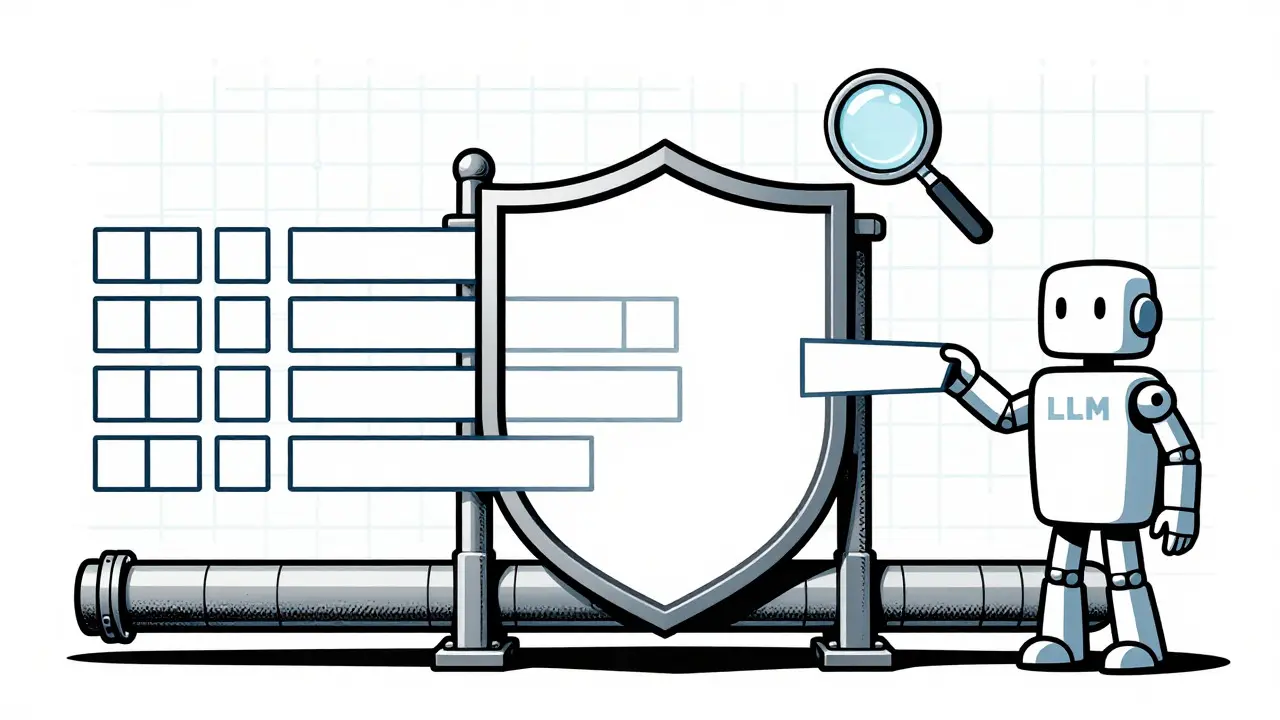
The solution is a two-way street. You must sanitize the input before sending it to the LLM and scan the output before showing it to the user. This process is known as redaction. It involves identifying specific entities-names, addresses, phone numbers-and replacing them with placeholders like <NAME> or <PHONE>. Once the LLM processes the safe version, you can optionally restore the original values for the end-user experience, ensuring the AI never actually sees the real data.
Hybrid Detection: Speed Meets Accuracy
There is no single magic bullet for finding PII. Relying solely on one method leaves gaps. The most effective pipelines use a tiered approach that balances computational cost with detection accuracy.
- Regular Expressions (Regex): This is your fast-pass filter. Regex patterns are incredibly quick and perfect for structured data. They easily catch credit card numbers, standard email formats, and US phone numbers. However, they fail miserably on unstructured data. A regex might miss a name like "Bob" if it’s embedded in a complex sentence without punctuation clues. In production tests, regex-only systems often hit a recall rate of only 65%, meaning 35% of PII slips through.
- Named Entity Recognition (NER): This is where the heavy lifting happens. NER models use Natural Language Processing (NLP) to understand context. They know that "John" in "John called yesterday" is likely a person, whereas "John" in "John Deere tractor" is a brand. While slower than regex, NER boosts recall rates to 96% or higher. It handles ambiguous cases that pattern matching ignores.
By combining these two, you get the best of both worlds. The regex layer quickly filters out obvious matches, reducing the load on the expensive NER model. This hybrid strategy is the industry standard for balancing latency and precision.
Architectural Patterns: Decoupling Your Pipeline
How do you integrate this detection logic without slowing down your application? The dominant pattern today is decoupled microservices. Imagine your main application server speaking Go. It intercepts telemetry or user prompts. Instead of processing PII locally, it sends the data via gRPC to a specialized Python-based PII Detection Service.
Why Python? Because the NLP ecosystem there is mature. Libraries like spaCy and Microsoft Presidio live natively in the Python world. By separating the interception layer (Go) from the detection engine (Python), you gain flexibility. You can scale the detection service independently if traffic spikes. You can update your NER models without redeploying your entire application stack. Configuration files allow operators to define exactly which attributes to scan (e.g., llm.prompt) and which redaction policies to apply, keeping the logic declarative and easy to manage.

Key Tools and Platforms
You don’t have to build everything from scratch. Several powerful tools exist to handle the heavy lifting.
| Tool/Method | Primary Use Case | Strengths | Limitations |
|---|---|---|---|
| Microsoft Presidio | Dedicated PII detection library | Customizable patterns, context-aware recognition, integrates with PySpark for batch processing. | Requires managing external dependencies; primarily optimized for English. |
| Amazon Comprehend | Cloud-native integration with SageMaker | Automates redaction during ML data preparation; seamless AWS integration. | Tied to AWS ecosystem; less flexible for custom on-premise setups. |
| Fine-tuned LLMs | Semantic redaction of complex text | Understands deep context; high semantic preservation. | High inference latency; significant computational cost. |
Microsoft Presidio is frequently cited as the go-to open-source library for this task. It offers a rich set of built-in recognizers for common PII types and allows you to add custom ones. For large-scale batch processing, teams often pair Presidio with PySpark to handle millions of records efficiently. On the cloud side, Amazon SageMaker Data Wrangler integrates directly with Amazon Comprehend, allowing you to redact PII from tabular data automatically as part of your machine learning workflow. If you’re on the Microsoft stack, Fabric provides native AI functions like ai.extract, though it currently caps out at 1,000 requests per minute, which can be a bottleneck for high-volume applications.
Implementation Steps for Production
Getting this right requires careful sequencing. Here is a practical flow for integrating PII redaction into your LLM pipeline:
- Intercept Input: As soon as the user submits a prompt, your API Gateway captures it. Do not let it pass to the LLM yet.
- Check Cache: Before running expensive NER checks, look in a detection cache. If you’ve seen this exact pattern before, reuse the previous result. This saves significant compute resources.
- Run Hybrid Detection: Pass the text through the Regex filter first. Then, send the remaining text to the NER model (via your Python microservice). Validate checksums for structured data like SSNs or Credit Cards.
- Apply Masking Policy: Replace identified entities with type-aware placeholders (e.g.,
<EMAIL>). Keep a mapping table so you can reverse this later if needed. - Send to LLM: Forward the sanitized prompt to your LLM provider. The model now sees only generic tokens, protecting user privacy.
- Scan Output: When the LLM responds, run the same detection pipeline on the output. Sometimes models hallucinate PII or repeat parts of the prompt.
- Restore & Return: If you stored the original values, swap the placeholders back to real data for the user. If not, return the redacted version.
This asynchronous sanitization function acts as a shield. It ensures that even if your LLM provider changes their privacy policy tomorrow, your core data remains protected because it never left your secure perimeter in plaintext form.
Compliance and Regulatory Drivers
Why go through all this trouble? Because the laws say you have to. General Data Protection Regulation (GDPR) mandates data minimization-collecting only what you need. California Consumer Privacy Act (CCPA) gives users the right to know what data you hold. HIPAA protects healthcare data, and PCI-DSS secures payment information.
In the context of LLMs, these regulations apply to the entire inference pipeline. If you send a patient’s medical history to a general-purpose LLM API, you are arguably violating HIPAA unless that data is de-identified. PII redaction is your technical control mechanism to demonstrate compliance. It proves that you took reasonable steps to prevent data leakage, which is crucial during audits or after a breach incident.
Performance Trade-offs and Future Trends
Accuracy comes at a cost. Regex is nearly instant. NER adds milliseconds to seconds of latency. Fine-tuned LLMs for redaction offer the highest semantic understanding but are the slowest and most expensive. For real-time chatbots, you need to balance this. If your use case allows for slight delays, you can afford deeper NER analysis. If you need sub-second responses, lean heavier on regex and caching.
One major limitation today is language support. Most tools, including Presidio, are heavily optimized for English. If your users speak Spanish, French, or Mandarin, your false-negative rates will climb. Multilingual NER models are improving, but they aren’t as mature as their English counterparts. Plan for this gap if you operate globally.
Looking ahead, we’re seeing a trend toward automated deployment tooling. Tools like the OpenTelemetry Collector Builder allow you to compile custom collector binaries with embedded PII processors using simple manifest files. This reduces manual compilation errors and standardizes how teams deploy their privacy infrastructure across different environments.
Frequently Asked Questions
Is regex alone enough for PII detection in LLMs?
No. While regex is fast, it misses contextual PII like names and addresses that lack strict formatting. Production data shows regex-only systems miss up to 35% of PII. A hybrid approach with Named Entity Recognition (NER) is required for high recall rates.
What is the best open-source library for PII redaction?
Microsoft Presidio is widely considered the leading open-source option. It offers customizable recognizers, context-awareness, and strong integration capabilities with Python frameworks like PySpark. It is highly configurable for both batch and real-time processing.
Do I need to redact both LLM inputs and outputs?
Yes. Inputs must be redacted to prevent sending raw PII to third-party providers. Outputs must be scanned because LLMs can sometimes hallucinate PII or echo parts of the prompt. Scanning both ends ensures complete coverage of the inference pipeline.
How does PII redaction affect LLM performance?
It can slightly impact semantic nuance if the redacted entity was crucial to the query's meaning. However, using type-aware placeholders (like <PERSON>) helps the model maintain context. The trade-off is generally worth it for the privacy benefits, especially in regulated industries.
Can I use cloud-native services instead of building my own?
Yes. Amazon SageMaker integrates with Amazon Comprehend for automatic redaction. Microsoft Fabric offers native AI functions for extraction. These solutions reduce maintenance overhead but may limit flexibility compared to custom microservice architectures built with tools like Presidio.