| Method | Data Needed | Compute Cost | Primary Goal | Avg. Accuracy Gain |
|---|---|---|---|---|
| In-Context Learning | Few-shot prompts | Very Low | Immediate task switch | ~62.4% (Base) |
| SFT (Supervised Fine-Tuning) | 500 - 5,000 labeled pairs | Medium | Task-specific precision | +22-35% |
| DAPT (Domain-Adaptive Pre-Training) | 5,000 - 50,000 documents | High | Deep domain knowledge | +7.3-12.8% over SFT |
| DEAL Framework | < 100 labels | Low/Medium | Cross-task alignment | +18.7% |
The Heavy Lifters: Parametric vs. Non-Parametric Adaptation
When you want an LLM to "understand" a new field, you have two main paths. The first is parametric adaptation, where you actually change the model's weights-essentially rewiring its brain. The second is non-parametric, often called Retrieval-Augmented Generation (RAG), where the model looks up a textbook before answering. While RAG is great for facts, parametric adaptation is where the real magic happens for language style and nuance. One of the most powerful parametric methods is Domain-Adaptive Pre-Training (DAPT). Instead of starting from scratch, you take a foundation model and let it read a massive pile of unlabeled domain text-think 20,000 medical journals-using a next-token prediction objective. It’s computationally expensive, often requiring several days on a cluster of A100 GPUs, but it produces a model that truly "speaks" the language. Then there is Continued Pretraining (CPT). The danger with DAPT is "catastrophic forgetting," where the model becomes so obsessed with medical terms that it forgets how to form a basic English sentence. To stop this, engineers mix in about 10-20% of the original general training data. It’s like keeping a general education class on your schedule while you pursue your PhD; it keeps your base skills sharp.Precision Tuning with SFT and the DEAL Framework
Once a model understands the domain's vocabulary, you need to teach it how to perform specific tasks. This is where Supervised Fine-Tuning (SFT) comes in. You provide a few thousand high-quality examples of "Question $\rightarrow$ Correct Answer." In the legal world, this might mean teaching the model exactly how to summarize a deposition without losing the critical legal weight of a specific phrasing. But what happens when you don't have thousands of examples? This is a common nightmare for startups. Enter the DEAL (Data Efficient Alignment for Language) framework. Developed by researchers like David Wu and Sanjiban Choudhury, DEAL focuses on cross-task alignment. If you have plenty of data for one task but almost none for another similar task, DEAL transfers that supervision. It can boost performance by nearly 19% even when you have fewer than 100 labels. For those working in low-resource languages or niche industries, this is a game-changer.
The Practical Workflow: From Raw Data to Deployment
If you're looking to implement this today, don't just throw data at a model and hope for the best. There is a standardized rhythm to a successful adaptation project. First, curate your dataset. While some claim 500 examples are enough, real-world experience-especially in volatile fields like finance-suggests you might need 15,000+ to handle shifting jargon. Next, choose your framework. Hugging Face Transformers is the industry gold standard for flexibility, while AWS SageMaker JumpStart offers a more streamlined, managed experience. Speaking of costs, be mindful of your cloud provider. AWS often comes in cheaper for training Llama 2 models compared to Google Vertex AI, with a cost difference of roughly 44% per training hour on comparable instances. Finally, evaluate using a benchmark like AdaptEval. Don't rely on the model's own "confidence" or general benchmarks. You need to test if the model actually performs better on your specific specialized tasks than the base model did.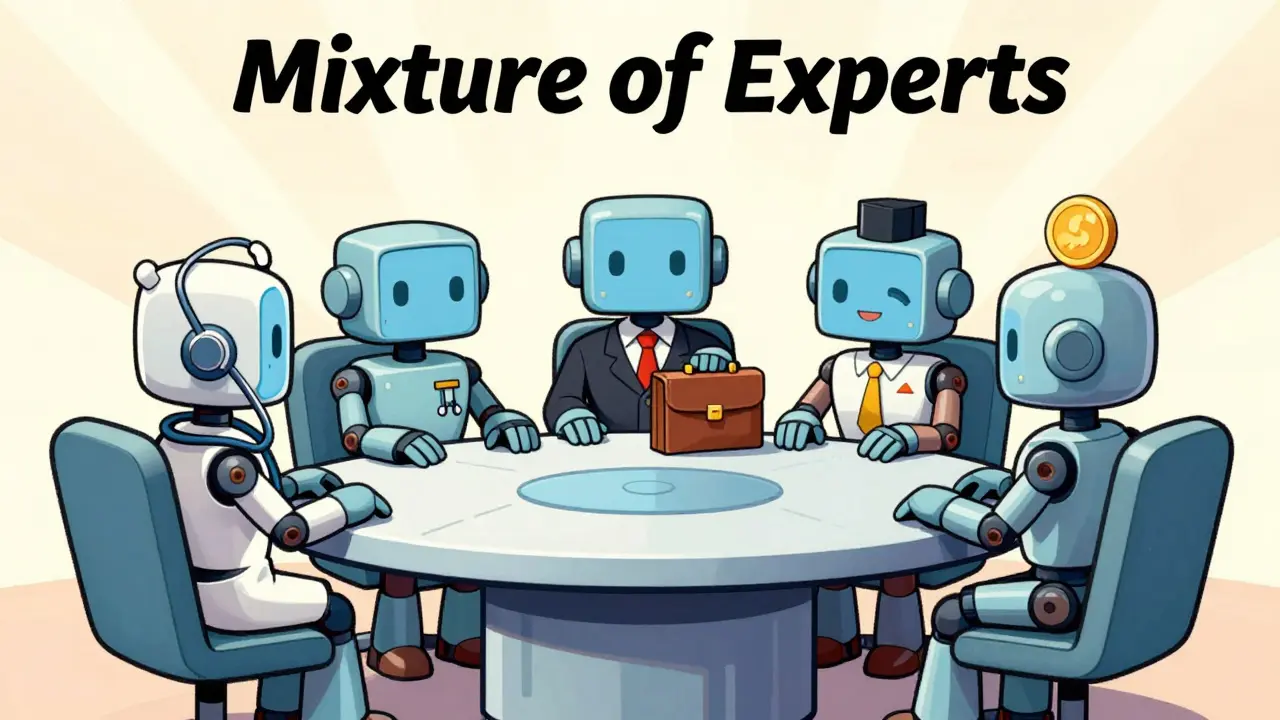
Avoiding the Pitfalls: Forgetfulness and Bias
Domain adaptation isn't without its traps. The most common is the aforementioned catastrophic forgetting, which hits about 68% of fine-tuning attempts if not managed. If your model suddenly starts speaking in a weird, repetitive loop or loses its ability to follow simple instructions, you've likely pushed the domain data too hard without enough general-purpose balancing. There is also the risk of "domain-specific bias." A study in Nature highlighted that preference-based optimization can actually amplify biases by up to 22%. In legal models, this can manifest as an adversarial tone or inappropriate assumptions about case outcomes. You have to monitor your model not just for accuracy, but for safety and neutrality. Lastly, watch out for the "domain complexity ceiling." Meta's research suggests that once you try to adapt a single model to more than five distinct specialized domains, the effectiveness of the adaptation starts to plummet. At that point, it's usually better to have a "mixture of experts"-several smaller, highly specialized models-rather than one giant, confused one.The Future of Specialized AI
We are moving toward a world where domain adaptation happens automatically. Gartner predicts that by 2027, 65% of enterprise LLMs will have automatic adaptation capabilities. We're seeing a shift toward LoRA (Low-Rank Adaptation) and other Parameter-Efficient Fine-Tuning (PEFT) methods. Instead of updating billions of parameters, LoRA updates a tiny fraction, making it possible to train models on a budget without needing a warehouse full of GPUs. For businesses, the stakes are high. The EU AI Act now requires strict audit trails for adaptation data in high-risk sectors. This means you can't just scrape the web and hope for the best; you need a clean, documented pipeline of how your model was taught to be a "doctor" or a "lawyer."How many examples do I really need for fine-tuning?
While documentation often suggests 500-2,000 examples can provide a 15-30% boost, the actual number depends on the complexity of the jargon. For highly volatile fields like finance, you may need 15,000 or more labeled examples to maintain accuracy against quarterly changes in terminology.
What is the difference between DAPT and SFT?
DAPT (Domain-Adaptive Pre-Training) is a self-supervised process using unlabeled text to teach the model a domain's general language and structure. SFT (Supervised Fine-Tuning) is a supervised process using labeled pairs (Question/Answer) to teach the model how to perform specific tasks within that domain.
How do I prevent my model from forgetting general knowledge?
The most effective method is mixing in a small percentage (typically 10-20%) of the original general pre-training data during the domain adaptation process. This reduces catastrophic forgetting by about 34.7% according to internal AWS benchmarks.
Is LoRA actually better than full fine-tuning?
For most practitioners, yes. LoRA (Low-Rank Adaptation) is significantly more computationally efficient because it only modifies a small subset of weights. While full fine-tuning can sometimes yield slightly higher peaks, the cost-to-performance ratio of LoRA makes it the preferred choice for over 80% of developers in community discussions.
What is the DEAL framework used for?
The DEAL framework is designed for scenarios where target labels are extremely scarce (under 100 examples). It allows the model to align across different tasks or languages by transferring supervision from data-rich tasks to data-poor ones.