You have a massive Large Language Model (LLM) like LLaMA-2 or BERT. You need it to do something specific-maybe analyze medical records or write code snippets in your company’s style. Full fine-tuning sounds like the obvious path, but it demands multiple high-end GPUs and weeks of compute time. That’s where Parameter-Efficient Fine-Tuning (PEFT) comes in.
Instead of rewriting the entire brain of the model, you tweak just a tiny fraction of its parameters. Two methods dominate this space right now: Prompt-Tuning and Prefix-Tuning. Both keep 99.9% of the original model frozen. Both are lightweight. But they work very differently under the hood, and choosing the wrong one can cost you accuracy or waste your GPU hours.
The Core Difference: Where the Magic Happens
To understand which method fits your project, you first need to see where each technique injects its changes into the transformer architecture.
Prompt-Tuning is the minimalist approach. Introduced by Lester et al. in 2021, it adds trainable "soft prompts"-continuous vectors that don’t map to actual words in the vocabulary-to the very beginning of the input sequence. Think of it as giving the model a secret handshake before it starts reading your data. The rest of the model stays completely untouched. You only train these few embedding vectors at the input layer.
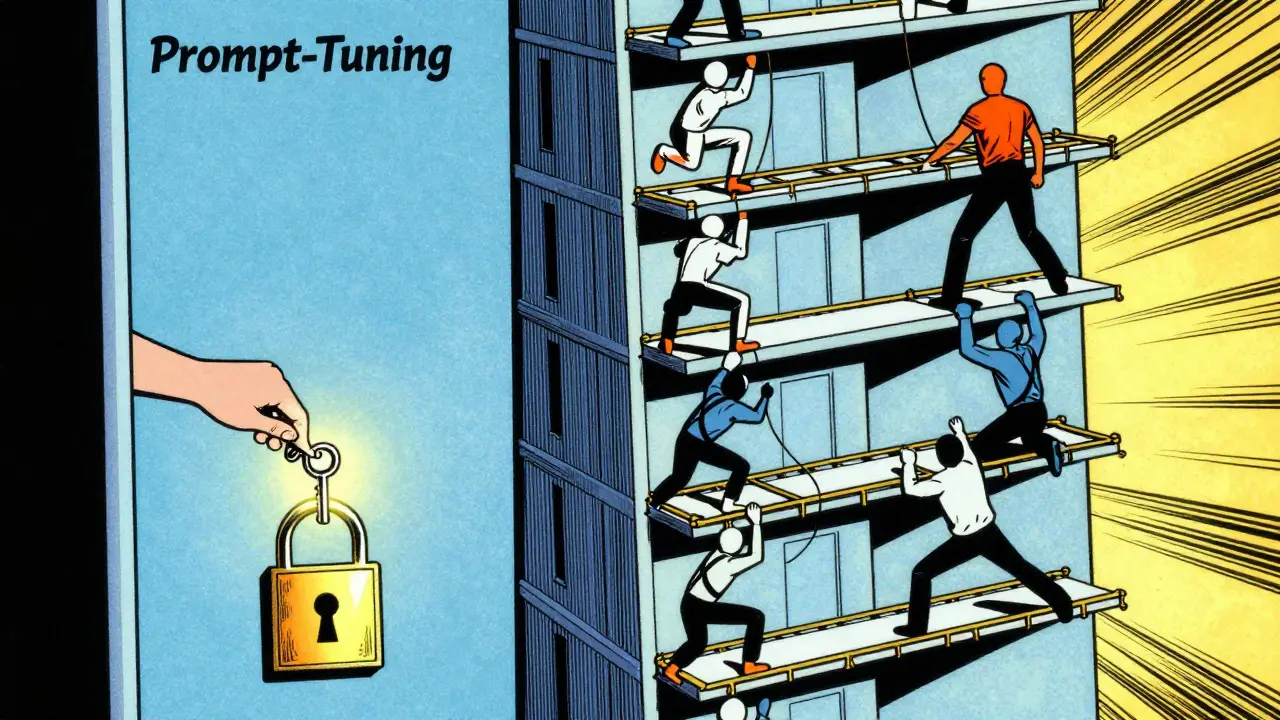
Prefix-Tuning, developed by Li and Liang also in 2021, goes deeper. It inserts trainable key and value vectors into the attention mechanism at every transformer layer. If you imagine the model as a multi-story building, Prompt-Tuning only changes the lobby signage. Prefix-Tuning installs new guidance systems on every floor. This allows it to guide the model’s internal reasoning process more aggressively.
| Feature | Prompt-Tuning | Prefix-Tuning |
|---|---|---|
| Parameters Tuned | Input embeddings only | Key/Value vectors in all layers |
| Parameter Count | ~0.1% of total model | ~0.5-1% of total model |
| Computational Cost | Very Low | Low (but higher than prompt) |
| Depth of Influence | Surface level (input) | Deep (all transformer layers) |
| Best For | Tasks close to pre-training distribution | Complex tasks requiring deep adaptation |
Performance Trade-offs: Accuracy vs. Efficiency
In the real world, efficiency means nothing if the model doesn’t perform well. So, how do they stack up?
Prompt-Tuning shines when your task is similar to what the model already knows. Because it only modifies the input, it acts as a learned hint. If you’re asking a general-purpose LLM to summarize news articles-a task it was likely trained on extensively-Prompt-Tuning works beautifully. It’s fast, lightweight, and easy to swap between different tasks.
However, when tasks get tougher, Prompt-Tuning hits a ceiling. A 2023 study published on arXiv highlighted a critical limitation: neither prompting nor prefix-tuning can easily change the relative attention patterns over content. They can bias outputs, but they struggle to teach the model fundamentally new ways of looking at data.
This is where Prefix-Tuning pulls ahead. By injecting vectors into every layer, it provides a stronger signal throughout the network. In experiments comparing sentiment analysis on a single A100 GPU, users reported Prompt-Tuning achieving 82% accuracy with 20 soft tokens in 1.2 hours. Prefix-Tuning reached 87% accuracy but took 3.5 hours. That 5% boost in accuracy often justifies the extra compute time in enterprise settings.
Consider a medical QA task from a Kaggle competition in May 2023. Prefix-Tuning achieved 78.3% accuracy by updating only 0.7% of parameters. Full fine-tuning got 79.1%, but required 12x more training time and resources. For most businesses, that trade-off is a no-brainer.
When to Choose Prompt-Tuning
You should lean toward Prompt-Tuning if:
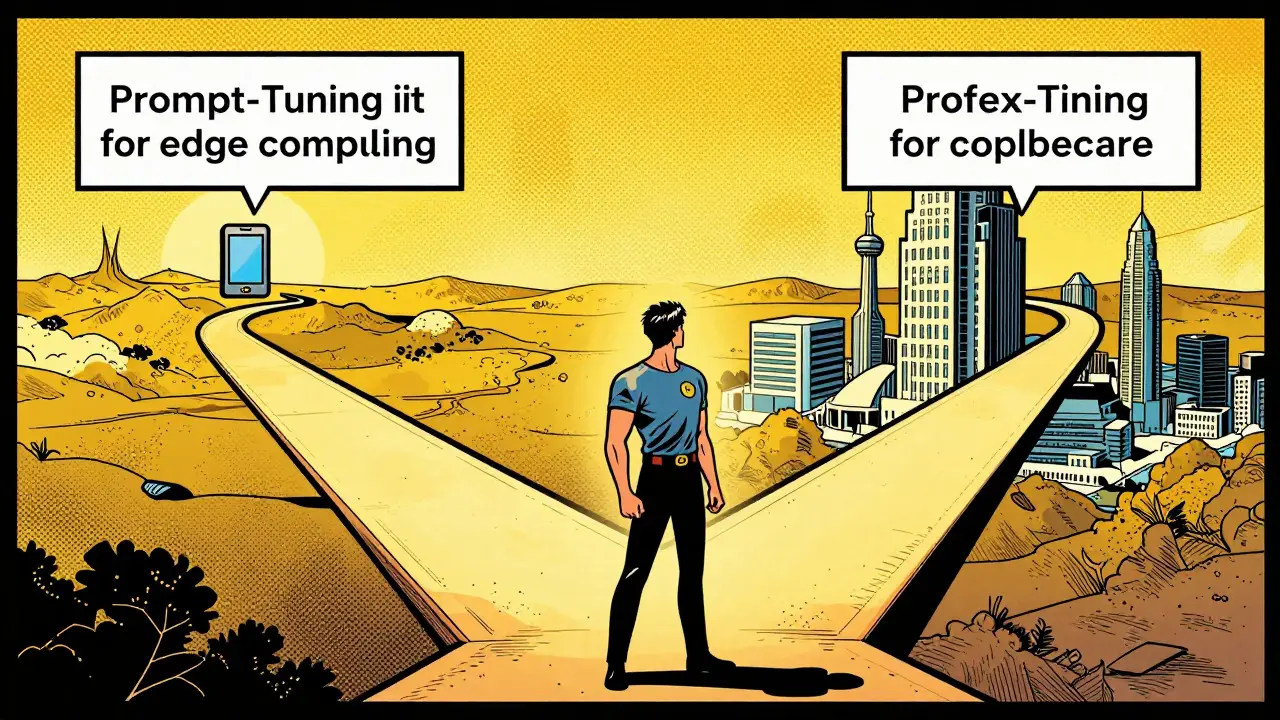
- You have severe resource constraints. If you’re deploying on edge devices, mobile apps, or limited IoT infrastructure, the minimal footprint of Prompt-Tuning is unmatched. It requires fewer parameters to store and update.
- You need rapid task switching. Since only the input embeddings change, swapping between different prompts for different tasks is computationally cheap. You can maintain multiple specialized versions of the same base model without storing heavy adapters.
- Your task aligns with pre-training data. If you’re doing classification, summarization, or translation-tasks where the model already has strong latent knowledge-Prompt-Tuning is often sufficient.
- You want simplicity. Implementation via libraries like Hugging Face PEFT takes about 15 lines of code. Hyperparameter tuning is straightforward; you mostly adjust the length of the soft prompt (typically 10-100 tokens).
When to Choose Prefix-Tuning
Opt for Prefix-Tuning if:
- Accuracy is paramount. In high-stakes environments like healthcare diagnostics or financial risk assessment, that extra 5-10% performance gain matters. Prefix-Tuning consistently outperforms Prompt-Tuning on complex benchmarks.
- The task requires deep structural adaptation. If you need the model to follow complex logical chains or adhere to strict formatting rules that contradict its natural tendencies, the layer-wise influence of Prefix-Tuning helps enforce these behaviors.
- You have moderate GPU resources. While not as light as Prompt-Tuning, Prefix-Tuning still uses less than 1% of the model’s parameters. It runs comfortably on consumer-grade GPUs or single-cloud instances, unlike full fine-tuning.
- You are working with generation-heavy tasks. For open-ended text generation where coherence and style matter deeply across long sequences, the continuous guidance provided by prefix vectors improves output quality significantly.
Implementation Realities and Pitfalls
Both methods are supported by the popular Hugging Face PEFT Library (version 0.4.0+). However, getting them right involves navigating some common traps.
The Black Box Problem: Soft prompts and prefix vectors are continuous embeddings, not human-readable words. Practitioners frequently complain about the lack of interpretability. Why does a prompt length of 20 work better than 30? Often, there’s no clear answer. One GitHub issue (#1245) detailed struggles with debugging why certain configurations failed silently. My advice? Initialize your soft prompts with task-relevant token embeddings rather than random noise. It gives the optimizer a head start.
Diminishing Returns on Length: Researchers at Stanford found in early 2023 that increasing prefix length beyond 50 tokens yields negligible gains-only a 2.3% average accuracy improvement from 50 to 100 tokens across eight datasets. Don’t blindly increase size; test small increments first.
Attention Pattern Limits: Remember the theoretical limit mentioned earlier? If your task requires the model to ignore context it previously relied on (e.g., reversing a sorted list), both methods may fail. In one experiment, prefix-tuning achieved 0% accuracy on a descending sort task because it couldn’t override the pretrained ascending pattern. In these rare cases, you might need to combine PEFT with other techniques like LoRA (Low-Rank Adaptation).
Future Outlook: Hybrid Approaches
The landscape isn’t static. As of 2026, we’re seeing a rise in hybrid models. Combining Prefix-Tuning with LoRA creates a powerful synergy: LoRA handles low-rank matrix updates for capacity, while Prefix-Tuning guides the attention mechanism. Hugging Face’s roadmap indicates continued optimization for dynamic prefix lengths, allowing the model to adapt its "depth" of intervention based on input complexity.
Gartner predicted that by 2025, 60% of enterprise LLM deployments would use some form of PEFT. Today, that trend is accelerating. Prompt-Tuning dominates edge computing due to its tiny footprint, while Prefix-Tuning leads in enterprise applications where precision outweighs marginal compute costs.
Neither method will replace full fine-tuning entirely-they complement it. But for 90% of business use cases, understanding the distinction between tweaking the input versus guiding the layers is the key to unlocking efficient, scalable AI deployment.
Is Prefix-Tuning just a type of Prompt-Tuning?
Technically, yes. Prefix-Tuning is often described as an extension or variant of Prompt-Tuning. Both use continuous, trainable vectors instead of discrete text tokens. However, the key difference lies in scope: standard Prompt-Tuning only affects the input embeddings, while Prefix-Tuning injects these vectors into every transformer layer, making it a deeper and more computationally intensive method.
Which method uses fewer parameters?
Prompt-Tuning uses significantly fewer parameters. It typically tunes around 0.1% of the total model parameters, whereas Prefix-Tuning usually requires 0.5% to 1%. This makes Prompt-Tuning ideal for extreme resource constraints, while Prefix-Tuning offers a balance between efficiency and performance.
Can I use these methods with any Large Language Model?
Yes, both methods are designed for standard Transformer architectures. They work seamlessly with popular models like BERT, GPT, T5, and LLaMA variants. Libraries like Hugging Face PEFT provide pre-built implementations for these models, ensuring broad compatibility across the NLP ecosystem.
Why does my Prefix-Tuning model fail on simple logic tasks?
This is a known limitation. Research shows that context-based fine-tuning methods like Prefix-Tuning struggle to alter fundamental attention patterns established during pre-training. If a task requires the model to contradict its core learned biases (like sorting in reverse order), these lightweight methods may fail where full fine-tuning succeeds.
How do I choose the optimal prompt/prefix length?
Start small. For Prompt-Tuning, 10-20 soft tokens are often sufficient. For Prefix-Tuning, begin with 10-20 tokens per layer. Studies show diminishing returns after 50 tokens. Use validation set performance to tune this hyperparameter incrementally rather than guessing large values upfront.