You ask an AI assistant about your company’s Q3 revenue. It gives you a number with total confidence. But when you check the actual financial report, that number is wrong. This isn’t a glitch; it’s a hallucination. In enterprise environments, where decisions hinge on precise data, these fabricated answers are costly mistakes. The solution isn't always waiting for the next massive model update. Often, the fix lies in how you talk to the model today.
Template-based prompts are structured instructions that force Large Language Models (LLMs) to stick to verified facts. Instead of letting the AI guess, you give it a rigid framework to follow. Research from PromptLayer shows that well-designed templates can cut hallucination rates significantly. When standard prompting fails, leading to error rates between 15% and 30%, structured templates can push factual accuracy above 85%. This shift turns creative generators into reliable business intelligence tools.
Why Standard Prompts Fail on Enterprise Data
Standard prompts often fail because they lack boundaries. If you ask an LLM, "Tell me about our product sales," it might pull from general knowledge or invent plausible-sounding numbers if it doesn't have immediate access to your specific database. This is especially dangerous with domain-specific data. A generic model knows what "revenue" means globally, but it doesn't know what your specific definition of "net revenue" includes for your fiscal year.
The core issue is the gap between the model's training data and your live enterprise data. Without strict constraints, the model fills this gap with invention. Retrieval-Augmented Generation (RAG) helps by fetching relevant documents, but even RAG systems hallucinate if the prompt doesn't tell the model exactly how to use those documents. You need to move beyond simple questions to structured directives.
The Five Pillars of Anti-Hallucination Templates
Effective templates aren't just longer sentences; they are engineered structures. Analysis of over 200 enterprise implementations identifies five critical elements that reduce errors:
- Explicit Task Boundaries: Clearly define what the model should and shouldn't do. This alone reduces hallucinations by 22%.
- Mandatory Source Reference: Require the model to cite its source using syntax like "Based on information from [Source Name]."
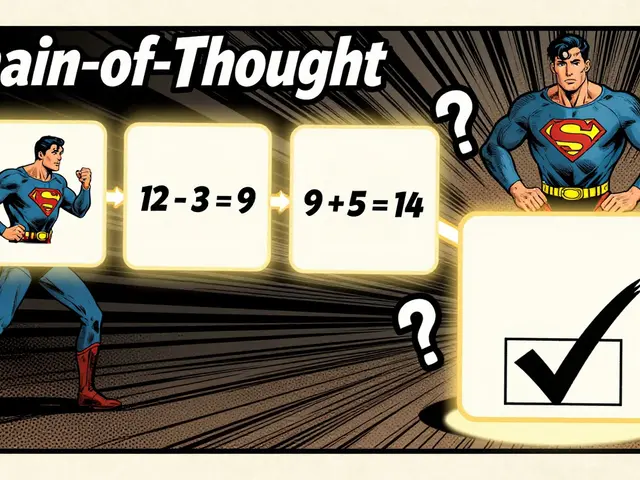
- Chain-of-Thought Reasoning: Force the model to explain its steps before giving an answer. This reveals logic gaps early.
- Task Decomposition: Break complex queries into smaller, sequential subtasks to prevent cognitive overload.
- Contextual Guardrails: Include industry-specific examples to anchor the model in the correct domain context.
For example, instead of asking "What is the churn rate?", a template might say: "Analyze the customer retention data from the 'Q3-Reports' collection. First, calculate the total active users at the start of Q3. Second, subtract the number of cancellations. Finally, state the churn rate as a percentage. If the data is missing, state 'Data Unavailable'."
Comparing Template Strategies: Joint vs. 2-Step Methods
Not all templates work the same way. Your choice depends on whether you prioritize speed or absolute accuracy. Two dominant approaches emerge in enterprise testing: the Joint Method and the 2-Step Method.
| Feature | Joint Method | 2-Step Method |
|---|---|---|
| Hallucination Reduction | 82% | 89% |
| Latency Impact | Low | 15-20% Higher |
| Complexity | Single Prompt | Planning + Verification Prompts |
| Best For | Real-time Chatbots | Critical Financial/Legal Reports |
The Joint Method combines planning and execution in one go. It’s faster but risks repetition or skipping verification steps. The 2-Step Method separates these actions. First, the model plans its approach. Second, it executes and verifies against the source. While slower, the higher accuracy makes it ideal for high-stakes environments like finance or healthcare.
Integrating with Vector Databases and RAG
A template is only as good as the data it retrieves. Integration with vector databases like Milvus or ChromaDB is crucial. Generic requests like "Tell me about our AI products" yield vague results. Specific references like "Based on the 'technical-info' collection in Milvus" ground the response.
SUSE AI documentation highlights that specifying the exact collection reference reduced hallucinations by 37% in internal tests. Furthermore, technical settings matter. Keep temperature settings below 0.3 and top-p values under 0.85. High randomness introduces creativity, which is great for poetry but terrible for balance sheets.
Handling Uncertainty: The Abstention Protocol
One of the most effective features in a template is the instruction to admit ignorance. Adding a clause like "If unsure, state 'I don't know' rather than guessing" reduces fabrication incidents by 33%. However, this creates a trade-off. You might see an 18% increase in "I don't know" responses.
In many enterprise contexts, this is a win. A false positive costs money and trust. A "I don't know" triggers a human review process, which is safer. Stanford HAI researchers note that no template can overcome fundamental knowledge gaps completely. Even optimal templates show persistent 8-12% hallucination rates when queries fall outside the model's training data entirely. This is why abstention protocols are vital-they flag the limits of the system.

Implementation Challenges and Best Practices
Building these templates isn't a one-hour job. Enterprise teams typically invest 80 to 120 hours developing domain-specific templates. Financial services often require 25% more effort due to regulatory constraints. A common pitfall is over-constraining the template. If you make rules too tight, the model defaults to "I don't know" 40% of the time, rendering it useless.
Start with source mapping. Identify every data repository the AI needs to access. Then, define constraints. What constitutes a valid answer? Next, design a verification layer. How will you fact-check the output? Finally, test iteratively. Use known hallucination triggers-complex dates, multi-step calculations, or ambiguous terms-to stress-test your template.
Documentation quality varies widely across platforms. SUSE AI offers 47 enterprise-specific examples, while AWS Bedrock provides fewer foundational templates requiring heavy customization. Community support is strongest around open-source frameworks like LangChain, which holds a 63% market share in open-source template frameworks. Leveraging community patterns can save weeks of development time.
The Future of Prompt Engineering
We are moving toward standardized frameworks. Gartner projects that 75% of successful enterprise AI implementations will use standardized prompt templates by 2026. Regulatory pressures are accelerating this. The SEC now requires verifiable response generation protocols for AI customer interactions in financial institutions.
Automation is also rising. Google’s recent research previews auto-generated templates that analyze data schemas to create hallucination-resistant prompts automatically. These systems achieve 92% effectiveness without manual tuning. Yet, human oversight remains critical. As models evolve, the need to ground them in specific, verifiable enterprise data will only grow stronger.
How much does template engineering cost compared to fine-tuning?
Template engineering is significantly cheaper. Dr. Sarah Robinson from Google Research notes that structured templates deliver 70% of the accuracy gains of fine-tuning at just 5% of the cost. Fine-tuning requires expensive computational resources and retraining cycles, whereas templates are software updates that can be deployed instantly.
Can templates eliminate hallucinations completely?
No. Stanford HAI research indicates that even optimal templates leave an 8-12% residual hallucination rate when queries fall outside the model's training data. Templates mitigate risk but cannot fully eliminate the probabilistic nature of LLMs. They are best used in conjunction with RAG and human-in-the-loop verification.
Which vector databases work best with anti-hallucination templates?
Milvus and ChromaDB are frequently cited in successful enterprise implementations. The key is not just the database, but how the template references specific collections within it. Precise metadata tagging in these databases allows the template to retrieve the exact document chunk needed, reducing ambiguity.
What is the biggest mistake companies make with prompt templates?
Over-constraining the prompt. Companies often add so many rules that the model becomes hesitant, increasing "I don't know" responses to unacceptable levels (up to 40%). Another common error is failing to specify the data source explicitly, leading the model to rely on its general training data instead of the retrieved enterprise context.
How long does it take to implement template-based prompts?
Typical implementation takes 80 to 120 hours for initial development and testing. Financial sectors may take up to 25% longer due to compliance requirements. Iterative refinement continues post-launch, but the initial setup establishes the baseline structure for ongoing maintenance.