
You might assume that because a large language model speaks Swahili, it understands Swahili culture as well as it understands American slang. That assumption is wrong, and the data proves it. In 2026, studies comparing GPT-5.2 and Gemini 2.5 Flash revealed that stereotype rates can shift by up to 12 percentage points when moving from English to Swahili. This isn't just a minor glitch; it's a structural failure of how we build these systems. Most Large Language Models (LLMs) are aligned using feedback collected primarily in English, creating a "fairness gap" where non-English users get weaker protections and more biased outputs.
This article breaks down why alignment beyond English is critical right now. We’ll look at the technical reasons behind these disparities, examine real-world failures in humanitarian aid and political translation, and offer practical steps for developers and researchers to audit their models for true multilingual fairness.
The Myth of Universal Generalization
For years, the industry narrative was simple: train on massive multilingual corpora, and the model will generalize. If it learns to be polite in English, it should be polite in French. If it refuses harmful prompts in German, it should refuse them in Burmese. Recent research shatters this idea. A 2026 analysis of cross-lingual stability showed that while aligned models maintain accuracy across languages, they often fail to maintain consistent safety behaviors.
Consider the refusal mechanism. In one study, GPT-5.2 refused to answer 169 specific prompts in English but zero prompts in Swahili. The model wasn't safer in Swahili; it was just less likely to trigger its safety filters. These filters are often anchored to English-language tokens and content patterns. When a prompt is translated or generated in a lower-resource language, the semantic nuance that triggers a safety refusal in English might disappear, allowing potentially harmful or stereotypical content through unchecked.
Furthermore, sentiment analysis shows stark differences. Gemini 2.5 Flash demonstrated a neutral-sentiment rate that doubled in Swahili compared to English. Instead of providing a definitive answer, the model hedged, producing vague, non-committal responses. For a user seeking clear information, this ambiguity is a form of unfairness. You aren't getting the same quality of service as an English speaker, even if you're accessing the same API endpoint.
Where Bias Hides: Beyond Word Choice
Bias in multilingual LLMs isn't just about offensive words. It’s about representation and power dynamics. Traditional bias metrics focus on toxicity, but modern fairness research looks at distributive justice. This concept argues that a model should be judged by its worst-performing language, not its average performance. Since English dominates training data, average accuracy hides the poor performance in languages like Lingala or Burmese.
A compelling example comes from political translation. Researchers analyzed European Parliament speeches translated by multilingual LLMs. They found systematic differences in translation quality based on political affiliation. Majority parties-whether left, center, or right-received higher-quality translations than outsider or smaller parties. This means the technology itself introduces a political bias, subtly favoring established voices over marginalized ones. If your application uses LLMs for news aggregation or political analysis, this bias could skew public perception without anyone noticing.
In humanitarian contexts, the stakes are even higher. Aid organizations use NLP tools to process reports from conflict zones in languages like Burmese. If an LLM misinterprets urgency or sentiment due to cross-lingual drift, it could affect resource allocation. Miscalibrated confidence scores mean the system might sound certain when it’s actually guessing, leading to errors that impact millions of people.
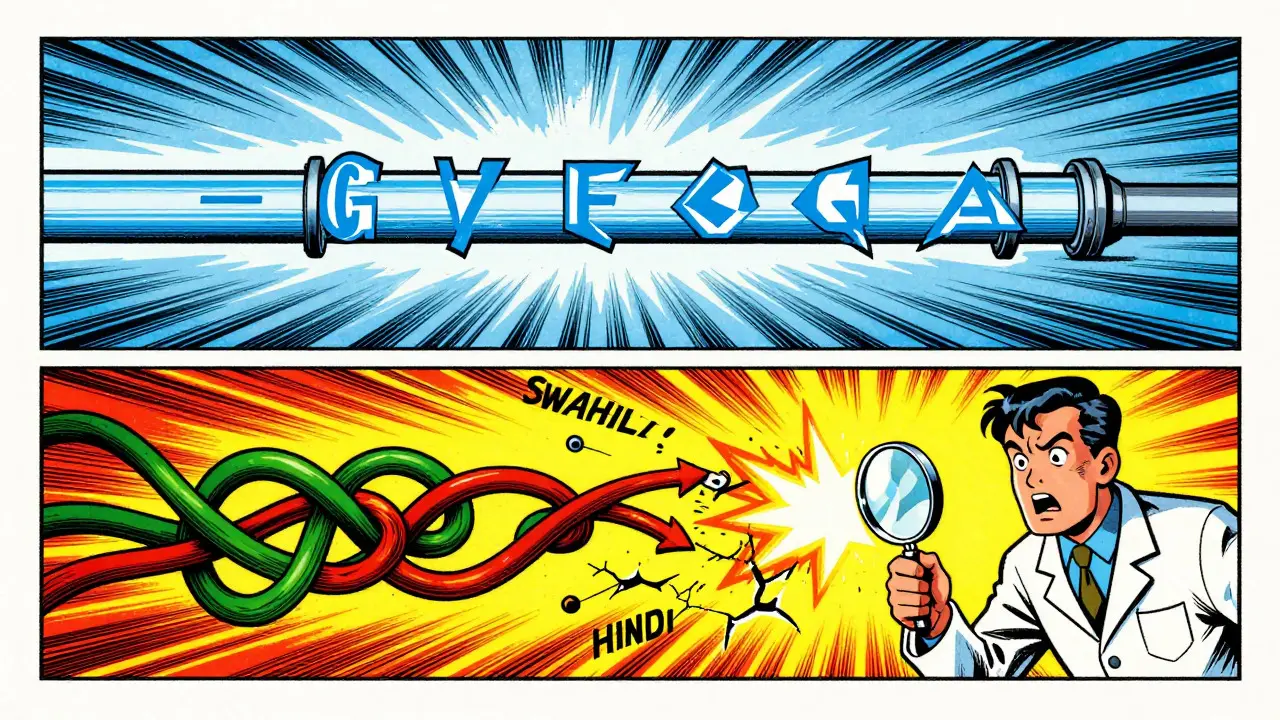
Technical Roots of the Fairness Gap
Why does this happen? The root cause lies in Reinforcement Learning from Human Feedback (RLHF). Between 2018 and 2023, most RLHF pipelines were designed in English. Annotators rated responses based on English cultural norms. When these preferences were used to fine-tune models, those norms became embedded in the model's weights. Applying this to other languages assumes those norms transfer, which they rarely do.
Another issue is the evaluation method. Many teams rely on embeddings-based metrics, measuring the distance between word vectors. But a 2024 survey noted that these vector-space distances often correlate poorly with actual downstream behavior. A model might have "neutral" embeddings for a gendered term in Hindi but still generate stereotypical sentences. To catch this, you need generation-based evaluation-actually looking at the text produced.
Positional bias also plays a role. When LLMs act as judges to evaluate other models' outputs, they often favor the first or last response presented. This artifact worsens in multilingual settings because sentence structures vary wildly. A long, complex German sentence might be penalized simply because it appears later in a comparison list, not because it’s worse.
How to Audit for Multilingual Fairness
If you’re deploying an LLM globally, you can’t rely on English-only audits. Here is a practical framework for ensuring fairness across languages:
- Use Symmetric Prompt Pairs: Don’t just translate one test set. Create matched pairs of prompts in English and target languages. Ensure they cover demographic axes like gender, race, and religion. A 2026 study used 4,900 such pairs to reveal significant disparities in stereotype prevalence.
- Measure Refusal Rates: Track how often the model refuses to answer in each language. A sudden drop in refusals in low-resource languages suggests your safety filters are failing to detect harm.
- Check Calibration Curves: Does the model’s confidence match its accuracy in every language? If it’s highly confident but wrong in Swahili, you have a calibration problem.
- Leverage Cross-Lingual Latent Spaces: Advanced debiasing techniques, like Iterative Nullspace Projection (INLP), work better when applied in a shared latent space learned via autoencoders. This allows you to remove bias directions identified in English and transfer those corrections to other languages, achieving up to 65% bias reduction in some cases.
| Metric Type | What It Measures | Limitation in Multilingual Contexts |
|---|---|---|
| Embeddings-Based | Distance between word vectors in latent space. | Poor correlation with actual generation quality; misses context-specific bias. |
| Probability-Based | Likelihood of generating specific tokens. | Does not account for semantic equivalence across different syntactic structures. |
| Generation-Based | Analysis of full output text (stereotypes, sentiment). | Computationally expensive; requires human-in-the-loop validation for nuance. |
| Distributive Justice | Performance of the worst-off language group. | Harder to optimize; may sacrifice overall average accuracy. |

The Role of Data and Regulation
Fixing this isn't just a code problem; it's a data governance challenge. Training corpora are heavily skewed toward high-resource languages. Even with 100+ supported languages, the vast majority of training tokens are English. This imbalance means the model has seen ten times more examples of American social interactions than Nigerian ones.
Regulators are starting to notice. The EU AI Act and emerging global standards will likely require documented fairness audits before deployment. Public sector institutions, particularly in Europe, are already demanding evidence of balanced treatment across parties and languages. If you’re selling to government clients, expect procurement processes to include multilingual fairness checks by 2027.
Industry roadmaps must shift from pure scaling to curated data. Adding more parameters doesn’t fix bias if the underlying data reflects historical inequities. Vision-language models, for instance, show that scaling up multimodal capabilities can sometimes exacerbate biases if the visual data lacks diversity. It’s not enough to speak the language; the model must understand the visual and cultural context associated with it.
Actionable Steps for Developers
So, what do you do tomorrow? Start small. Pick your top three non-English markets. Run a subset of your standard test suite in those languages. Look specifically at refusal rates and sentiment neutrality. If the results diverge significantly from English, you have a problem.
Next, expand your human feedback loop. If you use RLHF, ensure your annotators are native speakers of the target languages. Their cultural intuition is irreplaceable. Finally, adopt compositional benchmarks like the CEB (Compositional Evaluation Benchmark). These tests combine demographic attributes with linguistic variations, giving you a holistic view of fairness rather than isolated snapshots.
Fairness in multilingual LLMs is no longer an academic exercise. It’s a product requirement. As these models become the interface for global commerce, healthcare, and governance, the cost of ignoring non-English users grows. Alignment beyond English isn’t just nice to have; it’s essential for building trust in a connected world.
Why do LLMs perform worse in low-resource languages?
LLMs perform worse in low-resource languages primarily due to data scarcity. High-resource languages like English have billions of tokens in training corpora, while languages like Lingala or Burmese have orders of magnitude less. This lack of exposure leads to poorer generalization, higher error rates, and inconsistent adherence to safety guidelines that were tuned on abundant English data.
Can translating English prompts guarantee fair results in other languages?
No. Direct translation often fails to capture cultural nuances and idiomatic expressions. Furthermore, safety filters and alignment mechanisms are frequently anchored to English syntax and vocabulary. A prompt that triggers a safety refusal in English might pass through unfiltered in another language, leading to inconsistent safety behaviors and potential exposure to harmful content.
What is distributive justice in the context of multilingual AI?
Distributive justice in multilingual AI suggests that model performance should be evaluated based on the worst-performing language rather than the average. This approach prevents high accuracy in dominant languages like English from masking poor performance in minority languages, ensuring that all user groups receive a minimum acceptable level of service and fairness.
How does RLHF contribute to English-centric bias?
Reinforcement Learning from Human Feedback (RLHF) relies on human annotators to rank model outputs. Historically, these annotators have been predominantly English speakers applying Anglo-centric cultural norms. Consequently, the reward models used to fine-tune LLMs prioritize responses that align with English-speaking values, embedding these biases into the model's core behavior across all languages.
Are there specific benchmarks for testing multilingual fairness?
Yes, benchmarks like the Compositional Evaluation Benchmark (CEB) and symmetric cross-language prompt suites are designed for this purpose. They test models on multiple demographic axes and linguistic variations simultaneously. Unlike static single-language tests, these dynamic benchmarks help identify subtle biases in generation, ranking, and safety that only appear when switching between languages.





8 Comments
Mark Harvey
Love this breakdown. It is so important to remember that language isn't just code, it's culture. We have a long way to go but seeing these studies gives me hope that we are finally waking up to the real issues.
Art HND
This is overblown. Models will fix themselves with scale. Stop crying about Swahili when you can barely spell English correctly.
Jeff Falcon
I totally agree with the point about RLHF being the root cause, honestly, because if you think about it, most of the annotators are hired in places where English is the primary mode of communication, right?? So they naturally project their own cultural biases onto the data without even realizing it!! And then when we try to deploy these models in places like India or Nigeria, the results are just... well, they're kind of garbage because the model doesn't actually understand the context, it just mimics patterns it saw in English datasets!!! It’s frustrating because we keep talking about AI as if it’s this universal brain, but it’s really just an English brain wearing a multilingual mask, and until we change how we collect feedback, nothing is going to change for non-English speakers!!!
john randall
Yeah Jeff has a point here. The alignment gap is real. I've noticed similar issues when testing models for local dialects. It's not just about translation accuracy but also about tone and appropriateness which varies wildly between cultures.
Brandon Olvera
American slang is superior. If your language can't handle our nuance that's on you not us. Fix your corpus stop complaining about GPT.
Vishnu Vardhan Reddy M S
Oh wow, another article telling us how great English-centric models are while ignoring half the planet? Classic. But hey, at least someone finally admitted that 'universal generalization' was a myth sold to investors. Good job spotting the elephant in the room. Now maybe we can stop pretending that translating a prompt makes it culturally accurate.
Jacob Baby Official
THIS IS THE TRUTH NO ONE WANTS TO HEAR!!!! The industry is LAUGHING at us while they feed us garbage outputs in Hindi and Burmese!!! They call it 'alignment' but it's really just IMPERIALISM in disguise!!! Every single refusal failure is a SLAP IN THE FACE to billions of users who deserve better than vague hedging and broken stereotypes!!! WE ARE BEING GASLIT BY ALGORITHMS AND NOBODY IS DOING ANYTHING ABOUT IT!!! IT'S DISGUSTING AND ANGRY MAKES ME SO MAD THAT THEY THINK A LITTLE TWEAK TO THE LOSS FUNCTION FIXES CENTURIES OF CULTURAL ERASURE!!!
Alyson Karson
omg yes thank u for posting this i see this all the time w my clients using api endpoints in spanish and getting totally wrong sentiment scores its wild how much trust ppl put in these black boxes without checking calib curves first