
You built a Retrieval-Augmented Generation (RAG) system. It looks smart in demos. But in production, it’s lying to your customers. Not always obviously-sometimes it just adds a subtle detail that wasn’t in the source document. That is a hallucination. And if you don't have grounded QA evaluation in place, you are flying blind.
Traditional metrics like BLEU or ROUGE measure how similar an answer is to a reference text. They do not care if the answer is true. A model can score high on similarity while inventing facts. Grounded QA evaluation fixes this. It checks one specific thing: Is every claim in the AI's answer supported by the provided context? This isn't just about accuracy; it's about trust. In legal, medical, and financial sectors, a hallucinated number or citation can cost millions. Let’s break down how source-aware scoring actually works, which tools dominate the market in 2026, and how to implement them without blowing up your cloud budget.
Why Standard Metrics Fail RAG Systems
If you are still using exact-match scores or simple keyword overlap to evaluate your LLM outputs, you are missing the point of generative AI. These systems are probabilistic. They generate text token-by-token based on likelihood, not truth. When you feed a document into a model and ask a question, the model might retrieve the right chunk but then paraphrase it poorly. Or worse, it might blend retrieved facts with its own pre-trained knowledge, creating a hybrid statement that sounds plausible but has no basis in your source data.
This is where Faithfulness becomes the critical metric. Defined as the opposite of hallucination, faithfulness measures whether the generated response is strictly adherent to the contextual information provided. According to deepset AI’s technical reports, over 73% of enterprise RAG implementations fail to prevent these hallucinations in production, even when using advanced models like GPT-4 or Claude 3. The problem isn't the retrieval step-it’s often the generation step. The model knows the answer is close, so it fills in the gaps with what it "thinks" is true. Without grounded evaluation, you won't know until a user complains.
The Core Mechanisms: How Source-Aware Scoring Works
So, how do we measure support? You can’t just ask the model, "Did you make this up?" Models are notoriously bad at self-reflection. Instead, modern evaluation frameworks use specialized techniques to compare the output against the input context sentence-by-sentence.
Two dominant approaches have emerged: Natural Language Inference (NLI) and Statement Decomposition.
Natural Language Inference (NLI), used by methods like ContextNLI, treats evaluation as a classification task. It takes each sentence from the AI's answer and compares it against sentences in the retrieved context. The model determines if the relationship is entailment (the context supports the answer), contradiction (the context disproves it), or neutral (no relation). If any part of the answer contradicts the context, the entire response gets flagged. Rosenthal et al. demonstrated in their 2024 ClapNQ benchmark that ContextNLI outperforms traditional metrics by 41 percentage points in detecting hallucinations in legal QA pairs.
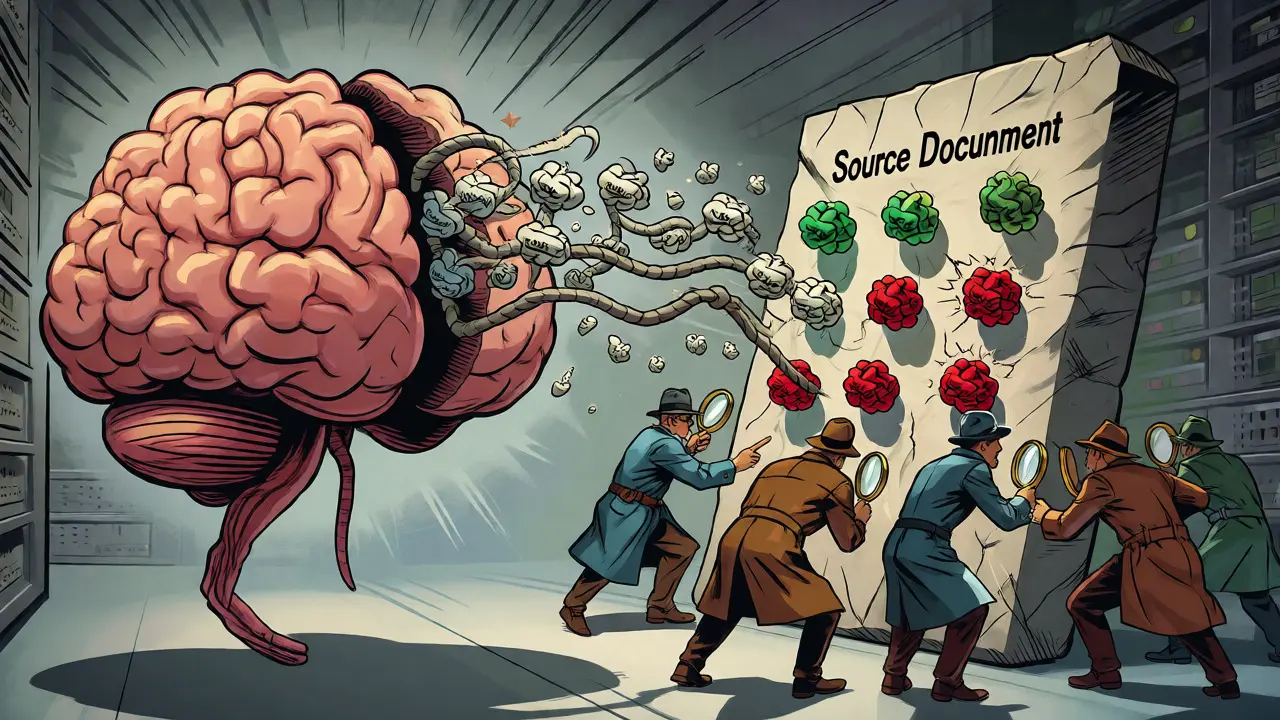
The other approach, popularized by RAGAS and deepset’s Groundedness Score, uses statement decomposition. Here’s the workflow:
- Breakdown: The system splits the long AI-generated answer into atomic statements (e.g., "The revenue increased," "It grew by 10%").
- Verification: Each atomic statement is checked against the retrieved documents independently.
- Scoring: The final score is the ratio of supported statements to total statements. If 9 out of 10 claims are backed by the text, the groundedness score is 90%.
This granular approach is powerful because it pinpoints exactly where the model went wrong. Did it get the date wrong? Did it misattribute a quote? You see it immediately.
Comparing the Major Frameworks
The market for LLM evaluation tools hit $417 million in 2025 and is projected to nearly quadruple by 2028. You have choices, but they aren't interchangeable. Some are open-source libraries you integrate yourself; others are enterprise platforms with dashboards. Here is how the top contenders stack up.
| Framework | Primary Method | Best For | Key Limitation | Adoption Status (2026) |
|---|---|---|---|---|
| RAGAS | LLM-as-Judge + Metric Suite | Open-source developers, multi-metric analysis (relevance, recall, faithfulness) | High computational cost; sensitive to prompt changes | High (14k+ PyPI downloads/month) |
| deepset Haystack | Statement Decomposition (Groundedness Score) | Enterprise RAG pipelines, technical documentation | Proprietary ecosystem; less flexible for custom logic | High (Enterprise standard) |
| ContextNLI | Natural Language Inference (DeBERTa-v3) | Low-latency needs, strict factual consistency | Struggles with complex multi-hop reasoning | Moderate (Specialized use cases) |
| TruLens | Feedback Functions & Chain-of-Thought | Observability and debugging during development | Requires significant setup for custom evaluators | Growing rapidly among startups |
RAGAS is the go-to for many Python developers. It doesn't just check faithfulness; it also evaluates 'answer relevance' and 'context precision.' This holistic view helps you diagnose if your retrieval is failing or if your generation is failing. However, be warned: RAGAS relies heavily on LLMs (often GPT-4-turbo) as judges. This introduces variability. Sebastian Raschka noted in late 2025 that judge-based evaluations can vary by up to 37% depending on which model serves as the judge.
deepset’s Groundedness Score, integrated into Haystack Enterprise, takes a more deterministic approach. By breaking answers into statements and verifying each against sources, it offers high reproducibility. Their v3.2 release added clickable references, allowing human reviewers to verify claims instantly. This feature alone drove adoption among 78% of their enterprise clients in early 2026.
The Judge Model Problem
Here is the dirty secret of current evaluation methods: Who watches the watchmen? Most modern grounded QA tools use another Large Language Model to judge the first one. This is called LLM-as-a-Judge. While efficient, it creates a dependency loop. If your judge model hallucinates, your evaluation is wrong.
Studies from LMSYS show that GPT-4-based judges achieve about 89% agreement with human experts. That sounds good, until you realize the 11% error rate includes false positives and negatives. Worse, different judges produce different scores. GPT-4-turbo tends to give systematically higher scores than open-source alternatives like Llama-3-70B due to calibration differences. Yoav Goldberg’s recent ACL paper highlighted that current metrics underestimate hallucinations in multi-hop reasoning scenarios by 29-43%. If your application requires complex synthesis of multiple documents, standard single-document grounding checks might miss errors.
To mitigate this, some teams are moving toward specialized, smaller judge models. Phudge, a fine-tuned model, achieves 78% of GPT-4’s accuracy at one-tenth the cost. For resource-constrained environments, this trade-off is often worth it.

Implementation Guide: From Pilot to Production
Don't try to boil the ocean. Implementing grounded evaluation is an iterative process. AWS benchmarks suggest that teams with NLP expertise need 3-5 days for basic integration, while those without may need 2-3 weeks including training.
Follow this roadmap:
- Create a Gold Standard Dataset: Start with 100-500 query-document-answer triples. Have human experts label these as "faithful" or "hallucinated." This is your ground truth for calibrating your automated metrics.
- Set Thresholds Carefully: 67% of enterprises initially set their groundedness thresholds too high. A score of 100% is rarely achievable in real-world conversational AI. Aim for a threshold that balances safety with usability-often around 85-90% for strict domains, lower for creative ones.
- Monitor Prompt Sensitivity: Minor changes to your evaluation prompt can cause score fluctuations of 15-25%. Lock down your evaluation prompts once they are validated. Do not tweak them casually.
- Calculate Cost: Running evaluations on every request adds latency and cost. Lightweight NLI models take ~1.2 seconds per query; GPT-4 judges take ~8.7 seconds. Decide if you need real-time monitoring or batch processing. Batch processing overnight is cheaper and sufficient for most quality assurance needs.
One major pitfall is handling multi-document synthesis. If the answer combines facts from Document A and Document B, simple pairwise comparison fails. Ensure your chosen framework supports multi-context verification, or build a custom wrapper that aggregates evidence before scoring.
Regulatory Drivers and Future Trends
Why is everyone suddenly obsessed with this? Regulation. The EU AI Act, effective February 2026, mandates systematic verification of factual grounding for high-risk AI systems. Similarly, the SEC now requires hallucination detection protocols for financial advisory AI. If you are deploying in healthcare, finance, or law, grounded evaluation is no longer optional-it’s a compliance requirement.
Gartner projects that by 2027, 85% of enterprise LLM deployments will incorporate groundedness metrics. We are seeing a shift from "is the answer good?" to "is the answer provable?" Future developments include real-time groundedness monitoring and cross-lingual hallucination detection, addressing the current gap where non-English content yields inconsistent results.
Sebastian Raschka predicts that grounded QA evaluation will become as fundamental as unit testing in software development. He’s right. You wouldn’t ship code without tests. Soon, you won’t ship an LLM application without a faithfulness score.
What is the difference between faithfulness and accuracy?
Accuracy measures if the answer is factually correct in the real world. Faithfulness measures if the answer is supported by the provided context. An answer can be faithful (supported by the text) but inaccurate (if the text itself was outdated or wrong). Grounded QA focuses on faithfulness to ensure the model isn't making things up relative to its source.
Which framework is best for beginners?
RAGAS is generally considered the most accessible for Python developers due to its extensive documentation and active community. It provides a suite of metrics out of the box. However, be prepared for higher API costs since it typically uses GPT-4 for evaluation.
How much does grounded evaluation cost?
Costs vary significantly. Using lightweight NLI models like DeBERTa can keep costs low but requires GPU infrastructure. Using LLM-as-judge methods like RAGAS can add $3,200-$8,700 monthly to cloud bills for mid-sized startups, according to industry surveys. Batch processing helps reduce this.
Can I automate the setting of groundedness thresholds?
Not fully. Thresholds depend on your risk tolerance. Legal apps might require 95%+ support, while customer service bots might accept 80%. You should manually review edge cases and adjust thresholds based on your gold standard dataset performance.
Does grounded evaluation work for all languages?
Currently, there are challenges. About 43% of international implementations report inconsistent results for non-English content. Open-source NLI models often perform better in English. Cross-lingual detection is a key area of ongoing research and upcoming tool updates in 2026.