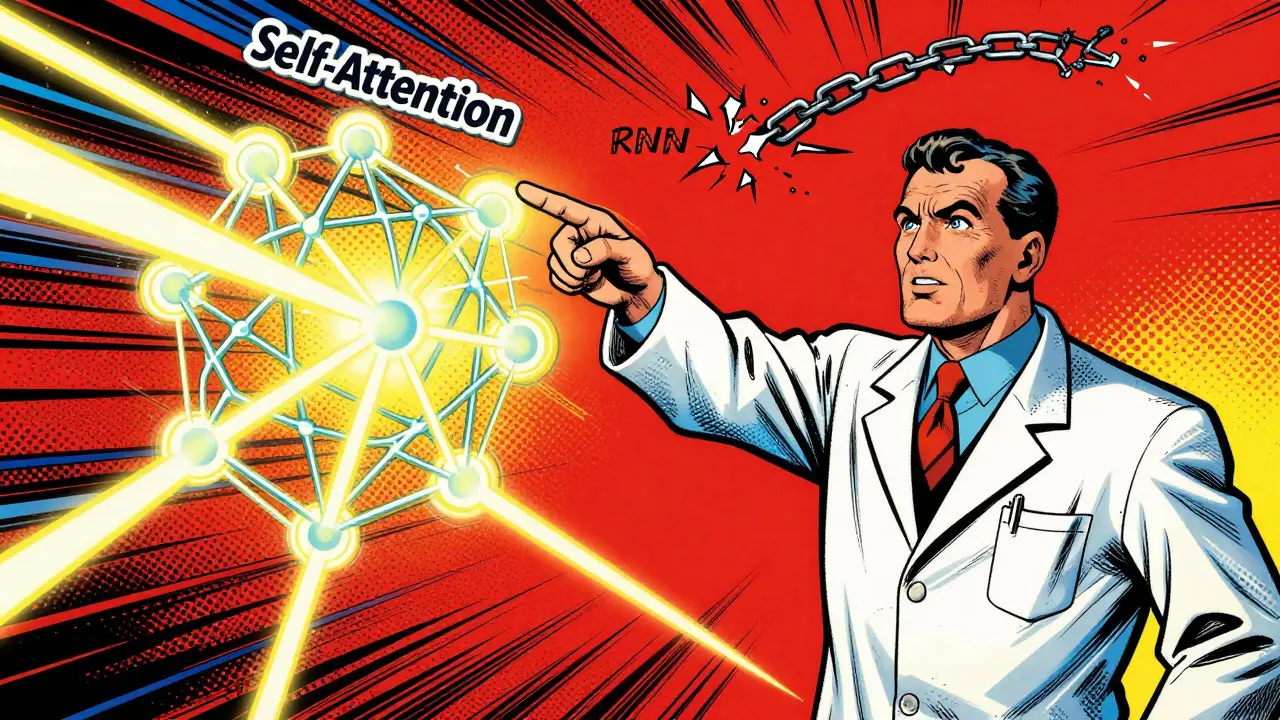
Back in 2017, a single paper changed everything. Before that year, artificial intelligence struggled with the "long-term memory" problem. If you asked an early AI to connect a word at the start of a sentence with one at the end, it often forgot the context. The Transformer is a neural network architecture introduced in 2017 that uses self-attention mechanisms to process all elements in a sequence simultaneously solved this by letting every word "see" every other word at once. It wasn't just a tweak; it was a complete redesign of how machines read.
But the story doesn't stop at 2017. The original design was brilliant but raw. Over the last nine years, engineers and researchers have fine-tuned the engine. They swapped out parts, streamlined processes, and added new tools. Today's large language models (LLMs) look different under the hood than the first Transformers did. Let’s break down exactly what changed and why those changes matter for speed, accuracy, and cost.
The Core Problem: Why Attention Changed Everything
To understand the innovations, you first need to grasp the baseline. Before Transformers, we relied on Recurrent Neural Networks (RNNs). RNNs read text like a human reads a book-one word after another. This sequential process is slow. If you want to predict the next word, the computer has to finish processing the previous word first. This creates a bottleneck.
The Transformer introduced Self-Attention is a mechanism that allows the model to weigh the importance of different tokens in a sequence relative to each other, enabling parallel processing. Instead of waiting, the model looks at the entire sentence simultaneously. Imagine reading a paragraph where you can instantly highlight related concepts without scanning linearly. That is self-attention.
This shift allowed for parallel computation. You could throw massive amounts of data at GPUs all at once. But parallel processing brought a new problem: order matters. In the phrase "The dog bit the man," the meaning flips if you swap the nouns. The original Transformer handled this with "positional encodings," but that method had flaws. Fixing these flaws became the primary focus of architectural innovation from 2018 to 2026.
Positional Encoding: From Sine Waves to Rotations
In the original 2017 design, positional encoding used fixed sine and cosine waves to tell the model where a word sat in a sentence. It worked, but it struggled with longer contexts. If you tried to feed a novel into the model, the position signals got noisy and confused.
Enter RoPE is Rotary Position Embeddings, a technique that applies rotation matrices to token embeddings to encode positional information, allowing models to handle longer sequences more effectively. Developed around 2021, RoPE quickly became the industry standard. Instead of adding a separate position signal, RoPE rotates the vector representation of each token based on its position. This approach preserves the relative distance between words better than the old method.
Why does this matter? Because modern LLMs need to process thousands of tokens at once. RoPE helps the model maintain coherence over long documents. It also makes the model more flexible during inference. If you train a model on short sentences, RoPE allows it to generalize better when faced with longer inputs later. This innovation is now found in nearly every major model, including LLaMA, Qwen, and Yi.
Activation Functions: Beyond ReLU
Deep learning relies on activation functions to introduce non-linearity into the network. For years, ReLU (Rectified Linear Unit) was the go-to choice. It’s simple: if the input is positive, keep it; if negative, zero it out. But simplicity isn’t always efficient.
Modern architectures have largely moved toward SwiGLU is an advanced activation function that combines the SiLU gating mechanism with linear projections, improving model performance and efficiency compared to traditional ReLU or GELU. SwiGLU splits the input into two paths, applies a gating mechanism, and multiplies them together. This sounds complex, but the result is cleaner gradients during training and better accuracy during prediction.
Another contender, GELU (Gaussian Error Linear Unit), also gained popularity. GELU smooths out the transitions in the data, helping the model learn subtle patterns. The shift from ReLU to SwiGLU and GELU represents a move toward more sophisticated mathematical operations that yield higher quality outputs for the same computational cost.
Normalization: Stabilizing the Training Process
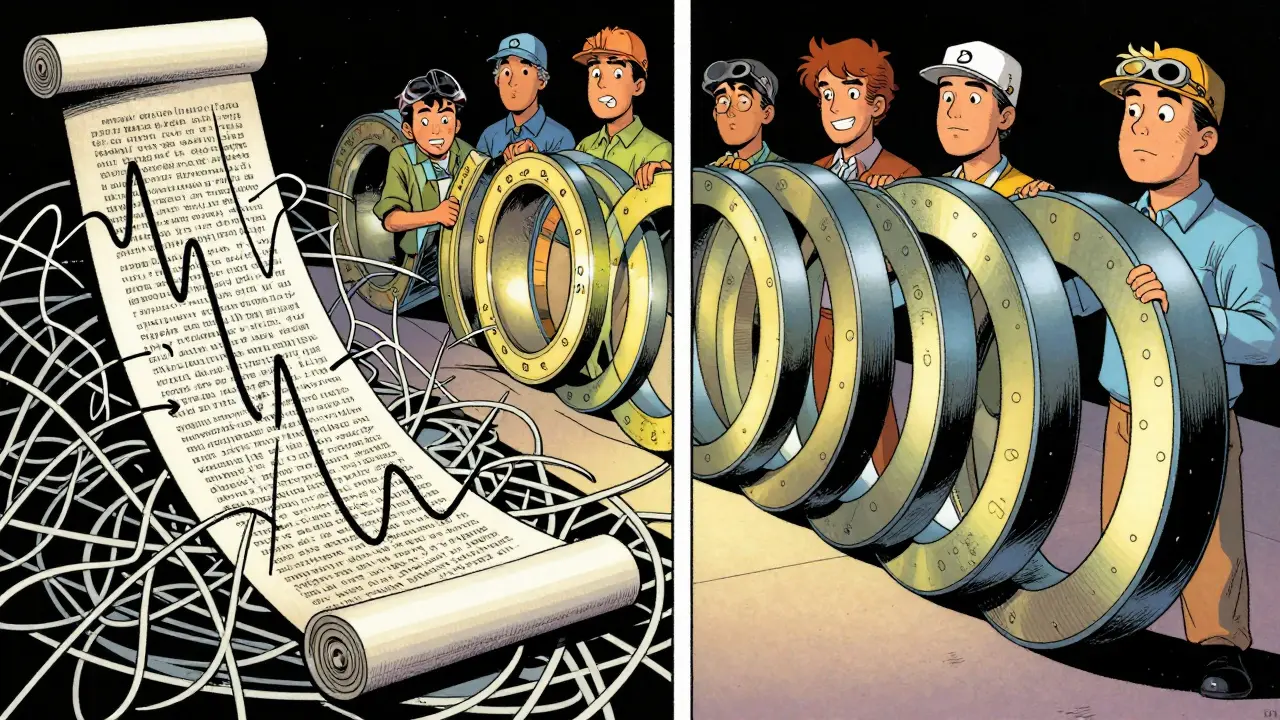
Training a massive model is like trying to balance a stack of plates while running. Small errors can cause the whole system to collapse. Normalization techniques help stabilize this process. The original Transformer used post-normalization, which applied normalization after the attention and feed-forward layers.
However, researchers found that Pre-Normalization is a technique where layer normalization is applied before the attention and feed-forward sub-layers, leading to more stable training dynamics and faster convergence works significantly better. By normalizing the inputs before they enter the heavy computation layers, the gradients flow more smoothly. This prevents the "exploding gradient" problem that often derailed training runs.
This change might seem minor, but it allowed models to scale up dramatically. Without pre-normalization, training models with hundreds of billions of parameters would likely fail due to instability. It’s a foundational improvement that enabled the era of giant LLMs.
Scaling Laws and Architectural Ratios
You might wonder why some models are wider (more neurons per layer) and others are deeper (more layers). The answer lies in scaling laws. Research since 2020 has shown that there is an optimal ratio between the number of parameters, the amount of data, and the compute budget.
Many recent models, such as LLaMA-1 and DeepSeek, follow a specific pattern. They tend to favor depth over width, adhering to a ratio that maximizes performance per parameter. This is often referred to as the "2.6-ish ratio rule" in community discussions, though the exact number varies. The key insight is that simply throwing more money at hardware doesn’t guarantee better results if the architecture isn’t balanced.
T5 is Text-To-Transfer Transfer Transformer, a model developed by Google that treats all NLP tasks as text-to-text problems, featuring bold architectural choices like encoder-decoder structure and relative attention biases stands out here. T5 took a different path, using an encoder-decoder structure similar to the original Transformer but optimizing it for transfer learning. It proved that diverse architectural approaches could succeed if aligned with specific goals.
| Component | Original (2017) | Modern Standard (2025-2026) | Primary Benefit |
|---|---|---|---|
| Positional Encoding | Sine/Cosine Waves | RoPE (Rotary Position Embeddings) | Better handling of long contexts and extrapolation |
| Activation Function | ReLU / GELU | SwiGLU | Improved accuracy and gradient stability |
| Normalization | Post-Normalization | Pre-Normalization | Faster convergence and training stability |
| Context Window | Limited (~512 tokens) | Extended (32k - 1M+ tokens) | Ability to process books or codebases |
Multimodality: Beyond Text
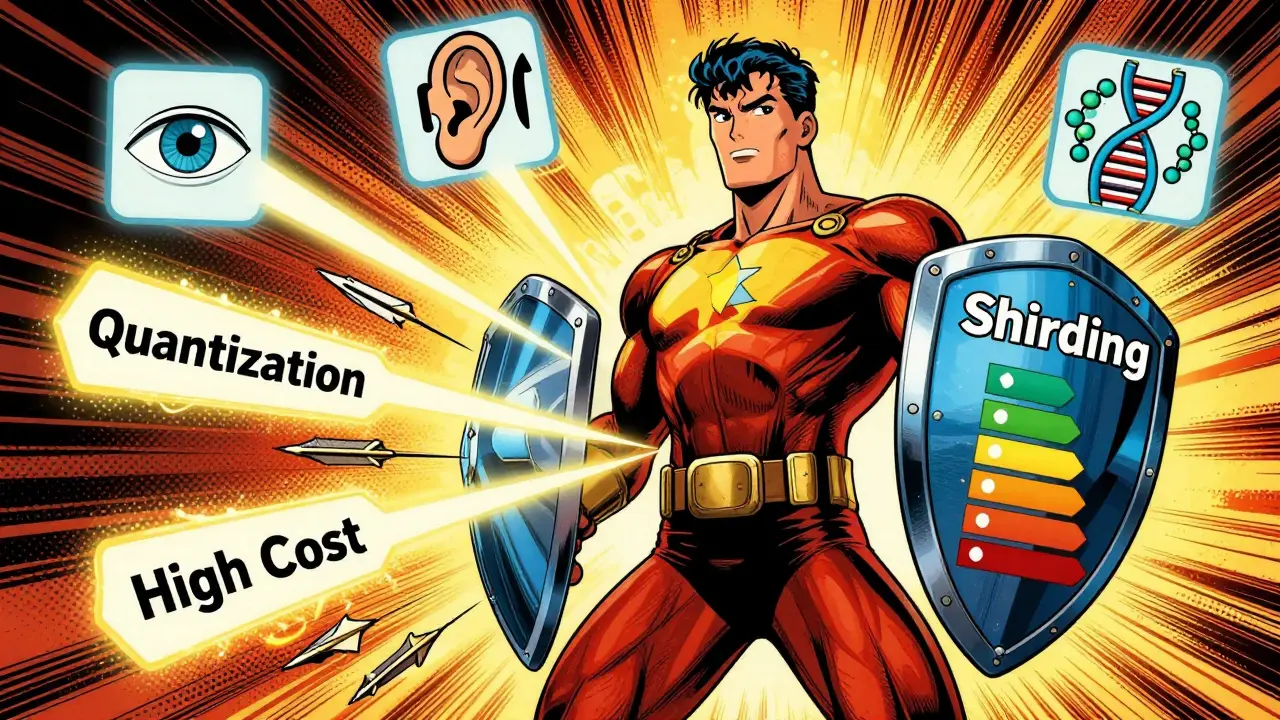
The original Transformer was designed for text translation. Today, it powers much more. The architecture’s flexibility allowed it to expand into images, audio, and even protein folding.
Models like CLIP is Contrastive Language-Image Pre-training, a multimodal model that aligns text and image embeddings in a shared vector space, enabling zero-shot image classification and retrieval and GPT-4V use the Transformer backbone to process multiple types of data. They convert images into patches and treat them like tokens. Audio is converted into spectrograms and processed similarly. This unification means one architecture can handle vision, speech, and language.
Even in science, AlphaFold is A deep learning system developed by DeepMind that predicts protein structures by treating amino acid sequences as language tokens, leveraging attention mechanisms to understand long-range interactions uses Transformer principles. Proteins fold based on distant interactions between amino acids-just like words in a sentence relate across distances. AlphaFold’s success proves that the attention mechanism captures universal patterns of dependency, not just linguistic ones.
Efficiency Gains: Quantization and Sharding
Architecture isn’t just about the math; it’s about deployment. Running a 70-billion-parameter model requires expensive hardware. To make these models accessible, engineers developed optimization techniques.
Quantization is A compression technique that reduces the precision of model weights (e.g., from 32-bit floats to 8-bit integers), reducing memory usage and increasing inference speed with minimal loss in accuracy reduces the numerical precision of the model’s weights. Instead of storing precise floating-point numbers, the model uses simpler integers. This can cut memory usage by half and speed up processing significantly.
Model Sharding is A distributed computing technique that splits a large model across multiple GPUs or devices, allowing parallel processing of different parts of the model during inference splits the model across multiple GPUs. This allows smaller servers to run large models by sharing the load. Combined with caching strategies, these techniques reduce serving costs by 30-50%. This economic efficiency is crucial for widespread adoption.
The Future: What’s Next?
We are still iterating. The pace of innovation remains rapid. In 2025 alone, nearly 20 new major language models were released, each with slight architectural tweaks. Some experiments include sparse attention mechanisms, where the model only pays attention to relevant tokens to save compute. Others explore mixture-of-experts designs, where different parts of the model activate for different tasks.
The core principle remains the same: attention is powerful. But the implementation continues to evolve. As hardware improves and datasets grow, the architecture will adapt to maximize efficiency and capability. The journey from the 2017 prototype to today’s sophisticated systems shows that small, targeted improvements compound into massive gains.
What is the main difference between the original Transformer and modern LLMs?
The main differences lie in positional encoding (RoPE vs. sine waves), activation functions (SwiGLU vs. ReLU), and normalization (pre-norm vs. post-norm). These changes improve stability, accuracy, and the ability to handle longer contexts.
Why is RoPE preferred over original positional encodings?
RoPE (Rotary Position Embeddings) handles long sequences better by preserving relative distances between tokens. It also allows models trained on shorter texts to generalize well to longer inputs, which is crucial for modern applications.
How does SwiGLU improve model performance?
SwiGLU introduces a gating mechanism that allows the model to learn more complex non-linear relationships. This leads to better accuracy and smoother training gradients compared to simpler activations like ReLU.
What is pre-normalization and why is it important?
Pre-normalization applies layer normalization before the attention and feed-forward layers. This stabilizes the training process, prevents exploding gradients, and allows for faster convergence, enabling the training of very large models.
Can Transformers be used for non-text tasks?
Yes. Transformers are used in image recognition (ViT), audio processing, and even scientific domains like protein folding (AlphaFold). The self-attention mechanism is versatile enough to capture dependencies in any sequential or structured data.