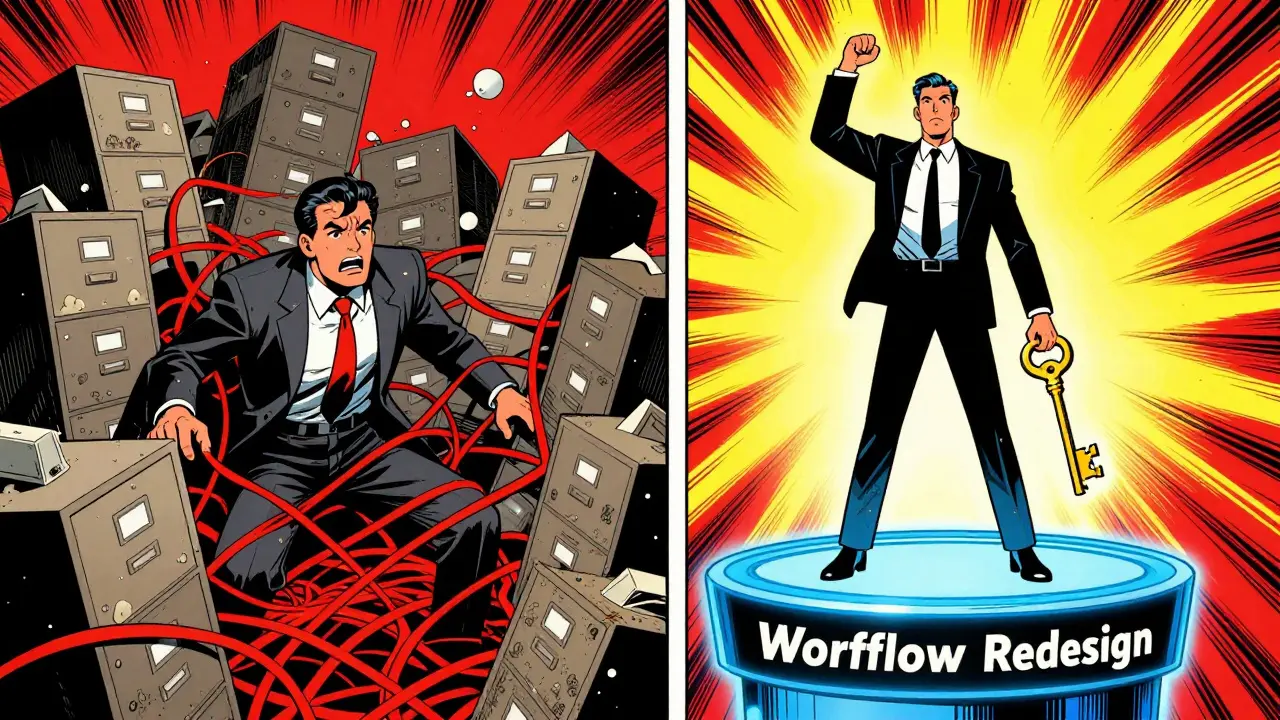
You’ve probably heard the stats. Ninety-five percent of generative AI pilots fail. It’s a brutal number that keeps CTOs up at night. But here is the twist: the other five percent aren’t just lucky. They are AI high performers, and they are capturing massive value while everyone else burns cash on shiny tools that gather dust.
The difference isn’t the software. It’s not about who bought the most expensive API credits or hired the flashiest data scientists. The gap lies in one specific behavior: workflow redesign. Most companies try to bolt AI onto broken processes. High performers tear those processes down and rebuild them with AI as the core engine. If you want to move from the failing 95% to the elite 5%, you need to stop asking how AI can help your current job and start asking how the job itself should change when AI exists.
The Myth of Automation vs. The Reality of Redesign
We have a habit of thinking about AI as a faster version of what we already do. We imagine an AI assistant that writes emails slightly quicker or summarizes meetings a bit more efficiently. That is automation. And it’s nice. But it doesn’t transform your business.
Workflow redesign means changing the fundamental steps of a task because AI has made certain steps obsolete or irrelevant. Think about market research. Traditionally, this meant hiring agencies, waiting weeks for reports, and then having analysts read hundreds of pages to find three useful insights. That workflow is built around human limitations in reading speed and synthesis.
Colgate-Palmolive didn’t just use AI to read reports faster. They used Retrieval-Augmented Generation (RAG) frameworks connected to large language models to ingest proprietary consumer research, third-party data, and Google search trends. Now, employees don’t review reports. They query the entire dataset directly. The "analyst" role shifted from summarizing documents to asking better questions. The workflow changed from "read and synthesize" to "query and validate." That is how you capture value. You remove the middleman-the manual processing-and let humans focus on strategy.
If you keep the old workflow but add AI, you’re just paying for expensive efficiency gains. If you redesign the workflow, you unlock new capabilities that were previously impossible due to time or cost constraints.
Why Most Pilots Die: The Broad Deployment Trap
So why do so many projects fail? According to Aditya Challapally, lead author of the MIT report on this topic, failure usually comes from trying to boil the ocean. Companies launch enterprise-wide deployments without a clear anchor. They buy a tool and tell everyone to "use it somewhere." The result is confusion, low adoption, and wasted budget.
High performers do the opposite. They pick one painful, high-impact problem and solve it completely. Take Klarna. They didn’t deploy AI across their entire company overnight. They focused on customer service. They fed the AI thousands of past conversations and support documents. Then, they designed a "tag-team" system. The AI handles routine queries-password resets, order status checks. Humans step in only when empathy or complex judgment is required.
This wasn’t just automation. It was a structural change in how support tickets flow. The outcome? Reduced costs, shorter wait times, and happier agents who aren’t bored by repetitive tasks. This precision is key. Startups led by 19-year-olds are hitting $20 million in revenue in a year by focusing on single pain points. Large enterprises often miss this because they are too busy planning for scale before they have proven value.
| Strategy Aspect | Failed Pilot (The 95%) | High Performer (The 5%) |
|---|---|---|
| Scope | Broad, enterprise-wide deployment | Single, high-impact pain point |
| Workflow Approach | Automate existing steps (bolt-on) | Redesign process (core integration) |
| Data Strategy | Generic public models | RAG with proprietary data + LLMs |
| Human Role | Unchanged or reduced headcount | Elevated to higher-value tasks |
| Training Time | Months of specialized coding training | 15-20 hours for existing staff |

Technical Foundations: RAG and System Integration
You cannot achieve true workflow redesign with a generic chatbot. You need technical depth. The secret sauce for most high performers is Retrieval-Augmented Generation (RAG). RAG allows you to connect a large language model to your own private data sources. This solves the hallucination problem and ensures accuracy.
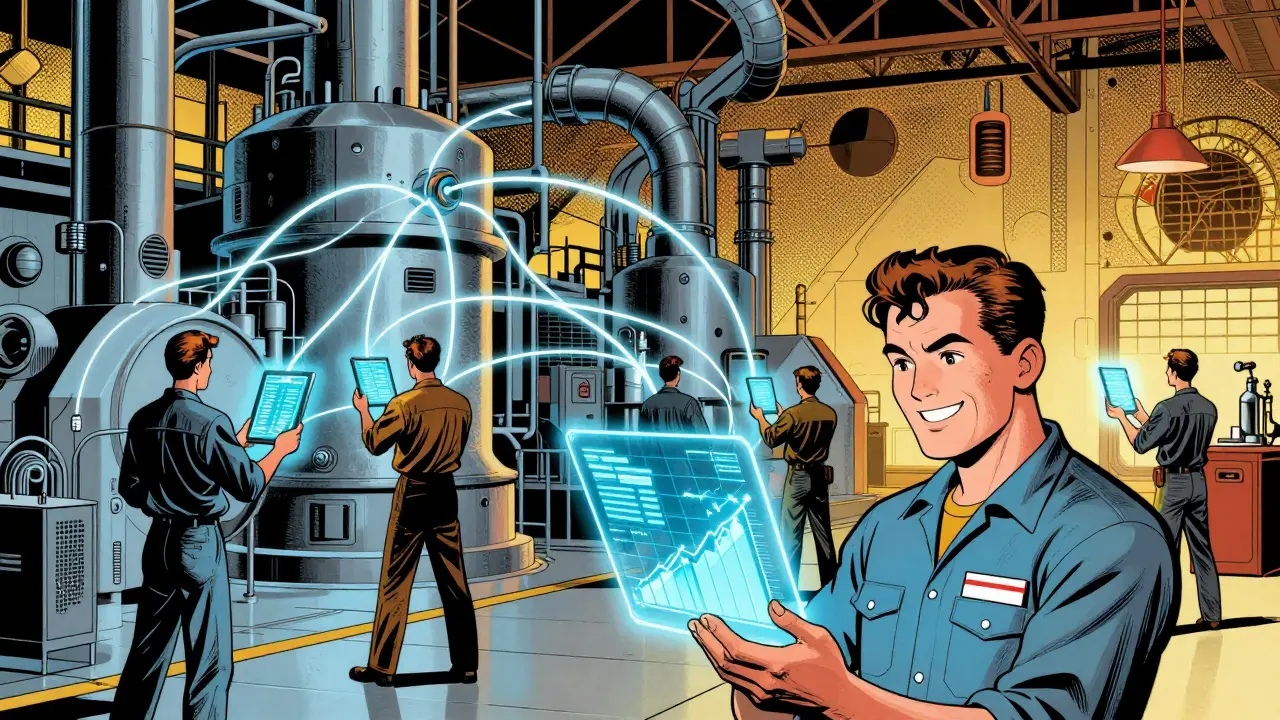
Consider Siemens. Engineers there integrated AI with their Senseye system. This wasn’t a standalone tool; it was woven into their maintenance workflows. The result? A 40% reduction in maintenance costs, a 55% increase in team productivity, and a 50% drop in machine downtime. The AI didn’t just give advice; it became part of the diagnostic loop.
Toyota took a similar approach using Google Cloud’s infrastructure. They enabled factory workers-not just IT specialists-to develop and deploy machine learning models. This democratization saved over 10,000 man-hours annually. The key takeaway? Your AI must integrate with your existing operational systems (ERP, CRM, IoT sensors). If it lives in a separate tab, it will be ignored.
Scaling: From One Use Case to Enterprise Impact
Once you have a winning pilot, the next challenge is scaling. High performers don’t replicate the same solution everywhere. They expand horizontally into related functions within 12 to 18 months.
Look at marketing. High-performing teams write 30% of their materials using AI, completing work almost twice as fast and cutting content costs by 30-50%. Bayer saw an 85% year-over-year click increase while paying 33% less per click. How? They used AI to generate copy and imagery for new product concepts in minutes, then tested them on digital consumer twins instead of traditional focus groups. This is a complete redesign of the creative testing workflow.
But scaling requires culture shift. HBR research notes that while AI boosts productivity, it can decrease motivation if employees feel replaced. High performers address this by framing AI as a partner. At MAS, a global experiential marketing agency, directors describe a collaborative conversation with AI to refine ideas. Human input and AI output achieve harmony through iteration. The goal isn’t to replace the creative; it’s to remove the drudgery so the creative can be more creative.
Training is also critical. Contrary to popular belief, you don’t need a PhD in computer science to use these tools effectively. Most employees at successful implementations needed only 15-20 hours of training to integrate AI into their redesigned workflows. The barrier isn’t technical skill; it’s mindset.
Measuring Real ROI: Beyond Efficiency Metrics
Most companies measure AI success by time saved. "We saved 105 minutes daily," says Superhuman’s analysis. That’s good. But high performers measure business outcomes. Five Sigma, an insurance claims processor, didn’t just track time. They tracked error rates and cycle times. Their AI engine freed human adjustors to focus on complex decisions, resulting in an 80% error reduction and a 10% reduction in claims processing time.
When you measure errors, customer satisfaction, and revenue impact, you see the true value. Rivian employees reported getting up to speed on complex topics 70% faster using Gemini integrated with Google Workspace. That speed translates to faster product development cycles and quicker responses to market changes. Gazelle, a real estate AI service in Sweden and Norway, increased output accuracy from 95% to 99.9% and cut content generation time from four hours to 10 seconds. They launched four new products in less than a year. That is velocity. That is competitive advantage.
To capture value, you must align AI objectives with growth, not just efficiency. McKinsey’s 2025 survey found that companies setting both efficiency and growth objectives are more likely to succeed. If you only use AI to cut costs, you’ll hit a ceiling. If you use it to enable new services or improve quality, the sky’s the limit.
Your Next Steps: A Practical Checklist
Ready to move from pilot to performer? Here is how to start:
- Identify one bottleneck. Don’t look for everything AI can do. Look for where your team spends the most time on low-value work. Is it contract review? Customer support triage? Code debugging?
- Map the current workflow. Write down every step. Which steps require human judgment? Which are purely mechanical?
- Redesign, don’t automate. Ask: "If AI could do the mechanical parts instantly, what would the process look like?" Remove steps entirely.
- Implement RAG. Connect your AI to your proprietary data. Accuracy builds trust. Trust drives adoption.
- Train lightly, iterate quickly. Give your team 20 hours of hands-on training. Let them break things. Celebrate small wins.
- Measure business outcomes. Track error rates, customer satisfaction, and revenue impact, not just time saved.
The gap between the 5% and the 95% is widening. The tools are available to everyone. The difference is in the willingness to change how you work. Stop bolting AI onto old habits. Build new workflows. That is how you win.
What is the biggest mistake companies make when implementing generative AI?
The biggest mistake is treating AI as an automation tool for existing workflows rather than a catalyst for workflow redesign. Companies often try to bolt AI onto broken processes, leading to the 95% pilot failure rate cited by MIT. Successful organizations tear down inefficient processes and rebuild them with AI as a core component.
How does Retrieval-Augmented Generation (RAG) improve AI performance?
RAG connects large language models to a company's proprietary data sources, such as internal databases, customer records, and research reports. This reduces hallucinations and ensures that AI outputs are accurate and relevant to the specific business context, enabling trusted integration into critical workflows.
Do employees need advanced technical skills to use generative AI effectively?
No. Case studies show that most employees need only 15-20 hours of training to effectively integrate AI into redesigned workflows. The barrier to entry is mindset and process design, not coding expertise. Democratizing access allows non-technical staff to leverage AI for significant productivity gains.
What metrics should high performers use to measure AI ROI?
While time savings are a starting point, high performers focus on business outcomes such as error reduction, customer satisfaction scores, revenue impact, and cycle time improvements. For example, Five Sigma measured an 80% error reduction and 10% faster claims processing, which directly impacts profitability and customer trust.
How long does it take to scale AI from a pilot to enterprise-wide deployment?
High performers typically scale from one successful use case to three or more within 12 to 18 months. This gradual expansion allows organizations to refine their processes, build internal expertise, and demonstrate tangible value before expanding further, reducing risk and increasing adoption rates.




9 Comments
Bineesh Mathew
the tragedy of the modern corporate soul is not that it fails to adopt technology but that it adopts it with the blind faith of a cultist who has never read the scripture. we are told to redesign workflows as if the human spirit were merely code waiting for a patch yet we ignore the existential dread that comes when one realizes their entire professional identity was built on tasks that can be performed by a machine in seconds. this is not progress this is obsolescence dressed up in silicon and sold back to us at a premium.
Oskar Falkenberg
i totally get where you are coming from about the workflow redesign thing because i have seen so many companies just slap ai onto their existing messes and wonder why nothing works out right in the end. it is like trying to put a new engine into a car that has no wheels or brakes and expecting it to drive smoothly down the highway without crashing into every other vehicle on the road which is pretty much what happens when you do not take the time to actually look at how your team does things before adding any new tools into the mix. you really need to sit down with everyone involved and map out every single step of the process because there are usually so many hidden inefficiencies that nobody even notices anymore since they have become such a normal part of daily life that it feels impossible to imagine doing anything differently until someone shows you exactly how much time is being wasted on stupid repetitive tasks that could easily be handled by an algorithm instead of a person staring at a screen for eight hours straight.
Andrea Alonzo
it is truly heartbreaking to watch organizations struggle with this transition because people are naturally afraid of change and often feel threatened when new technologies are introduced without proper support or clear communication about how their roles will evolve rather than disappear. i believe that leaders need to approach this with immense empathy and patience, recognizing that every employee brings unique value that cannot simply be automated away, and that the goal should always be to augment human capabilities rather than replace them entirely. when we fail to listen to our teams and understand their concerns, we create a culture of fear and resistance that ultimately undermines any potential benefits that the technology might offer, leaving everyone feeling disconnected and undervalued in their own workplace. we must remember that behind every data point and efficiency metric is a human being who deserves respect, dignity, and a voice in shaping the future of their work environment, especially during times of significant technological disruption that can feel overwhelming and uncertain for many individuals.
Jeanne Abrahams
oh please spare me the corporate buzzwords about 'workflow redesign' as if tearing apart a company's processes is some kind of heroic journey rather than a chaotic nightmare that results in layoffs and confusion. you talk about high performers like they are saints while ignoring the fact that most of these success stories are cherry-picked examples designed to sell consulting services to desperate c-suite executives who are terrified of falling behind. the reality is that most companies are too bloated and bureaucratic to ever truly innovate in this way, so they just pretend to use ai while continuing to do everything the same old inefficient way they always have done it. it is laughable how much money is wasted on pilots that go nowhere because leadership refuses to admit that their fundamental business model is broken beyond repair.
Stephanie Frank
here is the cold hard truth that nobody wants to hear: most of you reading this are already obsolete if you cannot adapt to using ai effectively within the next six months. stop whining about job security and start learning how to leverage these tools to make yourself indispensable because the market does not care about your feelings or your comfort zone. the companies that succeed are the ones that ruthlessly eliminate inefficiency and anyone who cannot keep up gets left behind whether they like it or not. it is brutal but it is also fair because those who embrace change thrive while those who resist it perish in the digital age.
Marissa Haque
WOW!!! This article is absolutely groundbreaking!! I mean seriously!! Who knew that we needed to rethink our entire approach to work?? It is so exciting to see companies finally getting it right!! The part about RAG was mind-blowing!! I never realized how important proprietary data is!! And the stats about Siemens and Toyota are just incredible!! It makes me want to run out and buy every ai tool on the market right now!! We need more articles like this that show us the real path to success!! Thank you for sharing this wisdom!!
Caitlin Donehue
i suppose it makes sense that focusing on a single pain point yields better results than trying to boil the ocean but i wonder if this approach scales well for smaller businesses that do not have the resources to dedicate entire teams to pilot programs. it seems like a luxury that only large corporations can afford to experiment with workflow redesigns while smaller entities are just trying to survive day to day. maybe there is a middle ground where small businesses can adopt simpler ai solutions without overhauling their entire operations but it remains to be seen if the benefits justify the effort for everyone involved.
Keith Barker
we are building towers of babel with code and calling it progress. the essence of work is not in the task but in the meaning we assign to it. when we remove the friction we also remove the depth. ai gives us speed but takes away soul. we chase efficiency until there is nothing left but empty calories. the true cost is invisible. we trade presence for productivity. and wonder why we feel hollow. the machine does not dream. it calculates. and we follow its lead blindly into the void.
Lisa Puster
only american companies seem to understand this level of sophistication in ai integration while the rest of the world is still struggling with basic digital literacy. it is pathetic how other nations lag behind in adopting these advanced strategies because they lack the cultural discipline to prioritize efficiency above all else. we should not waste time helping others catch up when we have already achieved dominance through superior innovation and strategic foresight. let them fail while we continue to scale and capture value from generative ai without any interference from inferior systems or outdated methodologies.