Running large language model (LLM) agents in production is no longer just a technical challenge; it is a financial minefield. In 2026, organizations are seeing monthly infrastructure bills skyrocket past $250,000 when they deploy sophisticated AI systems without strict cost controls. The problem isn't just the base price of API calls. It is the compounding effect of expanded context windows, iterative tool calls, and the new wave of "think tokens" used for complex reasoning. If you treat your agent architecture like a black box, you will watch your budget evaporate. But if you understand the mechanics of how these costs accumulate, you can cut spending by 30-50% while maintaining or even improving performance.
The core issue is that agent-based architectures behave differently than simple chatbots. They loop. They plan. They execute tools. Each step adds latency and token consumption. To keep costs manageable, you need to optimize three specific areas: how much context you feed the model, how efficiently the agent uses external tools, and whether expensive reasoning capabilities are actually necessary for every task.
Managing Context Window Costs
Many developers assume that dumping all available historical data into the context window is the best way to ensure accuracy. This is a costly mistake. Research shows that smart context management techniques can reduce token usage by 20-40% in conversational applications without sacrificing quality. The key is intelligent pruning.
Instead of sending the entire conversation history, implement strategies that remove irrelevant information. Summarize older interactions into concise bullet points rather than keeping raw transcripts. Carefully select which documents or database entries the agent includes when making decisions. For example, if an agent is troubleshooting a login error, it does not need the user’s entire purchase history from six months ago. By stripping away noise, you directly reduce the number of tokens processed and generated, which lowers your API charges based on the deployed model's pricing structure.
Optimizing Tool Call Efficiency
One of the defining features of modern LLM Agents is their ability to interact with external systems through tool calls, such as querying databases, sending emails, or accessing weather APIs. However, each tool invocation creates indirect cost implications that compound quickly.
- Additional API Calls: Each tool use typically requires an extra API call, either to internal functions or external services. This multiplies the computational footprint beyond the base LLM inference cost.
- Context Expansion: When a tool returns results, that data feeds back into the LLM context. A verbose JSON response from a database query can bloat the context window, increasing the cost of the next inference pass.
- Iterative Loops: Agents often examine tool outputs and make subsequent calls. These iterative patterns create compounding costs across multiple inference cycles.
To control these costs, design your agents with efficiency in mind. Minimize unnecessary tool invocations by having the agent plan its steps before executing them. Batch related operations where possible-for instance, retrieving multiple user records in one database call instead of ten separate ones. Additionally, cache tool results aggressively. If an agent checks the status of a server twice within five minutes, serve the second request from memory rather than triggering another expensive API call.
Navigating Think Token Pricing
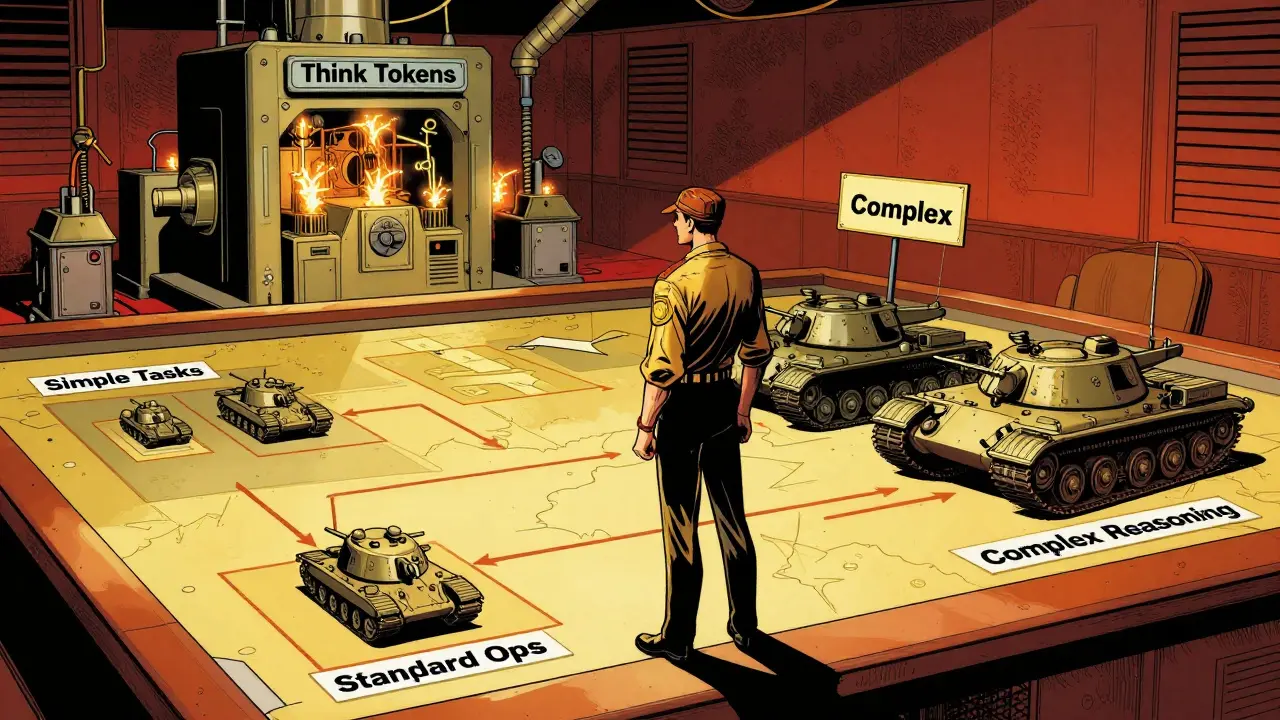
In 2026, the introduction of models with extended reasoning capabilities has changed the inference cost model. Models like OpenAI o1 and DeepSeek R1 spend additional compute during inference on "Think Tokens are internal reasoning steps that models generate before producing a final answer, allowing for deeper problem-solving but at a higher computational cost." Unlike traditional tokens that appear in the output, these tokens represent hidden processing work.
This introduces a new dimension to cost calculation. Organizations must weigh the accuracy improvements and problem-solving benefits against the increased inference token consumption. Not every task requires deep reasoning. A simple greeting or a factual lookup does not benefit from extensive chain-of-thought processing. Deploying high-reasoning models for routine tasks wastes money.
The strategy here is measurement. Track whether the improved solution quality justifies the higher per-request token expenditure. For complex, multi-step problems where error rates are costly, think tokens may be worth the premium. For high-volume, low-complexity requests, stick to standard inference models. At scale, this distinction can save thousands of dollars daily.

Strategic Model Routing and Selection
Perhaps the highest-impact lever for cost control is model selection. A tiered approach routes different request types to appropriately-sized models based on complexity requirements. This routing intelligence can deliver cost reductions of 37-46% for many workloads.
| Task Complexity | Example Use Cases | Recommended Model Tier | Cost Impact |
|---|---|---|---|
| Simple | Greetings, confirmations, FAQ lookups | Lightweight (e.g., GPT-3.5, Claude Haiku) | Lowest |
| Standard | Customer support, content generation | Mid-tier (e.g., GPT-4o-mini, Claude Sonnet) | Moderate |
| Complex | Multi-step reasoning, code debugging | Premium (e.g., GPT-4, Claude Opus) | Highest |
When applied to LLM agents, this means agents performing routine tasks use smaller, cheaper models. Only when the agent encounters a problem requiring extended reasoning should it access more capable (and expensive) models. Implementing this logic prevents over-engineering simple responses.
Infrastructure-Level Optimizations
Beyond prompt engineering and model selection, infrastructure choices play a massive role in cost control. Two techniques stand out for self-hosted deployments: continuous batching and quantization.
Continuous Batching is an inference scheduling technique that processes requests dynamically, inserting new sequences as others complete, rather than waiting for entire batches to finish. This delivers up to 40% cost reduction through better GPU utilization. Users of frameworks like vLLM report throughput increases of up to 23x. For agents handling concurrent users, this means you can serve more instances on the same hardware, directly reducing per-request costs.
Quantization reduces model size by converting weights from high precision (FP16/FP32) to lower precision formats (INT4, FP8). Since memory bandwidth is often the bottleneck for LLM inference, smaller weights mean faster computation and lower energy costs. For example, Llama 3's 8B model achieves 95.8% of the 70B model's performance while using only 11.75% of the memory. For agents where perfect accuracy isn't critical, deploying quantized smaller models reduces both cost and latency significantly.
Caching and Load Balancing
Intelligent caching strategies reduce costs by 15-30% while simultaneously improving response times. For agent systems, semantic caching identifies similar queries and reuses cached responses. This is particularly valuable for agents fielding repeated queries, such as customer support bots. Cache hit rates can reach 30-50%, effectively providing those responses at near-zero incremental cost.
Additionally, load balancing across multiple API providers helps manage costs through rate limit management and provider cost differences. By routing traffic to the most economical provider for each request type, agents maintain flexibility to shift load toward whichever service offers the best cost-to-quality ratio at any given time. This avoids throttling penalties and maximizes volume discounts.
Monitoring and Continuous Improvement
You cannot control what you do not measure. Establish comprehensive benchmarking frameworks that track four dimensions simultaneously: throughput (tokens per second), latency (time to first token), cost per token, and quality (model accuracy). Tools like GenAI-Perf and CEBench help identify specific cost gaps in your deployments.
Implement real-time spending visibility with anomaly detection and budget alerts. If an agent suddenly starts consuming 5x more tokens due to a bug in its tool-calling logic, you want to know immediately. Experiment tracking tools like MLflow and Weights & Biases log cost metadata, enabling cost-per-experiment analysis. This monitoring discipline ensures that cost reduction efforts target the highest-impact opportunities and prevent retroactive firefighting.
How much can I save by optimizing context windows?
Smart context management techniques, such as pruning irrelevant history and summarizing past interactions, can reduce token usage by 20-40% in conversational applications. This directly lowers API charges since costs are proportional to the number of tokens processed.
What are think tokens and why do they cost more?
Think tokens are internal reasoning steps generated by advanced models like OpenAI o1 or DeepSeek R1 before producing a final answer. They require additional compute during inference, leading to higher per-request costs compared to standard models that generate output directly.
Does quantization affect model accuracy?
Quantization converts model weights to lower precision formats, which can slightly reduce accuracy. However, for many use cases, the trade-off is minimal. For example, Llama 3's 8B quantized model retains 95.8% of the performance of its larger counterpart while using significantly less memory and compute resources.
How does tool calling impact LLM agent costs?
Tool calls increase costs through additional API requests, expanded context windows from tool outputs, and iterative loops where the agent analyzes results and makes further calls. Minimizing unnecessary invocations and caching results are key to controlling these expenses.
Is continuous batching worth implementing for small teams?
Yes, especially if you are self-hosting models. Continuous batching improves GPU utilization by dynamically scheduling requests, which can lead to up to 40% cost reduction and significant throughput increases. This allows smaller teams to serve more concurrent users on limited hardware.